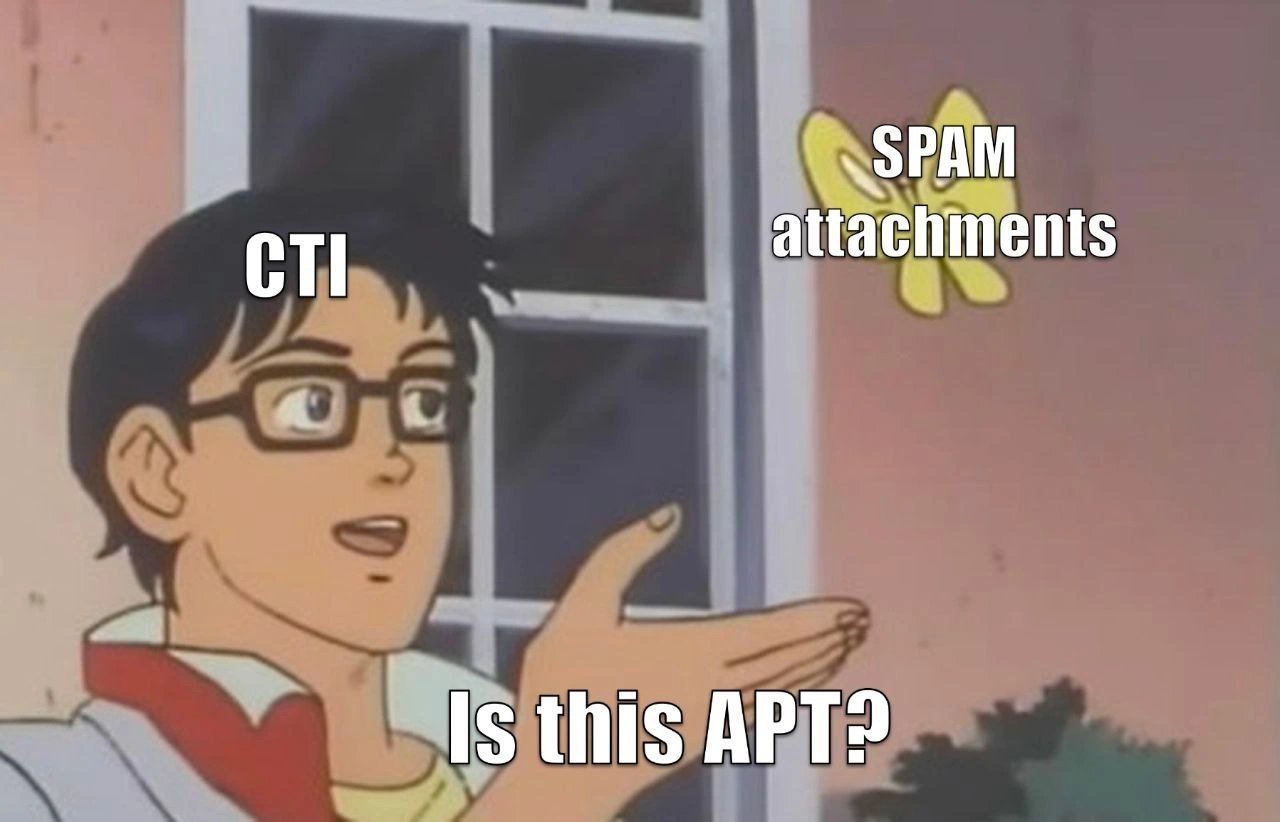
CTI mistakes spam attachments for APT in classic meme template
Why is this Security meme funny?
Level 1: Crying Wolf
Imagine a little kid who sees a tiny butterfly and gasps, “Is it a dragon?!” That’s basically the joke here, but with computers. The person in the picture is like a new security guard who finds a regular bad email (like those junk mails with a fake prize or a virus file) and thinks it’s a super sneaky master spy attack. It’s funny because he’s overreacting – kind of like shouting “Wolf!” when there’s just a puppy around. Everyone else who knows the situation can see it’s just an ordinary problem, not a big scary one. In simple terms, the meme is making us laugh at how someone inexperienced might mistake something common for something really dangerous. It’s the same smile you get when a friend panics about a shadow on the wall that turns out to be just a harmless tree branch. Here, the “shadow” was a spam email attachment, and our friend (the CTI guy) thought it was an APT – a super villain of the cyber world. The humor comes from that innocent mix-up, and it also gently teaches: not every little bug is a monster in disguise.
Level 2: Phishing vs APT
Let’s break down the terms and context to understand why this meme is funny to cybersecurity folks. The image references a popular meme format where a character confusingly points at a butterfly and asks if it’s something completely different – a way to poke fun at misidentification. In this version, the man represents CTI, which stands for Cyber Threat Intelligence. A CTI team in a company or security firm collects information about hacker groups, new cyber threats, and attack patterns. They often analyze suspicious emails, malware, and network activity to figure out who might be behind an attack and how it’s being done. Basically, they are like digital detectives tracking bad guys on the internet. If you’re new to security, imagine CTI analysts as researchers who read a lot of hacker crime novels and try to piece together which “villain” is responsible for a given crime scene (security incident).
Now, the butterfly in the meme is labeled “SPAM attachments.” Spam attachments refer to those files you get in junk email – think of random emails that say “Invoice attached, please open” when you know you never ordered anything. These attachments (often Word documents, PDFs, or .zip files) commonly contain malware or nasty code. Spam is undesired junk email sent out in mass. Most of it is harmless advertising or annoying scams, but a chunk is malicious phishing attempts. Phishing is a trick where attackers send deceptive emails to lots of people, hoping someone will click a bad link or open a bad attachment. It’s like casting a wide fishing net – not targeted at one particular person, but hoping to catch someone. If you’ve ever gotten an email from “Your Bank” asking you to verify your password via a link, that’s phishing. And if that email had an attachment named UrgentUpdate.exe, that file is what we mean by a spam attachment – usually something you shouldn’t run! Companies use spam filtering tools to catch many of these, but some still slip through to users or the security team’s queue.
On the other side, we have APT, which stands for Advanced Persistent Threat. This term is used for the really sneaky, skilled hacking groups often backed by nation-states or organized crime. “Advanced” because they use sophisticated techniques (sometimes even unknown exploits, called zero-days), “Persistent” because they don’t just hit and run – they quietly stick around in a target’s network for a long time, and “Threat” because, well, they’re dangerous adversaries. Famous APT examples include groups like the ones nicknamed Fancy Bear or Lazarus Group, which have been tied to state-sponsored hacking. These attackers might spend weeks researching a specific organization (say a bank or a government agency) and craft a tailor-made plan to breach them. Often, their first move is a spear phishing email – which is like phishing, but targeted at one person or organization with very specific bait. For instance, instead of “Dear user, please open this invoice,” a spear-phishing email might say “Hey [Your Name], here’s the project plan we discussed last week” with an attachment that looks work-related. It’s designed just for you, so you’re more likely to fall for it. That attachment might also contain malware, but perhaps a more customized one that antivirus programs haven’t seen before.
So, why wouldn’t a spam attachment usually be an APT? It comes down to targeting and sophistication. Regular spam malware is usually sent to thousands of emails randomly. It’s often cheaply made, maybe a known ransomware or trojan virus that many antivirus programs can catch. It’s like a generic key that can open a few old locks. An APT attack’s malware is more like a lockpick set made specifically for one high-security lock – custom tools, stealthy methods, and specific targets. False positives happen when an analyst or a system identifies something ordinary as something extraordinary by mistake. In security, a false positive could be your virus scanner flagging a normal program as a virus, or an analyst thinking a basic malware infection was the work of an elite hacker group. This meme jokes about that: the CTI analyst is looking at a spam email attachment (likely a basic piece of malware sent to many people) and calling it an APT attack, which would be a big overreaction. It’s as if a weather forecaster saw a rain cloud and declared a Category 5 hurricane – technically related phenomenon (both are weather), but massively different in scale!
The bottom caption, “Is this APT?”, mimics the original “Is this a pigeon?” line from the meme template. It’s what drives home the joke. You have this character (labeled CTI) sincerely asking if a butterfly (spam attachment) is the ultra-rare thing he’s heard about (an APT). For a junior security analyst or developer just learning these terms, it highlights a common learning curve: not all malware incidents are world-class attackers. Part of growing in cyber threat intelligence is learning to differentiate everyday threats from truly advanced ones. The meme is funny (and educational) because it exaggerates a rookie mistake – misclassifying the threat. It’s also poking at how the term “APT” sometimes gets overused or misused. In meetings, you might hear someone dramatically call a simple phishing incident an APT and more experienced folks will exchange knowing glances. It doesn’t mean the phishing email isn’t dangerous at all, it just means it’s probably not some James Bond-level adversary behind it, but rather a common criminal operation.
To sum up the ingredients of this meme:
- CTI (Cyber Threat Intelligence) – the team or person analyzing threats, here shown as a somewhat naive character.
- Spam attachments – malicious files sent in generic phishing emails, the “butterfly” that’s actually pretty commonplace.
- APT (Advanced Persistent Threat) – the big bad sophisticated hackers, which the CTI person is wrongly assuming behind every butterfly… er, email.
- The meme format – borrowed from an anime scene known for a character pointing at a butterfly and misidentifying it, used here to illustrate confusion in a security context.
All combined, it’s a humorous warning: Not every cyber attack is an APT. Learning to tell the difference is a key skill. If you call every incident “super advanced,” people might stop believing you when a real advanced threat comes along. The meme gets a laugh by showing a clear example of this rookie error in a way any techie who knows the meme template can instantly recognize. It’s a little bit of nerdy security humor packed in a single image and caption.
Level 3: False Positive Paranoia
In the security trenches, CTI (Cyber Threat Intelligence) analysts are tasked with separating the signal from the noise – but sometimes enthusiasm backfires. This meme nails a scenario where an overzealous analyst points at run-of-the-mill spam attachments and excitedly asks, “Is this APT?”. An APT (Advanced Persistent Threat) is supposed to mean an elite, stealthy, state-sponsored hacking group infiltrating your network with sophisticated tactics. But here our CTI protagonist is mistaking a common phishing email for an APT attack, like an amateur birder calling every small bird a rare eagle. It’s a classic case of false-positive analysis in security operations – seeing a butterfly and yelling “Dangerous monster!” because it might be one in disguise.
Experienced security engineers chuckle (or cringe) at this because they’ve seen it time and again: a newbie analyst encounters a malicious email attachment (perhaps an Invoice.pdf.exe file carrying malware) and immediately jumps to nation-state conspiracy. In reality, most phishing emails with dodgy attachments are the digital equivalent of background noise – cybercriminal spam sent in bulk to anyone with an inbox. Yes, APT groups do use email phishing too, but they’re more spear-phishing (targeted, tailored) than shotgun spammers. The humor here comes from the over-attribution: calling every malware-laced attachment an APT plot is like seeing graffiti on the office wall and suspecting international espionage. Seasoned analysts know to look for actual advanced techniques or specific Indicators of Compromise (IOCs) before screaming “APT!”
This meme uses the iconic “Is this a pigeon?” template – itself a joke about misidentifying a butterfly as a pigeon – to lampoon how CTI teams can misidentify plain-old threats as exotic ones. The man in the image labeled “CTI” is reaching toward a butterfly labeled “SPAM attachments,” earnestly asking “Is this APT?”. It satirizes a pattern in threat intel circles: APT-everywhere syndrome. It’s akin to the running joke “It’s always DNS” in debugging – here, any security incident triggers someone to say “It must be APT!”. The industry reality behind this joke is that distinguishing mundane malware from a sophisticated targeted attack isn’t always straightforward, especially for less experienced analysts or those hyped on threat reports. There’s pressure to not miss anything major, so sometimes folks err on the side of overcalling an incident as an APT. The result? Lots of false alarms, amused senior analysts, and maybe a few eye-rolls on the SOC (Security Operations Center) floor at 3 AM.
Why does this matter? Overestimating a threat level has real costs: chasing ghosts wastes time and resources, and crying “APT” too often can desensitize the team (the boy who cried wolf, cybersecurity edition). APTs do exist – think of well-known groups like Fancy Bear (APT28) or Equation Group – but they’re relatively rare encounters. If every spam email makes the threat intel report as “possible state actor activity,” credibility takes a hit. The meme resonates with anyone who’s had to calm down a panicked colleague or sift through alarming-but-incorrect threat reports. It playfully highlights the gap between textbook threat intelligence (where every incident is analyzed for nation-state hallmarks) and messy real-world operations (where 99% of the time it’s just generic malware doing generic bad things). In short, the humor is a mix of “we’ve all been that guy once” and “please, not every butterfly is a bomber”.
In summary, the top caption CTI and the butterfly labeled “SPAM attachments” set up the joke: an eager threat intel analyst is confusing a simple phishing email for an advanced persistent threat. The bottom caption “Is this APT?” delivers the punchline – echoing the original meme’s infamous misidentification line. For veteran security folks, it’s a sarcastic reminder of all the false alarms and overshot threat attributions they’ve witnessed. The next time someone in an incident response call shouts about "advanced attackers" when a generic virus hits, you might just picture this meme and smile (or sigh). It’s infosec humor at its best: acknowledging the very human tendency to sometimes see a dragon in every butterfly.
Description
The image uses the “Is this a pigeon?” anime reaction meme: a cartoon man (face blurred) stands outside a building, one hand extended toward a yellow butterfly. Text over the man reads "CTI" (Cyber Threat Intelligence), text over the butterfly reads "SPAM attachments," and large caption text at the bottom asks "Is this APT?" The joke highlights how inexperienced or over-zealous threat-intel teams sometimes misidentify ordinary email spam or phishing attachments as sophisticated Advanced Persistent Threat (APT) activity. Visually, the background shows a pink exterior wall and a window; the meme’s colors are pastel with bold white text outlined in black for readability. Technically, it pokes fun at false-positive analysis in security operations and the difficulty distinguishing mundane spam from genuine targeted attacks

Comments
7Comment deleted
Watching CTI escalate a canned “invoice.doc” phish as nation-state activity feels like when a junior names every util class AbstractFactorySingletonManager - slap a scary label on mediocrity and suddenly it’s enterprise-grade
After 15 years of threat hunting, you realize the real APT was the Nigerian princes we ignored along the way - because that one time it actually WAS Lazarus Group using a typo-filled template as cover
When your SIEM flags every malspam campaign as 'nation-state activity' and suddenly your SOC is tracking 47 different APT groups, all of whom apparently have the same TTPs as a Nigerian prince. Bonus points if the threat intel report cites 'sophisticated obfuscation techniques' for base64-encoded PowerShell that any script kiddie could generate
If your “APT” arrives as invoice.zip from a freemail domain, that’s not nation-state tradecraft; it’s your SIEM-to-alert-fatigue conversion pipeline working as designed
CTI: Turning spam attachments into APTs faster than a CISO turns metrics into budget asks
Calling every invoice.docm an APT is infosec’s cron-job-as-orchestrator move: shiny on the budget slide, meaningless for TTPs
P? yes A? no Comment deleted