Skip to content
DevMeme
4003 of 7435
The C++ Type System's Deceptive Disguise
Languages Post #4359, on May 5, 2022 in TG

The C++ Type System's Deceptive Disguise

Why is this Languages meme funny?

Level 1: Secret Identity

Imagine you have a friend who loves dress-up. One day, your friend puts on a superhero costume – mask, cape, everything – and comes to a party. Everyone thinks this person is a superhero because of the costume. You ask, “You’re sure it’s not just my friend in disguise?” and the friend (in a muffled voice) insists, “Yep, I’m a real superhero!” It’s all fun and pretend. But then, later on, the “superhero” steps up to talk to everyone. As soon as they start speaking in their normal voice, the truth comes out: it was your friend in disguise the whole time! Everyone is surprised and has a good laugh, because the superhero wasn’t who they appeared to be.

In this meme’s story, the tiny number uint8_t is like that friend in a costume. It was supposed to be just a small number (like how our friend was supposed to be a superhero), and it acted like one most of the time. But when it came time to show itself on screen (talk in front of everyone), it revealed its secret identity as a character (like the friend revealing his real voice). The result? A funny surprise! We all expected a number to show up, but we got a letter "E" instead – just like expecting a hero and finding out it was your friend. The humor comes from that little twist: something that looked one way turned out to be something else in disguise.

Level 2: The Char Reveal

Let’s unpack what’s happening in simpler terms. We have a C++ type called std::uint8_t. It comes from the <cstdint> header and is meant to represent an exact 8-bit unsigned integer – basically an integer that can only hold values from 0 to 255. In practice, on most systems a byte is 8 bits, so uint8_t is just another name (an alias) for the type unsigned char. Now, char in C++ is the type for a single character (like 'A' or 'z'), but it’s also a tiny integer type. This dual identity is where the confusion starts.

In the meme, Patrick (representing a developer) insists uint8_t is just a small number type. And indeed, you can use it in math or as a counter just like an int. For example, you can do:

std::uint8_t a = 10, b = 20;
auto sum = a + b;  // sum will be 30 (and promoted to int)

No problem there – the arithmetic works and the compiler treats those as numbers (behind the scenes uint8_t values get promoted to int when doing math due to C++ rules). So far it masquerades as an int just fine. The surprise comes when you try to print this value to the screen using std::cout. std::cout is C++’s standard output stream (think of it like a print-to-console tool). The code std::cout << u; tries to print variable u. But since u is actually of type unsigned char (remember, uint8_t is just an alias), the compiler uses the overload of operator<< that is meant for characters. This overload doesn’t print the number’s value; it prints the corresponding ASCII character for that value. ASCII is a character encoding where each number corresponds to a letter or symbol (for example, 65 = 'A', 66 = 'B', up to 69 = 'E', etc.).

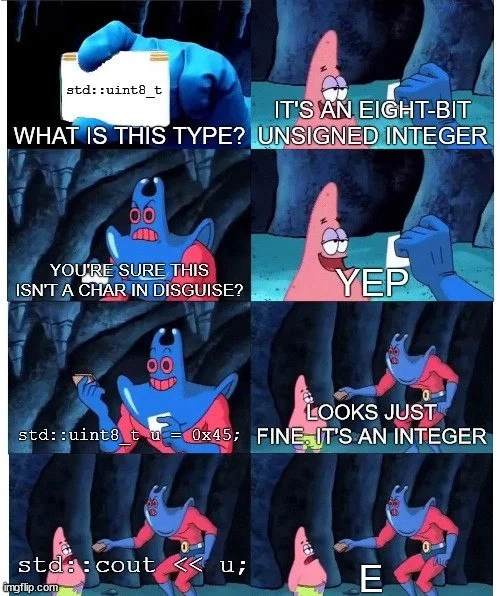
So in our case, we set u = 0x45;. The notation 0x45 means 0x45 in hexadecimal, which is 69 in decimal. The ASCII table says 69 represents the letter 'E'. When we do std::cout << u;, it’s as if we wrote std::cout << (unsigned char)69;. The console therefore prints E. Patrick’s face in the last panel (showing just the letter “E”) is the moment of realization: our “number” revealed itself as a character! This is the big revealuint8_t was a char all along for output purposes.

For a newer developer, this can be really confusing. You expected a number to print as a number, not as some letter. It might even look like your program is printing gibberish if u held a value that corresponds to a non-printable ASCII code (imagine if u was 7, you might not see anything, or your terminal might beep!). This joke highlights that confusion in a lighthearted way. The DebuggingTroubleshooting angle is: you might spend time wondering “Why on earth am I seeing an E instead of 69 in my logs?” The answer is this C++ type quirk.

Key terms to know here:

  • std::uint8_t: an unsigned 8-bit integer type defined in the C++ standard library. It’s typically just an alias for unsigned char (since unsigned char usually is 8 bits). It’s often used in LowLevelProgramming when you need exactly one-byte data, like reading raw bytes from a file or network.
  • char vs unsigned char: In C++, a char holds a single character (e.g., 'A'). It can be signed or unsigned depending on the compiler, but unsigned char is explicitly an 8-bit type that only holds positive values (0 to 255). Both are considered “character types.” When you output them with std::cout, they print as characters (letters/symbols) by default, not as numbers.
  • ASCII: A standard mapping of numbers to characters. For example, 65 = 'A', 66 = 'B', ... 69 = 'E', and so on. So printing a char with value 69 shows the letter 'E'.
  • std::cout: the standard output stream in C++ (from <iostream>). It has many versions of the << operator defined for different data types. If you give it an int, it prints the integer number. If you give it a char or unsigned char, it prints a character.

The humor of the meme is that Patrick was so sure uint8_t was just a normal number type (“Yep!” he says). And yes, in calculations it behaves like a number. But the LanguageQuirk is that because of how it’s defined, it still behaves like a character in contexts like output. It’s like the code tricked us: we expected a numeric printout, and we got a letter. For a junior developer, the take-away is: be careful with small integer types in C++ – sometimes they aren’t what they seem! If you really want to print the numeric value of a uint8_t, cast it to an int when printing. That will force std::cout to treat it as a number. For example:

std::uint8_t u = 0x45;
std::cout << "Numeric value = " << static_cast<int>(u) << '\n';

This would output “Numeric value = 69” instead of “E”. Once you know this trick, the confusion is gone. But the first time, it’s an easy mistake that leads to a funny “gotcha!” moment – exactly what the meme captures. Patrick’s unwitting confidence and the villain’s skepticism humorously mirror a dev’s internal dialog when debugging: “It’s definitely an int… right? …Right?” Gotcha! 😅

Level 3: Byte-Sized Betrayal

C++ developers have a saying: no bug is too small to cause big confusion. This meme nails one of those sneaky LanguageQuirks. We see SpongeBob’s Man Ray (the villain) interrogating Patrick Star (the clueless friend) about a mysterious type: std::uint8_t. Patrick confidently calls it an “eight-bit unsigned integer,” which is correct in theory. But Man Ray’s suspicion – “Sure it isn’t a char in disguise?” – foreshadows the betrayal. In modern C++ (and C99), std::uint8_t is typically just a typedef (alias) for unsigned char on platforms where a byte is 8 bits (which is almost everywhere these days). So even though it sounds like a plain small int, it’s really an unsigned char wearing an int’s mask.

That matters because C++ treats char types specially, especially when streaming to output. The standard I/O library (<iostream>) has an overload for unsigned char (and signed char) that prints them as characters, not numbers. In panel 5 of the meme, Man Ray writes code:

std::uint8_t u = 0x45;
std::cout << u;

He thinks u “LOOKS JUST FINE, IT’S AN INTEGER.” And in memory, it is just the value 0x45 (hex for 69 in decimal) stored in an 8-bit slot. Nothing unusual… until we hit panel 6. Patrick uses std::cout << u; and instead of seeing a number 69, the program prints the character 'E'. Surprise! That’s because 0x45 is the ASCII code for the letter E (in ASCII, 0x41 = 'A', 0x42 = 'B', … 0x45 = 'E'). The output stream sees an unsigned char and thinks, “Oh, a character! I’ll print the character representation.” It doesn’t know uint8_t was supposed to be a numeric type here – it only knows the actual type at compile time, and uint8_t is unsigned char. This is the moment the poor dev (Patrick) realizes his “integer” was an undercover char all along.

For a seasoned developer, this scenario is a classic DebuggingFrustration. It’s the kind of bug you encounter when dumping out raw byte values for low-level debugging or printing message buffers. Everything looks fine until your log files or console start filling with weird letters (or nothing at all, if the bytes aren’t printable). Cue the “facepalm”. We’ve basically been bitten by a TypeAlias surprise: using a fixed-width type like uint8_t for clarity, but ending up with char behavior. In C/C++, char is an odd beast – it’s an integer type under the hood, but also meant for text. Here that dual nature leads to confusion. Many of us have learned (often at 3 AM during on-call) that if you want to see the numeric value of a uint8_t, you must explicitly convert it. For example:

std::cout << static_cast<int>(u);  // prints 69 instead of 'E'

By casting to int (or even using unary +u as a trick to promote it), we bypass the char printing overload. This “char masquerading as int” issue is not undefined behavior or a compiler bug – it’s by design. It stems from C heritage and how the iostream library is overloaded. Historically, C++ took C's approach: rather than invent a brand new 8-bit integer type, it said “we already have unsigned char which is 8 bits, so let’s just typedef that as uint8_t.” Efficiency-wise and compatibility-wise, that made sense. But it also means any quirks of unsigned char come along for the ride. And one quirk is that streaming unsigned char prints a character glyph, not its numeric code. This meme gets a laugh (and a groan) from experienced C++ devs because we’ve all been Patrick at some point – absolutely sure our byte is just a number, until cout proves us embarrassingly wrong. It’s a TypeSafety lesson wrapped in humor: even a tiny 1-byte type can hold a big gotcha. In the battle of Cpp wits, the smallest types can be the biggest impostors.

Description

This meme uses the multi-panel 'Man Ray and Patrick's Wallet' format from SpongeBob SquarePants to humorously illustrate a notorious C++ programming pitfall. In the comic, Man Ray (representing a developer) is suspicious of the `std::uint8_t` type, which Patrick (representing the C++ type system) insists is just an 'eight-bit unsigned integer.' Man Ray explicitly asks, 'You're sure this isn't a char in disguise?' and Patrick confirms, 'Yep.' The developer then proceeds to declare a variable `std::uint8_t u = 0x45;`, which is the hexadecimal value for the integer 69. However, in the final panels, when the developer tries to print the variable to the console using `std::cout << u;`, the output is 'E'. The joke, which is deeply relatable to systems programmers, is that on most C++ compilers, `std::uint8_t` is a typedef for `unsigned char`. The `std::cout` stream has an operator overload that treats `char` types as characters to be printed, not integers. Therefore, instead of printing the number 69, it prints the ASCII character corresponding to the hex value 45, which is the capital letter 'E', revealing the type's deceptive nature


Comments

22
Anonymous ★ Top Pick In C++, `uint8_t` is that one friend who insists they're just a number, but as soon as they go out, they act like a total character
  1. Anonymous ★ Top Pick

    In C++, `uint8_t` is that one friend who insists they're just a number, but as soon as they go out, they act like a total character

  2. Anonymous

    uint8_t is C++’s way of reminding you that strong typing is only a compile-time suggestion - pipe it into std::cout and your packet length field starts reciting ASCII poetry

  3. Anonymous

    After 20 years of C++, you'd think we'd have learned that the real type system is whatever the template instantiation decides it is today

  4. Anonymous

    uint8_t passed the interview as an integer, then on day one operator<< checked its references and found out it's been a char the whole time

  5. Anonymous

    Ah yes, uint8_t - the type that promises you an integer but delivers a char, because apparently the C++ standards committee thought 'let's make debugging I/O operations a delightful surprise.' You want to print 69? Here's 'E' instead. It's not a bug, it's a feature - specifically, a feature that's been gaslighting developers since C++11 standardized <cstdint>. Pro tip: cast to int before streaming, or enjoy explaining to your team why your telemetry dashboard is displaying ASCII art instead of sensor readings

  6. Anonymous

    Strong typing until the standard library shows up: uint8_t passes review as an integer, then operator<< ships an ASCII E to prod

  7. Anonymous

    uint8_t: integer until std::cout observes it, collapsing to char like a type-based quantum bit-flip

  8. Anonymous

    uint8_t: C++’s undercover unsigned char - numeric until operator<<, then it ships as ASCII E

  9. @na_weka 4y

    Explain please

    1. @neizvestnyi 4y

      "high-level" c++ language treats an explicitly typed integer as char-code in supposed object-oriented output library

      1. @na_weka 4y

        Спасибо!

        1. @lord_asmo 4y

          Man wtf is this chars

          1. dev_meme 4y

            It's danke on russian

          2. @sylfn 4y

            = thanks

          3. @SamsonovAnton 4y

            This is that you get when sending UINT8_C(0x45) to an overloaded output stream. Bwa-ha-ha!

    2. @nkormakov 4y

      in short, when you push something to stdout without formatting, it will try to print it as a char - check ASCII table in google

      1. @na_weka 4y

        Thanks!

  10. @brbrmensch 4y

    std::byte

  11. @Vlasoov 4y

    That's because std:: ints are usually typedefs, and uchar is printed just like signed one

  12. @feskow 4y

    'murica moment

  13. @ZgGPuo8dZef58K6hxxGVj3Z2 4y

    😂😂😂😂😂😂😂

  14. @lord_asmo 4y

    Нет 🧐

Use J and K for navigation