When Stack Overflow AND Claude are down, senior devs face true dependency crisis
Why is this DevCommunities meme funny?
Level 1: No One to Ask
Imagine you’re doing a really hard puzzle and you always get help from two special helpers: one is a big book of answers (like an encyclopedia) and the other is a smart friend who knows almost everything. Now picture both your book and your smart friend are suddenly not there when you’re stuck. You’d feel pretty nervous, right?
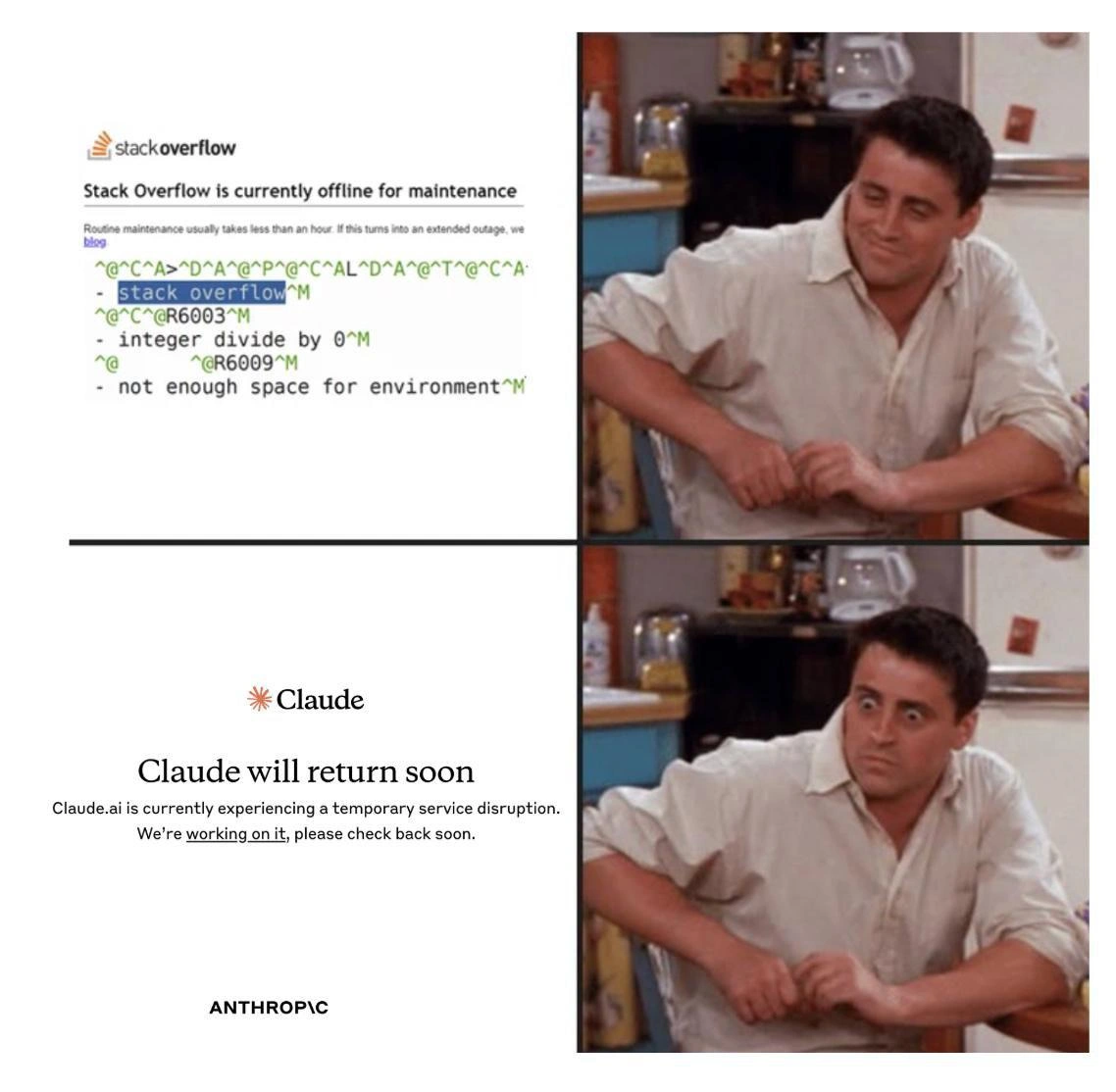
That’s exactly what’s happening in this meme, but for a computer programmer. Usually, when programmers get confused or see a weird error, they ask for help – either by looking it up in a huge online Q&A site (like looking in a book of answers) or by asking an AI helper (like asking a super smart friend). In the picture, both of those helpers are “down” or not available, at the same time. The top part shows the message “Stack Overflow is offline” (that’s the big answers website) and the bottom part shows “Claude will return soon” (that’s the AI friend being offline).
We see a funny character (from the TV show Friends) in two poses: first he’s smiling nervously (hoping maybe one helper is enough), then he looks shocked and scared when he realizes both helpers are gone. It’s like a student who finds out the teacher left the room and the textbook is missing right when a tough question comes up. They have to solve it alone and they’re like, “Oh no, what do I do now?!”
The humor comes from that relatable feeling of being stuck with no one to ask. We usually feel safe knowing help is just a click or question away. When it isn’t, even the best of us can freak out a little. It’s funny in the picture because the guy’s facial expression goes from “I got this... maybe” to “I definitely don’t got this!” in an exaggerated way.
So, in super simple terms: the meme shows a programmer who suddenly can’t use his two favorite help tools and is left all on his own, making a scared face. It’s poking fun at how we all feel a bit lost when our usual helpers disappear, even if we’re supposed to be “experts.” Imagine if you were trying to fix your bike and both your how-to book and the one friend who always helps you were unavailable – you’d probably make the same face as in the meme. That mix of panic and laughable bad luck is why it’s both funny and totally understandable.
Level 2: Knowledge Base 404
Let’s break this down in simpler terms. This meme shows a programmer’s two main help sources going offline, and it’s making fun of how panicked even an experienced dev becomes when that happens.
Stack Overflow is a hugely popular Q&A website where developers ask questions and get answers about programming problems. It’s basically the world’s largest knowledge base for coding issues. If you get a weird error or can’t remember how to do something in JavaScript, you probably search Google and end up on a Stack Overflow page with someone’s solution. Now, in the meme, Stack Overflow is down for maintenance. This is depicted by the banner “Stack Overflow is currently offline for maintenance”. That alone can cause some developer frustration – it’s like your dictionary or encyclopedia is suddenly locked up. It doesn’t happen often (routine maintenance usually is quick), but when it does, developers collectively groan because it’s such a go-to resource. The meme cranks up the absurdity by showing some strange text and error messages under that banner (like “integer divide by 0” and “not enough space for environment”). That looks like the kind of cryptic stack trace or error log you might copy-paste into Google for help – but of course, if Stack Overflow itself is spitting out weird errors and is offline, you can’t even search those! It’s a playful way of saying “the site is so broken right now, it’s spewing code gibberish.”
Next, the other half of the meme is about Claude being down. Claude is an AI assistant (a chatbot created by Anthropic, similar to OpenAI’s ChatGPT) that uses a type of AI model called an LLM (Large Language Model). Developers have started using AI assistants like Claude or ChatGPT to help with coding: you can ask them questions in plain English, like “What does error R6003 mean?” or “How do I fix an integer divide by 0 error in C?,” and these assistants will generate an answer or even write code for you. They’ve become the new buddies for programmers, kind of like an always-available mentor or pair-programming partner. So nowadays, if documentation is confusing or Stack Overflow doesn’t have a specific answer, many devs will ask an AI for help. It’s fast and often pretty good (though not always 100% correct).
In the meme’s bottom-left panel, we see Claude’s outage message: “Claude will return soon – ... temporary service disruption.” This is essentially an AI saying “Sorry, I’m down right now.” Just like any website or online service, AI platforms can have downtime or issues (server problems, too many users, etc.). It’s like when your internet connection dies, but here it’s the AI service that’s unavailable.
Now imagine being a senior developer facing a tough bug or urgent coding task. Normally, even if you don’t know the answer off the top of your head, you have two strong lifelines:
- Search on Stack Overflow (or Google, which often leads to Stack Overflow answers),
- Ask your AI assistant (Claude, ChatGPT, etc.) for guidance.
The joke of the meme is that both of these lifelines are cut off at the same time (double outage!). The senior dev is depicted by two images of Joey from Friends (a popular ’90s sitcom character known for comedic exaggerated expressions). In the top-right image, Joey is leaning forward nervously smiling – this represents the dev trying to stay calm when Stack Overflow goes offline. You can almost hear the internal monologue: “Alright, no Stack Overflow… it’s fine, I’m a pro, I have other options…” It’s a slightly worried face but hoping things will be okay.
Then the bottom-right image shows Joey looking completely shocked, eyes wide and almost horrified. This is the moment the dev finds out Claude is also down. That’s the “oh no, now I’m REALLY on my own!” face. It’s a funny dramatic reaction that perfectly captures the feeling of developer anxiety when you have no one (and nothing) to turn to for quick answers.
So why is this particularly a “senior dev’s” crisis? It’s a bit tongue-in-cheek; normally, you’d expect a senior developer to know a lot from experience. But it humorously acknowledges that even seniors rely on outside help. In fact, being experienced often means you’re better at knowing where to find answers rather than magically knowing everything by heart. Senior devs often have a mental index of “common problems and solutions” – and a big part of that index says “if you hit something weird, check Stack Overflow or Google it.” Similarly, many are now getting used to delegating some thinking to AI helpers. Take those away, and even a veteran can feel like a newbie again for a moment. It’s like if you’re a seasoned driver but suddenly both your GPS and the road signs disappear – you can still drive, but now you’re unsure if you’ll find your destination easily.
This ties into developer experience (DX): modern tools (online communities, AI assistants) usually make the developer’s life easier and more productive. But as with any tools, we can become dependent on them. The term “dependency crisis” suggests that the developer has a dependency (StackOverflow and Claude) that is now broken, causing a crisis. In software, a dependency means a piece of code or service your project relies on. Here it’s metaphorical: the person relies on these external aids. When they’re gone, it’s a crisis of “oh no, I have to solve this all by myself.”
It’s also referencing DevCommunities: sites like Stack Overflow are community-driven – programmers helping each other. When that community is temporarily unavailable, it feels like losing a mentor or peer group suddenly. And the AI angle brings in AI/ML humor: we treat these advanced AI models almost like colleagues now (“Claude, help me out here…”), so when Claude is unresponsive, it’s like your super-smart robot friend had a breakdown.
In simpler technical terms:
- StackOverflow down: No copy-paste solutions, no quick search hits. You might actually have to dig into official documentation or remember stuff you learned long ago.
- Claude (AI) down: No quick natural language explanations or code generation on demand. If you were leaning on it to interpret an error or generate a snippet, you’ll have to do that manually.
- Senior dev panic: Shows that even pros lean on these supports. He probably has the skill to eventually solve the issue, but it’s going to be slower and more painful without his usual helpers. And if this is during an on-call production issue, every minute counts, so you can sense the panic.
The meme resonates with any programmer who has felt suddenly cut off from their helpers. It’s both funny and a bit scary. Funny, because the situation is exaggerated (how often will both StackOverflow and your AI be down exactly at once?), and the reaction image is over-the-top comedic. Scary, because it’s not entirely impossible and it reminds us of our own reliance on these tools. Many of us can recall hitting a wall when the internet was out or when StackOverflow was read-only for maintenance – you feel almost powerless for a moment.
In essence, Level 2 understanding: The meme is depicting a programmer’s nightmare scenario in a humorous way. Both the community Q&A and the fancy AI assistant are unavailable, and our “confident” senior developer is left sweating bullets, comically illustrating how we all depend on these knowledge bases. If you’re a newer developer (junior), take note: even the seniors don’t do it alone – they just usually have better debugging tricks and resources. And when those resources go poof, everybody panics equally. It’s a shared experience across the developer community, wrapped in a funny image. The message: save your work, and maybe keep an offline manual handy – just in case! 😉
Level 3: Dual Dependency Disaster
At the highest level, this meme hits on a cascading failure in a developer’s support system. It’s a perfect storm: Stack Overflow goes down for maintenance and the AI assistant (Claude by Anthropic) also has an outage. For a senior developer used to having these lifelines, it’s a nightmare scenario – a tongue-in-cheek depiction of our hidden single points of failure.
In the top-left panel, we see Stack Overflow’s dreaded maintenance banner: “Stack Overflow is currently offline for maintenance.” To rub salt in the wound, there’s a dump of garbled terminal output:
^@C^A>^D^A*P^C^AL^D^A^@T^@^C^A
- stack overflow^M
^@^C@R6003^M
- integer divide by 0^M
- not enough space for environment^M
This gibberish is a cocktail of control characters and error messages, almost like the site coughed up a hairball. Amusingly, it includes a stack overflow mention and the classic Runtime error R6003 (“integer divide by 0”), an ancient relic of MS-DOS/Windows programming. It’s as if the universe itself threw a low-level exception at the worst time. A veteran dev sees that and groans: really? Stack Overflow literally overflowed its stack? – a meta-joke only a systems nerd would appreciate. It evokes the feeling of a system crash or memory corruption right on the page that’s supposed to help you fix crashes. How poetic. 😑
Now cue the top-right panel: a familiar sitcom character (yes, that’s Joey from Friends, blurred but recognizable) leaning forward with a nervous smirk. This is the senior dev trying to stay calm. Maybe he’s thinking, “No big deal, I can manage… I’ve seen outages before.” Every seasoned engineer has that forced chill when a primary tool is down – you pretend it’s fine while internally sweating bullets. It’s a look of anxious anticipation: “Alright, Stack Overflow is offline… but I still have my AI helper, right?” It’s the same energy as an on-call engineer seeing the first monitoring alert and hoping it’s a false alarm.
Then comes the second hit: bottom-left panel shows Claude’s outage page: “Claude will return soon – temporary service disruption.” Oh, terrific. The backup is also busted. This is a textbook cascading outage – your primary and your failover both fail. In reliability engineering, we design for redundancies (e.g. multi-AZ deployments, secondary datacenters) to avoid exactly this scenario. But here, the knowledge base and the AI assistant were both single points and they’ve gone dark together. It’s as if the developer’s entire knowledge infrastructure had a dependency cycle and someone just cut the power. This exposes the fragility of modern workflows: we’ve grown so dependent on cloud-hosted solutions and AI assistants that when they hiccup, even a battle-hardened dev can feel helpless.
The bottom-right panel nails the punchline: Joey (the senior dev) is now slumped back, eyes bulging in panic. That confident smirk is gone, replaced by “what do I do now?!” dread. The humor here is darkly relatable – even the senior engineer, who supposedly has years of expertise, is having a mini heart attack when his two trusty resources vanish. The phrase “true dependency crisis” in the title isn’t just about software dependencies; it’s about psychological dependencies in developer life. The meme is winking at the fact that “senior dev” doesn’t mean “walking encyclopedia.” It often really means “knows how to quickly find answers”. And our go-to answers are usually on Stack Overflow or nowadays in an LLM’s brain. Remove both, and the senior feels as lost as a junior encountering NullPointerException for the first time.
Why is this so funny (and a bit painful)? Because it’s true. We’ve all joked about being “full-stack overflow developers” who copy-paste from Stack Overflow, or recently about consulting ChatGPT/Claude for help. In practice, a lot of real-world development is gluing together solutions from these sources. The meme exaggerates it to a disaster scenario where both go offline simultaneously – a dev’s worst-case scenario. It highlights an industry pattern: our workflow has a new SPOF (Single Point of Failure) – the internet knowledge base. The cloud and community have become our extended memory. Seasoned devs remember when you’d hoard physical programming books or offline documentation (MSDN CDs, anyone?) for exactly this reason. But in 2025, who prints manuals? We assume StackOverflow is up 24/7 and our AI bots are always available. Until they’re not.
From a senior perspective, this double outage hits on deeper issues:
Trade-offs of Convenience: Relying on external help is efficient – why reinvent the wheel when someone on Stack Overflow has done it, or when Claude can explain it in seconds? But the trade-off is dependency. It’s like having an incredibly skilled teammate who’s usually around, so you don’t memorize things – and then that teammate takes a day off and you realize you’re in trouble.
On-Call Nightmare Parallel: During a major production outage, you might face multiple systems failing at once (the classic “the monitoring is down, and the backup monitoring is also down” scenario). Here the “systems” are knowledge sources. The meme resonates as a mini PTSD flashback: that helpless feeling when your tools aren’t working and you’ve got a problem to solve is so real. It’s funny on the surface, but every experienced dev knows it’s only funny because it’s happened (at 3 AM, with an angry manager on hold, naturally).
Cultural Shift – AI Assistants: A couple of years ago, Stack Overflow was the primary go-to for errors and “How do I do X in Python” questions. Now many devs also use LLM-based assistants for instant answers or code suggestions (GitHub Copilot, ChatGPT, Claude, etc.). Seniors have adapted and maybe grown over-reliant on these too. The meme underscores that even these shiny new AIs are just another service – and services have downtime. As a cynical old-timer might say: “100% uptime? Yeah right, and my code has zero bugs.”
Hidden Insecurity of Seniors: It’s implicitly poking fun at the idea that senior devs should know everything. Truth is, seniors often simply know how to find out everything. The anxiety on Joey’s face is relatable because any honest senior dev has had that “oh crud, I have no idea how to fix this and now I can’t even search it” moment. It’s a reminder that expertise isn’t about memorizing thousands of API calls – it’s about experience and resourcefulness. But when your resources vanish, experience only takes you so far. Even the best get imposter syndrome creeping in during such moments.
So here we have a DevCommunity and AI_ML crossover joke: the two pillars of modern Developer eXperience (DX) failing in unison. It’s the dependency hell we didn’t know we had. The meme cleverly uses Joey from Friends to amplify the emotional rollercoaster: first feigned confidence, then outright panic. A jaded senior engineer might chuckle and then quietly bookmark some offline documentation after seeing this. It’s funny because it shines light on a taboo: the senior dev’s secret dependency on Google, StackOverflow, and now AI – things we half-jokingly deny (“I swear I know this stuff, I just… like to confirm on StackOverflow”). When both your human-curated knowledge base and your AI oracle are unavailable, you’re left staring at a cryptic error alone, truly testing if all those years of experience count for something.
And let’s be real, the first thing any of us would do in that situation? Probably try turning to a third backup: maybe Google search, Discord/Slack communities, or even digging into actual official docs (the horror! 😜). But if everything fails, well… time to confront the code with only your wits and maybe a rubber duck. This meme exaggerates that paranoia for comedic effect, but it’s a gentle roast of modern dev culture’s dependency on external knowledge. The “true dependency crisis” isn’t a package.json conflict – it’s the dev having to operate without StackOverflow or AI.
In summary, the Level 3 view reveals the industry inside joke: even the most experienced engineers are one double-outage away from feeling like a newbie again. It humorously critiques how our Developer Experience is improved by these tools, yet we’ve built a fragile new layer into our workflow. When those layers go down, we face a dependency crisis of confidence and capability. The senior dev’s wide-eyed stare in that bottom panel? That’s the face of realizing your cloud-based backup brain just 404’d on you.
Description
Two - by - two meme panel. Top-left: a screenshot of the classic Stack Overflow outage banner reading “Stack Overflow is currently offline for maintenance” followed by garbled terminal output lines: “^@C^A>^D^A*P^C^AL^D^A^@T^@^C^A”, “- stack overflow^M”, “^@^C@R6003^M”, “- integer divide by 0^M”, and “- not enough space for environment^M”. Top-right: a well-known sitcom character, face blurred, leaning forward and looking nervously at the screen with hands clenched. Bottom-left: a white outage page from Anthropic reading “Claude will return soon - Claude.ai is currently experiencing a temporary service disruption. We’re working on it, please check back soon.” Bottom-right: the same character now slumped deeper, exasperated. The juxtaposition highlights a senior developer’s anxiety when both their primary knowledge base (Stack Overflow) and their LLM assistant (Claude) simultaneously go offline, exposing the fragility of modern developer workflows and our hidden single points of failure

Comments
9Comment deleted
Looks like my incident response plan violates the CAP theorem - Consistency and Availability just rage-quit, leaving me with Partitioned sanity
The real production incident isn't in your codebase - it's when your entire debugging methodology relies on two external services that apparently share the same SLA window
The modern developer's worst nightmare: Stack Overflow returns a divide-by-zero error while Claude is experiencing a 'temporary' disruption - suddenly you're forced to actually read the documentation
SO's Docker choked on unanswered questions; Claude's neurons fried on prompt overload. Devs: forced into that rare 'think locally' architecture
When Stack Overflow and Claude 503 together, you discover your team’s real knowledge architecture: a copy - paste SPOF backed by my brain’s cold cache with a 0% hit rate
We built multi‑region failover for prod, but my ability to remember regex now depends on a single SaaS pair‑programmer returning something other than 503
No, seriously! Comment deleted
Use your dumb brain and do it yourself, like a man! Comment deleted
Like THE man Comment deleted