Oracle bites own wheel then blames AWS over S3 API copyright meme
Why is this AWS meme funny?
Level 1: Tripping Yourself, Blaming Others
Imagine a kid trying to win a race by doing exactly what the fastest kid is doing. He says, “I’ll run just like him so I can catch up!” But then this kid remembers he once told everyone that copying someone’s moves is “against the rules.” So, in the middle of running, he sticks his leg out and trips himself to stop that “cheating.” He falls down hard. Instead of admitting he tripped himself, he points at the kid in front and yells, “This is all your fault!” Everyone can see the first kid did nothing to cause the fall – it was a silly self-imposed rule that made the second kid stumble. The situation is funny because the kid who fell won’t take responsibility for his own mistake. He tried to copy the leader, then hurt himself over his own rule about copying, and finally blamed the leader for his tumble. It’s a classic case of someone causing their own problem and then unfairly blaming someone else, which is exactly what the cartoon shows with Oracle and Amazon.
Level 2: API Copycat Crash Course
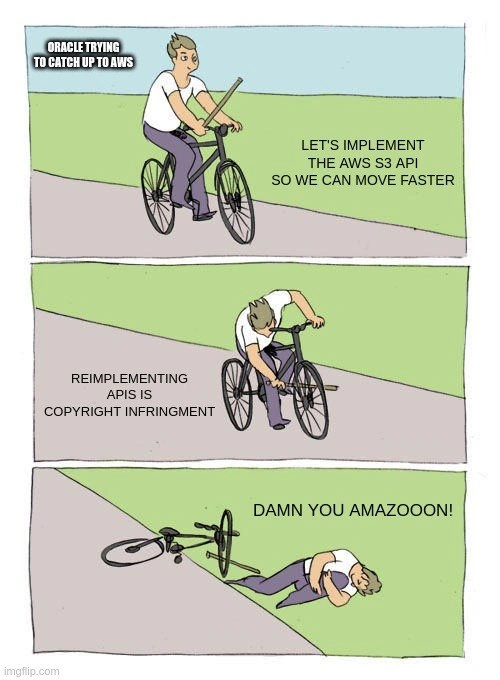
Let’s break down the scene for those newer to the saga:
Panel 1 (Riding happily) – The cyclist is labeled “Oracle trying to catch up to AWS.” Oracle is a big tech company known originally for databases, now running its own cloud services. AWS (Amazon Web Services) is the cloud industry leader (hosting everything from websites to data storage). Oracle wants to catch up to Amazon’s success in the cloud. In the speech bubble, Oracle says:
“Let’s implement the AWS S3 API so we can move faster.”
This means Oracle plans to make their cloud storage work just like Amazon S3. An API (Application Programming Interface) is like a contract or set of rules for how software components interact. Amazon S3’s API defines how you can store and retrieve files in the cloud (e.g., how to create a bucket, upload a file, list files, etc.). “Implementing the AWS S3 API” implies Oracle’s developers would create an interface on Oracle Cloud that is S3-compatible. For example, a developer could take code written for AWS and just change the endpoint to Oracle’s cloud:
import boto3 # AWS's official SDK for Python
# AWS S3 client (talks to AWS by default)
aws_s3 = boto3.client('s3')
# Oracle Cloud S3-compatible client (pointing to Oracle's endpoint URL)
oracle_s3 = boto3.client('s3', endpoint_url='https://oracle-cloud.example')
# Using both clients in the same way
aws_s3.upload_file('report.pdf', 'my-aws-bucket', 'report.pdf')
oracle_s3.upload_file('report.pdf', 'my-oracle-bucket', 'report.pdf')
In the code above, both aws_s3 and oracle_s3 have the same methods like upload_file because Oracle would be imitating Amazon’s API. This S3 compatibility is a big win for developers – it means you don’t have to learn a new system or change your tools to use Oracle’s service. It’s as if Oracle’s menu is copied from Amazon’s, so customers can order the same dishes. This strategy can indeed help Oracle “move faster” to attract users who are used to AWS.
Panel 2 (Self-sabotage) – Now the cyclist (Oracle) sticks a rod in his own front wheel. The overlaid text says:
“Reimplementing APIs is copyright infringement.”
Here the meme references Oracle’s own notorious argument from a legal case. In plain terms, copyright infringement means illegally copying someone’s creative work. Oracle had claimed in court that copying the design of another company’s API without permission is against the law. This came up in a major lawsuit: Oracle sued Google for using the Java API in Android. Oracle felt Google shouldn’t be allowed to reimplement Java’s set of functions and classes (which Oracle owned after acquiring Sun). Many developers found this absurd because writing compatible software often requires implementing the same APIs. It’s as if someone tried to say “you can’t create a new light bulb that fits in my lamp socket because that socket interface is my creative design.” In tech, reusing APIs is common APIDesignBestPractices – it helps different systems work together. Oracle’s stance was widely seen as hostile to interoperability and developer humor at the time often poked fun at it.
So in this panel, Oracle basically trips itself. By insisting “reimplementing APIs is infringement,” Oracle creates a legal roadblock for its own engineers. They’re about to do the very thing their company called unlawful! It’s a comic visualization of self-sabotage: Oracle’s legal policy is the stick that Oracle (the biker) jams into its own wheel. The momentum Oracle had in chasing AWS comes to a sudden stop.
Panel 3 (On the ground) – The cyclist has crashed and is holding his hurt leg, yelling:
“DAMN YOU AMAZOOON!”
This illustrates blame shifting in a humorous way. Oracle caused the crash, but instead of saying “ouch, my bad for doing that,” they shout at Amazon (misspelling it humorously as “Amazooon” to mimic an angry, exaggerated cry). Essentially, Oracle is blaming AWS for the predicament that Oracle’s own actions created. This reflects a bit of corporate culture satire: sometimes big companies won’t admit their missteps and instead accuse competitors or external factors when things go wrong. Oracle here looks ridiculous because everyone can see Amazon didn’t stick that rod in the wheel – Oracle did it to itself by adhering to its litigious mindset.
In summary, the meme uses the well-known bike accident comic to explain a real tech industry joke: Oracle tried to emulate a successful competitor (Amazon’s S3 API) to gain ground, but tripped over its own long-held legal position about APIs. It’s funny to developers because it’s a mix of hypocrisy and folly. Oracle’s attempt to speed up with a compatible API faceplants on the notion that “hey, weren’t you the guys who said this kind of copying is illegal?” It highlights how focusing on lawsuits over APIs can backfire spectacularly when you need to be compatible with the very thing you argued against. And then, true to form, the blame is cast outward instead of inward. This tech humor resonates especially with those who followed the Oracle vs Google case or who work with cloud APIs – it’s a spot-on cartoon of a big tech own-goal.
Level 3: Litigation as a Service
Oracle’s cloud strategy in this meme is a real snake eating its own tail. The company is depicted trying to catch up to AWS (Amazon Web Services) by adopting AWS’s hugely popular S3 API. Why? Because Amazon’s S3 (Simple Storage Service) has become a de-facto standard for object storage. Tons of third-party storage systems boast “S3-compatible API” so that existing tools and code (aws s3 cp, SDK calls, etc.) work out-of-the-box. It’s a smart tactical move: if Oracle’s cloud storage speaks the same API “language” as AWS S3, developers could easily switch to or integrate with Oracle’s service without rewriting their tools. In theory, reimplementing a competitor’s API is a shortcut to feature-parity and a way to piggyback on the competitor’s ecosystem. It’s a common practice in tech (APIDevelopment and WebServices teams often mimic widely used interfaces for interoperability). So far, so good – Oracle wants to move faster by not reinventing the wheel, just copying the wheel’s design.
But here comes the wheel of misfortune: Oracle’s own legal stance is that doing this kind of API reimplementation is verboten copyright infringement. This references the infamous Oracle vs Google lawsuit over the Java APIs (which Oracle inherited from Sun Microsystems). Oracle literally sued Google claiming that copying the Java API structure for Android was stealing Oracle’s intellectual property. In that drawn-out legal battle, Oracle argued that even the organization of classes/methods – essentially the “shape” of an API – is a creative work protected by copyright. Most software folks facepalmed at this, since reimplementing APIs is how the industry thrives (think of all the APIDesignBestPractices that encourage standard interfaces, or how many databases mimic the SQL interface). For a decade, that lawsuit cast a shadow: if Oracle’s view prevailed, any clean-room reimplementation of an API could require permission or licenses. That’s like saying you can’t interoperate with a platform unless you pay up or risk being sued. So Oracle gained a rep for weaponizing APIs in court, prioritizing IP claims over developer freedom.
Now picture Oracle’s cloud team trying to do exactly what their lawyers fought against: cloning AWS’s API. The meme nails this irony by having Oracle jam a stick into its own front wheel. The stick is labeled “reimplementing APIs is copyright infringement,” i.e., Oracle’s legal position trips up Oracle’s technical ambition. It’s a self-inflicted wound. No one forced Oracle to take that aggressive legal stance — it’s their own stick! The result? Oracle wipes out (falls behind in the cloud race) and then, true to form, immediately engages in blame shifting. In the final panel the cyclist (Oracle) is on the ground howling, “Damn you, Amazooon!” This dramatizes Oracle blaming AWS for its woes, instead of taking accountability. We in the industry have seen this movie before: a legacy giant struggling with TechCorporateCulture that leans on litigation rather than innovation, essentially self-sabotage. The humor is darkly on-point: Oracle’s attempt to chase AWS by copying a successful API is hamstrung by Oracle’s own litigious mindset. It’s like offering a service and a side of lawsuit – Litigation-as-a-Service (LaaS). Seasoned devs chuckle (or groan) because this trope is all too familiar: when corporate strategy and legal posturing collide, progress faceplants. In other words, the meme sums up why Oracle’s cloud efforts often feel like a bike ride with one foot on the brake and a stick in the wheel, followed by a loud “It’s not my fault!”
Description
Three-panel pastel cartoon of the classic bicyclist-with-stick meme. Top panel shows a cyclist labeled "ORACLE TRYING TO CATCH UP TO AWS" cheerfully riding while saying, "LET'S IMPLEMENT THE AWS S3 API SO WE CAN MOVE FASTER." In the second panel the same rider jams a stick into his own front wheel; overlaid text reads, "REIMPLEMENTING APIS IS COPYRIGHT INFRINGMENT." The third panel shows the cyclist on the ground, clutching his leg next to the fallen bike, shouting, "DAMN YOU AMAZOOON!" The meme satirizes Oracle’s history of litigation over API re-use, contrasting it with AWS’s dominance and highlighting how self-inflicted legal actions can slow competitive efforts in the cloud market
Comments
17Comment deleted
Oracle’s version of “S3-compatible storage” is great - right up until the Legal GC pauses the whole JVM and throws a StopTheWorldCopyrightException at anyone who calls PutObject
Oracle spent a decade arguing APIs are copyrightable against Google, then realized they need to copy AWS S3's API to have any chance in the cloud market - turns out legal precedents are a lot like production deployments: they always come back to haunt you at the worst possible moment
Oracle's brilliant strategy: spend years reimplementing AWS S3 APIs for compatibility, then realize they've potentially created a copyright minefield - because nothing says 'cloud innovation' like getting stuck in legal quicksand while your competitor laps you. It's the enterprise equivalent of building a bridge to your competitor's castle, only to discover you're now trespassing on their architectural patents. Classic Oracle: when you can't beat them with technology, blame them for the legal framework you walked into
S3 has become the POSIX of object storage - copy the interface and you gain users; litigate the interface and your go‑to‑market is literally a stick in your own front wheel
S3 is the unofficial RFC ratified by billing; if reimplementing it were copyright infringement, half the cloud would be contraband and your migration runbook would read like a subpoena
Reimplementing S3: pedal to the metal on compatibility, until Amazon's lawyers drop the fork bomb
What's the story behind this? Comment deleted
Oracle sued Google for reimplementing Java Api for Android Comment deleted
And what about AWS? Comment deleted
Oracle tries to reimplement AWS Api and Amazon sues them as far as I know Comment deleted
reimplementing Java API for Android in what sense? Android apps pretty much are Java... Comment deleted
Bruh Comment deleted
So the java apps are running and you don‘t have to rewrite them. I think it‘s more about lowlevel api, maybe of the jre itself, not sure. Comment deleted
In the sense of standard library classes, like ArrayList, HashMap, this kind of shit Comment deleted
Oracle kind of deserves this Comment deleted
Lmao Comment deleted
So who won that time, Oracle or evil searchsite? Comment deleted