When wrong code runs blazing fast: the premature optimization paradox
Why is this Performance meme funny?
Level 1: Faster Isn’t Better
Imagine you’re taking a math test in school. There’s a student who finishes the entire test really fast – faster than anyone else. But when the teacher grades it, almost all the answers are wrong. The student proudly says, “But I finished first!” Does that matter if the answers are incorrect? Not really – they still fail the test, just a lot quicker than everyone else.
This meme is making the same kind of joke, but about writing computer programs. It’s saying someone wrote a computer program and made it run really fast (like the student who finished the test quickly). However, the program itself was doing the task wrong (like all the wrong answers on the test). So even though it’s speedy, it’s useless – just as finishing a test first means nothing if you get the questions wrong. The funny part is that the person is bragging about the one thing that doesn’t actually help. It’s a reminder that doing something correctly is more important than just doing it quickly. In simple terms: being fast is nice, but being right is what really counts!
Level 2: At Least It’s Fast
Let’s break down what’s going on in simpler terms. The meme is about performance optimization gone wrong. Performance in coding means how fast (or efficiently) your code runs. Optimization means making changes to the code to run faster or use fewer resources. Premature optimization is a phrase describing when a programmer tries to make code super efficient too early – for example, before making sure the code is actually doing the right thing.
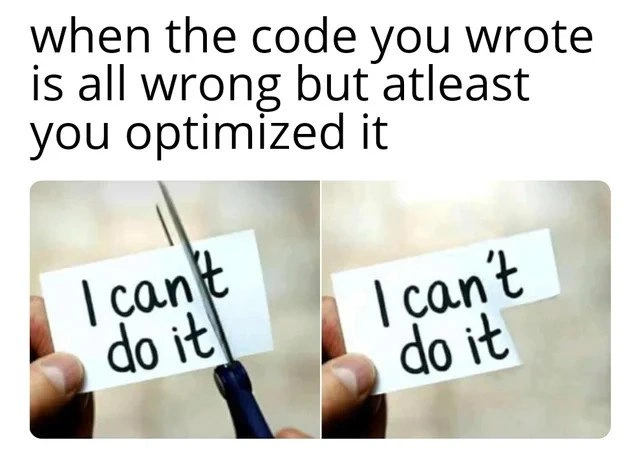
Imagine you wrote a program, but it doesn’t work correctly – in other words, it has a bug (a mistake that causes wrong behavior or results). Instead of fixing the bug, you decide to tweak the code to make it run in half the time. Now the program runs blazing fast, but the output is still wrong. This is what the top text of the meme is saying: "the code you wrote is all wrong but at least you optimized it." It’s poking fun at the idea that someone would celebrate their code being fast without noticing that it doesn’t do what it’s supposed to do.
In real coding, correctness (getting the right result) usually comes before trying to make the code run faster. If you optimize code that’s wrong, you’re just getting the wrong answer more quickly. The phrase “fast but wrong” sums it up. It’s like boasting that a calculator gives answers in 0.001 seconds, but if 2+2 equals 5, that speed isn’t very helpful, is it? This situation is unfortunately relatable to many new developers. Early on, you might focus on clever code optimization tricks — maybe you learned about using bitwise operations or a fancy algorithm that is theoretically faster. But if you apply them without fully understanding the problem, you can end up with code that’s very efficient in theory yet completely off in results.
To understand this better, let’s look at a simple example in code. We’ll use a basic problem: summing numbers from 1 to n. First, here’s a straightforward approach that is easy to read and obviously correct:
def sum_to_n_slow(n):
total = 0
for i in range(1, n+1):
total += i
return total # Correct result, but uses a loop (takes longer as n grows)
This sum_to_n_slow function adds up each number one by one. It’s correct – for example, if n = 5, it will do 1+2+3+4+5 and return 15, which is right. However, it’s not the most efficient way for large n because it does n additions (so it takes time roughly proportional to n).
Now, a clever programmer remembers a formula from math: the sum of 1 to n can be calculated without a loop using n * (n+1) / 2. That would be much faster (just a couple of operations, no matter how big n is). They rush to optimize the code using that formula:
def sum_to_n_fast(n):
# Trying to optimize using a formula (constant time calculation)
return n * (n - 1) // 2 # Oops! This formula is wrong for summation
Do you spot the bug? The formula should have been n * (n + 1) // 2. The programmer accidentally used (n - 1) instead of (n + 1). This sum_to_n_fast function runs in constant time (it doesn’t loop at all, which is great for performance), but if you call sum_to_n_fast(5) you’ll get:
print(sum_to_n_slow(5)) # Outputs 15 (correct)
print(sum_to_n_fast(5)) # Outputs 10 (wrong, but the code ran faster)
For n = 5, sum_to_n_fast gives 10, which is incorrect. It’s computing something, just not the right thing. However, it’s doing it very efficiently! This example shows what it means to optimize incorrect code. The code was made faster using a neat trick, but because the formula (logic) was wrong, the result is wrong. We ended up with a super speedy function that lies to us about the sum.
In practice, when a developer does this, they’ve put performance over correctness. They might have been trying to impress others (or themselves) by how quickly their code runs or how low the memory usage is. But if the core functionality is broken, none of those optimizations matter. In fact, those optimizations might make things worse:
- The code can become more complicated or harder to read due to optimization tweaks (for example, a simple loop was replaced with a tricky one-liner formula). This hurts code quality.
- The bug might be harder to find because the code is less straightforward. If someone else reads
n * (n - 1) // 2, they might not immediately realize the formula is wrong unless they derive it. - Time was wasted optimizing. If the developer had first made sure the code was correct (using the right formula), they could then confidently optimize if needed. Now they have to debug and fix under the pressure that “but it was so fast…”.
The meme’s image of cutting "I can't do it" into "I can do it" is like a playful analogy for this. Instead of actually solving the problem (changing the code logic or, in the image’s case, genuinely gaining confidence), it’s a cheap shortcut: just remove the negative part. The developer metaphorically removed the "not working" part by focusing on an irrelevant positive (performance). The result is superficially positive – the paper now reads a positive message; the code now runs fast – but it’s a bit of an illusion. The underlying truth hasn’t changed: originally "I can’t do it" was a true statement, and the code was wrong. By cutting the paper or optimizing the code, nothing was fundamentally fixed, but it looks improved at a glance.
For a junior developer (or anyone learning programming), the lesson is clear and that’s why this joke lands: Always make sure your code works correctly before you make it work fast. It’s more important that the code does what it’s supposed to do (no bugs in the logic) than it is for it to be super efficient from the start. You can usually optimize later if you find out something is too slow. In fact, one common piece of advice is: "First make it work, then make it right, and only then make it fast." Focus on correctness and clarity, then improve the efficiency where it actually matters. If you optimize too early, you might optimize the wrong thing, or you might even introduce new bugs like in our example.
This meme is relatable humor because many of us have felt the temptation to prematurely optimize. Maybe you tried to shrink your code from 10 lines to 1 super-clever line to run faster, but in the process, you accidentally changed its behavior. If someone has ever told you “don’t worry about performance yet” or “no need to optimize this until we know it’s a bottleneck,” it’s because of exactly this trap. Bugs in software often come from small mistakes, and those mistakes can hide or get worse when we complicate the code unnecessarily. So, the next time you think about cutting corners for speed, remember this meme’s joke: don’t cut the “not” out of “not working” code. Get it working first, then bring out the metaphorical scissors to trim down execution time if needed! ✂️🚀
Level 3: Wrong Answers Faster
In the developer humor world, nothing hits closer to home than premature optimization. This meme nails the paradox of Performance vs CodeQuality: focusing on speed while the program is functionally wrong. Picture a proud programmer boasting, "Sure, it blazes through the data in milliseconds... it just gives the wrong result!" This is a satirical take on the classic scenario of optimizing incorrect code – essentially delivering bugs at warp speed.
The top text sets the stage: "when the code you wrote is all wrong but atleast you optimized it" (typo and all). Interestingly, the caption itself has a minor bug: "atleast" should be "at least". The meme is self-referentially showing a lack of correctness even in its own text, which perfectly matches the theme of overlooking correctness. It's poking fun at developers who proudly declare, "But hey, at least it's fast!" after realizing their code logic is flawed. This is the premature optimization paradox: improving performance metrics while fundamental correctness is missing.
The image is a clever visual metaphor: a hand with scissors cuts the phrase "I can't do it", removing the "n't" so it appears to say "I can do it". It's the same piece of paper magically turned positive by trimming off a part. This is exactly what a developer indulging in premature optimizations might do – trim away the inconvenient details. Instead of reworking the logic (rewriting the phrase properly), they just cut out the part that says "not". The code is still the same underlying mess (the paper hasn't changed content, just pieces), but now one could pretend it's fine because it runs faster or looks cleaner superficially. The meme humorously suggests that by slicing away the "can't", the problem is "solved" – just like optimizing bad code can create the illusion of success without actually solving the real issue.
Seasoned developers know this scenario all too well. Perhaps you’ve seen a colleague spend a week micro-optimizing an algorithm — using bit operations, inlining functions, unrolling loops — and indeed the code runs 20% faster. The only catch? It doesn’t produce the right output for certain cases. The optimization was a classic case of putting the cart before the horse. All that effort only made the program more efficiently wrong. As a result, the bug is still there, and now it might even be harder to fix because the code has become more complex or less readable due to the optimizations. In real projects, this leads to BugsInSoftware that are tricky: the code might pass performance tests or handle high load, but functional tests or user reports reveal that it doesn’t do what it’s supposed to do. It’s fast but wrong – a high-performance failure.
Donald Knuth famously warned, "Premature optimization is the root of all evil." What he meant is that optimizing too early (or without evidence of a real performance need) often causes more problems than it solves. This meme embodies that wisdom: the developer optimized the code before ensuring it was correct. The result? A program that perhaps uses less memory or runs in O(n log n) time instead of O(n^2), but with one tiny issue – it gives the wrong answer! As another adage goes: "Nothing is more useless than doing efficiently that which should not be done at all." If the code’s logic is broken, making it run faster is like putting a jet engine on a train that’s on the wrong track. You’ll get to the wrong destination faster, but you’re still lost.
From a senior perspective, the humor also reflects on code quality and engineering priorities. In healthy development practice, you first make it correct, then make it fast. When performance truly matters, you identify bottlenecks and optimize those critical parts – but only after you have a working solution. The meme jokes about doing the reverse: prioritizing speed everywhere (“optimize everything!” mindset) without checking if the output is right. This is all too relatable in software teams: maybe there's pressure to hit a performance metric, and someone optimizes the code prematurely. Or a well-intentioned coder just wants to show off clever tricks like using a low-level memory hack or a fancy algorithm. They deliver impressive benchmark numbers... and then the QA team finds that for certain inputs, the feature is broken. RelatableHumor? Absolutely – many of us have either committed or witnessed this mistake.
The shared pain (and laughter) here comes from the fact that performance optimization can be thrilling. As developers, we love when our code runs faster or more efficiently. It's easy to tunnel-vision on squeezing out more speed or reducing that memory footprint, because it’s measurable and satisfying. But the meme reminds us of the absurd extreme: optimization gone wrong. It's parodying the scenario where someone might say, "Our search function returns the wrong results, but wow, it returns them in 0.001 seconds!" No user will be happy that the wrong answer came back instantly. In software, correctness is usually the top priority – without it, speed is irrelevant. A slow program that works is at least useful; a fast program that fails is basically a flashy bug. Thus, the meme resonates with experienced devs as a tongue-in-cheek cautionary tale: don’t let performance over correctness happen to you.
In summary, this meme’s humor comes from highlighting a common developer folly: premature optimization. It’s the comedic horror story every senior engineer can tell – that time someone (maybe our past self) optimized an all-wrong algorithm. The end result? The wrong answer, just delivered faster than ever. It’s a gentle jab at our eagerness to make code efficient while forgetting the fundamental goal: make it correct first. After all, a bug running at light speed is still a bug! 🐛🚀
Description
Top text reads: "when the code you wrote is all wrong but atleast you optimized it" (note the misspelling of "at least"). Below, a two-panel photo meme shows a hand holding scissors slicing through a small card that originally says "I can't do it." In the left panel the blades cut between the "n" and "t" so the card now appears to say "I can do it" - still the same paper, just rearranged. The right panel shows the trimmed card with the new optimistic phrase intact. Visually it conveys turning an incorrect statement into a seemingly correct one by merely removing characters, paralleling developers who spend time micro-optimizing logic that is fundamentally wrong. Technically, the meme satirizes premature optimization: improving performance metrics while ignoring functional correctness, a classic trade-off that leads to fast yet buggy software

Comments
6Comment deleted
Mission accomplished: after the SIMD refactor, the pricing engine still rounds down instead of up - but now it can lose money 30× faster
Successfully reduced our error rate from 100ms to 12ms. The errors are still there, but now they happen with enterprise-grade efficiency and proper observability metrics
This perfectly captures the senior engineer's dilemma: spending three days optimizing an O(n²) algorithm to O(n log n), only to realize during code review that the entire feature was based on a misunderstood requirement and needs to be deleted. At least the git history will show some impressive performance gains on that branch nobody will ever merge
Optimized the failure path - p99 went from 200ms to 20ms, still returns 500 faster than ever
Congrats - you reduced p95 by 40% on the function that returns the wrong value; you’ve successfully parallelized a defect
Premature optimization gold: from O(n) denial to O(1), still can't deliver but benchmarks soar