When a student discovers UTF-8 identifiers
Why is this CodeQuality meme funny?
Level 1: The Emoji Homework Request
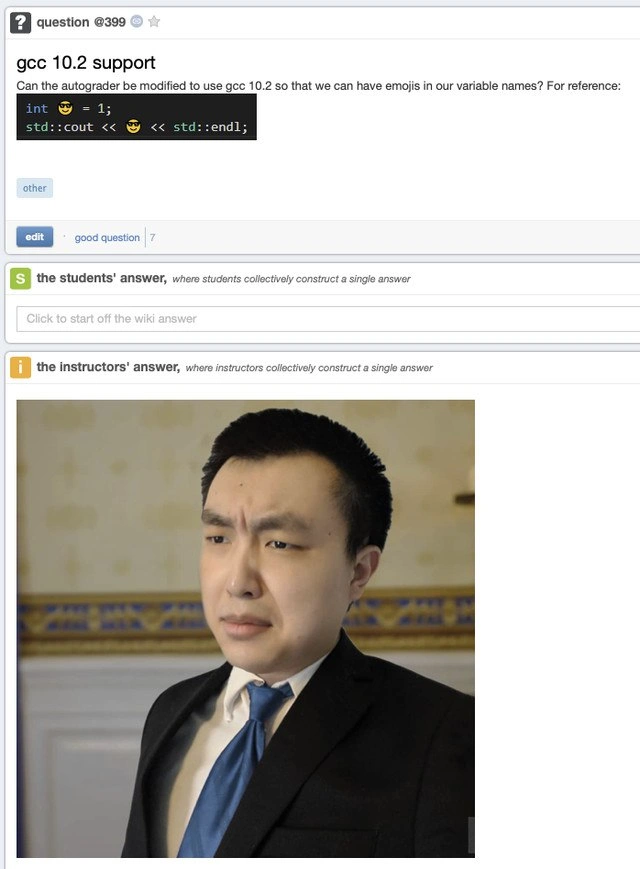
Imagine you’re writing a school essay, and you really want to dot your i’s with little smiley face stickers. 😊 It sounds fun, right? But the school’s old printer can only print regular letters, not fancy smiley faces. Now, instead of just sticking to normal dots, you ask the teacher, “Hey, can the school buy a brand new high-tech printer so it can print my smiley faces?” The teacher would probably give you a funny look 😕. In this meme, the student is basically doing that: they want to use a sunglasses emoji 😎 as a variable name in their code (just like naming your pet or a character in a story with an emoji). The automatic grading system (the teacher’s “printer” for code) is old and doesn’t understand that emoji name. The student asks the instructors to upgrade that system to a new version just so his cool emoji-named variable will work. The instructor’s reaction, shown by the confused man in a suit, is like the teacher silently staring, trying not to laugh, and thinking, “Is this kid serious?” It’s funny because the student’s request is over-the-top – doing a big complicated upgrade just for a tiny playful detail – and the grown-up (instructor) is not having it.
Level 2: When Code Meets 😎
Let’s break this down in simpler terms. A student in a programming class wants to use an emoji – the 😎 “cool face” – as a variable name in their C++ code. In programming, a variable name (identifier) is usually made of letters, numbers, and maybe underscores. Traditionally, you’d name things like score, count, or playerName. But here the student literally wrote int 😎 = 1;, treating the emoji character as the name of an integer variable. Amazingly, modern programming languages and compilers do allow some Unicode characters in names. Unicode is the universal system that encodes characters from virtually every language (and a bunch of symbols and emoji too) into numbers that computers understand. So, theoretically, 😎 is just a valid character in Unicode and could be part of a name in code.
However, whether the code will compile depends on the compiler and its version. GCC, which stands for the GNU Compiler Collection, is a very common tool used to compile C++ programs (turning the code you write into something the computer can run). GCC has version numbers (like 9.3, 10.2, etc.), and each version can support newer features of the C++ language. Here, GCC 10.2 is a specific release of this compiler around 2020. The student likely discovered that GCC 10.2 supports emoji in variable names (perhaps thanks to updates for C++20, the then-new version of the C++ standard). The problem? The autograder – which is the automated system the course uses to compile and test student code – probably wasn’t using GCC 10.2. It might have been using an older version (say GCC 9 or something) that didn’t know what to do with an emoji in a variable name.
An autograder is basically a server or program set up by the instructors that automatically takes each student’s code, compiles it, runs it against some tests, and grades it. To keep things consistent, the instructors usually lock the autograder to a specific environment (specific compiler version, libraries, etc.) for the duration of the course. This ensures everyone’s code is judged under the same conditions. If you write code that only works on your machine with a newer compiler, the autograder might choke if it’s using an older one. In this case, the student’s code with the emoji-named variable likely caused a compiler error on the autograder. A compiler error is when the compiler can’t even turn your code into a program – here it probably encountered the 😎 and said “I have no idea what this character is!” and refused to compile. That’s why the student is asking, “Can the autograder be modified to use GCC 10.2 so that we can have emojis in our variable names?” In other words: “Could you update the compiler on the grading system to a newer version that supports this funky feature I want to use?”
Now, consider the perspective of the instructors. Updating the autograder’s compiler isn’t as simple as flipping a switch. They’d have to install the new compiler on the server, ensure all the existing setup works with it, and verify that this change doesn’t inadvertently affect other students’ code or the grading outcomes. It’s a lot of work and risk – all so that a student can use an emoji as a name, which is not a necessity at all. Instructors probably prefer students stick to standard variable names (both for sanity and to avoid these technical issues). The meme shows the forum post screenshot. The student’s question (number 399) is displayed, with the title “gcc 10.2 support” and the text of the question asking for the autograder to be updated for emoji support, complete with the code example:
int 😎 = 1;
std::cout << 😎 << std::endl;
(This code declares an integer with the name 😎, assigns it the value 1, and then prints that value to the screen using C++’s output stream std::cout.)
Below the question, the forum has two sections for answers: one for “the students’ answer” (a place where students can collaboratively write an answer, which is blank here) and one for “the instructors’ answer.” In the instructors’ answer section, instead of any text, there’s just an image of an instructor-looking person in a suit, with a blurred face, giving a very perplexed, skeptical expression. Essentially, the instructor didn’t write a formal answer – their “answer” is just this look. That image is basically saying: “Really? You want me to do what now?” or “I can’t believe you’re asking this.” It’s a humorous way for the instructor to indicate that the answer is likely “No, we’re not doing that,” without actually saying it in so many words. The blurred face and suit might be to anonymize the instructor but still show the emotion.
Let’s touch on why emojis in variable names are even a thing. Language features evolve over time. C++ (the language in question) in its early days only allowed English letters, digits, and underscore for naming. But newer standards (like C++11 and onward) started to allow Unicode characters in identifiers, mainly so programmers around the world could use their native alphabets. For instance, someone could name a variable 长度 (length in Chinese) or síntesis (Spanish word with accent) in modern C++. This is part of being more inclusive and flexible. Emojis are a quirky subset of Unicode. Some languages like Swift and Kotlin explicitly showcased that you could use emoji as identifiers, mostly as a fun demo of Unicode support. It’s seldom used in real projects (because imagine debugging or typing those!), but it’s possible. UnicodeSupport in compilers has to be pretty advanced to handle this, as it means dealing with multi-byte characters properly and following Unicode’s classification of characters. Many compilers by version 10.x have that ability. But if the autograder was using, say, GCC 7 or 8 (common on older systems or certain distributions), those might not accept an emoji in a name. The error the student likely saw was a CompilerError complaining about an “invalid character” or similar. That led them to realize, “Hey, if only it was GCC 10.2, it would work!”
For a junior developer, it might be surprising that upgrading a compiler is a big deal. You might think, why not always use the newest one? The catch is stability and compatibility. In a classroom or production, you pick a known working version so that everyone’s environment is the same. If you upgrade in the middle, some people’s code might break due to new warnings or stricter rules, and that’s unfair or at least inconvenient. So, instructors tend to say “no” to such changes unless there’s a very good reason. An emoji variable name, while fun, isn’t a strong reason. It doesn’t add functionality; it’s more like a stylistic novelty. The student’s request, therefore, comes off as comically bold. It’s like a student asking the school to repaint the classroom because they found a new color of whiteboard marker they want to use — not wrong to want, but not something the school is likely to do on a whim.
In summary, this meme is about a student forum post that humorously captures a clash between a student’s playful request and an instructor’s pragmatic stance. It touches on compilers (specific versions and what features they support), programming language rules (what you can name a variable), and the sometimes funny things students ask. The categories “Compilers, Languages” are spot on: it’s literally about a compiler version and a programming language feature. The tags like GCCCompilerCollection and UnicodeSupport point to the technical bits (the type of compiler and the Unicode issue), while VariableNaming and LanguageFeatures highlight the coding practice aspect. CompilerErrors was likely what prompted the question (the student hit an error due to the emoji), and CPlusPlusStandardLibrary is referenced since the code snippet uses C++ library components (std::cout). Finally, the context tags like emoji_variable_names and gcc_10_2 are exactly what the question is about. The instructor_silence tag hints at the punchline: the instructor’s response was basically silence (or just a disapproving look). This highlights the meme’s core: the request was met with a kind of humorous non-response, implying “This question probably shouldn’t even be answered seriously.” It’s a lighthearted look at how newcomers’ priorities can be a bit misaligned with what matters in a coding project, and how instructors or senior devs react when confronted with such out-of-left-field requests.
Level 3: Emoji-Driven Development
Why is this funny to experienced developers? It’s the contrast between serious tooling upgrades and an arguably frivolous reason. Upgrading a compiler version in mid-course (or mid-project) is not a trivial ask – it’s the academic equivalent of a production environment change. Seasoned devs have seen how a seemingly small version bump can introduce new compiler errors, warnings, or subtle differences. Here a student requests the autograder’s GCC be updated to 10.2 specifically to allow emoji-named variables. That’s like asking a team to overhaul their build system because you want to use a new smiley-face feature – it’s equal parts audacious and adorable. The senior engineers (or instructors, in this case) immediately think of all the moving parts: The autograder’s environment was likely set up and tested with a certain GCC version (maybe GCC 8 or 9 which was stable on the server). Upgrading to GCC 10.2 might mean reinstalling packages, ensuring all existing code still compiles, and verifying the autograder scripts aren’t broken by new compiler behaviors. All that effort just so someone can use 😎 as a variable name? It’s a classic case of bikeshedding: focusing on a flashy triviality while bigger, more important things (like, say, the correctness of the algorithm or passing the actual assignment) are being glossed over.
From an experienced perspective, the humor also comes from the variable-naming absurdity. We spend our careers preaching good VariableNaming practices – clear, descriptive names that help others understand code. And here comes a student who wants to use an emoji 😎 as an identifier. It’s both technically impressive (hey, it is possible in C++20) and practically absurd. How do you pronounce that in a code review meeting? “Um, so here we assign 1 to... sunglasses-face?” The shared industry joke is “just because you can, doesn’t mean you should.” This meme captures that perfectly: the student is excited about a shiny new LanguageFeature (Unicode identifiers), whereas the instructors (and other seasoned developers) are nonplussed, perhaps even rolling their eyes a bit. It’s a collision of priorities: the youthful urge to try the coolest new thing versus the veteran focus on stability and clarity.
The Q&A forum format in the image adds an extra layer of comedic timing. The student’s post (#399) earnestly asks for “gcc 10.2 support” on the autograder, with the justification being “so that we can have emojis in our variable names.” They even provide a code snippet for reference, as if demonstrating a crucial missing capability:
int 😎 = 1;
std::cout << 😎 << std::endl;
This snippet is real C++ code (using std::cout and std::endl from the C++ Standard Library to print the value). Aside from the wild choice of identifier, it’s a completely normal program. That contrast makes it hilarious – all this fuss, and for what? Printing 1 to the console, but with a cool emoji variable. You can almost hear a senior dev chuckling, “Kid, that’s not exactly what Bjarne Stroustrup had in mind for C++.” The instructors’ answer section in the screenshot shows a photo of a suited person with a deeply perplexed expression. It’s basically a silent “Come again? You want us to do WHAT?” look. Notably, the instructor’s face is blurred, adding to the meme vibe – it’s like any seasoned professional trying to maintain a straight face when confronted with such a left-field request. The fact that the “students’ answer” section is empty implies no fellow student even attempted to justify this – it’s collectively left for the instructors, and their collective answer is a bemused silence.
For senior developers, there’s also a nostalgic chuckle here. It reminds us of our own early days when we might have been excited about something technically neat but trivial. Many of us have stories of trying to push boundaries in toy ways – like writing code in Latin or attempting to compile with exotic flags – only to be gently guided back to focus on what really matters. There’s an undercurrent of “we’ve all been that student, at least once.” Some might also recall the many debates about upgrading toolchains in production: managers and dev leads weighing the cost-benefit of new features. Usually, the reasons are more serious (security patches, performance improvements, modern C++ standard features like lambdas or constexpr). Here it’s literally “I want to use 😎 as a variable.” It’s a delightful parody of those debates.
In essence, the meme works on multiple levels of insider humor:
- Compiler Versioning Pain: Upgrading compilers can be a headache; doing it for emoji support is comically disproportionate.
- Unicode in Code: Using emoji or non-ASCII in code is a power feature that almost never appears in serious codebases. It’s funny to see someone insist on it for a class assignment.
- Student-Instructor Dynamics: Instructors typically expect questions about project requirements or critical bugs, not requests to accommodate whimsical coding style. The instructor’s blurred, deadpan face says, “Of all the things to ask…”
- Shared Amusement: Notice the post has 7 upvotes labeled “good question.” That suggests other students found it amusing or were in on the joke. The class collectively recognizes this as a light-hearted, maybe tongue-in-cheek request. It’s a bit of levity in what might otherwise be a stressful course.
The senior perspective appreciates the absurd balance here – it’s harmless and humorous, yet it touches on real tech concepts. We smile because we know the autograder configuration is unlikely to change just to allow a 😎 variable. We also know that if the student really wanted, they could probably work around it (perhaps by compiling locally with a newer compiler to satisfy their curiosity). But the audacity to ask the official graders to update is what sells it. In industry, you’d rarely request a production CI pipeline to upgrade compilers for such a minor perk; you’d get the same reaction as the instructor’s meme face. Ultimately, it’s a gentle jab at how LanguageFeatures that excite us techies (like Unicode identifiers) can clash with pragmatic constraints. And it’s a reminder that sometimes the coolest new feature isn’t the most important thing to get the job done – but it sure gives everyone a good laugh when someone tries to chase it.
Level 4: U+1F60E Identifiers
At the bleeding edge of compiler design, even an emoji can be a valid variable name. This meme spotlights the arcane details of how Unicode support in languages has evolved. Modern C++ compilers like GCC (GNU Compiler Collection) have gradually expanded beyond plain ASCII, allowing Unicode identifiers. In theory, 😎 is just another code point (specifically U+1F60E, the "smiling face with sunglasses") which a compiler can treat as an identifier, much like x or _var123. Under the hood, the source code is stored in an encoding (usually UTF-8), so that cool emoji actually comes through as a sequence of bytes. A lexer (the part of the compiler that reads raw text into tokens) must recognize that sequence as one single character that qualifies as a letter.
C++’s standard has rules about what characters can start or be in a name. Initially, it was simple: [A-Za-z_] for the first letter and alphanumerics for the rest. But as programming went global, the standard embraced universal character names, meaning letters from other languages (Χ, 漢, α, etc.) could appear in identifiers. Compilers like GCC needed to keep up: they had to handle multi-byte UTF-8 sequences and map them to valid internal symbols. An emoji is a bit of an edge case – it's not a letter or digit in the traditional sense but rather falls under Unicode's “Symbol” category. GCC 10.2 came with improved Unicode handling, aligning with the latest C++ standard (C++20) which doesn’t outright forbid pictographic characters as identifiers. In practice, this means GCC 10.2’s lexer is savvy enough to treat the 4-byte sequence 0xF0 0x9F 0x98 0x8E (the UTF-8 for 😎) as one identifier character. The compiler will happily generate an Abstract Syntax Tree (AST) where there’s a variable node named "😎". To the compiler internals, that name is just a unique key (it might even appear in the symbol table as some mangled form or escape sequence – the linker and debugger might show it as _ZNSt4😎E or similar gibberish).
Of course, getting this to work relies on every part of the toolchain understanding Unicode. If anything is misconfigured – say the source file encoding or an older default in the autograder’s environment – you’d see bizarre errors. Many C++ devs have encountered something like:
$ g++ code.cpp -std=c++17
code.cpp:1:12: error: stray '\360' in program
Here the compiler complains about a “stray ‘\360’” (octal 360 is 0xF0) – essentially it saw a byte from the emoji and went “Huh? This isn’t a valid character for any token I know.” GCC 10.2, with proper settings, knows that those bytes together form one valid identifier character. The deep irony is that enabling full Unicode in code is a serious computer science feat – bridging the gap between human languages (and now pictographs) and programming languages. Historically, languages like Java and Python led the way, letting you use, say, Chinese or Cyrillic variable names. C++ was slower to adopt this, mostly because early C/C++ stuck to ASCII. But with C++20 and compilers catching up, even emoji variable names became technically possible. It’s a testament to how far language design has come: compilers now juggle multi-byte character sets, normalization forms, and internationalization issues that early programmers couldn’t imagine. The humor, of course, is that this powerful capability is being invoked not to support non-English alphabets in code (a noble cause) but to let a student name their integer with a 😎 emoji. In theory it’s brilliant – in practice it’s programming peacocking at its finest.
Description
The image is a composite meme, structured like a post on an educational Q&A platform, likely Piazza. The top part displays a student's question titled 'gcc 10.2 support'. The student asks, 'Can the autograder be modified to use gcc 10.2 so that we can have emojis in our variable names?' and provides a C++ code snippet for reference: 'int 😎 = 1; std::cout << 😎 << std::endl;'. Below this absurd request, under the section for 'the instructors' answer,' is a picture of a man in a suit with a deeply perplexed, concerned, and slightly pained expression. This reaction image perfectly captures the silent despair of an instructor or any senior developer when faced with a request that is technically possible but represents a flagrant violation of coding standards, readability, and maintainability. The humor lies in the student's naive enthusiasm for a 'feature' that is professionally abhorrent
Comments
24Comment deleted
The fact that the compiler supports this is a testament to the Unicode consortium's thoroughness. The fact that a student wants to use it is a testament to why senior devs have trust issues
We’ll totally bump the autograder to GCC 10.2 so you can name a variable 😎 - right after compliance approves UTF-8 identifiers, security whitelists that code point, and the last revenue-critical daemon still on GCC 4.4 decides to peacefully retire
The autograder is running on CentOS 6 with a regex from 2003 that assumes all valid identifiers fit in ASCII, but at least it's dockerized so we can reproduce the exact same Unicode parsing failures locally
The students want GCC 10.2 for emoji variable names. The instructors' silence speaks volumes - because when your code review consists of 😂💩🔥, you've achieved the rare feat of making COBOL variable names look like a model of clarity. At least 'CUSTOMER-ACCOUNT-BALANCE-AMOUNT' tells you something; '🚀' could be a rocket ship, a deployment script, or just your career trajectory after this PR
Emojis in C vars: the refactor that'll make your grep regexes obsolete and merge conflicts a Unicode horror show
Sure, let’s bump the autograder to gcc 10.2 - UAX#31 will still veto 😎 as an identifier, but after the container rebuild and ABI roulette, at least the change request compiles
Upgrade the autograder to GCC 10.2 so we can use emoji identifiers? Perfect - nothing says reproducibility like “libstdc++.so.6: GLIBCXX_3.4.28 not found” caused by int 😎
in c++ u can already use emoji, lol Comment deleted
Depends on the compiler Comment deleted
g++ 10 has support for unicode variable names, clang++ also Comment deleted
i have only gcc 9 installed, so will show on clang Comment deleted
there is g++ 10 showcase on unicode variable names https://godbolt.org/z/bTGPed Comment deleted
Does it work fine with string functions like reverse? Comment deleted
what do you mean? Comment deleted
I heard that emoji (and unicode) sometimes has funny side-effects with some basic string functions. But I’m not quite sure if it was about C++ Comment deleted
oh, i understood unicode symbols are bigger than regular char, so when u trying to do some operations on them, u should use something like wchar Comment deleted
Bruh Comment deleted
swift devs 😎 Comment deleted
why Comment deleted
👍 Comment deleted
Собралась куча русских и строит из себя англичан😁 Comment deleted
да Comment deleted
Keep it going ;) Comment deleted
no Comment deleted