Skip to content
DevMeme
4828 of 7435
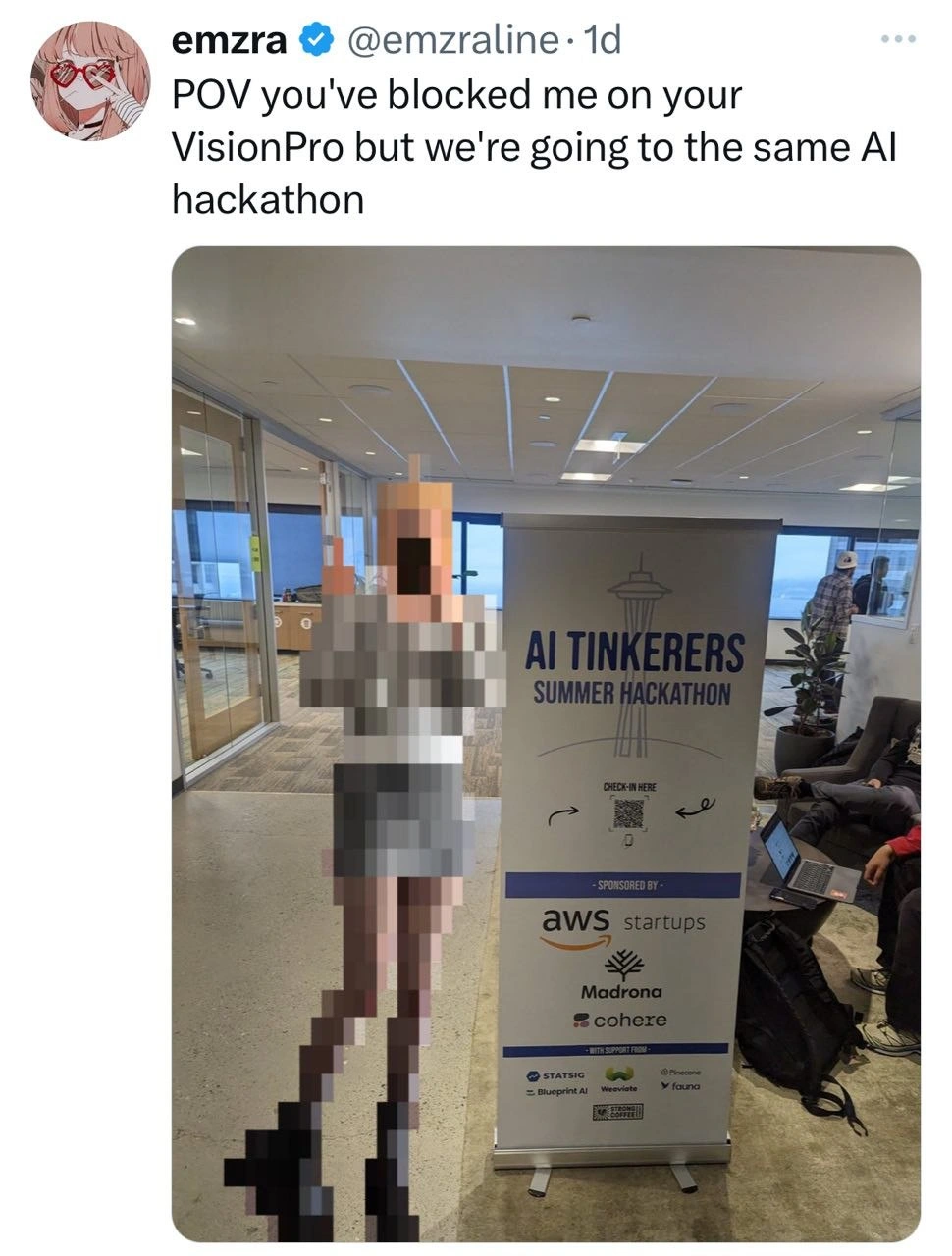
When VisionPro block lists fail at the AI Tinkerers summer hackathon
AI ML Post #5288, on Jul 1, 2023 in TG

When VisionPro block lists fail at the AI Tinkerers summer hackathon

Why is this AI ML meme funny?

Level 1: Peekaboo Fail

Imagine you have special magic glasses that let you not see someone you don’t like. If you put them on, that person looks all blurry or even invisible to you, like they’re covered by a big fuzzy filter. Sounds handy, right? Now picture going to a fun group event with lots of people – maybe a school science fair or a big team project – and that person you’re avoiding is there too. You’re wearing your magic glasses, so you’re pretending they aren’t there by literally blurring them out from your view.

But here’s the silly part: just because you can’t see them clearly doesn’t mean they’re actually gone. They’re still in the room, and everyone else can see them normally. They might come up and say, “Hi!” or stand right next to you to look at something. You might try to ignore them (since to you they look like a big pixelated blob), but everyone around will see you awkwardly not responding to someone who’s plainly there. It’s like playing peekaboo: you cover your eyes and think, “Ha, you can’t see me!” or “You’re not here now!” but of course that’s not true – the person is still standing there, waving their hand and probably very confused.

This is funny because it shows how even cool technology can’t truly make a real person disappear. The guy with the high-tech Apple glasses is basically doing a grown-up, high-tech version of “If I can’t see you, you don’t exist!” We laugh because we all know that’s not how real life works. It’s a goofy situation where fancy AR gadgets meet the simple truth that you can’t just wish away someone in front of you. Reality always wins the hide-and-seek game in the end, and that’s why the whole thing is so comically awkward and relatable.

Level 2: Mixed Reality Check

This meme mixes a high-tech gadget with a real-life social situation, and that contrast is where the joke comes from. In the picture (a tweet by @emzraline), someone says: “POV you’ve blocked me on your VisionPro but we’re going to the same AI hackathon.” The photo shows a person who’s been pixelated (blurred into big square blocks) standing in front of a sign that reads “AI TINKERERS SUMMER HACKATHON.” Let’s unpack all that:

  • Apple VisionPro: This is a new advanced headset (like futuristic goggles) that Apple announced in 2023. It’s used for AR (Augmented Reality) and VR (Virtual Reality). In AR mode, you can see the real world around you, but the headset can add or change what you see by overlaying digital images. (Think of Pokémon Go, where digital creatures appear on your real street through your phone – AR glasses like VisionPro do that directly in your field of view.) In VR mode, the headset can immerse you in a completely virtual world (like a 360° video or a game). The VisionPro is super high-tech: it has lots of cameras, sensors, and powerful chips so it can blend the real and digital worlds smoothly.

  • “Block” someone on VisionPro: In social media or online games, when you block someone, you basically hide them from your digital life – you don’t see their messages, profile, etc. This meme imagines that idea applied to real life using the VisionPro. That means if you don't want to see a particular person, you’d use the headset’s software to filter them out. The effect shown is that the person becomes blurry and pixelated, as if the device is covering them up in your view. It’s like saying, “I only want to see some of reality – please omit that person.” (Just to be clear, Apple’s VisionPro doesn’t officially have a “block person” feature, but people are joking about it as if it did.)

  • AI Tinkerers Summer Hackathon: A hackathon is an event where programmers and tech enthusiasts gather, form teams, and try to build cool projects in a short time (often 24-48 hours). This one is themed around AI (Artificial Intelligence), meaning the projects likely involve AI or machine learning. “Tinkerers” implies it’s a bunch of folks who love to experiment with new tech. It’s summer, so maybe a fun, community vibe. At such hackathons, sponsors often provide tools, APIs, or prizes. On the sign in the photo, you can see sponsors:

    • AWS Startups: Amazon Web Services for Startups. AWS is a huge cloud computing platform. At a hackathon, AWS might give free server time or credits so teams can host apps or run AI models.
    • Madrona: This is a venture capital firm (they invest in tech startups). Their logo suggests they support the event, possibly to connect with upcoming talent or ideas.
    • Cohere: An AI company that offers large language models (imagine a service like OpenAI’s GPT that you can use in your own apps). Teams could use Cohere’s API to add smart language features (like chatbot brains or text analysis) to their hackathon projects.
    • Along the bottom, “with support from” includes Statsig (a tool for feature flags and A/B testing, which helps developers gradually roll out features or test different app versions), Pinecone and Weaviate (both are vector databases, which are databases designed to store and search through data for AI tasks — for example, finding similar text or images via their numeric embeddings), and Fauna (a modern cloud database service). Basically, a lot of cutting-edge tools and services are represented, showing this hackathon is all about new tech in the AI era.
  • The photo and pixelation: The attached photo has a tall banner with the hackathon name, QR codes for check-in (scanning a QR code with your phone to register attendance is a common, techy way to check in), and that list of sponsors. In front of it, there’s a person posing, but their image is pixelated (blurred out with big squares). Pixelation is often used in images to hide someone’s identity or censor something. Here it’s used to visually joke that this person has been “blocked” out of the VisionPro wearer’s sight. It’s like how in some videos if a person doesn’t want to be seen, they might pixelate their face — here the whole person is pixelated.

Now, why is this funny or interesting? Imagine two people who know each other from online interactions (maybe not on good terms, since one blocked the other) end up at the same real-world event. One is wearing the VisionPro headset. They really try to avoid the other — literally using technology to not even see them. So person A sees person B as just a fuzzy blob wandering around. But everyone else at the hackathon, including us looking at the photo, sees person B normally. Person B isn’t actually invisible; they’re just digitally invisible to that one headset. It’s a recipe for an awkward situation: person A might ignore person B’s existence (because to them, B is hidden), but if they stand next to each other in line or at a demo table, it’s going to look pretty odd! It’s a playful take on how far personal tech can go.

For a newcomer:

  • Augmented Reality will blur or add to what you see, but it doesn’t change the physical world. The VisionPro can blur someone for the wearer, but it doesn’t make that person disappear in reality.
  • Socially, completely ignoring someone right next to you is awkward. We usually use “block” online to avoid drama or harassment. In person, doing the equivalent is much harder. The meme shines a light on that by showing the absurd extreme: high-tech goggles that let you pretend someone isn’t there.
  • Hackathon culture is generally inclusive and interactive. You form teams, you network, you help each other. Running into someone you blocked online is ironic because hackathons are about coming together to create things. It’s a small world: people you meet online (for better or worse) often pop up at industry events. Here the poor VisionPro user is trying to stay literally in their own bubble, but a hackathon is a very communal space.

So, this meme is both tech humor and a bit of social commentary. It jokes that even with state-of-the-art AR headsets and fancy AI software, you can’t avoid real-life social encounters. The AI hype at the event (all those sponsors and projects) meets a human reality: two people who would rather not see each other end up in the same room. And the attempt to use an Apple gadget to solve that is humorously ineffective. For anyone still learning: it’s a reminder that technology can be powerful and cool, but it has limitations – especially when it comes to real-world human interactions. It’s like saying, "Sure, you can tweak what you see with gadgets, but if the person you blocked is offering you a slice of pizza at the hackathon, you’ll notice them eventually!"

Level 3: Ghosted in Plain Sight

Picture this: you're at a bustling developer event, the AI Tinkerers Summer Hackathon, surrounded by the latest AI/ML buzz. Cloud credits are flowing (thanks to AWS as a sponsor), and everyone's excitedly building with vector databases and large language models. You stride in wearing the brand-new Apple VisionPro headset – a cutting-edge AR device – feeling like you've leveled up into the future. Now, the VisionPro, being a sci-fi-grade gadget, hypothetically offers a feature to "block" people in your view (like an IRL mute button). There's a certain rival or ex-colleague here you've had enough of, so you add them to your headset's block list. Presto: the device literally pixelates them out of your sight, turning them into a blurry mosaic figure in the room. It’s as if reality has a content filter and that person is the censored bit.

The humor sparks from this absurd clash of personal tech vs. shared reality. In a purely digital world (think Twitter or chat apps), hitting "block" means you never see that person’s content; they vanish from your online experience without a trace. But in augmented reality, you can only filter sensory input, not physical presence. So here you are, seeing a pixelated humanoid shape near the “CHECK-IN HERE” banner, while everyone else sees a completely normal attendee. Your high-tech glasses are telling you “nope, you don't have to look at them”, but the real world around you hasn't gotten the memo. It's a classic AR fail: you “ghost” someone only in your own vision, while in everyone else's reality (including the blocked person's own view) nothing has changed. This is social awkwardness running at 90 frames per second, right in the middle of a tech event.

From a technical standpoint, implementing a VisionPro block feature like this is an insane engineering challenge (and Apple hasn't actually announced it – it's more of a meme fantasy). The VisionPro's outward cameras and onboard computer vision algorithms would need to constantly detect and track the unwanted person. Modern AR toolkits can do people occlusion – using ML models to recognize human shapes – so conceptually the device knows “a person is at these coordinates.” To specifically block one particular individual, it likely needs facial recognition or some unique tag (imagine the headset running a mini FaceID on everyone it sees – privacy alarm bells, anyone?). If it manages to lock onto the correct person, the device then has to edit them out in real time. This might mean rendering them as a vague transparent blob or overlaying a blur where they are. Real-time video inpainting is cutting-edge tech: essentially, the system guesses what's behind that person and paints over them on-the-fly. Apple’s VisionPro has a dedicated R1 chip streaming camera data to the displays with only 12ms latency, plus an M2 chip for heavy computation, so it’s a beefy system. Still, erasing a live human seamlessly is super hard. One glitch and you might see a disembodied arm flicker into view, or a Picasso-esque smear where the person's face should be. In all likelihood, the “block” would be more of a big pixel blur (like we see in the meme photo) to avoid fancy guesswork. The result: the blocked individual looks straight out of an 8-bit video game or like a mosaic-censored witness on TV. High-tech meets low-res ghost.

This scenario echoes a Black Mirror-style dystopia (that show had an episode where “blocking” someone made them appear as a grey blur in real life). The meme takes that concept and plays it for laughs in a down-to-earth setting: an AI hackathon – which is usually a friendly, communal coding marathon with pizza and swag, not some cyberpunk thriller. The AIHumor here is that we have all this futuristic tech and AI wizardry at our fingertips, yet human relationships and chance encounters still cut right through it. It’s the ultimate reality check: no amount of augmented reality can save you from the awkwardness of bumping into someone you’ve tried to digitally erase. As any seasoned dev will tell you, you can't just call BanUserInRealLife() and expect life to comply.

Speaking of the hackathon backdrop: the banner in the image proudly displays logos of big sponsors like aws startups (providing cloud computing credits), Madrona (a venture capital firm aiding startups), and cohere (an NLP AI platform), alongside a list of “with support from” smaller tech players. On that bottom strip we see Statsig (feature flagging and experimentation tools), Pinecone and Weaviate (both are cutting-edge vector databases used for AI search and retrieval tasks), and Fauna (a modern serverless database). This tells us the crowd here is all about next-gen tech. Everyone is probably chatting about embeddings, model prompts, and scaling hacks. And here you are, literally using cutting-edge gear to not chat with someone. The incongruity is golden.

To really highlight the contrast, consider how blocking works online versus in AR:

Normal Digital Block (e.g. on Twitter) VisionPro AR Block (in real life)
They’re 100% gone from your feed or chat – like they don’t exist. They’re a blurry pixelated shape in your view, but physically still standing there.
Easy for the platform to enforce (it just hides their posts from you). Hard for the device to enforce (it must continuously mask a moving, breathing person in real space).
No chance of bumping into them online once blocked. ✅ High chance of literally bumping into them at a venue. 🚫
No one else knows you've blocked them; it’s invisible socially. Everyone can tell you’re * pointedly * ignoring someone who is right next to you – talk about obvious!

In short, the meme hits home for developers because it’s tech vs. reality, and reality hilariously wins. It’s like deploying a “brilliant” new feature, only to have a user do something unexpected that breaks it. Your fancy AR block works as designed (the person becomes a blur, success!), but the DevCommunity around you sees the bigger picture – literally. The blocked person can still wave, talk, or sign in with the QR code, and you might look like you're awkwardly interacting with a glitch no one else sees. We’ve all learned that even the coolest software patch can’t account for real-world chaos. Here, the Apple VisionPro tries to patch the user’s reality… and stumbles. The result? A wonderfully nerdy joke about how even in an age of AI hype and immersive tech, you can’t solve human problems by just pixelating them away.

Description

Screenshot of a tweet by @emzraline reads: “POV you've blocked me on your VisionPro but we're going to the same AI hackathon.” The attached photo shows a pixel-blurred person posing in front of a tall roll-up banner that declares “AI TINKERERS SUMMER HACKATHON.” The banner instructs “CHECK-IN HERE” above two QR codes and lists sponsors: “aws startups,” “Madrona,” and “cohere,” with smaller supporters like Statsig, Pinecone, Weaviate, and Fauna along the bottom strip. Laptop-wielding attendees lounge on couches in the background, underscoring a typical developer event vibe. The humor comes from the clash between Apple’s VisionPro AR ‘block’ feature - effective in mixed reality - but powerless when the blocked user is physically standing beside the roll-ups at an AI-heavy, cloud-sponsored hackathon
Comments

9
Anonymous ★ Top Pick Yet another reminder that access control lists don’t cover Layer 0 - the hallway routing protocol
  1. Anonymous ★ Top Pick

    Yet another reminder that access control lists don’t cover Layer 0 - the hallway routing protocol

  2. Anonymous

    The real innovation at this hackathon isn't the AI models being fine-tuned, it's discovering that Apple's VisionPro blocking feature doesn't have a production-ready fallback for meatspace encounters - classic case of forgetting to handle the edge case where your distributed social graph has to reconcile with physical proximity constraints

  3. Anonymous

    Nothing says 'mature professional ecosystem' quite like realizing your carefully curated VisionPro block list doesn't extend to IRL hackathons. At least the spatial computing can't help you avoid eye contact when you're both debugging the same LLM hallucination at 2 AM, fueled by sponsor swag and the shared realization that your vector embeddings are somehow even more misaligned than your professional relationship

  4. Anonymous

    Vision Pro blocks are just client-side filters; the venue is the authoritative backend, so my presence bypasses your ignore feature flag

  5. Anonymous

    Eventual consistency: Twitter blocks achieve quorum failure when nodes collide at hackathons

  6. Anonymous

    Blocking me on VisionPro is just display:none for your retina; the event scheduler runs server-side with no ACLs, so we’ll still deadlock at the same QR check-in

  7. @monstertotonster 3y

    https://en.wikipedia.org/wiki/White_Christmas_(Black_Mirror)

  8. @SamsonovAnton 3y

    Yet another AR/VR meme? I just hope explanation squad is on duty today.

    1. dev_meme 3y

      Explanation was sent even before this comment :D

Use J and K for navigation