The Modern 'It's Compiling': Waiting on AI Rate Limits
Why is this AI ML meme funny?
Level 1: Downtime Fun Time
Imagine you’re in class and the teacher says you have to wait a little while because the computer is updating. You and your friend have nothing to do until it’s finished. So, you both start playing a silly game with your chairs, racing and pretending to sword-fight because, well, you’re bored and you can’t do your work yet. Now, the principal walks by and sees you goofing off. He starts to tell you to stop and get back to your assignment, but you quickly explain, “We can’t do our work right now – the computer’s busy updating and we have to wait.” The principal thinks for a second and then says, “Oh, okay then. Carry on.” In other words, he understands you’re not misbehaving without reason; you’re just killing time until the computer is ready. This is funny because usually getting caught playing around would mean trouble, but in this case, even the authority figure accepts the excuse. The meme is just like that: the programmers are waiting for their AI helper to be ready again, so they turn their waiting time into play time. Even their boss sees them messing around and, once he knows why they’re waiting, he’s totally fine with it. It’s a playful way to show that sometimes when our tools are busy, it’s okay to take a little fun break – we’re not just slacking off, we’re waiting!
Level 2: When Tools Make You Wait
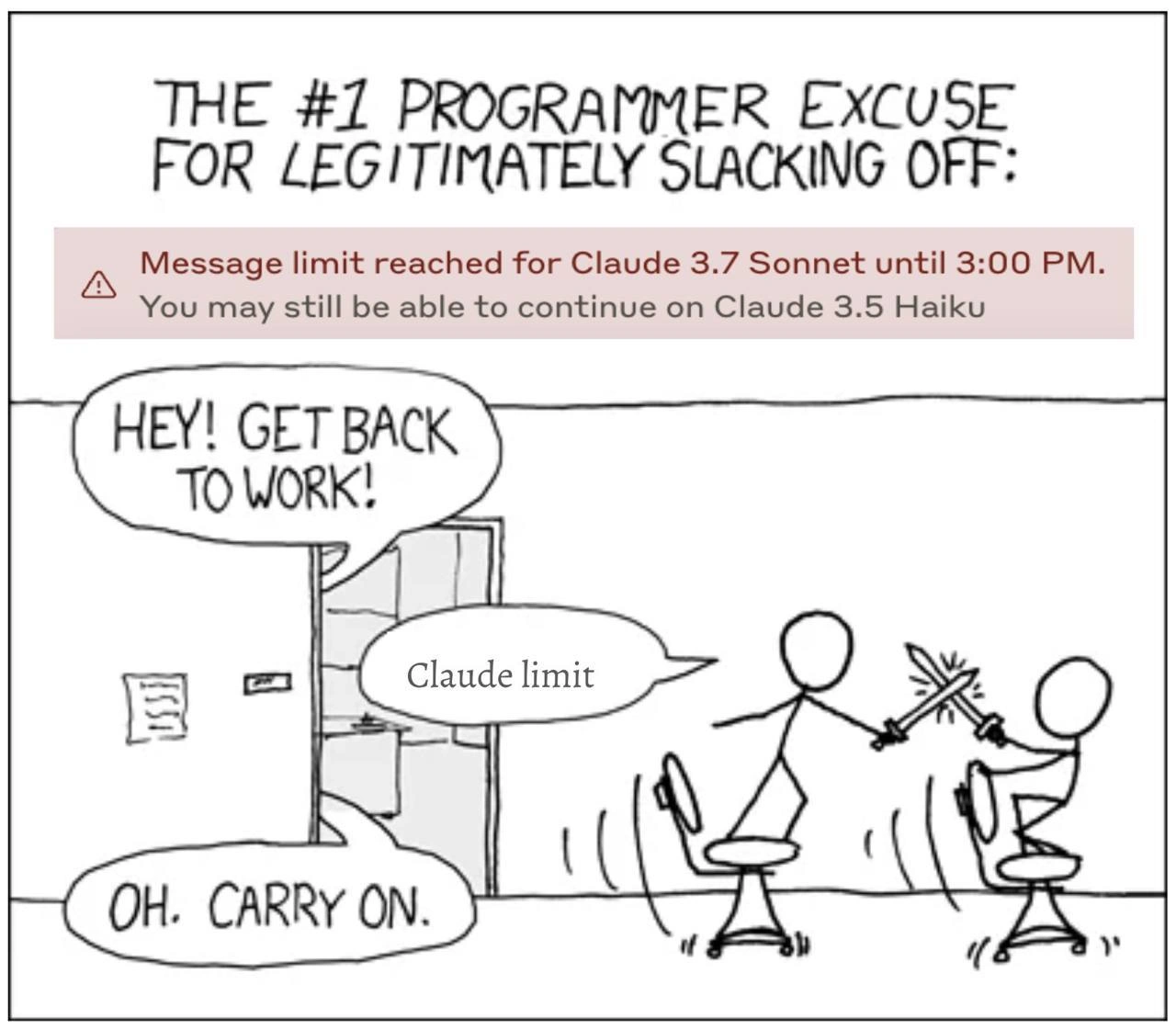
Let’s break this down in simpler terms. In software development, “my code is compiling” is a classic phrase. Compiling is the process where a computer takes the source code a programmer wrote (in languages like C++ or Java) and translates it into a lower-level form (machine code) that the computer can run. This compilation can take some time, especially in older systems or with big projects – anywhere from a few seconds to several minutes (or even hours for huge codebases!). Back in the 90s and 2000s, it was common for developers to start a compile and then have to wait idly for it to finish. This downtime was often used to stretch, grab a coffee, or even engage in some fun little distractions. Hence the running joke: if a boss catches a programmer not actively typing, the dev might quickly say, “Hey, the code’s compiling!” – meaning “I’m not being lazy, the computer is just busy right now, and I can’t do much until it’s done.” It was seen as a legitimate excuse for a short break. In fact, there’s a famous XKCD comic from 2007 that shows programmers having a sword fight while waiting for code to compile (the boss in that comic also says “Carry on” when told “Compiling”). This meme we have here directly references that old joke, but updates it to the modern age of AI assistants.
Now, what’s with Claude 3.7 Sonnet and the message limit? Claude is the name of an AI language model (like ChatGPT, but developed by Anthropic). Think of it as a very advanced chatbot that can help you with coding questions, write code, or explain technical concepts. By 2025, tools like Claude have been integrated into many programmers’ workflow, becoming almost like an AI pair programmer. For example, a developer might ask Claude to generate a function or to troubleshoot an error. However, these AI services aren’t limitless. They often have rate limits or quotas – rules that restrict how many questions you can ask in a certain time frame or how much data you can send. This is done because running these AI models costs money and computing power. If a user hits the limit, the service won’t respond again until a certain time passes or until you pay for a higher tier.
In the comic’s alert message, “Message limit reached for Claude 3.7 Sonnet until 3:00 PM” means the developer has used up all their allowed queries to the Claude AI (version 3.7 nicknamed "Sonnet") for now. Perhaps their company has a plan that only allows a certain number of prompts per hour, and they’ve maxed it out. The message suggests they might switch to Claude 3.5 Haiku, which sounds like a smaller or less capable version (possibly with shorter answers, jokingly like a haiku). The naming is humorous – sonnets are longer poems, haikus are very short poems – implying the “Sonnet” version is more powerful (longer, more detailed answers) while “Haiku” is a concise, maybe less helpful mode. The comic exaggerates it as if even the tool’s versions are poetically named, but it’s really referencing how AI services often have a premium version vs. a basic version. For example, OpenAI’s GPT-4 might have message caps, whereas GPT-3.5 is more unlimited but also less advanced. Here, Claude 3.7 vs Claude 3.5 is a play on that idea.
So what do the devs do when Claude hits its limit? According to the comic, they basically say, “We can’t continue our work right now because the AI that helps us is unavailable.” In a real office, if a programmer fully relies on an AI assistant for certain tasks, hitting a usage limit can indeed slow them down. Maybe they were using Claude to quickly generate boilerplate code or handle a tricky regex, and now they’ll have to do it manually or wait until the limit resets at 3:00 PM. In the joke, rather than keeping busy with something else, the devs choose to goof off – they start a playful sword fight using their swivel chairs. This is obviously an exaggeration for comedic effect; most developers wouldn’t immediately start a duel in the office (at least not every time!). But it emphasizes the point that they have free time forced upon them.
Slacking off means not working when you’re supposed to. However, the phrase “legitimately slacking off” implies that you have a genuine reason that is accepted by others as valid. In the context of the comic, “Claude limit” has become the new acceptable reason to not be working for a while. Notice how the boss reacts: when he shouts “GET BACK TO WORK!”, one of the developers simply responds with “Claude limit.” That’s a super terse way of saying, “We’re not working because we hit the Claude message limit and can’t proceed right now.” The boss immediately understands and says, “Oh. Carry on.” That means the boss acknowledges this reason as legitimate — as if it’s common knowledge that when the AI tool is unavailable, of course the programmers can’t do their regular work.
This interaction highlights DeveloperExperience changes. The boss’s quick acceptance suggests that in this company (and by joke, in 2025 tech culture), using an AI assistant is a normal part of development. So normal, in fact, that its downtime is like server downtime or power outage – something you can’t fight. It’s also an example of how communication in tech teams often uses shorthand. Just saying “Claude limit” conveys a whole situation in two words. Both the devs and the boss understand all the implications: the team uses Claude 3.7 as a vital tool, it has a known usage cap, that cap has been reached, it resets at a specific time, and until then progress will be slow or halted. Rather than the boss lecturing them on finding other tasks, he basically gives them permission to enjoy the break.
From a junior developer’s perspective, this is a humorous look at dependency on tools. On one hand, AI tools hugely boost Developer Productivity — they can save you time by writing code or answering questions quickly. On the other hand, if you become too dependent on them, you might find yourself stuck when they aren’t available. It’s similar to how many of us rely on the internet: when the internet goes down, a lot of work grinds to a halt. Similarly, if an AI assistant goes down or you hit a limit, you have to either wait or do things the slower way (on your own). Many new developers are learning to code with these assistants always on hand, so hitting a limit can feel like losing a coding partner. The comic takes a lighthearted jab at that: instead of showing the devs trying to soldier on, it shows them taking an absurdly comic break.
Let’s also talk about tool rate limits in general. This concept isn’t unique to AI. If you’ve ever used a free tier of an API (like a Google Maps API for a project or the Twitter API for a bot), you might have seen errors like “Too Many Requests” or “Rate limit exceeded”. It means you’ve called the service more times than you’re allowed within a given timeframe. Companies impose these limits to prevent any single user from overloading the system or racking up huge costs. In the case of AI assistants like Claude or ChatGPT, the computation for each query can be expensive (it uses a lot of CPU/GPU power on the server side), so they often limit how much one person can ask in a short period. By 2025, it’s plausible that workplaces have accounts for these AI services with set quotas. Developers have to be mindful of how often they hit the AI with queries. Running out of “AI credits” might be as common as running low on coffee beans in the office kitchen – and both can cause a bit of panic! This meme exaggerates it to “We’re out of AI for the next hour, so no work can be done.” It’s funny, but also a tiny bit grounded in truth for heavily AI-integrated workflows.
The xkcd-style comic aspect means the drawing is simple stick figures, which is intentionally done to focus on the humor and dialogue. XKCD comics often label scenes with text and have minimal art, relying on geeky jokes. This particular meme explicitly mirrors that style, even the phrasing “THE #1 PROGRAMMER EXCUSE FOR LEGITIMATELY SLACKING OFF:” on top is directly referencing an old famous comic. So if you’re a junior dev and haven’t seen that, now you know: this joke has lineage! It’s like a sequel set in the age of AI. The sword-fighting on rolling chairs is a silly example of what bored programmers might do when nobody’s looking (or when they have an excuse). It’s an absurd activity, which makes the scenario even funnier. It implies they’ve done this before – possibly every time there’s a delay. Offices with a playful culture often have these random moments, especially in tech startups or game development studios where people are young and full of energy. While it’s cartoonishly exaggerated, it captures the idea that when programmers are forced to pause work, they might engage in creative or fun mini-breaks. Some real-world examples could be a quick ping-pong match, a console game, browsing funny websites, or spinning around in a chair out of boredom. Here they chose an over-the-top example (jousting like medieval knights on wheeled chairs), which visually emphasizes just how slack the slack-off is.
In summary, for a newer developer: the meme is showing a situation where programmers can’t continue their task because their AI assistant tool hit a usage limit. Instead of sulking, they take advantage of the downtime to have fun. The boss recognizes the situation (he knows about the AI limit too) and doesn’t punish them – essentially saying “carry on” with their break until the tool is available again. It’s funny because it’s an exaggerated reflection of real issues: depending on tools (whether it’s a compiler or an AI) means sometimes you just have to wait, and programmers have turned that waiting into a joking matter for years. The combination of modern AI tech (Claude) with a very old joke (compiling) makes it a perfect TechHumor snapshot of how things change yet stay the same.
Level 3: Rate-Limited Recess
This comic hits experienced developers right in the nostalgia. It parodies the classic excuse “My code is compiling” by updating it to the AI era. In the AI/ML-driven dev world of 2025, hitting an AI rate limit has become the new legitimate downtime. The scene shows two programmers literally rolling with it – jousting on swivel chairs – which is exactly the sort of shenanigans you’d expect when there’s forced idle time. Back in the day, long compile times were the perfect cover for a coffee break or an impromptu Nerf battle. Now, with AI coding assistants like Claude in the mix, we’ve come full circle: the machines are busy “thinking”, and the humans get a DeveloperExperience_DX pause. It’s a hilarious inversion of productivity: a tool meant to accelerate coding (AI assistants) ends up reintroducing waiting periods that developers gleefully repurpose as playtime.
Let’s unpack the elements. The pink-red alert box in the comic reads:
:warning: Message limit reached for Claude 3.7 Sonnet until 3:00 PM.
You may still be able to continue on Claude 3.5 Haiku.
This faux-error message is gold. To a senior dev, it screams “blocked on external dependency.” The specifics are dripping with satire: Claude 3.7 “Sonnet” versus Claude 3.5 “Haiku” suggests an AI assistant available in different “flavors” or tiers (perhaps Sonnet being a more powerful, verbose model, and Haiku a lightweight fallback). The naming humor – Sonnet vs. Haiku – hints that the higher-tier model can produce 14 lines of answer (a sonnet) but after overuse you’re stuck with the model that gives you 3 lines (a haiku). It’s a playful jab at how AI tools might be marketed in the future, and how their tooling frustration (like usage caps) becomes part of daily DeveloperProductivity calculus. Seasoned devs recognize this pattern instantly: the best new tools always have a catch. Here the catch is a hard usage limit that stalls your work in the middle of the day.
The boss yelling “HEY! GET BACK TO WORK!” and then immediately backing off with “OH. CARRY ON.” after hearing “Claude limit” is a punchline that nails tech workplace culture. There’s an unspoken understanding in many dev teams and IT departments: sometimes the system itself enforces a break. Historically, if you told your tech lead “I can’t do X right now, the code’s compiling/testing/updating,” they knew it was a legit excuse. In the comic, the boss’s instant acceptance of “Claude limit” signals that by 2025, AI assistants are so integral to coding workflows that even management knows about their quirks. The manager doesn’t question it — he treats an AI throttle the same way one would treat a necessary but slow compile or a long test suite: as gospel. This reflects a shared experience across the industry: everyone from juniors to CTOs has hit a “Sorry, you’ve exceeded your plan’s limit” message at some point. It’s DeveloperHumor blending with reality; even the higher-ups are in on the joke because they’ve probably been blocked by a “Please wait for reboot” or a cloud service quota themselves.
Why is this so funny (and a bit painful) for senior engineers? It highlights a cycle in our field. We innovate to remove inefficiencies, yet similar patterns creep back in new forms. We replaced slow C++ compiles (minutes of waiting) with instant interpreted languages and hot-reloading... but then huge CI pipelines and thousands of unit tests started slowing us down again. We got faster build tools and parallel execution... then along comes an AI helper that can write code at lightning speed, only to introduce its own waiting game due to rate limits or expensive model calls. It’s the “two steps forward, one step back” dance of DeveloperExperience. The comic exaggerates it to great effect: instead of bemoaning it, the devs are literally dueling on chairs, embracing the forced break as a moment of office fun. That’s a senior-level inside joke: after you’ve been paged at 3 AM enough times or fought build failures for days, you learn to savor any guilt-free break the tech gods allow you. :sweat_smile:
Another layer here is the normalization of AI dependency. A decade ago, relying on an AI to generate code or answers would have sounded like sci-fi. Now many devs genuinely lean on tools like Claude or ChatGPT daily for help with syntax, boilerplate, or debugging. The comic’s scenario might be absurdist, but it’s grounded in truth: if your workflow depends on an external AI service and it stops responding (due to hitting a message limit, outage, or latency), you can be left twiddling your thumbs. Sure, an expert coder can always try to soldier on without the AI, but the whole point of such tools is boosting productivity – and when they’re unavailable, it genuinely feels like everything’s on hold. The humor is that these devs don’t even attempt a fallback like writing code unaided or using the smaller Claude 3.5 Haiku model. They immediately jump to goofing off, as if to say, “Welp, work’s impossible until the AI is back — might as well have some fun!” This wryly comments on how quickly we adjust our behavior around new tools; the moment we trust them, we also use their absence as an excuse to disengage.
From an organizational vantage, it’s also poking fun at how companies sometimes inadvertently sanction this behavior. It’s reminiscent of big tech firms where everyone knows a certain daily build kicks off at 4 PM and takes an hour — many employees take that time to play ping-pong or go for a snack. The boss character saying “Carry on” acknowledges that the DeveloperProductivity loss is out of the programmer’s control, and any attempt to force work during that window is pointless or even counterproductive. In real life, forward-thinking managers might actually encourage short breaks during long automated processes, knowing that folks come back refreshed. Here, the absurd twist is needing a break because your AI assistant is on a timeout. It’s a ToolingFrustration that has become oddly accepted. In fact, it wouldn’t be surprising if some teams start scheduling around known AI quota resets (e.g. “The Claude cap resets at 3 PM, let’s do our meeting just before that so by the time we’re back we can query it again”). The comic hyperbolically suggests even supervisors have adapted to these quirks – it’s a normal part of DeveloperExperience (DX) now.
There’s also an underlying commentary about how AI tools are provisioned and monetized. Many such assistants have tiered plans: the fancy, verbose model (here dubbed “Sonnet”) likely costs more or has strict limits, while the smaller “Haiku” model is offered as a consolation with fewer capabilities. This is a tongue-in-cheek nod to real services where the good version might have a daily message cap (to control costs or GPU usage), and when you hit it, you’re either locked out or stuck with a far inferior alternative. Senior devs who use these tools have experienced the annoyance of “Sorry, you’ve reached your limit, come back later” messages. It’s at once frustrating and comical — frustrating because it halts your flow, comical because it’s such a first-world developer problem. We solved so many hard computing limits over the years, and now we’re bumping into an AI quota. The phrase “Claude limit” in the comic has already become shorthand in some teams for “I’m blocked by the tool that was supposed to unblock me.” It’s meta and self-aware: the AIHumor is that our fancy intelligent assistant needs a timeout like a tired co-worker.
To make the comparison crystal clear, consider how the “legit slacking” excuse has evolved:
| Era | Legit Slack Excuse | Underlying Reason |
|---|---|---|
| Classic (2000s) | “My code is compiling.” | Long compile/build times on local machines |
| AI Era (2020s) | “I’ve hit the AI message limit.” | Exhausted the AI assistant quota, must wait for reset |
The meme cleverly ties these eras together. In both cases, the developer isn’t lying – the wait is real. But the humor lies in how quickly the absurd becomes normal. A manager in 2005 might have rolled their eyes at “I’m waiting on the compiler,” but ultimately accepted it. Fast-forward to 2025, and a manager hears “I’m waiting on Claude” and gives the same resigned nod. As a senior engineer reading this, you chuckle because you’ve lived through the compile waits, the test pipeline waits, and now possibly AI rate-limit waits. It’s a mix of “Ugh, I know right?!” and “Did we really invent an excuse to sword-fight at work again?!” There’s even a whiff of TechHistorian irony: decades of progress, yet here we are, reintroducing artificial delays (quite literally in this case) into our workflow.
One more subtle joke is in the physical comedy of the panel: the two devs balancing on rolling chairs, using probably rulers or keyboard wrists as swords, implies they’ve had enough boredom to orchestrate a chair jousting tournament. Only a truly legitimate excuse (like a lengthy compile or, now, an AI lockout) gives you that kind of free time without fear. The boss’s response “Carry on” almost reads like an IT department inside joke – perhaps he himself just got out of a meeting where they discussed increasing the AI query budget, so he totally gets it. In the absurd arms race of office excuses, “Claude limit” might outrank even “It’s a production outage” for how quickly it shuts down further questions. How can the boss argue? You can’t exactly yell “Type faster!” when the holdup is an external AI’s timer.
In summary, this meme resonates on multiple levels for seasoned developers. It lampoons our reliance on new tech (AIAssistants) and the recurrence of downtime in new guises. It’s AIHumor meeting CodingHumor: we laugh because it’s true. The next time someone catches a developer watching cat videos at work, they might just shrug and say, “Claude’s on a break, so I am too.” And honestly, every engineer who’s been around the block will nod in understanding – after all, we’ve been there, just with different jargon. Oh, carry on. 😉
# Pseudo-code capturing the meme's "work or slack" logic:
if code_is_compiling or ai_message_limit_reached:
start_office_chair_jousting() # Legitimately slacking off since there's nothing else to do
else:
continue_coding()
Description
This is a four-panel comic strip, stylistically a black-and-white stick-figure drawing, based on the famous XKCD 'Compiling' meme (number 303). The top of the image has a large title: 'THE #1 PROGRAMMER EXCUSE FOR LEGITIMATELY SLACKING OFF:'. Below this, a red-backgrounded warning message is prominently displayed, reading: 'Message limit reached for Claude 3.7 Sonnet until 3:00 PM. You may still be able to continue on Claude 3.5 Haiku'. The comic itself depicts a manager-like figure opening an office door and shouting 'HEY! GET BACK TO WORK!' at two programmers. The programmers are shown standing on their rolling office chairs, engaged in a sword fight. One programmer yells back the excuse, 'Claude limit'. Upon hearing this, the manager figure, now outside the closed door, says 'OH. CARRY ON.'. The meme cleverly substitutes the original's classic excuse of 'compiling' with the very modern problem of hitting usage limits on a large language model (LLM). For an experienced developer, this is highly relatable; waiting for an AI API to become available is a new form of legitimate, unavoidable downtime, just as waiting for a long compilation was in the past. It humorously captures the evolution of developer workflows and their associated blockers

Comments
26Comment deleted
My productivity is now measured in tokens per minute, and my main blocker isn't the CI/CD pipeline, it's the AI's rate-limiting window
We used to schedule chair-jousts for 45-minute C++ link times; now we call it “exponential backoff on Claude’s rate limit” and invoice it as AI resilience testing
Remember when 'the compiler is still running' was our go-to excuse? Now it's 'I've hit my Claude rate limit' - at least this one comes with an official error message and a timestamp. The real irony is we're so dependent on AI to write our code that when it's down, we genuinely can't remember how we used to do this job without it
When your sprint velocity is literally throttled by Anthropic's token buckets, and management can't argue with a 429 status code. It's the modern equivalent of 'my code's compiling' - except now it's 'Claude's rate-limited' and you're genuinely blocked. The beauty is that non-technical managers understand AI hype enough to accept it as legitimate, but not enough to question why you're not using the fallback model. Peak developer efficiency: finding the one external dependency that's both critical to your workflow and conveniently unreliable enough to justify extended coffee breaks
Funny how compiling used to buy five minutes, but Claude's rate-limit reset at 3pm buys the whole afternoon -- and it still shows up in the OKRs as AI-driven productivity
Claude rate limit: the only backpressure mechanism that justifies throttling your commit velocity without a single SRE alert
We’re no longer compile-bound; we’re token-bucket-bound - the sprint halts until the LLM’s rate limiter refills at 3pm
Real programmers: Comment deleted
How terrible do you have to be in your job to exceed the message limit? 😭😭 Comment deleted
100x engineers use llms 100x more often Comment deleted
Skill issue Comment deleted
no correlation there Comment deleted
True, the title was slacking off Comment deleted
I'm an Android programmer and I almost never use GPT for Android or Kotlin. Even for Gradle - still very rare. What eats up my limit (on those rare occasions when it does) is bash and python (which I never learned properly) - for various dev and CI tools and tasks 🤷♂️ And that is the beauty of these new AI tools: I'd never embark myself on those tasks if it wasn't for ability to get help from AI Comment deleted
Shell is a shoot yourself in a foot language unless you precisely know what you are doing. Like half of the scripts I see have problems in them. Whitespace handling mostly, but other stuff too. I can't imagine LLM getting that right. GIGO If it's for one-off stuff, sure. If it's something you distribute, that's gonna be *fun*. Comment deleted
Define "distribute" Comment deleted
Runs on someone else's files/data. Comment deleted
Well, as I wrote: for various dev and CI tools and tasks We don't ship these or sell them - all used internally in dev-teams or within the company. And they almost always have single responsibility and stable format of input and output, because they are, e.g. linked to their neighbouring tools up- and downstream of our continuous-integration/delivery/whatever. In general I guess we're good 😅 Comment deleted
Yeah. I think the worst you can expect is "oops our test suite was failing all along and no one noticed". It should be sanboxed enough to not nuke anything important. The weird thing to me is that shell isn't even complicated and it's the one thing that's certainly well worth learning from all the obscure UNIX tools. It just made some tradeoffs that are highly unusual from today's POV but functionally it's really simple. Good source is https://mywiki.wooledge.org/ Also you want to be aware if you are writing (POSIX) sh, bash, or some other flavor and what the difference is. Mostly to avoid the old error-prone constructs that are available there for compatibility. Comment deleted
Thank god my fellow colleagues, this company's toolchains and processes are better than that 😅 I wouldn't want to work anywhere near company, where this is possible due to some 70-lines *.sh script being written by careless coder, with or without AI tools 💯 But I hear you - actually learning a tool that you use is crusial. The issue in my case is that I don't use it regularly. More like a once a month or two - for several days (until I get it to do what I need). Imagine you go to a barber once a month and they does not speak your language, but only, let's say, Portugese. You wouldn't learn it to just chat with them once a month. You would learn basic words like "Hi", "Bye" and "Thanks". If you actually would need to give them a big motivational speech 😅 you'd use Google Translate or whatever and show them the translation on the screen. That is what I'm doing with GPT here. Comment deleted
Yeah. That's vast majority of shell use judging by the scripts I see. Try things that look about right and the first thing that works gets used. And once in a while it erases someone's /usr because variable was unset or gives out arbitrary command execution capability. The amount of professional sysadmins that I see using shell like this though is concerning to say the least though. I usually try to push people to use zsh and enable setopt no_unset because that disables the two most dangerous "features" of classic sh. But as it's not something that's installed by default in many places I don't think I've had much success. Comment deleted
There are so many great tutorials/courses out there. Just learn it if you need it. Comment deleted
Imo AI is good for when you do know what you're doing and what you want but you're stuck at actually getting started. It won't give you a finished product first try but with a bit of back and forth you'll get a usable "first draft" as it were Comment deleted
not if you work at anthropic Comment deleted
You may still be able to contribute to Haiku OS. Comment deleted
Back in the day it was "Stack overflow is down" Comment deleted