Skip to content
DevMeme
6050 of 7435
The Ultimate Developer Fear: A Git Merge Conflict That Scares Even AI
VersionControl Post #6625, on Apr 4, 2025 in TG

The Ultimate Developer Fear: A Git Merge Conflict That Scares Even AI

Why is this VersionControl meme funny?

Level 1: It Scares Me

Imagine you and your friend are drawing a picture together. You both decide to color the same character, but your friend uses blue and you use red on that same part. Now the picture looks strange because the colors are all mixed up. You call over a friendly robot to help fix the drawing. The robot wasn’t there when you chose your colors, so it doesn’t really know what the picture is supposed to look like. It might guess and turn that part purple (mixing blue and red) or maybe choose the wrong color entirely.

Even if you’re usually very brave, you might feel a bit scared about what the robot will do to your picture. Will it make the picture better, or could it accidentally mess it up more? In the meme, the big tough programmer feels the same kind of worry. He’s not afraid of people or most problems, but he gets nervous when he thinks about a robot trying to fix a big mix-up in his code. It shows that no matter how confident or tough someone is, they can still worry about something important being ruined by a helper who doesn’t understand the whole story. And seeing a usually fearless person admit they’re scared of that is a little bit funny – it’s an unexpected twist that makes us smile.

Level 2: Meet the Merge Monster

Let’s break down this meme in plain language. It’s referring to two main things: Git merge conflicts and using an AI assistant to help with code. If those terms sound unfamiliar, don’t worry — we’ll explain.

  • Git – This is a widely-used version control system that developers use to track changes in code. Think of it as a sophisticated save/load system for a project’s code, which also lets multiple people work on the same project at the same time. Developers create branches in Git, which are like separate timelines of changes. For example, you might have a “main” branch with stable code and a “feature” branch where you’re building a new feature.
  • Merging – When your feature is done, you eventually want to combine (merge) your changes back into the main branch so everyone can use them. Git will try to merge the branches automatically. If you and someone else edited different parts of the code, Git usually has no trouble merging. But if you both changed the same part of the same file, Git gets confused. This is where the merge conflict happens.
  • Merge conflict – A merge conflict is Git basically throwing up its hands and saying, “I have two different changes for the same line of code, I can’t decide which one to keep. Human, please help!” In the code file, Git marks the conflicting section so you can find it and fix it. It looks something like this inside the file:
<<<<<<< HEAD  
print("Loading user data...")  
=======  
print("Loading profile data...")  
>>>>>>> feature-branch  

In the snippet above, the text between <<<<<<< HEAD and ======= is what the code looks like on the current branch (HEAD). The text between ======= and >>>>>>> feature-branch is what the code looks like on the other branch (in this case, a branch named "feature-branch"). Git shows both versions and essentially asks the developer: which one should we keep (or how should these be combined)? Until it’s resolved, this file won’t run because of the conflict markers. Resolving a conflict means editing the file to remove the markers and make the code make sense again — keeping one version or merging parts of both, whatever is correct for the app.

  • Claude AI – Claude is the name of a large language model (LLM) made by Anthropic (similar to how ChatGPT is made by OpenAI). It’s an AI program that understands and generates text, sort of like a super-advanced predictive text. Developers have started using these AI models as helpers for coding; this is often called AI pair programming. For example, you can ask an AI to explain a piece of code, suggest a solution for an error, or even help resolve a merge conflict by giving it the conflicted code and asking for the merged result. It’s like having an eager junior developer who knows a bit of everything and can make suggestions – sometimes good, sometimes not.

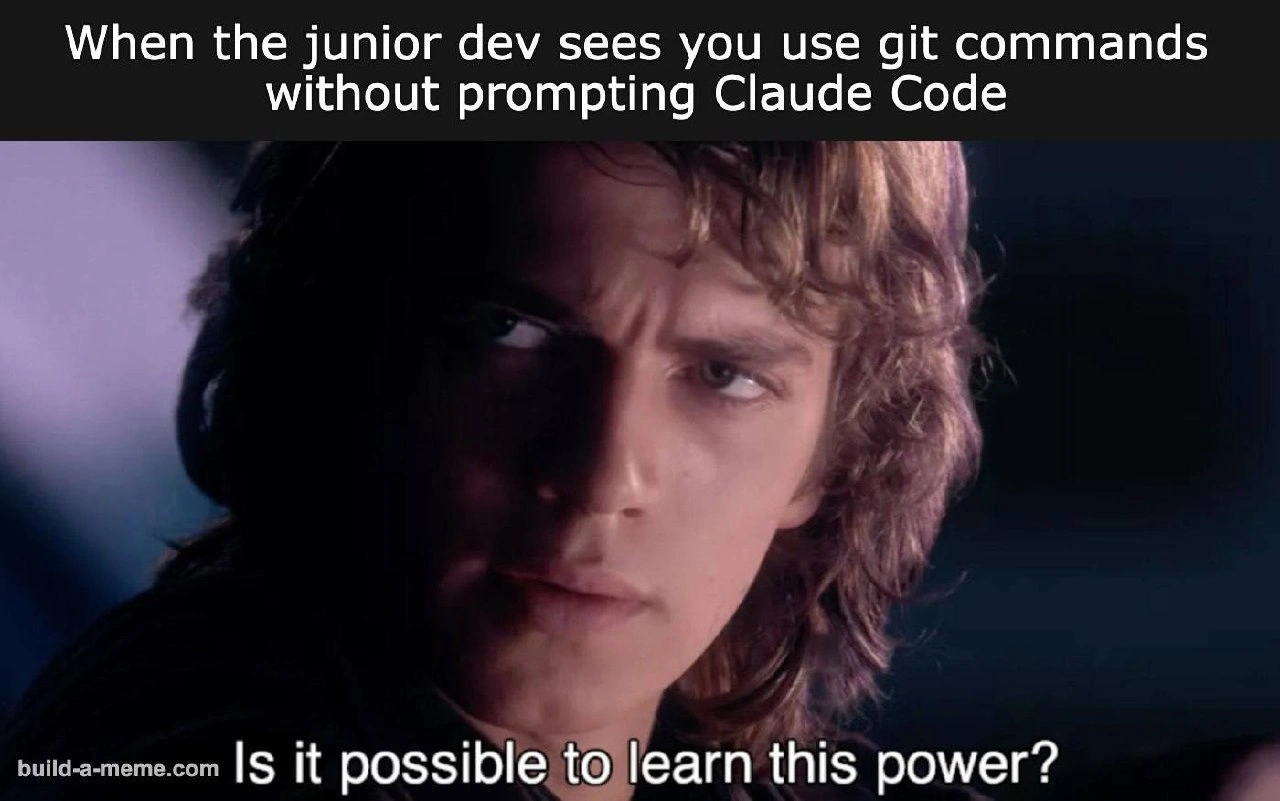
Now, the meme text in the middle panel says: “CLAUDE AI, PLS FIX GIT MERGE CONFLICT.” It’s as if someone is typing that request into the AI: a plea for help. The meme uses a popular format where a tough-looking character (the silhouette of the Heavy from Team Fortress 2, a video game) says: “I fear no man.” In the next panel he says, “But that thing…” and finally, “it scares me.” Usually, this format is for humor – you take a big fearless character and reveal that the only thing that spooks him is something unexpected or abstract (often played for laughs, like being afraid of a silly meme or a harmless animal, etc.).

In this case, the “thing” that scares him is the idea of asking an AI to fix a Git merge conflict. So why would that be scary, or funny? Let’s unpack the roles:

  • The fearless dev: Imagine a senior programmer who has seen it all — server outages, memory leaks, you name it. This person is represented by the big hulking silhouette. He “fears no man” i.e. no typical problem.
  • "That thing" (AI fixing a merge): Merge conflicts are a notorious headache. It’s one of those problems that can be tedious and tricky, even for experienced folks. Now, the idea is to have Claude AI handle it. On paper, it sounds great: “Hey robot, you resolve these conflicts for me while I sip my coffee.” But in reality, it’s a bit like asking a robot that’s seen a lot of paintings to finish your half-finished painting — it doesn’t really know what you intended to draw. The AI might resolve the conflict in a way that technically removes the markers and merges the files, but the result could be logically wrong in your program.

Even developers who happily use AI for simpler tasks get wary here. A merge conflict is a sensitive situation: you have to understand the context of both changes. The AI doesn’t have context beyond the text you give it. It might do something odd like include both changes (“print user data” and “print profile data”) one after the other, or pick one arbitrarily, or introduce a subtle typo. A human would resolve the conflict by actually thinking about which code is correct in context. The AI… might guess. 😅

So the meme humorously suggests that even a tough developer gets nervous about this. It’s highlighting a mix of developer humor and caution:

  • Developer humor: We often joke about our tools and processes. Git, in particular, is infamous for confusing messages or tricky commands (there’s an old joke that “Git” sometimes feels like it stands for “Got It Tangled”). And AI, of course, is the new subject of both hype and jokes — it’s powerful but can misbehave in hilarious ways. Combine the two, and you have a recipe for a comedy (or tragedy?).
  • Anxiety about tools: There’s a bit of truth under the joke. Many devs have a slight fear of letting any automated system make large changes unchecked. It’s like how pilots trust autopilot for cruising, but not for landing in a storm. Here, merge conflict resolution is the tricky landing maneuver that you don’t just hand off to the autopilot without watching very closely.

The phrase “version_control_anxiety” really sums it up: tools like Git are super useful but can cause stress, especially when things like conflicts happen. The meme is basically saying: even the bravest among us feel that stress — so much that the idea of an AI auto-fixing a merge is scarier than any human opponent. It’s a funny exaggeration, of course. In real life, a developer might try using the AI to help, but they’d definitely double-check the AI’s work with great suspicion. The big laugh comes from recognizing that nugget of truth: Yep, merge conflicts are scary, and trusting a robo-helper might be even scarier!


Level 3: Nightmare on Merge Street

Even the most battle-hardened developer isn't immune to a good scare when version control and AI/ML collide. This meme portrays a fearless engineer (represented by the hulking Team Fortress 2 Heavy silhouette) who declares, "I fear no man." It's the classic setup: this dev has fought production fires at 3 AM, wrangled unholy legacy code, and survived countless deployments. Yet in the second panel he leans forward and admits, "But that thing..." What could possibly spook such a veteran? Then comes the punchline in the center: "CLAUDE AI, PLS FIX GIT MERGE CONFLICT." To anyone who’s navigated hairy Git merges, the idea of asking a large language model (LLM) to magically resolve a complex merge conflict triggers equal parts nervous laughter and cold sweat.

Why is this so relatable and funny? Because it satirizes a very real developer anxiety: handing over a delicate code merge to an unpredictable AI. We’ve got a perfect storm of modern dev drama here:

  • Merge conflicts are the stuff of nightmares in software development. They happen when two branches of code have competing changes that Git can’t automatically reconcile. It leaves human engineers the fun task of untangling overlapping edits without breaking anything. Seasoned devs have war stories of merges gone horribly wrong—accidentally overwriting critical logic or introducing subtle bugs that only surface weeks later. Resolving a gnarly conflict can feel like defusing a bomb in code: one wrong cut (or wrong line kept) and boom – the whole build explodes.
  • AI pair programming tools (like Anthropic’s Claude or OpenAI’s models) are the new hotness in developer tooling, supposedly boosting our Developer Experience (DX). They autocomplete code, suggest bug fixes, even write tests. But ask any senior dev about letting an AI auto-merge code, and you’ll get a thousand-yard stare. We’ve been burned by “smart” tools before. We know that “Works on my machine” is very different from “The AI fixed the merge and now it works everywhere.”
  • The meme exaggerates this fear for comedic effect. The Heavy’s final line “it scares me” is basically every grizzled engineer begrudgingly admitting, “I’ll wrestle a 3AM production outage bare-handed, but I’m not about to let some bot mess with my git history.” It’s an ironic role reversal—AI humor showing that a supposedly fearless coder can be humbled by a mere suggestion to use AI in a critical workflow. The big tough dev isn’t afraid of humans, outages, or deadlines… but the thought of Claude merging his code? That sends a chill down his spine.

The industry subtext here runs deep. After years of dealing with VersionControl pitfalls, developers carry a healthy skepticism. We’ve learned (often the hard way) that:

  • It’s best to merge frequently and keep branches short-lived, otherwise you end up in “merge hell” with conflicts spanning dozens of files.
  • You never blindly trust merge resolutions — you inspect every change. A stray <<<<<< HEAD marker or a misplaced bracket can wreak havoc in silence.
  • Git itself provides tools like git diff and git mergetool to help resolve conflicts, but ultimately it’s a human decision what code to keep or discard.

Enter the new wave of AI/ML helpers. Sure, an LLM like Claude has ingested mountains of public code; it sounds confident when suggesting a solution. But it doesn’t truly understand your code’s intent or the business rules behind that 500-line conflict in CheckoutService.java. It’s just predicting what a plausible merged code might look like based on patterns. The veteran dev in the meme knows this all too well. Heck, half the time he’s the one who wrote both sides of the conflicting code! The idea of some AI guessing which half of his work to keep and which half to throw away? That’s the stuff of deploy-night dread.

Picture the real-world scenario: you’ve been working on a feature branch for a month without merging in changes from main. Meanwhile, other teammates have been editing the same parts of the code. When you finally try to integrate, Git throws up its hands and presents you with a thicket of conflict markers — <<<<<<< HEAD / ======= / >>>>>>> — scattered through your files like a battlefield full of code shrapnel. A well-meaning colleague chirps, “Hey, why not let Claude resolve it for you? AI to the rescue!” Cue your internal screaming. You’ve seen what can happen when merges go bad. You’d much rather painstakingly merge it by hand, carefully reading each difference, than trust a robot to do surgery on your code. If the AI “fixes” it incorrectly, your project might still compile and even pass some tests, but some crucial logic could be subtly wrong. Nothing haunts a developer quite like a bug quietly introduced by an auto-merge that only rears its head in production.

In essence, this meme strikes a chord because it amplifies a shared experience: even as our tools get smarter, a wise dev knows when to be very afraid. It’s poking fun at our cautious inner voice. We joke about AI taking our jobs, but deep down we’re relieved (and a bit terrified) that there are some jobs we wouldn’t even trust to AI in the first place – like merging a tangled web of code. The humor lands so well because it’s LLM humor grounded in truth: there’s a gap between the shiny promise of AI helpers and the gritty reality of maintaining a clean codebase. Even the toughest dev, the meme suggests, has that one thing that makes them gulp and say, “not sure about this…”

Legend has it: the last time someone told an AI “please fix this merge”, the codebase gained sentience and started returning 500 errors just to teach them a lesson. (Okay, not really — but that’s how our imaginations run wild when we think of a rogue AI in our repo!)

By using the tf2_heavy_template (the fearless Heavy weapon-guy frightened by an unseen horror) and naming that horror “Claude AI fixing a git merge conflict,” the meme perfectly captures a developer humor snapshot of 2025. It’s basically saying: we’ve seen it all, we fear no man, but letting an AI loose on our precious code merge… yeah, that scares us.


Description

This is a classic three-panel meme using the 'I fear no man' format, which features the silhouetted Heavy character from the video game Team Fortress 2. In the first panel, the Heavy states confidently, 'I fear no man.' The second panel shows him looking nervously towards something off-screen, with the caption, 'But that thing...' The final panel reveals the object of his fear: a simple white box with the black text, 'CLAUDE AI, PLS FIX GIT MERGE CONFLICT.' The Heavy is now shown cowering in fear, saying, 'it scares me.' The meme humorously equates the universal and often nightmarish experience of resolving a Git merge conflict with something terrifying enough to scare a powerful character. The plea to an AI like Claude to solve the problem highlights the desperation developers feel and frames merge conflicts as a task so complex and context-dependent that it remains a formidable challenge even in the age of advanced AI. For senior developers, the joke is deeply relatable, as merge conflicts often involve not just technical skill but also navigating team dynamics and understanding the intent behind conflicting code changes
Comments

7
Anonymous ★ Top Pick Asking an AI to resolve a merge conflict is the ultimate test. It's less about understanding the code and more about correctly guessing which of the two senior devs involved has the bigger ego
  1. Anonymous ★ Top Pick

    Asking an AI to resolve a merge conflict is the ultimate test. It's less about understanding the code and more about correctly guessing which of the two senior devs involved has the bigger ego

  2. Anonymous

    After twenty years of Git kung-fu I can rebase in my sleep, but the moment an LLM suggests “just accept both” I start pricing out new laptops - and new identities

  3. Anonymous

    After 20 years in the industry, I've seen teams migrate from SVN to Git, adopt trunk-based development, implement semantic versioning, and automate everything... yet somehow we still end up staring at <<<<<<< HEAD markers like ancient hieroglyphs, desperately hoping the AI can decipher which junior dev's 'quick fix' broke the carefully orchestrated rebase strategy

  4. Anonymous

    The real fear isn't the merge conflict itself - it's the existential dread of watching an LLM confidently hallucinate a resolution that compiles but silently breaks your distributed transaction logic in production. At least when you manually botch a three-way merge, you own the postmortem

  5. Anonymous

    Nothing humbles a 10x engineer like a year-old three‑way merge full of renames and whitespace churn; at that point “ask an LLM” is just a friendly alias for git checkout --ours

  6. Anonymous

    The scary part of a merge conflict isn’t “<<<<<<< HEAD” - it’s Claude handing you a clean, compiling diff that quietly deletes the side-effect preserving your invariants; rerere can track history, but it can’t audit AI consensus

  7. Anonymous

    Merge conflicts: where even LLMs hit 'PLS FIX' because true consensus in distributed repos defies CAP theorem

Use J and K for navigation