
Skip to content
DevMeme
2510 of 7435
AI Classification: From Cats to Combat
AI ML Post #2784, on Feb 23, 2021 in TG

AI Classification: From Cats to Combat

Why is this AI ML meme funny?

Level 1: The Sponsor’s Surprise

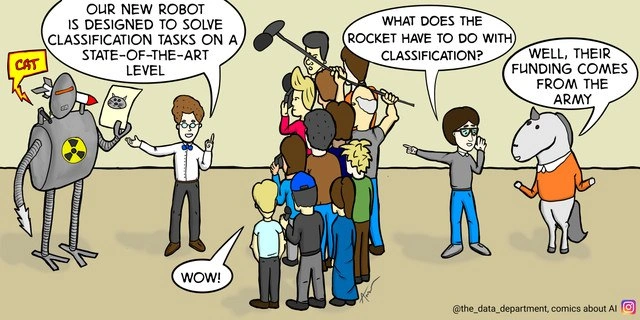
Imagine you and your friend build a cool robot for the school science fair that can sort crayons by color. Your friend’s dad (who paid for all the robot parts) happens to be a big fan of rockets and explosions. So, to keep him happy, you strap a small firework rocket onto the robot even though it has nothing to do with sorting crayons. During the presentation, you proudly show everyone how the robot separates red crayons from blue ones, and the crowd goes “Ooooh!” because it’s a neat trick. But then one of your classmates raises their hand and asks, “Why does your crayon-sorting robot have a firework rocket on it?” You shrug and answer, “Well… because my friend’s dad paid for it, and he really likes rockets.” It’s funny in a silly way: the robot’s special skill was only supposed to be sorting colors, but it ended up with a totally unrelated rocket attached, all because the person funding it wanted something exciting for himself. This meme is showing the same idea — a super smart robot that identifies a cat picture perfectly, yet it has a random rocket on its back just because the Army funded it. It’s a joke about how sometimes whoever pays for a project can sneak in their own wild ideas, even if those ideas don’t quite fit.

Level 2: Classification with a Catch

At its core, this meme is about a robot demo and a surprise twist due to its funding. The robot is being showcased as an advanced AI system that can perform classification tasks. In plain terms, a classification task in Machine Learning means teaching an AI to recognize or label things. For example, you might train a model to look at a drawing and tell if it’s a cat, a dog, or something else. Here, the robot holds up a paper with a doodle of a cat labeled “CAT” – it’s demonstrating that it can correctly identify a cat drawing. The presenter proudly calls it “state-of-the-art,” which is a phrase that means the most advanced level of technology available. This tells the audience that the robot uses the latest AI techniques (likely complex Deep Learning models) to achieve very high accuracy in these recognition tasks. Hearing this, the onlookers say “Wow!”, showing they’re impressed by the robot’s cutting-edge capabilities.

However, something unusual stands out: the robot has a rocket strapped to its back (and even a radioactive warning symbol on its chest for good measure!). Normally, you don’t need a literal rocket attached to a robot that’s just identifying images or drawings. That’s why one of the journalists asks, “What does the rocket have to do with classification?” – basically, “Why on earth does a cat-spotting robot need a rocket?”. This question points out the seeming mismatch. The answer comes from another engineer character (drawn as a horse in a hoodie, adding a bit of cartoon humor): “Well, their funding comes from the Army.” This one line explains the whole joke: the robot includes a rocket because the project is paid for by the Army, and the Army is all about military tech. In other words, the robot’s purpose isn’t purely to show off AI skills; it also has to satisfy the interests of its military stakeholders (the people sponsoring it).

In the tech world, stakeholders or clients who fund a project often influence what that project becomes. Here, the sponsor is the Army, so the project that started as an AI for classifying images (a very academic/civilian task) was likely modified to have a military angle – hence the rocket launcher aspect. This kind of technology is sometimes called “dual-use”, meaning it has two uses: one innocent (like identifying cats or other objects) and one military. The meme humorously exaggerates this by literally strapping a weapon to the robot’s body for the Army’s sake. It’s making fun of the way AI hype presentations can gloss over those uncomfortable details. The presenter talks only about the cool AI part (“state-of-the-art classification”), while conveniently not mentioning the obvious warlike part (the rocket) until someone points it out. When that truth is finally revealed, it changes how we see the whole demo: it’s not just a cute AI robot, it’s potentially a prototype for an Army gadget.

For a newcomer, the takeaway is this: sometimes tech demos, especially in AI and Robotics, are guided by who’s funding them. If a project is funded by a military group, even a system doing something as simple as recognizing cat pictures might end up with military hardware bolted on. The meme points out this funny and somewhat ironic situation: an AI robot that’s supposedly about advanced image classification but is clearly geared up like a tiny soldier because of its sponsor. It’s both a joke and a commentary on how stakeholder expectations can add a surprising “catch” (in this case, a rocket) to a project that would otherwise just be about machine learning.

Level 3: State-of-the-Artillery

This comic is set at a flashy AI/Robotics press conference, showcasing a humanoid robot proudly performing “state-of-the-art” classification tasks. We see the robot holding up a doodle labeled “CAT” as if to prove it can identify a cat. The crowd of onlookers and journalists responds with an impressed “WOW!” – a familiar reaction to AI/ML hype. MachineLearning experts recognize this as the classic demo: get an AI to label something correctly (often a cat vs. not-cat) to wow a non-technical audience. The phrase “state-of-the-art” is a buzzword signaling that this robot uses the latest and greatest DeepLearning algorithms for classification. It implies cutting-edge performance, likely invoking powerful image recognition models or neural networks under the hood.

But there’s a glaringly incongruous detail: the robot has a bright yellow radiation warning symbol on its chest and a rocket strapped to its back. A puzzled reporter in the crowd asks the obvious question: “What does the rocket have to do with classification?” This punchy question exposes the comedic twist. A bespectacled engineer (humorously depicted as a white horse in an orange hoodie) points to the robot and dryly answers, “Well, their funding comes from the Army.” StakeholderExpectations just crashed the party. Suddenly, the narrative shifts from a pure tech demo to a commentary on dual_use_ai and military sponsorship. The joke lands because it reveals a truth most seasoned developers know: if a particular “feature” seems out of place in a project, stakeholders (especially ones with deep pockets like the military) might be the reason. In other words, no funding is truly free – there are always strings (or in this case, rockets) attached. It’s a satirical take on how AIIndustryTrends are often influenced by whoever writes the checks.

For experienced engineers and tech historians, this scenario triggers knowing smiles. It echoes real-world patterns where advanced AI research and robotics projects get bankrolled by defense organizations. Historically, many breakthroughs in AI were funded by military agencies under a veil of solving generic problems. (Case in point: early image classifiers were developed under DARPA grants to identify targets, even though the demos showed harmless things like cats or handwritten digits.) The term “dual-use” technology exists because innovations often have both civilian and military applications – and the military side tends to slip in quietly when funding is involved. In this meme, the harmless task of identifying a cat picture is the civilian facade; the rocket is the not-so-subtle hint of a military application (think target acquisition or even a literal weapon). The comic exaggerates it for humor: the robot’s design includes a cartoonish rocket booster/missile visibly bolted on, something you’d never see in a purely civilian image classifier demo. It’s as if the engineers were told, “Sure, you can work on your cute cat-classifying AI, but make sure it can also fire a rocket, because our sponsor insists on some bang for their buck.”

The humor here also pokes fun at AIHype in the media. The presenter confidently announces the robot’s prowess in solving classification tasks at a state-of-the-art level, and the audience is initially dazzled by the jargon. This mirrors countless tech announcements where lofty claims get public praise. Yet right beside that hype is a physical reality that undercuts it – literally rocket science overshadowing data science. The journalist’s question highlights what any technically savvy observer would think: “Why on earth (or above it) does a classifier need a rocket?” The deadpan answer reveals the all-too-familiar industry truth: Stakeholders_Clients often drive product decisions, and if your client is the Army, don’t be surprised when a straightforward AI project gets a tactical twist. The AIHypeVsReality gap in this comic is wide: the hype is “we have an amazing learning algorithm,” the reality is “we had to bolt on a military feature to get it funded.”

In a senior engineer’s career, this pattern – building something cool and then bending it to fit a sponsor’s agenda – is painfully relatable. Maybe you’ve developed a nifty database tool, then a corporate client insists it also include blockchain, or you’re making a friendly robot and an investor asks, “Can we add a taser to it for security applications?” It’s the same vibe: features that don’t quite fit the original vision appear out of nowhere due to outside influence. The meme uses the rocket_strapped_robot as an extreme example of scope creep driven by sponsorship. It’s the ultimate “feature request” from a stakeholder who couldn’t care less about classifying cats unless there’s a combat edge.

To put it in dev terms, here’s a pseudocode interpretation of the situation:

class RobotDemo:
    def __init__(self, funding_source):
        self.capabilities = ["state_of_the_art_classification"]
        if funding_source == "Army":
            self.attach("rocket")  # Add extra feature to satisfy the sponsor

In this snippet, a robot starts life as a sophisticated image classifier. But if the funding_source is the Army, suddenly attach("rocket") gets called – meaning our pure classifier robot now comes with optional weaponry. This is obviously a tongue-in-cheek code example, but it nails the joke: the robot didn’t need a rocket functionally, but financially it did. The comment says it all: add extra feature to satisfy the sponsor. Every engineer who’s ever had to implement an oddball requirement because “the client wants it” can relate (though usually those extras are less dramatic than a missile).

At this deepest level, the meme is a commentary on the intersection of cutting-edge AI research with real-world funding pressures. It highlights the irony of AI_hype: lofty technical goals can be steered (or outright hijacked) by the priorities of those paying for them. The robot’s rocket is a metaphor for how research projects sometimes carry hidden agendas. It’s funny because it’s true: in tech, you can tout an innovation as “state-of-the-art”, but if the money comes from a source with an agenda, you might end up literally strapping that agenda onto your project – whether it makes sense or not.

Description

A single-panel cartoon from '@the_data_department, comics about AI'. On the left, a scientist proudly presents a new robot to a crowd of reporters, saying, 'OUR NEW ROBOT IS DESIGNED TO SOLVE CLASSIFICATION TASKS ON A STATE-OF-THE-ART LEVEL'. The robot, which has a radiation symbol on its torso and a rocket on its shoulder, holds a drawing of a cat and correctly identifies it with a 'CAT' speech bubble. The crowd reacts with 'WOW!'. On the right, a skeptical observer asks a unicorn wearing a sweater, 'WHAT DOES THE ROCKET HAVE TO DO WITH CLASSIFICATION?'. The unicorn replies with the punchline: 'WELL, THEIR FUNDING COMES FROM THE ARMY'. The comic satirizes the dual-use nature of AI/ML research, where benign, publicly demonstrated capabilities like image classification often mask underlying military applications driven by defense funding. For senior developers, it's a cynical but relatable commentary on AI ethics and the sometimes uncomfortable reality of who funds major technological advancements

Comments

11
Anonymous ★ Top Pick Our new image recognition model is state-of-the-art. It can classify 15 types of cats, 4 types of dogs, and 8 types of armored personnel carriers. The client was only specific about the APCs
  1. Anonymous ★ Top Pick

    Our new image recognition model is state-of-the-art. It can classify 15 types of cats, 4 types of dogs, and 8 types of armored personnel carriers. The client was only specific about the APCs

  2. Anonymous

    PO: “Just build a cat-vs-dog classifier.” Two sprints later it’s got a rocket booster, a radiation sticker, and Legal asking which export-control regime covers “inferencing at Mach 3.”

  3. Anonymous

    The real classification task is determining whether your ML model will end up categorizing cats or enemy combatants - turns out the confusion matrix includes moral ambiguity as a hidden dimension

  4. Anonymous

    Ah yes, the classic 'our image classifier is totally for civilian use' pitch - funded by a defense contract that definitely has nothing to do with autonomous targeting systems. Nothing says 'state-of-the-art cat detection' quite like a radioactive hazmat suit and a rocket budget. At least when your model's precision-recall curve tanks, you can blame it on 'dual-use technology constraints' in the grant proposal

  5. Anonymous

    Escape velocity doesn’t move the ROC curve, but it sure moves the procurement budget

  6. Anonymous

    We built a SOTA classifier; the defense sponsor bolted on a rocket. Grant-driven architecture at its finest - “deployment” now describes the flight path, not the Kubernetes cluster

  7. Anonymous

    Classic ImageNet legacy: OOD rockets get confidently cat-egorized into one of 12 feline subclasses

  8. @repixel 5y

    یسسسس کامنت اول = Yesssss first comment

    1. @feskow 5y

      hello

      1. @AnarchistForLife 5y

        Yo

    2. @AnarchistForLife 5y

      Ma nigga dawsh, u gotta English it.

Use J and K for navigation
