Skip to content
DevMeme
5465 of 7435
The Industry's Love for FAANG Interviews, But Not FAANG Salaries
Interviews Post #5989, on May 8, 2024 in TG

The Industry's Love for FAANG Interviews, But Not FAANG Salaries

Why is this Interviews meme funny?

Level 1: Chores Over Candy

Imagine you have the chance to get a huge bag of candy, but first you need to do a really hard puzzle or a bunch of difficult chores. Most people would say, “I’ll struggle through the chores because I really want that candy!” But this joke is saying there’s a kid who actually likes doing the hard chores more than getting the candy. That’s pretty silly, right? Usually the candy (the reward) is the best part.

In this meme, getting into a big famous tech company is like the candy – it comes with lots of goodies (money, perks, success). But the way to get the candy is by doing tough puzzle-like interviews (that’s the chore). The funny twist is the person in the meme is happier about doing the hard puzzles than about getting all the candy at the end. It’s like a student saying they love taking the super hard test more than getting a great prize for acing it. We laugh because it’s upside-down from what you’d expect. The meme makes us think, “Wow, that person’s priorities are flipped!” – just like a kid preferring homework to playtime, or chores to chocolates. It’s a goofy way to show how some people in tech focus so much on the challenging interview that they forget about the sweet reward waiting for them.

Level 2: The LeetCode Grind

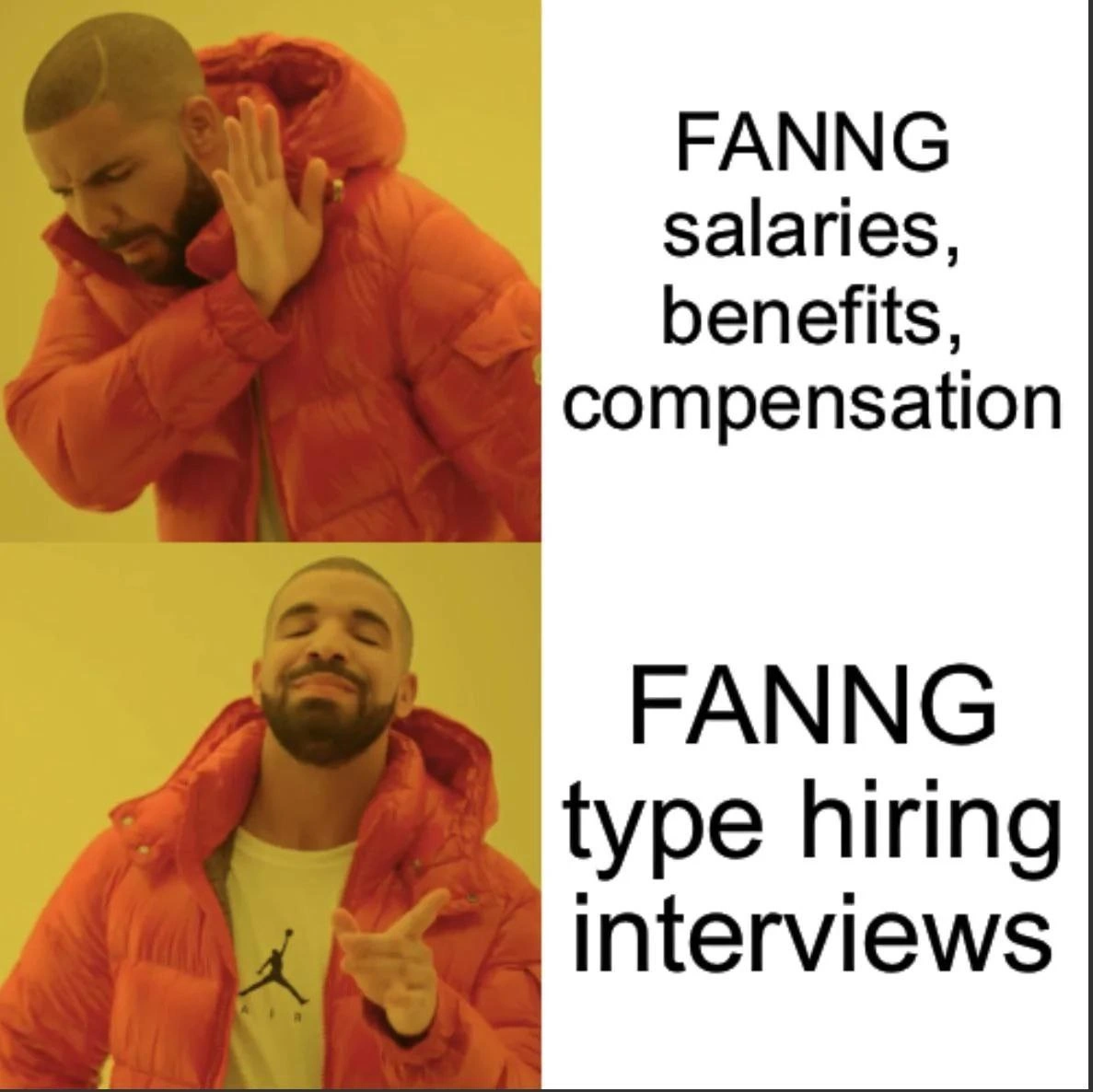
Let’s break down the meme in simpler terms. It’s using the popular Drake meme format. In the top image, Drake is making a “nope” face and holding a hand out to reject something; here the text next to him says “FAANG salaries, benefits, compensation.” In the bottom image, Drake is smiling and pointing approvingly at the text “FAANG type hiring interviews.” Normally, people are excited about FAANG companies because of their salaries and benefits – these companies pay a lot of money, give stock shares that can be worth tons, and offer perks like free food, big bonuses, and great health insurance. That’s what we call a compensation package. It’s legendary because companies like Google or Facebook can pay total packages that are much higher than an average software job elsewhere.

Now, FAANG type hiring interviews refers to the specific style of job interviews these big tech companies use. Typically, they involve whiteboard interviews or coding tests. A whiteboard interview means you stand in front of a whiteboard (or collaborate on a shared doc/online editor) and write code or solve programming problems by hand, usually without a computer to run your code. They’ll ask questions about data structures (like arrays, linked lists, binary trees) and algorithms (like sorting, searching, graph traversal). For example, an interviewer might say, “Write a function to check if a binary tree is symmetric,” or “How would you find the longest substring without repeating characters?” You have to think out loud, write the solution, and maybe analyze its efficiency (is it O(n) linear time? O(n²)? etc.). These interviews are famous for being challenging. People often prepare by practicing lots of sample problems on websites like LeetCode, a platform full of coding puzzles similar to what interviewers ask. This practice is sometimes called the LeetCode grind, because candidates might grind through (i.e., work on) hundreds of problems to get ready.

So why would Drake (or the engineer he represents) “prefer” the interviews over the salaries? That’s the joke! It’s poking fun at how some developers seem to obsess over the interview process itself. Instead of being motivated by the amazing pay or the benefits, they’re caught up in the challenge of the interview as if it’s the main attraction. In reality, most people would say, “I’ll put up with the hard interviews because I want that high-paying job.” The meme turns this on its head: “I want the hard interviews for their own sake, the salary is whatever.”

This jokingly highlights a part of tech career culture:

  • Many engineers swap tips on how to solve tricky interview questions, almost like it’s a sport or a game.
  • There’s even a bit of humor in interviews now, where we share war stories of bizarre questions or how someone solved a problem in a clever way under pressure.
  • The community sometimes glorifies the idea of cracking the interview, not just landing the job. For instance, someone might proudly post, “I did 200 LeetCode problems in 3 months and aced the Google interview!” They’re as proud of the grind as of the job offer.

The meme text “Preferring FAANG whiteboard interviews over their legendary compensation packages” is basically saying: imagine a person who literally likes the tough interview itself more than the huge salary that comes after. That’s pretty backward from expectations, which is why it’s funny. It exaggerates the reality that some folks focus too much on the interview prep – so much that it seems they’ve forgotten the actual prize (the job and money). It’s a playful jab at those in the tech world who are more hype about having beaten the hiring process or joining the FAANG interview “club” than they are about what the job gives them.

In summary, if you’re a junior dev or anyone outside this world:

  • FAANG = big tech companies with big pay and hard interviews.
  • Whiteboard interviews = coding exams you write out by hand, often tough.
  • LeetCode grind = the intense practice regime people do to prepare.
    The meme uses Drake’s famous “No/Yes” pose to joke that someone values the grind of the interview over the reward of the job, highlighting our industry’s odd habit of glorifying the struggle itself.

Level 3: Inverting Priorities

At a senior engineering level, the meme strikes a chord because it satirizes a real culture clash in tech. Big tech companies — the famous FAANG companies (Facebook, Apple, Amazon, Netflix, Google) — are renowned for jaw-dropping salaries, hefty stock options, and lavish benefits (think free gourmet meals and on-site massages). These are the legendary compensation packages that normally make engineers drool. But FAANG is equally infamous for its grueling technical interview process: multi-round whiteboard interviews where you solve algorithm puzzles under observation. The Drake format here humorously inverts the normal priorities. In the top panel, Drake (frowning) is rejecting “FAANG salaries, benefits, compensation” – which is crazy on its face, because who in their right mind would turn down a six-figure (often even multi-six-figure) offer with perks? In the bottom panel, Drake is all smiles, pointing eagerly at “FAANG type hiring interviews.” This suggests someone prefers the interview grind to the actual reward. It’s an absurd reversal, and that’s the joke.

Why is this so funny (and a bit painful) to experienced devs? Because it lampoons the leetcode_grind_culture we’ve all seen. There’s a running joke in the industry that some folks have developed Stockholm syndrome with whiteboard interviews. After months of practicing hundreds of coding problems on sites like LeetCode or HackerRank, they start to find the process almost fetishized. They’ll debate the elegance of a DFS vs BFS solution as if it’s more important than the fact that landing a FAANG job could change their financial future. It’s a form of gamification: the interview becomes a sport, akin to competitive programming contests. Solving a clever bit of code in front of a hiring panel can give a rush of adrenaline and bragging rights on LinkedIn (“I solved 500 LeetCode questions, ask me anything!”).

However, the seasoned cynical veteran in us chuckles because we know the truth: once you’re actually hired, nobody is going around in your day job manually reversing binary trees on a whiteboard. You might be using high-level frameworks, gluing APIs, dealing with legacy code, or debugging a prod issue at 3 AM – none of which require remembering how to implement a quicksort from scratch. The CorporateCulture irony is rich. FAANG human resources (HR) and engineering teams set up these hiring obstacle courses to filter thousands of applicants, and over time it created an almost mythic culture of its own. Now you have candidates who romanticize the very hurdles meant to stress-test them.

Inverting the meme’s text highlights that irony: the hiring process itself has become a status symbol. It’s poking fun at us engineers for sometimes valuing intellectual challenge over pragmatic rewards. Some of us secretly enjoy the whiteboard duel – it’s a chance to prove our mettle, to show we can code on the spot with no compiler or Google. The meme winks at this mentality. It’s InterviewHumor 101: we all know the interviews are tough and often nerve-wracking, so suggesting someone enjoys them more than the subsequent fat paycheck is delightfully ridiculous. It’s a gentle roast of those who have their priorities skewed or perhaps have made grinding LeetCode their hobby to the point where the grind overshadows the goal. For senior folks, there’s also a subtext: we remember when getting a good job was about building things and maybe a conversational interview – now it can feel like passing an exam. So we laugh (perhaps a bit ruefully) at this depiction of an engineer who’s fallen in love with the exam itself. We’ve seen it happen, and it’s both commendable in dedication and comical in misplaced focus.

Level 4: Complexity Over Compensation

In the FAANG interview arena, candidates often face an algorithmic gauntlet that hinges on core theoretical computer science concepts. This meme flips priorities to highlight a bizarre fascination with that gauntlet. Think of those notorious whiteboard questions: reversing a linked list in-place, finding cycles in a graph, or inverting a binary tree. These problems come straight out of CS textbooks on algorithms and data structures, touching on fundamentals like graph theory and recursion. Solving them efficiently requires understanding Big-O complexity (e.g. distinguishing an $O(n \log n)$ sort from an $O(n^2)$ brute force). It’s as if the interview is a mini exam in computational theory — ironically more academic than the actual job might be.

The humor arises from someone preferring this ritual of algorithmic puzzles over the end reward (the legendary compensation). It’s like celebrating the NP-hard challenge itself rather than the solution. In theoretical terms, it’s a reversal of the expected utility function: normally, one would maximize monetary payoff, but here the utility seems weighted towards intellectual puzzle-solving satisfaction. There’s almost a nerdy purity test vibe, akin to a developer choosing a challenging Turing Award problem for fun instead of a sure paycheck. The meme is poking fun at the almost academic zeal some engineers have for LeetCode problems — the kind of zeal that treats coding interviews as an end in themselves. In formal logic, it’s a paradox: valuing the means (the complex interview) over the ends (the lucrative job offer). And yet, in tech culture, we see this paradox play out, as engineers brag about conquering interviews the way one might brag about proving a tough theorem. It’s a quirky inversion where cognitive complexity is placed above financial gain, which is both absurd and strangely emblematic of our field’s idiosyncrasies.

Description

This image uses the popular two-panel 'Drake Hotline Bling' meme format. In the top panel, the rapper Drake, wearing an orange puffer jacket, holds up his hand in a gesture of disapproval. The text next to him reads: 'FANNG salaries, benefits, compensation'. In the bottom panel, Drake points with a smile of approval at the text: 'FANNG type hiring interviews'. The background for both panels is a solid light color, and the text is in a simple black sans-serif font. The acronym FANNG refers to top tech companies (Facebook/Meta, Apple, Netflix, Nvidia, Google), which are known for both high compensation and notoriously difficult hiring processes. The joke satirizes a frustrating trend in the tech industry where companies adopt the grueling, algorithm-heavy interview styles popularized by FAANG companies but do not offer the corresponding top-tier salaries and benefits. For experienced developers, it highlights the absurdity of being subjected to a high-stress, often irrelevant interview process for a role that doesn't provide the same level of reward. It's a commentary on companies 'cargo culting' the perceived prestige of a difficult hiring process without understanding that it's the compensation that attracts candidates to endure it in the first place

Comments

10
Anonymous ★ Top Pick I see you've adopted the FAANG interview process. Does that mean you also adopted their compensation bands, or just the part where you ask me to invert a binary tree on a whiteboard for a WordPress role?
  1. Anonymous ★ Top Pick

    I see you've adopted the FAANG interview process. Does that mean you also adopted their compensation bands, or just the part where you ask me to invert a binary tree on a whiteboard for a WordPress role?

  2. Anonymous

    When the dopamine hit from whiteboarding an LRU cache in 20 minutes outweighs four years of RSU vest - congrats, you’ve successfully memoized Stockholm syndrome

  3. Anonymous

    After 20 years in the industry, I've realized FAANG companies are like distributed systems - they promise eventual consistency between their compensation packages and interview difficulty, but in practice, you're dealing with split-brain syndrome where HR and engineering have completely different consensus protocols

  4. Anonymous

    Ah yes, the classic developer paradox: spending 6 months grinding LeetCode mediums and memorizing the intricacies of red-black tree rotations for a 45-minute interview, while barely glancing at the actual TC breakdown. Because nothing says 'I've made it' quite like being able to reverse a linked list on a whiteboard in front of a panel of engineers who haven't touched production code in years. The real compensation isn't the $500K package - it's the dopamine hit of finally solving that dynamic programming problem and the bragging rights of saying 'I passed the FAANG bar.' Who needs equity when you have the eternal glory of acing the behavioral round by perfectly reciting your STAR method stories?

  5. Anonymous

    Hiring manager's dream: FAANG gauntlet for startup wages - top talent, bottom line preserved

  6. Anonymous

    FAANG interviews: hand-roll an LRU cache on a whiteboard to earn four years of RSUs you’ll spend calling Redis.get

  7. Anonymous

    Love the “bar‑raiser” cosplay: strong consistency for interviews, eventual consistency for salaries

  8. @azizhakberdiev 2y

    interviews be like: A: So, what's your dog's name? B: I don't have a dog A: Next one!

    1. @ZgGPuo8dZef58K6hxxGVj3Z2 2y

      Fr

  9. @bakatrouble 2y

    shouldn't it be FAANG?

Use J and K for navigation