Skip to content
DevMeme
2880 of 7435
Web Sockets vs. Inefficient Polling: A Clear Winner
WebDev Post #3184, on Jun 3, 2021 in TG

Web Sockets vs. Inefficient Polling: A Clear Winner

Why is this WebDev meme funny?

Level 1: Are We There Yet?

Think of it like a road trip with a very impatient kid in the back seat. The kid really wants to know when you’ll reach your destination. Using constant HTTP GET requests is like that kid asking “Are we there yet? … How about now? … And now?” every single minute. It gets annoying and wastes everyone’s energy, right? Now, using WebSockets is like the parent turning around and saying, “I’ll tell you when we get there, I promise! Just relax.” After that, the kid stays quiet and waits, and the parent will speak up only when it’s actually time. In this analogy, the kid is the client (browser) and the parent is the server. Polling with constant requests is the kid nagging non-stop, and a WebSocket is the parent setting up a clear promise: “I’ll let you know when there’s news.”

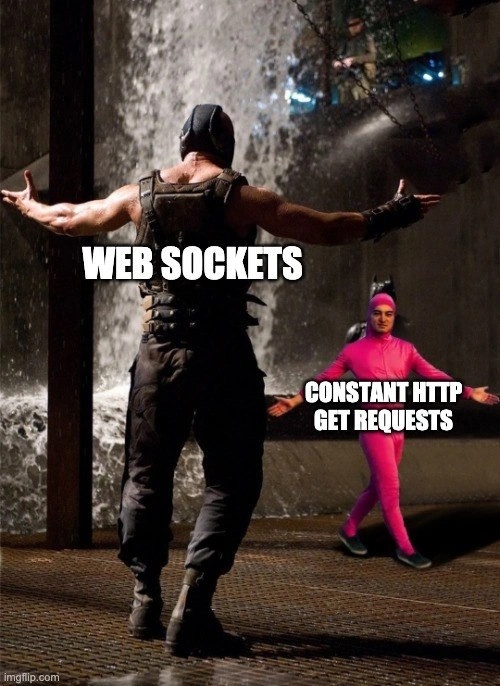
The meme is funny because we all understand it’s much more efficient for the parent to just announce when it’s time, instead of the child asking over and over. The picture with the big guy (WebSockets) and the tiny guy (constant polling) exaggerates this idea. The big guy looks confident and capable – he’s like the parent who’s in control. The tiny guy in pink is jumping around asking repeatedly – that’s the nagging kid energy. Of course the big, calm method is better! Even if you don’t know the technical side, you can laugh at the idea that one approach (WebSockets) completely overshadows the other (endless GET requests) just by how they’re represented. It’s obvious who you’d trust to “win” in a matchup. In simple terms: WebSockets let the server talk to you when there’s something new (smart and efficient), whereas constant GET requests make you ask over and over (silly and tiring). That’s why seeing WebSockets depicted as a huge strong character and constant polling as a scrawny goofball is both humorous and instantly understandable.

Level 2: Stop Hitting Refresh

Let’s break down the joke in simpler web development terms. In one corner, we have WebSockets (the text over Bane, the big muscular character). A WebSocket is a technology that allows a web client (like your browser) and a server to talk to each other continuously over a single open connection. It’s like opening a dedicated hotline phone between the browser and server – once it’s connected, either side can speak up and send data at any time. This is super useful for real_time_communication needs, such as chat apps, live game updates, stock tickers, or notifications, where you want new information to appear instantly without the user doing anything.

In the other corner, we have constant HTTP GET requests (the text on the small person in the pink suit). That phrase describes a simple but less efficient method of getting updates: the client just asks the server for new data over and over again, using the standard HTTP GET method (the same one your browser uses to fetch a webpage or an API data). “Constant GET requests” is basically polling – imagine the browser sending a request like GET /latest-data every few seconds, even if there’s nothing new. It’s called polling because the client is “polling” the server at regular intervals: “Got anything now? … How about now? … And now?” This approach works, but it’s a bit brute-force. It’s like refreshing a page over and over manually – hence “stop hitting refresh!” as a subtitle here, because a newbie might literally keep refreshing or have a script that mimics that.

To visualize the difference, consider some simple pseudocode on the client side:

// 🚫 Polling approach: repeatedly ask the server for updates
function pollServer() {
  fetch('/updates')                // HTTP GET request to an API endpoint
    .then(response => response.json())
    .then(data => updatePage(data));  // update the page with new data, if any
}
setInterval(pollServer, 5000);     // poll every 5 seconds

In the polling code above, setInterval is used to call pollServer every 5 seconds. That means every 5 seconds we send an HTTP GET request to /updates. If there’s new data, great, we update the page. If there isn’t, we basically did a request for nothing and will try again in another 5 seconds. Now imagine 100 users running this code – that’d be 100 requests hitting the server every 5 seconds, even if 90 of those times there’s no new info. That’s a lot of needless traffic! You might hear developers refer to this as “hammering” or spamming the server with requests. It creates load on the NetworkingProtocols (lots of TCP packets, repeated HTTP handshakes or at least header parsing) and can become a performance issue.

Now let’s see the WebSocket approach:

// ✅ WebSocket approach: open a continuous connection for live updates
const socket = new WebSocket('wss://example.com/updates');  // 'wss' is WebSocket Secure, like HTTPS for WebSockets
socket.onmessage = (event) => {
  const data = JSON.parse(event.data);
  updatePage(data);  // update the page whenever the server pushes new data
};
// The connection stays open, and the server will send a message when there's new data available.
// No need for the client to constantly ask anymore.

In this WebSocket code, we do new WebSocket(...) once, and that’s it – a connection is opened and kept alive. We provide an onmessage handler, which is like saying “When the server sends me some data, I’ll run this function to update the page.” Now the client stops asking altogether; it just sits and waits. The server on the other side will send a message over this WebSocket whenever there’s actually something new (for example, when a new chat message comes in, or new data is available). The connection uses a special protocol (ws:// or wss:// for secure) that isn’t HTTP, though it was initiated via an HTTP handshake. Once established, it’s a bit like a tunnel – a continuous connection that both sides can use to send data instantly.

This means with WebSockets, if those same 100 users are connected but nothing new has happened in the last minute, the server has sent 0 extra messages in that time – it doesn’t have to constantly respond “No new data” because the question was never asked! The server is free to chill until there is something to send. In the polling scenario, by contrast, those 100 users would have caused 1200 requests in that minute (100 users * 12 requests/minute if polling every 5 seconds) even when there was nothing to report. You can see why one method (polling) is considered wasteful and the other (WebSockets) is efficient. This directly ties into the meme’s Performance joke: WebSockets handle things in a lean way, whereas constant polling is heavy on networking and server resources. It’s a bit like the difference between scheduling an automatic API call every few seconds (polling) versus having the API notify you via a push message when data changes (WebSocket).

Now about the image itself: It’s referencing a scene from a Batman movie (The Dark Knight Rises). The large muscular character in the center is Bane, a villain known for his overwhelming strength (and dramatic voice). The meme labels Bane as “WEB SOCKETS” to imply WebSockets are strong and dominating. The smaller person in the goofy bright pink bodysuit (not actually from the movie, that’s an edit for humor) is labeled “CONSTANT HTTP GET REQUESTS”. The huge difference in their size and stance is a funny metaphor for how much more powerful and effective WebSockets are compared to constant GET polling. The pink suit adds comic flair – it makes the smaller figure look even more out-of-place and feeble next to Bane. Visually, Bane has his arms out confidently (almost mockingly, as if saying “come at me!”) while the pink guy also has arms out but looks absurd. This reflects the tech scenario: WebSockets can handle real-time updates with confidence and ease, while the approach of continuous GET requests is awkward and hardly a fair fight.

For a newcomer to WebDevelopment, the takeaway is: if you need real-time two-way communication in a web app (for example, instant updates or a live feed), WebSockets are usually the go-to solution because they keep an open line of communication. Constantly firing off HTTP GET requests is an older strategy that’s akin to ringing someone’s doorbell every minute to ask if there’s mail; it works, but it’s not elegant or scalable. In modern web apps, we favor event-driven updates – let the server tell us when there’s something new – and that’s exactly what WebSockets enable. The meme humorously exaggerates this by showing one as a hulking giant and the other as a pint-sized fool. It’s a bit of BackendHumor meeting a pop culture reference: even if you didn’t know all the technical details, you can tell from the image that WebSockets is the big, cool solution and constant polling is a dinky outdated trick. The captions and the image together make a clear point: one of these is much better than the other!

Level 3: Bane of Polling

This meme lands perfectly with experienced web developers because it exaggerates a well-known performance anti-pattern versus a best-practice solution. In the image, the towering Bane from The Dark Knight Rises represents WebSockets – a powerful, modern tool for real-time web communication. Opposite him, the much smaller man in a ridiculous bright pink outfit stands in for constant HTTP GET requests – the naive approach of incessantly polling a server for updates. The size and confidence difference (Bane’s intimidating “come at me bro” pose versus the tiny pink character’s stance) visually screams what every seasoned dev knows: WebSockets utterly overpower constant polling in capability and elegance. It’s a humorous dramatization of how ridiculous it feels to pit these two approaches against each other.

Why is this funny to a developer? Because it’s relatable. Many of us have either written or inherited code that uses setInterval or loops to hit an API endpoint every few seconds asking “any new data? how about now?” – essentially spam-checking the server. It’s a simple solution that works for small scale or low-data scenarios, but it becomes laughably inefficient as requirements grow. The meme resonates as a shared joke: remember the early days of web development, before we had easy real-time channels, when constant polling was our hacky solution for live updates? We’ve all seen the folly of that approach when, say, the server logs fill up with thousands of pointless GET requests, or a database gets hammered by repeated reads returning the same result over and over. It’s the web-dev equivalent of a tiny wannabe sidekick trying to fight a battle way out of their league.

The Dark Knight Rises reference adds an extra layer of geek humor. Bane famously tells Batman, “You merely adopted the dark; I was born in it, molded by it.” In the context of the meme, you can almost hear WebSockets (Bane) telling polling: “You merely adopted real-time updates; I was born for them.” 😈 WebSockets were designed from the ground up for real-time, bi-directional communication. Polling, on the other hand, is just HTTP – a protocol born in a request/response, stateless world – trying awkwardly to act “real-time” by sheer force (or rather, by sheer frequency). That mismatch is inherently comical when personified.

There’s real-world tech history behind this ridicule. Back in the early Web 2.0 days (mid-2000s), if you wanted a live-updating page (say a chat box or live stock prices), you had limited choices: either refresh the whole page periodically, or use AJAX to poll an endpoint repeatedly for new info. Both approaches were clunky. Developers remember writing code like “check every 5 seconds for new messages” and the bad side effects that came with it – high server load, unnecessary latency waiting for the next poll, and complexity in coordinating so many requests. We tried clever tricks like long polling (holding an HTTP request open until the server had new data to send) or Comet techniques to fake server push, but those were workarounds and still not efficient at scale. When WebSockets arrived (around the early 2010s with HTML5), it was a game changer. Suddenly we had a standardized way to maintain an open pipe to the server. Data could flow instantly in both directions. The first time you replace a clattering polling loop with a sleek WebSocket, it feels like freeing Bane from his shackles – massively empowering but a bit scary too (because managing persistent connections was a new challenge for servers used to stateless HTTP).

From an architecture perspective, the meme also jokes about performance optimization and doing things the “right way.” Constant polling is generally considered a bad smell in modern web applications beyond trivial cases. It wastes bandwidth and CPU, and if the polling interval is short, it can DDoS your own server (so to speak) with an army of well-meaning clients. Many a senior engineer has horror stories of an over-polling scenario: perhaps an IoT dashboard that queried a REST API every second from thousands of devices, or a mobile app that didn’t throttle its polling and drained batteries and servers alike. The pink-suited character could be that one naive script hitting the server relentlessly. Meanwhile, WebSockets is the solution those senior engineers eagerly introduce to stop the madness. It’s like bringing Bane into the fight to smash the problem. The relief and satisfaction of replacing 10,000 GETs per minute with a single open socket broadcasting updates is immense. So the meme’s over-the-top depiction speaks to that catharsis – finally, a robust solution stands triumphant.

Finally, there’s an element of BackendHumor here. Front-end devs (or inexperienced devs) might implement constant polling because it’s straightforward with a simple fetch loop. But the poor backend server has to deal with the bombardment of requests. Imagine a database server being hit thousands of times with “give me new data” queries when there might be nothing new 99% of the time. If that backend could talk, it might quip, “Please, have mercy!” 😅. WebSockets shift that model: the server can push data only when there’s something real to send. To a backend engineer, WebSockets can feel like the musclebound hero that steps in to silence the endless nagging of polling. In the meme, Bane’s broad-shouldered confidence is exactly how a backend dev views a solid WebSocket implementation – strong, efficient, and in control – compared to the almost pitiful constant polling tactic. It’s a triumphant moment of performance optimization: the big guy wins, the crowd (developers) cheers.

Level 4: Full Duplex Domination

At the network protocol level, this meme highlights a stark contrast in how data flows. WebSockets create a persistent, stateful channel over TCP that allows full-duplex communication – meaning the server and client can send data to each other simultaneously at any time. Under the hood, a WebSocket connection starts with a single HTTP handshake (the client sends an Upgrade: websocket request and the server responds with a 101 Switching Protocols). After this handshake, the connection is upgraded: both sides switch to the WebSocket protocol, which is a lightweight framing layer on top of TCP. From that point on, there’s no HTTP header overhead for each message, no re-negotiating the connection – just a continuous stream of frames carrying your data back and forth.

In contrast, constant HTTP GET requests for polling rely on the classic HTTP request/response cycle, which is inherently half-duplex and stateless. Each poll is a complete HTTP transaction: the client opens or reuses a connection, sends a GET request with all its headers, and the server sends a response, then the transaction closes (or the connection idles until next use). Even with HTTP keep-alive or HTTP/2 multiplexing, every single poll still incurs the overhead of an HTTP request and response. If you’re polling every few seconds, you’re repeatedly sending all those headers (cookies, auth tokens, etc.) and the server is repeatedly crafting a response – often just to say “no new data” most of the time. At the packet level, that’s a lot of extra bytes flying around and a lot of TCP/IP and TLS handshakes if connections aren’t kept alive. It’s like repeatedly tearing down and setting up a phone call just to say “Any updates? No? Bye.” over and over.

This is where WebSockets tower over polling: a WebSocket connection stays open as a single TCP session. The server can push data as soon as it has something, and the client can send messages upstream too – all without the latency of initiating a new request. The term full-duplex highlights why Bane (WebSocket) is so dominant here: WebSockets let both sides talk freely at the same time, whereas constant GET polling is strictly half-duplex (the client must ask, then the server answers, repeat). WebSockets reduce network overhead dramatically. Instead of 100 clients making 100 GET requests every second (100 separate HTTP exchanges per second), those 100 clients could hold 100 open WebSocket connections that mostly sit silent until there’s actual data. No needless packets saying “still nothing, just checking in.” The difference in efficiency scales hugely: with polling, if you have N clients polling every T seconds, the server must handle ~N/T requests per second continuously, even if nothing is changing. With WebSockets, if nothing changed, the server handles near 0 messages per second (just an occasional TCP keep-alive or WebSocket ping). The only cost is keeping connections open in memory, which modern servers and OSes handle with optimized I/O (using techniques like epoll or async I/O for thousands of sockets).

In essence, WebSockets embrace an event-driven model (server pushes updates when events happen) while polling is a brute-force polling loop on the client side (repeatedly asking “did it happen yet?”). This mirrors a classic computing concept: polling vs interrupts. Constant HTTP GET polling is like a CPU core constantly checking a flag in memory (“Are we there yet? How about now?”) which wastes cycles, whereas WebSockets are like hardware interrupts – the event triggers a notification when it occurs, which is much more efficient. The meme’s imagery of a massive Bane facing a scrawny pink figure captures this low-level truth: in the arena of real-time networking protocols, the WebSocket is a heavyweight champion using refined technique, and plain HTTP GET polling is wildly outmatched, flailing with inefficient overhead.

Description

This meme uses the 'Bane vs. Pink Guy' comparison format. On the left, the imposing, muscular villain Bane from 'The Dark Knight Rises' stands with his arms outstretched, labeled with the text 'WEB SOCKETS'. On the right, the absurd and comical character Pink Guy, in a bright pink bodysuit, walks towards Bane with a similar pose, labeled 'CONSTANT HTTP GET REQUESTS'. The scene is set in a dark, industrial environment, highlighting the dramatic contrast between the two figures. The meme humorously contrasts a powerful, efficient technology (Web Sockets) with a clumsy, inefficient alternative (constant polling with HTTP GET requests). For experienced developers, this is a relatable architectural choice. Web Sockets establish a persistent, bi-directional communication channel, ideal for real-time applications, while constant polling hammers the server with repeated requests, wasting resources. The meme perfectly captures the feeling of a modern, robust solution easily overpowering an older, hackier one
Comments

12
Anonymous ★ Top Pick Constant polling is the technical equivalent of a toddler on a road trip asking 'Are we there yet?' every five seconds. WebSockets is just getting a text when you arrive
  1. Anonymous ★ Top Pick

    Constant polling is the technical equivalent of a toddler on a road trip asking 'Are we there yet?' every five seconds. WebSockets is just getting a text when you arrive

  2. Anonymous

    “You merely adopted the GET; I was born in the 101 Switching Protocols, molded by the Upgrade header.”

  3. Anonymous

    WebSockets are great until you realize your load balancer doesn't speak sticky sessions and now you're debugging why half your users disconnect every time you deploy on a Tuesday

  4. Anonymous

    WebSockets: 'I was born in the persistent connection, molded by it. I didn't see a request-response cycle until I was already a man.' Meanwhile, HTTP polling is over there making 60 requests per second just to check if anything changed, burning through server resources like it's running a cryptocurrency miner. The real tragedy? Some architect somewhere is still defending their polling implementation because 'WebSockets are too complex' while their CloudWatch bill looks like a phone number

  5. Anonymous

    WebSockets to constant GETs: stop DDoSing yourself - do the Upgrade handshake, push events, and quit pretending chat is idempotent

  6. Anonymous

    Swapped constant GETs for WebSockets - bandwidth dropped; now our sprint is ALB idle timeouts, sticky sessions, and a corporate proxy that kills “real-time” at 59 seconds

  7. Anonymous

    WebSockets: Finally ditching the polling death spiral where your app DDoSes itself into scalability oblivion

  8. @sssty1ish 5y

    Server-Sent Events

  9. Deleted Account 5y

    Http long polling

  10. Deleted Account 5y

    201 Connection: tcp

  11. @pixelsex 5y

    418 bitch, I'm a teapot

  12. @yehorror 5y

    With keep-alive

Use J and K for navigation