VPN Usage Across Borders: Russians and Brits Swapping Digital Identities
Why is this Security meme funny?
Level 1: Costume Party Confusion
Imagine you throw a small neighborhood ice cream party. You expect only the kids from your block to show up, so you bring enough ice cream for them and even put up a sign that says “Local Neighborhood Only.” But word gets out on social media about your awesome ice cream. Suddenly kids from all over the city start arriving wearing fake badges that say they live on your block. They’re actually from far away, but they found a trick to look like locals. Your backyard fills up way more than you expected, and you scratch your head thinking, “Do I really have that many neighbors?!”
This meme is just like that: the VPN server in Afghanistan was like the “locals only” party spot, and people from other countries put on an Afghanistan mask (the VPN) to get in. The result? A hilarious surprise for the party host (the engineers) when they see so many "Afghan locals" overwhelming the place, even though most of them are actually visitors in disguise. It’s funny because the people running the party made a wrong guess about who would come, and the sneaky visitors totally upended those expectations – all thanks to a clever costume change on the internet.
Level 2: VPN Teleportation
Now let's break down what's happening in simpler technical terms. A VPN (Virtual Private Network) is like an encrypted tunnel through the internet that makes your connection appear to come from a different place. Think of it as teleporting your internet presence: you might be sitting in London or Moscow, but if you connect to a VPN server in Kabul, websites and observers will believe you’re in Kabul. The VPN server in Kabul is called an exit node – it's the point where your encrypted VPN traffic exits into the regular internet. From that point on, the server’s Afghan IP address is used for your requests. So any system looking at IP-to-country info will conclude "user = Afghanistan."
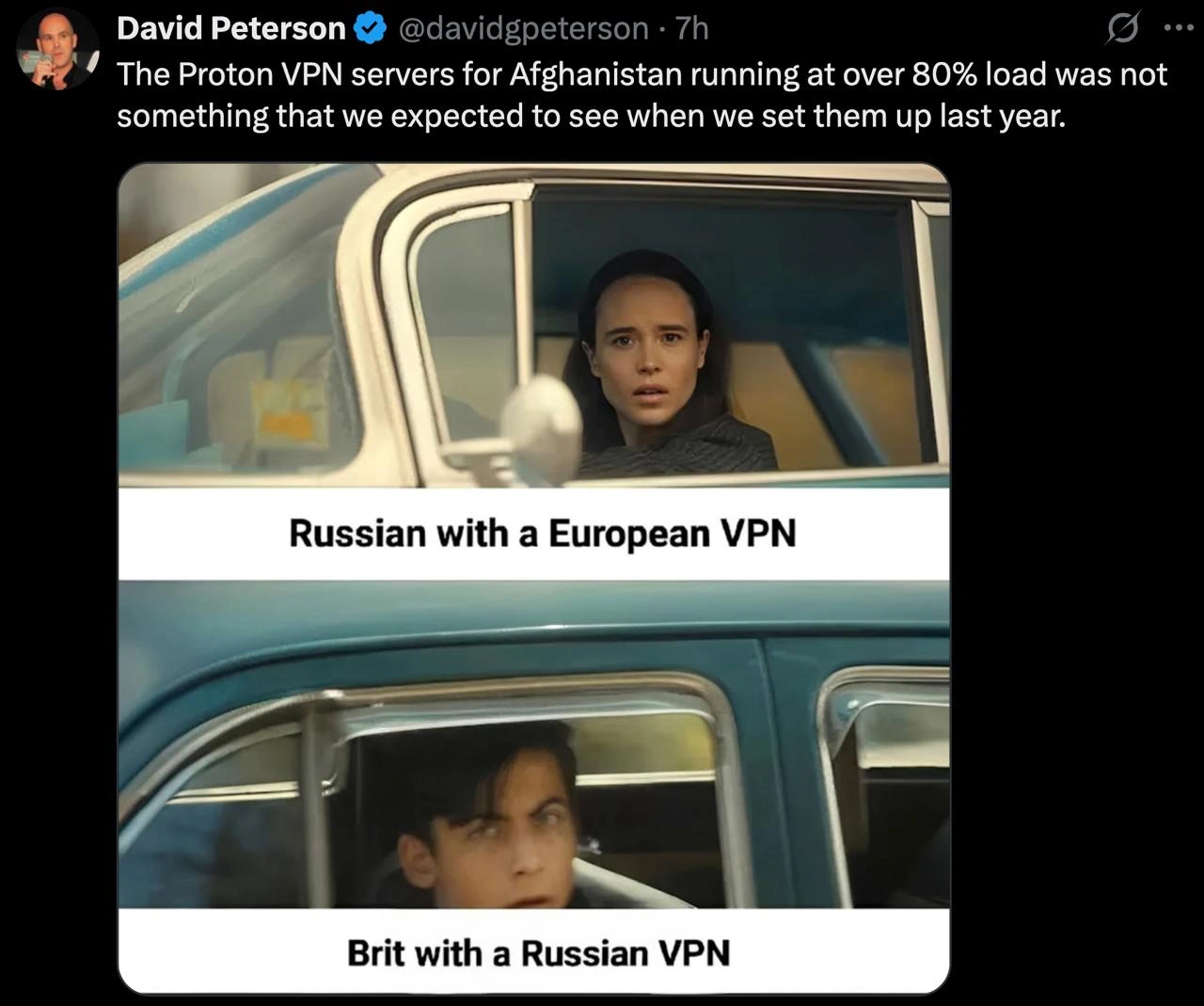
In the meme’s scenario, ProtonVPN set up an Afghanistan server location (POP) last year, probably expecting only a handful of local users or maybe travelers to use it. Fast forward, and suddenly that server is handling 80% of its maximum load – quite unexpected! Why? Because people from other countries are choosing Afghanistan as their VPN exit. For example, a person in Russia can open their VPN app and click on a server in Europe. Instantly, all their browsing goes through a European country – so to the outside world, that Russian user now looks European online. Similarly, someone in Britain can select a VPN server in Russia, making them appear to be browsing from Russia. They might do this to access region-locked content (like a Russian video site that is not available in the UK) or just to add an extra layer of obscurity. This swapping is exactly what's captioned: “Russian with a European VPN” (a Russian user virtually driving in Europe) and “Brit with a Russian VPN” (a British user virtually cruising through Russia). Their internet traffic paths are crossing like two cars going in opposite directions – each one appearing in the other’s origin country.
Now, how does this confuse observability and monitoring? Well, companies like ProtonVPN watch their servers' usage and often break it down by region. They might have a dashboard showing how much traffic each country’s servers are handling. If you see “Afghanistan: 80% capacity” on a graph, you’d normally assume, “Wow, lots of people in Afghanistan are using our service today!” But because of VPN teleportation, that number could mostly be foreigners’ traffic. The country code ‘AF’ in logs or metrics here really means “traffic exiting from the Afghan server,” not necessarily “traffic from Afghan users.” It’s a bit of a gotcha for anyone new to cloud networking or monitoring: you can’t blindly trust an IP’s reported location to tell you where the user actually is. In security terms, if a login attempt to your service comes from an Afghan IP, it could literally be anyone in the world using a VPN.
Let’s define a few terms:
- VPN exit node: The server that your connection comes out of when using a VPN. It gives you a new IP address. In this case, the exit node is in Afghanistan, so it provides an Afghan IP.
- GeoIP/Geolocation: A technology that maps IP addresses to geographic locations (country, city). It’s what turns an IP like
203.x.x.xinto “Afghanistan” on a dashboard. It’s useful but not foolproof, as we see here. - POP (Point of Presence): A physical or cloud data center location where a service provider has servers. ProtonVPN’s Afghanistan POP means they have infrastructure (servers) that provide VPN endpoints in Afghanistan.
- Capacity/Load (in networking): How much traffic or usage a server or link is handling, often as a percentage of its maximum. 80% load means it’s getting close to being maxed out.
So, putting it together in this story: ProtonVPN’s Afghanistan servers were at 80% load because a lot of people (likely from various countries) decided to use those servers as their internet jumping-off point. It’s like everyone discovered a shortcut through Kabul for their internet traffic. The engineers didn’t expect that behavior, so they were a bit surprised (hence the tweet and the humor around it). If you’re a junior developer or just getting into network security, the big lesson is that things like user location aren’t always what they appear. VPNs let users pretend to be somewhere else with just a click, and any monitoring system has to take that into account. In short, country != actual user location when VPNs are in play.
Level 3: Dashboard Deception
At a senior engineering level, the humor (and horror) of this meme sets in: it’s poking fun at how our dashboards and metrics can lead us astray when we rely on something like country codes in logs. ProtonVPN’s team saw their Afghanistan servers at 80% capacity, an alarming spike for a location they expected to be low-traffic. Seasoned ops folks know that feeling: it’s that "what on earth happened overnight?" moment when a quiet corner of your infrastructure suddenly lights up. The two images of shocked drivers passing each other – a Russian with a European VPN and a Brit with a Russian VPN – perfectly visualizes the WTF moment: users from Country A are exiting from Country B, and vice versa, zooming past each other on the information highway with astonished faces.
Why is this funny to those of us in infrastructure and observability? Because we've all made assumptions that seemed safe until users proved us utterly wrong. Here, the implicit assumption was "traffic labeled as Afghanistan in our monitoring is coming from Afghan users." Ha! In reality, it was likely users from places like Russia, Europe, or elsewhere cleverly circumventing restrictions or geoblocks. For example, a Russian internet user might use a European VPN endpoint to dodge domestic censorship or sanctions, effectively pretending to be European online. Conversely, a British user might connect through a Russian VPN server to access content that's region-locked to Russia (or perhaps just for the ironic novelty of it). They "pass in the night," each borrowing the other's region. The two_cars_passing_meme template nails this irony – each driver’s bewildered expression mirrors the engineers’ surprise seeing those inverted usage patterns.
This leads to some juicy real-world lessons in observability_and_monitoring: a spike in “Afghanistan” traffic on your graph doesn’t necessarily mean a surge of Afghan customers. It could mean your service became the newest tool for savvy users routing around internet roadblocks. Security analytics teams likewise learn not to take IP geolocation at face value – a login from Kabul might not raise an eyebrow if you realize that user often VPNs through Kabul. In capacity planning meetings, someone probably had to explain, "No, we didn't suddenly get popular in Kabul; our afghanistan_pop_overload is due to foreign users piling onto that server." It’s an geo_routing_irony that the one region you thought was over-provisioned (“who’s ever going to max out Afghanistan?”) became the surprise hot spot.
Infrastructure engineers also chuckle because it highlights a kind of internet whack-a-mole: if you block or heavily monitor the obvious VPN endpoints (say, in Europe or North America), users will find an unassuming exit node in an unexpected region to tunnel through. It's a game of sanctions_circumvention and cat-and-mouse. ProtonVPN’s Afghan servers likely offered a loophole for users in heavily regulated networks – a less scrutinized egress where traffic could flow freely under the radar. As a result, what was intended as a helpful local service turned into an inadvertent hub for outsiders. The meme is essentially a DevOps inside joke: monitoring only shows you what it can see (IPs and loads), and sometimes that view is hilariously misleading.
“We put one little server in Kabul thinking no one would notice. The Internet: Challenge Accepted.” 😅
Level 4: Exit Node Mirage
At the most technical layer, this meme highlights a counter-intuitive truth of networking and security: an IP address's apparent country is often a mirage. When you use a VPN (Virtual Private Network), your data is encapsulated and encrypted, then sent through a tunnel to an exit node. This exit node is the server that actually makes requests on your behalf to the internet, and it could be anywhere in the world. From the outside, all your traffic appears to originate from that server’s IP address. The underlying protocols (like IP itself) have no built-in concept of "what country a packet is really from" – they only know source and destination addresses. So we're forced to use external GeoIP databases (like MaxMind or IP2Location) that map IP ranges to countries, and those can be trivially fooled when users intentionally route traffic through distant points-of-presence.
In fact, what ProtonVPN (a privacy-focused VPN provider) experienced is a real-world demonstration of network topology meets human ingenuity. They set up a VPN endpoint in Afghanistan – let’s call it an Afghanistan POP (Point of Presence) – probably to serve any users in or near that region with better speeds. However, thanks to the flexibility of internet routing, users from completely different regions started channeling their traffic through this Afghan exit node. Technically, it's like creating a crafted path through the internet: packets leave the user's device encrypted, travel across perhaps thousands of miles, and emerge in Kabul as if that were their origin.
This can happen even in chains, where a user might hop through multiple VPN servers (or use multi-hop features) – for example, a Russian user could first connect to a Swiss "secure core", then exit via Afghanistan – achieving a double-hop that further obscures origin. Each hop decrypts one layer (à la onion routing in Tor), but at the final hop the traffic is plain and tagged with that server’s IP. The result is a network security protocol triumph (strong encryption keeping the original source hidden) but an observability nightmare: all logs and metrics see "Afghanistan" as the source. The infrastructure doesn't lie – those bytes really are flowing out of Afghan servers – but the assumption that IP country = user location fails dramatically.
From a theoretical standpoint, this is a perfect example of how the internet’s design prioritizes abstraction over physical reality. The network layer (Layer 3 in the OSI model) cares about reachable addresses, not passport stamps. BGP routing will happily send a Russian’s packets on a scenic tour to Afghanistan if that’s the chosen route. And because the VPN traffic is encrypted (often via protocols like OpenVPN or WireGuard), intermediate networks can’t inspect or alter the contents – they only see an encrypted blob heading to that Afghan server. Once there, the server decapsulates it and forwards it onward. In essence, a VPN exit node creates a NAT effect for potentially thousands of users: they all share the exit node’s IP address and country tag externally. This undermines naive geographic assumptions in monitoring systems. The mirage is complete when your observability tools dutifully report a surge of traffic from Afghanistan – mathematically correct in terms of source IP counts, yet completely misleading in terms of actual user geography.
Description
A tweet by David Peterson (@davidgpeterson) stating 'The Proton VPN servers for Afghanistan running at over 80% load was not something that we expected to see when we set them up last year.' Below is a two-panel meme using scenes from what appears to be a movie, showing a nervous woman in a car labeled 'Russian with a European VPN' and a suspicious-looking man in a car labeled 'Brit with a Russian VPN'. The meme humorously contrasts people from different countries using VPNs to appear as if they're in each other's regions, highlighting the irony of internet censorship circumvention going both ways
Comments
14Comment deleted
In the OSI model of geopolitics, VPNs operate at Layer 8: the political layer, where the routing table is determined by which government is blocking what this week
Using a VPN from a high-surveillance country is a firewall. Using a VPN from a low-surveillance country is usually just a NAT gateway for your torrent client
Nothing like Grafana paging you at 3 a.m. for “AF-east bandwidth saturation” only to discover it’s just Londoners tunneling through Moscow because Netflix thinks that’s the fastest hop
Nothing quite like provisioning servers for 'normal' traffic patterns, only to discover your capacity planning spreadsheet didn't have a 'geopolitical crisis' column in the load forecasting model
Ah yes, the classic capacity planning scenario: 'We provisioned for expected load plus 20% headroom.' Meanwhile, geopolitical events are in the corner laughing at your Gaussian distribution assumptions. Nothing says 'we didn't read the NIST guidelines on threat modeling' quite like discovering your Afghanistan VPN endpoints are the new CDN for an entire region's internet freedom. At least now you have a great postmortem template: 'Incident: Underestimated the demand elasticity coefficient of authoritarian regime implementation.' Next sprint's story: 'As a SRE, I want to add a geopolitical risk factor to our autoscaling policies, so that we don't get paged when governments decide to restrict internet access.'
SRE lesson: treat every VPN region as a multi-tenant CDN for geopolitics - your “low-traffic” Afghanistan exit node hits 80% the moment GeoIP meets reality
We provisioned Afghanistan as an “edge case”; the internet made it the default route - turns out capacity planning is just adversarial modeling of humans
Deployed ProtonVPN to Kabul for neutral peering - now our Nagios alerts come with Pashto profanity and demands for sudo access
what is reason for a brit to use russian vpn? Comment deleted
To not provide his ID for age verification, mandated by Online Safety Act(or something like that), which is quite literally 1984 Comment deleted
I suppose it is useless for Instagram, but if a Brit wants to use reddit, I think Russian VPN will do fine Comment deleted
Now, next player in creating the most dystopian internet is EU with his chat control Comment deleted
stupid idea because the other end of conversation can be not even from eu Comment deleted
it's just a sneaky way to collect data to train their AI Comment deleted