Marines Defeat AI Surveillance Camera Using Metal Gear Solid Tactics
Why is this AI ML meme funny?
Level 1: Hiding in Plain Sight
Imagine you have a super high-tech security camera that can normally spot people from far away, but it only really knows how to recognize people when they’re walking around upright like usual. Now picture some soldiers who want to trick this camera. What do they do? They start acting very differently than a normal person.
One guy covers himself in a bunch of leaves and branches until he looks just like a bush in the field. Another two hide under a big cardboard box and inch forward little by little, so to the camera they just look like a box moving (which by itself doesn’t seem important to the machine). And the funniest part: two more soldiers roll on the ground doing somersaults for 300 meters straight! Can you imagine someone rolling like a log all the way across a field? It looked silly, but it was effective. The AI camera was basically saying, “I’m scanning... I see no humans here,” because it didn’t recognize those rolling, crawling, and disguising figures as people.
It’s like a game of hide-and-seek, but the seeker is a robot that only looks for certain obvious things. The soldiers found a way to hide in plain sight by simply not behaving like the people the camera was taught to look for. The high-tech camera was easily fooled by these silly tricks – it never realized the bush was actually a person, or that there were people inside that “box,” or that the rolling shapes were humans approaching. In the end, the fancy camera totally missed the humans right under its nose, all because those Marines got creative and played dress-up and pretend. It’s funny, but it also shows that sometimes being unpredictable and sneaky can beat even a smart machine. The big, expensive security AI was outsmarted by a cardboard box, a fake bush, and a couple of guys doing somersaults – a real-life cartoon caper that actually worked!
Level 2: AI Hide-and-Seek
Let’s break this scenario down in simpler terms. An AI-powered camera means a security camera that has a smart program (an algorithm) trying to automatically spot people. It’s using computer vision to detect humans so that no guard is needed to watch the feed 24/7. Think of it as a camera with a built-in brain: it looks at the video and says “I see a person here” or “no people in this frame.” The program doing this is a kind of object detection model – basically software trained on lots of images of people (and other objects) so it can recognize them in new pictures or video.
What the Marines did was exploit a big weakness in that system. In AI terms, they performed an adversarial attack, which is a fancy way to say they tricked the AI by showing it something it wasn’t prepared to handle. And they did it not by hacking any code, but in the real, physical world. This is called a physical adversarial example: instead of adding digital noise to an image, the “noise” here was the Marines behaving in very unexpected ways. The result? The AI didn’t even realize humans were right in front of it! The gap they exposed is often called a model robustness problem – the AI wasn’t robust (or adaptable) enough to handle these odd scenarios outside its training.
Here’s how each of the Marines’ tricks fooled the camera’s computer_vision_fail in plain language:
Somersault approach: Two Marines somersaulted (rolled head-over-heels) for 300 meters towards the camera. A normal person walks or runs upright, but these guys were literally rolling on the ground. The AI’s person detector probably looks for an upright torso and legs. Seeing a tumbling, low-to-the-ground shape, the system might have thought, “Hmm, maybe that’s an animal or just random motion – not a person.” So it never flagged them as humans. It’s as if the sensor saw a chaotic blob moving, and had no idea it was actually two people doing cartwheels.
Cardboard box disguise: Another pair of Marines hid under a cardboard box and shuffled slowly. To the AI camera, this likely just looked like a plain old cardboard_box moving a bit. If the model wasn’t explicitly trained to say “a moving box could have a human inside,” it would just register “object: box” and nothing more. A human-shaped heat signature or outline was absent, so the algorithm stayed silent. This is literally the “guy hiding in a cardboard box” trick from video games, and amazingly, it worked on a real AI. The camera didn’t detect any person – just a box, which of course isn’t an alert-worthy object.
Bush costume evasion: The last Marine covered himself in bushes/leaves (essentially a bush_costume_evasion tactic, similar to a ghillie suit snipers use). He crawled or crouched, looking like a little moving bush. The AI saw the textures of leaves and the irregular shape of a shrub. Since it probably only learned what human figures look like (and not that a human could be hiding under foliage), it treated him as just part of the background vegetation. To the computer, nothing here resembled a person – just greenery. So, once again, no alarm from the “smart” camera.
In each case, the Marines made sure they didn’t look or move like a normal person from the AI’s perspective. The AI wasn’t programmed to be suspicious of a box or to recognize a forward-rolling man as a human. It lacked the common sense a human guard would have. This highlights the model_robustness_gap: the system was designed for typical situations, and it had a blind spot for these oddball tactics. The story is a funny example of AIHypeVsReality – we imagine these high-tech cameras as all-seeing, but they can fail in almost cartoonish ways if you know how to play hide-and-seek with them.
To put it plainly, the Marines outsmarted the AI by giving it a situation it couldn’t comprehend. The high-level term is a “physical adversarial attack,” but you can just think of it as a clever prank on the camera’s brain. The automation saw no intruders, while five intruders literally danced (or rolled) right past it. Here’s a bit of pseudo-code to illustrate what happened:
# Simplified pseudo-code for the AI security camera
for frame in camera_stream:
if model.detect("person", frame):
send_alert("Human intruder detected")
else:
# Marines fooled the model into thinking "no person here"
continue
# ... none of the frames triggered an alert because no "person" was detected!
The camera was dutifully scanning every frame of video for a person. Normally, as soon as a person appears, model.detect("person", frame) would return true and an alert would be sent. But because the Marines never looked like a normal person to the AI, that condition never triggered. The AI never raised an alarm, effectively saying “All clear!” even as the soldiers snuck in.
This whole scenario shows how HumanVsAI creativity can find holes in what humans build. It’s a security lesson: if you rely entirely on automation, people might discover wacky ways to beat it. For a junior developer or anyone new to AI, it’s a reminder that algorithms can be very literal. They only know the patterns we teach them. Give them something off-script (like a man-in-a-box or a somersaulting soldier), and they might get totally confused. It’s both funny and a bit humbling – even our advanced gadgets can be defeated by a bit of imagination and low-tech trickery. In the end, the Marines basically played a game of AI hide-and-seek and won. The big takeaway: those shiny AI models you read about are powerful, but they have quirks and blind spots, so AutomationGoneWrong moments like this keep us engineers on our toes (and laughing a little, too).
Level 3: Kojima Was Right
To seasoned engineers, this story is equal parts hilarious and unsurprising. It perfectly encapsulates AIHypeVsReality: the hype says an AI powered security camera is an infallible guard, but the reality is a bunch of Marines in goofy disguises waltzing (or rather, rolling) right past it. Imagine being the developer who boasted about 99% detection accuracy, only to watch two guys somersault their way through the “secure” perimeter – that’s a facepalm moment if there ever was one. If you’ve ever shipped a computer vision system to production, you’re probably nodding along: real-world users (or adversaries) always find those weird edge cases you never anticipated. In this case, the “users” were a squad of cheeky Marines, and boy did they ever do some QA testing on that AI. It’s like a quality assurance team from a comedy sketch: “We tried normal walking – it caught us. So then we tried cartwheels, hiding in a box, and dressing as shrubbery – and we utterly broke it!” This takes the classic developer refrain AutomationGoneWrong to a whole new level.
For gamers, the scenario has an extra layer of delight. Each Marine basically went full Metal Gear Solid on that poor AI. Hideo Kojima (the creator of Metal Gear) was spot on with those absurd stealth tactics – turns out a cardboard box strategy and bush camouflage can defeat not just hapless video game guards but also real $10,000 AI surveillance cameras. Kojima was right: sometimes the oldest tricks (and silliest – a moving cardboard box, really? 😄) are the best. It’s as if the Marines read the game’s playbook: one squadmate literally pretended to be a walking cardboard box, another literally became “a bush” using foliage, and the rest somersaulted like characters trying to glitch through a level. This isn’t just a meme; it’s practically a lost mission from a Metal Gear game. The phrase from the post – “each of them is Snake in their own way” – says it all. Five real-life Solid Snakes executing a mission against a vision model that never saw it coming. They speedran that AI. In speedrunning terms, they found an exploit in the guard AI’s code and skipped straight to the objective undetected, with style points to spare.
Basically, the marines abused exactly the kind of flaw that experienced developers know always lurks somewhere: the system’s assumptions. The AI was likely programmed with an assumption like “humans look like upright people with two legs, moving on foot.” The Marines said “roger that” and then proceeded to not fit that description at all. It’s the classic HumanVsAI showdown, and in this round the humans found the cheat codes. To illustrate how a human guard’s perception differs from the AI’s, consider:
| Marine’s Trick | Human Guard Reaction | AI Camera’s Reaction |
|---|---|---|
| Somersault 300m across open ground | Sees a person, albeit one doing bizarre flips – definitely an intruder (the guard would be baffled, but not blind to it) | Sees an odd, rapidly tumbling shape; not recognized as a person at all (no upright silhouette, so effectively invisible) |
| Cardboard box disguise | Notices a box creeping forward and thinks “Um, why is that box moving?!” – a huge red flag that someone’s hiding | Recognizes just a box shape and nothing more; no human detected (the AI doesn’t have a concept of “someone hiding under an object”) |
| Bush costume evasion | Gets suspicious of a bush casually crawling closer – a human would likely investigate a shrub that’s on the move | Assumes it’s just foliage in the scenery; the camera’s algorithm sees a clump of bushes, not a person (camouflage successful!) |
A human guard might laugh at the audacity but would ultimately raise an alarm (“HQ, we’ve got, uh, a guy dressed as a bush out here…”). The AI guard, by contrast, remains blissfully ignorant. Why did the AI fail so utterly? Partly by design: vision models are tuned to avoid false alarms. This highlights a SecurityTradeoffs issue. If the AI were too sensitive, it might flag everything – every blowing leaf or stray cat – as a person, leading to constant false alarms. So, to keep the system usable, the designers likely dialed back the sensitivity for anything that didn’t quite look human. The unintended consequence: a person doing a combat roll or hiding under a box didn’t trip the alarm because the system literally didn’t consider them human at all. The marines slipped right through this loophole.
For veteran developers, this is a chuckle-worthy case study in why AIHype needs a reality check and why robust testing is crucial. It’s the kind of thing we joke about in hindsight: “Did anyone feed the model some data of soldiers somersaulting for 300 meters? No? Oops.” It calls to mind all those times users find a way to break our software the moment it goes live. In infosec and QA circles, we’re taught to think like an attacker or a mischievous user – clearly some military red-teamers took that to heart and thought way outside the box (literally, outside and inside the box). The result was a legendary demonstration of AutomationGoneWrong: cutting-edge tech undone by 19th-century carnival tricks. It’s also a reminder that AISafetyResearch isn’t just about preventing hacking in the digital sense; it’s about anticipating wacky real-world exploits. We spend so much effort training models on huge datasets, but the real world will always produce something we didn’t include – like “guy somersaulting in front of camera” or “soldier-shaped cardboard box.”
Ultimately, this meme is a funny cautionary tale. The next time someone claims their AI security system is foolproof, an experienced engineer might quip: “Sure, but have you tested it against acrobatic Marines and their cardboard box cosplay?” – because if not, well, there’s your blind spot. The lesson: Never underestimate human creativity. No matter how advanced our automation gets, there will always be that ingenious person who finds a way to confound it with a banana peel, a fake mustache, or in this case, a forward-roll marathon. And those of us in tech will both laugh and nod, because we’ve seen enough to know nothing is truly foolproof in the hands of determined users.
Level 4: Camouflage vs Convolution
In machine learning terms, this scenario is a perfect demonstration of a physical adversarial attack on a computer vision system. Usually when we talk about adversarial attacks, we imagine adding tiny, almost invisible perturbations to images to fool a classifier. Here it’s much more theatrical: the marines performed a physical adversarial example – meaning they manipulated their physical behavior and appearance to exploit blind spots in the AI’s vision. It was likely a convolutional neural network (CNN) (imagine something like YOLO or another modern object-detector) tasked with spotting humans. But like all learned models, it had a limited notion of what "a person" looks like. By doing bizarre things (somersaulting, hiding in a box, camouflaging as a bush), the marines fed the model images that sat way outside its training distribution. In other words, they discovered inputs that the model didn’t recognize as humans at all – so no alarm was raised.
Deep neural networks, especially vision models, identify humans based on patterns they’ve seen: an upright body, two legs, typical walking gait, maybe thermal or motion cues of a person. When two soldiers somersaulted for 300m, their constantly flipping outline and unusual motion likely never matched the model’s internal features for a human. Those contortions and odd postures put the input in a region of the model’s high-dimensional feature space that wasn’t labeled “person.” Similarly, a pair of marines pretending to be a cardboard box created an object shape with straight edges and square form – something a person detector isn’t trained to flag as human (it might just register as a generic unknown object). And the one who disguised as a bush effectively merged with the background foliage in the AI’s eyes; the algorithm might have seen the textured greenery and not a human silhouette at all. Essentially, each marine found a way to move or look that was orthogonal to the model’s concept of a person, sneaking through the AI’s perceptual blind spots.
This highlights a core issue in AI/ML robustness: the gap between impressive lab performance and the chaotic open-world. In academic settings, we measure accuracy on test data drawn from the same distribution as the training data. But throw in out-of-distribution inputs – like these absurd but effective tactics – and all bets are off. The AI system likely had near 99% detection accuracy for normal adult humans walking upright in clear view. Yet its model robustness wasn’t enough to handle creative adversaries. This is a known problem: researchers have shown how adding a few stickers to a stop sign can make an AI misread it, or how wearing specially patterned clothes can make you “invisible” to person detectors. Those are deliberate digital or physical adversarial examples crafted to target the model’s weaknesses. What the marines did here is a more improvised but no less valid attack on the model’s perception. They leveraged the fact that deep learning models often latch onto specific cues (like shape, orientation, context) rather than truly understanding “this is a human being.” Unlike a human guard, the AI doesn’t have common sense or broad context – it can’t infer that “a moving box is suspicious” if its training never taught it that humans might hide in boxes.
Academically, this is both hilarious and enlightening. It exposes how the decision boundaries in the neural network – the dividing lines in feature space between “person” and “background” – can be exploited. The marines basically found a path through the model’s input space that kept them on the “non-person” side of those boundaries at all times. It’s a reminder of ongoing research in AISafetyResearch: how do we make models that are robust to adversarial tactics and weird corner cases? There’s work on adversarial training (training the model on many distorted or uncommon examples) and on architectures that incorporate physical reasoning, but it’s a hard problem. Real-world Security scenarios especially have to consider adaptive adversaries – people who won’t just stand still and obediently act like the data the AI saw in training. In summary, this meme’s scenario may read like slapstick comedy, but it illustrates a deep truth in AI: high-dimensional pattern recognizers can be amazingly brittle, and human creativity can still outsmart automation in the most AdversarialAttacks-proof way possible – by exploiting the assumptions the machine never even knew it had.
Description
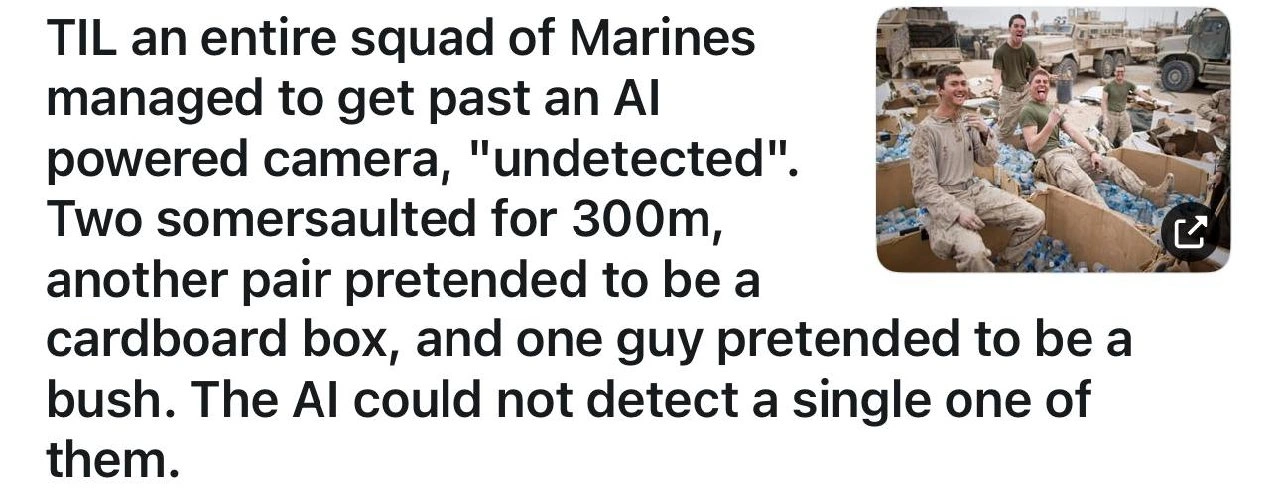
A text post with a small photo of laughing Marines. The text reads: 'TIL an entire squad of Marines managed to get past an AI powered camera, "undetected". Two somersaulted for 300m, another pair pretended to be a cardboard box, and one guy pretended to be a bush. The AI could not detect a single one of them.' The photo shows soldiers laughing among supplies and cardboard boxes. This references a real DARPA/Pentagon experiment where Marines successfully evaded AI object detection by using absurd stealth tactics inspired by the video game Metal Gear Solid, exposing fundamental weaknesses in computer vision systems
Comments
12Comment deleted
Turns out the most advanced adversarial attack against neural networks isn't carefully crafted noise patterns - it's a Marine doing somersaults in a cardboard box, achieving a 100% evasion rate against the model's training distribution
The AI's training data clearly lacked a 'Metal Gear Solid' stealth mission dataset. The model probably classified the cardboard box as 'static environment asset' with 99% confidence right before it got bypassed
Turns out the real production metric isn’t mAP - it's mean average performance against Marines doing solid Snake cosplay in the desert
Turns out the real adversarial example was the cardboard boxes we deployed along the way. Someone should tell the ML team that their $10M model just lost to the same tactics that worked in Metal Gear Solid on PlayStation 1
Turns out the Marines discovered what every ML engineer fears: their production model's precision-recall curve was optimized for 'normal human walking patterns' and completely failed on the long tail distribution of 'tactical somersaults' and 'sentient cardboard boxes.' Classic case of overfitting to the training set - the model had never seen a Marine who'd played Metal Gear Solid. Sometimes the best adversarial attack isn't a carefully crafted gradient perturbation; it's just doing something so absurd your model's prior probability assigns it zero likelihood
We spent six months tuning YOLO; they spent $6 on a hardware‑store box. That’s the delta between SOTA mAP and an actual threat model
Your detector bragged 99.7% mAP on COCO - then got owned by Dark Souls roll spam and a Metal Gear cardboard box; you optimized the metric, not the threat model
Billion-param detector aces COCO benchmarks, ghosts on a $5 cardboard box - classic prod-vs-dataset gap
genius kojumbo strikes again Comment deleted
cardboard box disguise? Comment deleted
Oh. Just a box Comment deleted
every time I see this story resurface, I can't hold back my smile Comment deleted