Skip to content
DevMeme
2737 of 7435
Visual Basic Finally Supports Hardware
LegacySystems Post #3025, on Apr 29, 2021 in TG

Visual Basic Finally Supports Hardware

Why is this LegacySystems meme funny?

Level 1: The Old Book Helps

Imagine having an old schoolbook you no longer study from, but it is thick and sturdy, so you use it to hold up your table. That is the joke here. The Visual Basic book used to be useful for learning programming, but in the photo its new job is much simpler: it keeps the laptop propped up.

Level 2: Legacy Book Stand

Visual Basic is a programming language and development environment historically associated with Microsoft Windows applications. It became popular because it let developers build graphical desktop tools quickly. Instead of writing every window and button by hand, developers could place interface elements visually and attach code to user actions like clicks.

Visual Basic 2008 refers to a specific era of Microsoft's development tooling, around Visual Studio 2008 and the .NET ecosystem. A book with that title would have taught developers how to write applications using the language and tools of that time. In the photo, the book's job has changed: it is holding up a laptop.

The joke depends on a few visible details:

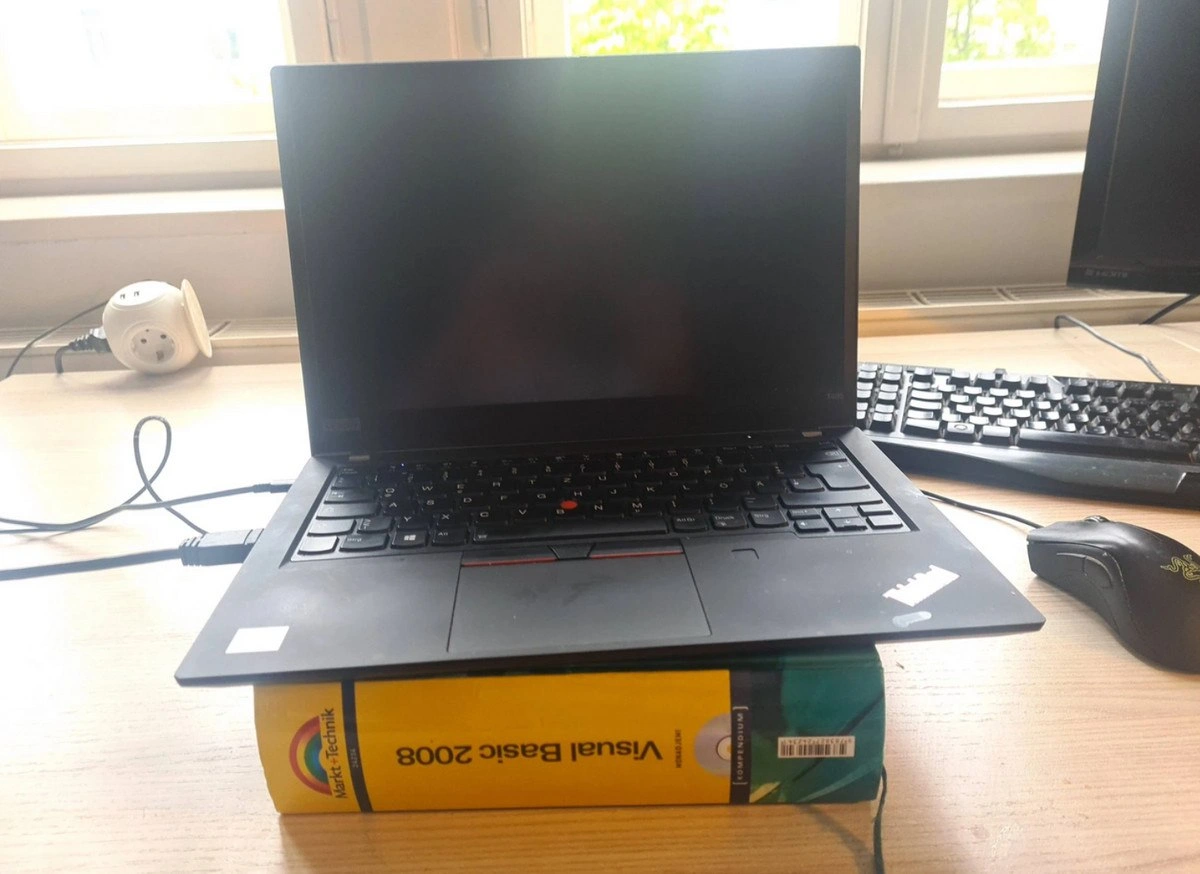
  • The laptop is physically resting on the book.
  • The title Visual Basic 2008 is clear enough to identify the book.
  • The book is upside down, making it look even less like an actively used reference.
  • The desk setup is ordinary, so the workaround feels authentic rather than decorative.

Legacy systems are older technologies that still exist in real organizations. They may be hard to replace because they encode business rules, integrate with old databases, or simply keep working. Developers often joke about legacy tools, but many of those tools created software that survived longer than the teams that wanted to rewrite it.

For someone early in their career, the lesson is that old technical books do not vanish when the industry moves on. They migrate from bookshelf to storage box to monitor riser. The humor is affectionate and slightly savage: this book once helped people build software; now it helps a laptop sit higher.

Level 3: Raising the Platform

The image has no overlay text, which makes the joke drier: a black ThinkPad sits on a thick yellow-and-green book whose upside-down title reads Visual Basic 2008. The book is not open, referenced, or revered. It is performing the most concrete possible support role: lifting hardware a few centimeters off the desk.

That is the whole punchline. A programming manual for Visual Basic, once sold as a serious path into Windows application development, has become ergonomic infrastructure. The post message calls it "The real-life use case for Visual Basic literature," and the photo delivers that literally. Visual Basic is supporting a developer's work, just not by providing language guidance.

The historical bite is that Visual Basic was not always a punchline. In the 1990s and 2000s, it was a major on-ramp for building desktop business software on Windows. It made GUI programming approachable: drag a button onto a form, double-click it, write event-handler code, ship an internal app that accounting will depend on for the next fifteen years. Many companies accumulated serious operational systems this way. Those systems were not glamorous, but they solved real problems with very little ceremony.

The meme works because the industry has a bad habit of treating yesterday's productive tools as today's fossils. Legacy tech often means "software that still runs a business but embarrasses the architecture diagram." A Visual Basic 2008 book under a laptop captures that shift in status with brutal efficiency: from teaching application logic to acting as a stack of wood.

There is also a nice hardware-software inversion here. "Platform" usually means the runtime, framework, operating system, or cloud layer where software executes. In the photo, the platform is an actual physical platform. The book is no longer part of the developer workflow as documentation; it is part of the desk setup. The old language still improves developer experience, but through posture, airflow, and monitor height. Progress, apparently.

The surrounding desk reinforces the realism: external keyboard, mouse, cables, bright window, and a ThinkPad that looks like it belongs to someone who has solved production problems with whatever was available. This is not a staged museum shot. It is the kind of practical workaround developers use all the time, and that makes the legacy-language joke land harder. The book may be obsolete as a learning resource, but it is perfectly backward-compatible with gravity.

Description

A real desk photo shows a black Lenovo ThinkPad laptop with a dark screen, cables attached, an external keyboard and mouse nearby, and bright windows behind it. The laptop is physically propped up on a thick yellow-and-green book whose visible upside-down title reads "Visual Basic 2008," with "Microsoft" visible on the spine and "Markt+Technik" branding on the cover. There is no overlaid text in the image itself. The joke is that an old Visual Basic reference book has found its most practical modern use as literal laptop support, turning legacy programming literature into ergonomic hardware.

Comments

1
Anonymous ★ Top Pick Visual Basic may not run the stack anymore, but apparently it can still raise the platform.
  1. Anonymous ★ Top Pick

    Visual Basic may not run the stack anymore, but apparently it can still raise the platform.

Use J and K for navigation