Ticket-Driven Destiny
Why is this ProjectManagement meme funny?
Level 1: The Magic To-Do List
Imagine a kid has a magic to-do list that says, "Put all the shoes in the bathtub." The kid does it perfectly, then an adult asks why the hallway is a mess. The kid points at the list and says, "The list told me to." This meme is funny because the developer is acting the same way: instead of checking whether the instruction makes sense, they obey the ticket like it is a magic crystal giving orders.
Level 2: Jira Made Me
A ticket is a task in a project-management tool such as Jira, Linear, Azure DevOps, or GitHub Issues. It usually describes a bug, feature, chore, or investigation. A good ticket explains the goal, why it matters, what behavior should change, and how the team will know the work is done.
Acceptance criteria are the checklist-style conditions that define success. For example, a login-page ticket might say that users can enter an email and password, invalid credentials show an error, and successful login redirects to the dashboard. If those criteria are badly written, missing, or copied from the wrong feature, developers can build exactly what the ticket says while still making the product worse.
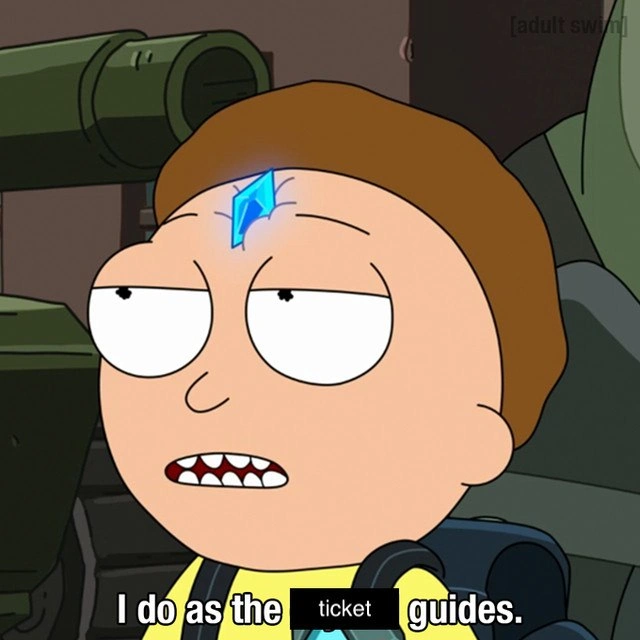
The image uses Morty's crystal-guided expression to represent a developer who is no longer thinking through the product consequences. He is simply obeying the issue tracker:
- The glowing crystal is the ticket.
- The blank stare is the developer's surrender to process.
- The caption
I do as the ticket guides.is the ritual phrase of someone who has been burned for going outside scope. - The PM in the post message represents the moment reality notices what the ticket caused.
For a junior developer, this captures a common early-career tension. You are told to follow tickets, avoid scope creep, and respect the backlog. Then, eventually, you discover that tickets are written by humans, humans omit context, and "done" does not always mean "correct." The grown-up skill is learning when to pause and ask, "Is this actually what we want users to experience?"
Level 3: Acceptance Crystal
The visible caption says:
I do as the ticket guides.
That one edited word turns Morty's glowing forehead crystal into a perfect stand-in for ticket-driven development. The character looks dazed, passive, and faintly doomed, which is exactly the emotional register of an engineer implementing a Jira issue whose acceptance criteria are either too vague, too literal, or quietly detached from the actual product goal. The post message adds the specific absurdity: a PM asks why the login page was removed. The answer is not "because it made sense," but because the ticket apparently pointed that way.
The best part is the black rectangle around ticket. It looks pasted in, almost bureaucratic, like process itself has overwritten the original prophecy. That visual clumsiness works: the meme is not about thoughtful engineering judgment; it is about the dead-eyed moment when a developer stops asking "should we?" and starts asking "does this match the story?"
In a healthy workflow, a ticket is a coordination artifact. It captures a problem, expected behavior, constraints, and enough context for engineering to make decisions. In the broken version being satirized here, the ticket becomes a commandment. The developer follows it because:
- The sprint has a commitment.
- The PM wants the issue closed.
- The reviewer checks scope, not product sanity.
- The team has learned that asking clarifying questions can be more expensive than shipping the wrong thing.
That is how organizations drift into process overhead masquerading as alignment. Agile ceremonies, backlog grooming, and acceptance criteria are supposed to reduce ambiguity. But when the artifact becomes more important than user value, the team can end up optimizing for ticket completion while the product quietly loses its login page. A ticket with unchecked assumptions is not a source of truth; it is a haunted spreadsheet cell with a due date.
The humor is especially sharp because smart teams still fall into this. Nobody wakes up intending to outsource judgment to Jira. It happens through incentive structures: velocity charts reward closure, sprint planning rewards predictability, and cross-functional politics reward "I implemented what was requested." The crystal is funny because it removes agency. The ticket does the same thing when a team treats it as destiny instead of a conversation.
Description
The image shows Morty from Rick and Morty with a glowing blue crystal stuck to his forehead, looking dazed, with a faint Adult Swim watermark in the corner. The caption at the bottom reads "I do as the ticket guides," with the word "ticket" inserted in a black rectangle between the surrounding white subtitle text. The meme references the idea that developers often follow Jira or issue-tracker tickets mechanically, even when the ticket is incomplete, over-specified, or detached from real product intent. It turns ticket-driven development into a deterministic prophecy rather than an engineering decision process.
Comments
1Comment deleted
A ticket with acceptance criteria is just a prophecy with checkboxes.