Sailors Stage Mutiny Over Kubernetes' Nautical Terminology Abuse
Why is this Containerization meme funny?
Level 1: Names All Mixed Up
Imagine your friend is pretending to be a pirate sailing a ship, but they keep using the wrong words for everything on the boat. They grab the ship’s wheel and say “This map will steer us!”, and then they point at the anchor and claim “This thing checks our treasure chest for gold.” 🤔 You’d probably giggle and correct them, right? You know a map isn’t the wheel, and an anchor just stops the ship – it doesn’t check treasure! In this meme, something similar happened. Some computer folks named parts of their software using fun boat words (because their software is all about “containers” like a ship). But a real sailor heard those names and went, “Hey, that’s not what those things do on a real ship!” He got annoyed (in a funny way) because the words were all mixed up. It’s like hearing someone call a car’s engine the “steering radio” – any car lover would find that silly. Everyone else found the sailor’s rant hilarious, because it pointed out just how goofy those mixed-up names sound to someone who knows the real deal. In simple terms, the tech people tried to be cool by using ship terms, but they ended up using some of them wrong, and that’s what makes it so funny!
Level 2: Kubernetes Goes Sailing
Kubernetes is a powerful system for running software containers across many machines – essentially it helps manage and scale applications in the cloud. The whole idea of containerization is built on a shipping metaphor: just like standardized shipping containers changed how goods are transported globally, software “containers” (each holding an app and its dependencies) changed how we deploy software. Because of this, a lot of Kubernetes’ language borrows from ships and the sea. (Fun fact: the name Kubernetes means helmsman in Greek, and its logo looks like a ship’s steering wheel!). In the DevOps and SRE world, this theming is pretty common – it makes tech concepts a bit more relatable and certainly more memorable.
In this meme, a sailor on Reddit is complaining that some Kubernetes tool names misuse real sailing terms. In other words, the software folks tried to use nautical_metaphors_in_k8s for fun, but they didn’t always get those terms right according to actual sailing. Let’s break down the key terms and tools mentioned, to see what they mean in real life versus what they do in Kubernetes:
| Term | Real-World Meaning (Nautical) | In Kubernetes (Tech Usage) | Sailor’s Complaint |
|---|---|---|---|
| Helm | The ship’s steering wheel or steering position (where the pilot/helmsman stands to steer) | Helm – a CLI tool (package manager) to deploy apps on K8s using charts | You wouldn’t be reading maps while steering at the helm! (They mixed up roles) |
| Chart | A nautical map used for navigation | Helm Chart – a package of YAML config files and templates for a K8s application | Charts are supposed to be read at the nav station, not by the person at the helm. |
| Anchor | A heavy device lowered to the sea floor to hold a ship in place | Anchore (Anchor) – a container image scanning tool (checks for security issues in container cargo) | Anchors don’t inspect cargo; in a port, customs agents do that job. (The name doesn’t match the function) |
| Stern | The rear/back end of a ship | Stern – a log tailing tool for Kubernetes (shows live logs from pods) | Ship logs are kept in a logbook, not at the ship’s stern. (They chose the wrong boat term for a logging tool) |
| Compass | An instrument that points north, helping navigate direction | Compass – (context: a Kubernetes-related tool likely helping with cluster navigation or configuration) | This one makes sense: a tool that helps guide or navigate the cluster is aptly named Compass. 👍 |
| Shipwright | A person who builds or repairs ships | Shipwright – a Kubernetes project for building container images (assembling the software “ships”) | This also fits well: it’s a tool for building something (containers), just like a shipwright builds ships. ✅ |
Essentially, Kubernetes and its ecosystem use a boatload of seafaring terms to name things:
- A container in tech is a packaged application (the term comes from actual freight containers).
- Helm is a command-line tool that helps you install/configure applications on Kubernetes (kind of like the helm steers a ship’s course).
- A Helm chart is like a pre-made map or blueprint for your application’s deployment.
- Anchore (spelled with an e at the end, but pronounced “anchor”) is a tool that inspects container images for vulnerabilities, ensuring they’re safe (think of it as security scanning of your software cargo).
- Stern is a utility to stream logs from your apps in Kubernetes, helping you see what’s happening under the hood in real time.
- Compass is another tool (less common than Helm) meant to help developers find their way – for example, it might assist in configuring things or discovering services in a cluster (just like a compass helps you find north).
- Shipwright is a project that automates building container images from source code (it “builds the ship” that will carry your application code).
The sailor on Reddit was basically upset because the sailing_terminology_vs_k8s didn’t line up correctly. He expected that if tech people are going to use cool boat terms, they should use them in a way that respects what those words mean on an actual ship. For example, reading navigation Charts at the Helm doesn’t happen in real sailing – you’d do that at a planning desk. And naming a log tool “Stern” felt odd to him because ship logs belong in a logbook, not at the ship’s stern. His post was a humorous reality-check: some Kubernetes names sound good to developers, but to someone who actually sails, a few of them seem off-course.
Why is this funny to the tech crowd? For one, it’s highlighting a classic tech problem: NamingThings is hard, and themes can be a double-edged sword. It also reveals a bit of the imaginative branding that happens in DevOpsHumor: we give everyday concepts (like deploying software) playful names (like Helm and Charts) to make them less intimidating. Usually nobody minds, but seeing an actual sailor react is unexpected and amusing. It reminds junior developers that these terms are just metaphors – you don’t actually need to know how to sail a boat to use Kubernetes! However, it also teaches a fun lesson: even in tech, our metaphors have meaning. If you dive a little deeper, you’ll see Kubernetes truly is full of nautical nods. Just know that not every term maps perfectly to the real world, and that’s okay – it still all works in the computer realm. The meme went viral because both developers and sailors (and those who are both!) got a good laugh from this lighthearted terminology mismatch.
Level 3: Mutiny Over Misused Metaphors
Naming things in tech is notoriously tricky (right up there with cache invalidation and off-by-one errors, as the old joke goes). Developers often lean on familiar themes to name new tools, and Kubernetes is a prime example – it’s swimming in nautical metaphors. In fact, “Kubernetes” itself is Greek for helmsman (ship pilot), which set the course for an entire ecosystem of maritime naming. We’ve got software containers (inspired by real shipping containers), Kubernetes’ wheel-like logo (a ship’s helm), and countless add-ons named after boat stuff. It’s usually fun and harmless... until a real sailor shows up and calls foul. That’s exactly what happened in this meme: a viral tweet titled “Sailors against Kubernetes” highlighted a Reddit rant where a sailing expert absolutely loses it over how Kubernetes tools abuse nautical lingo. It’s a hilarious collision between DevOps imagination and actual seafaring know-how, and experienced DevOps/SRE folks are nodding along while smirking.
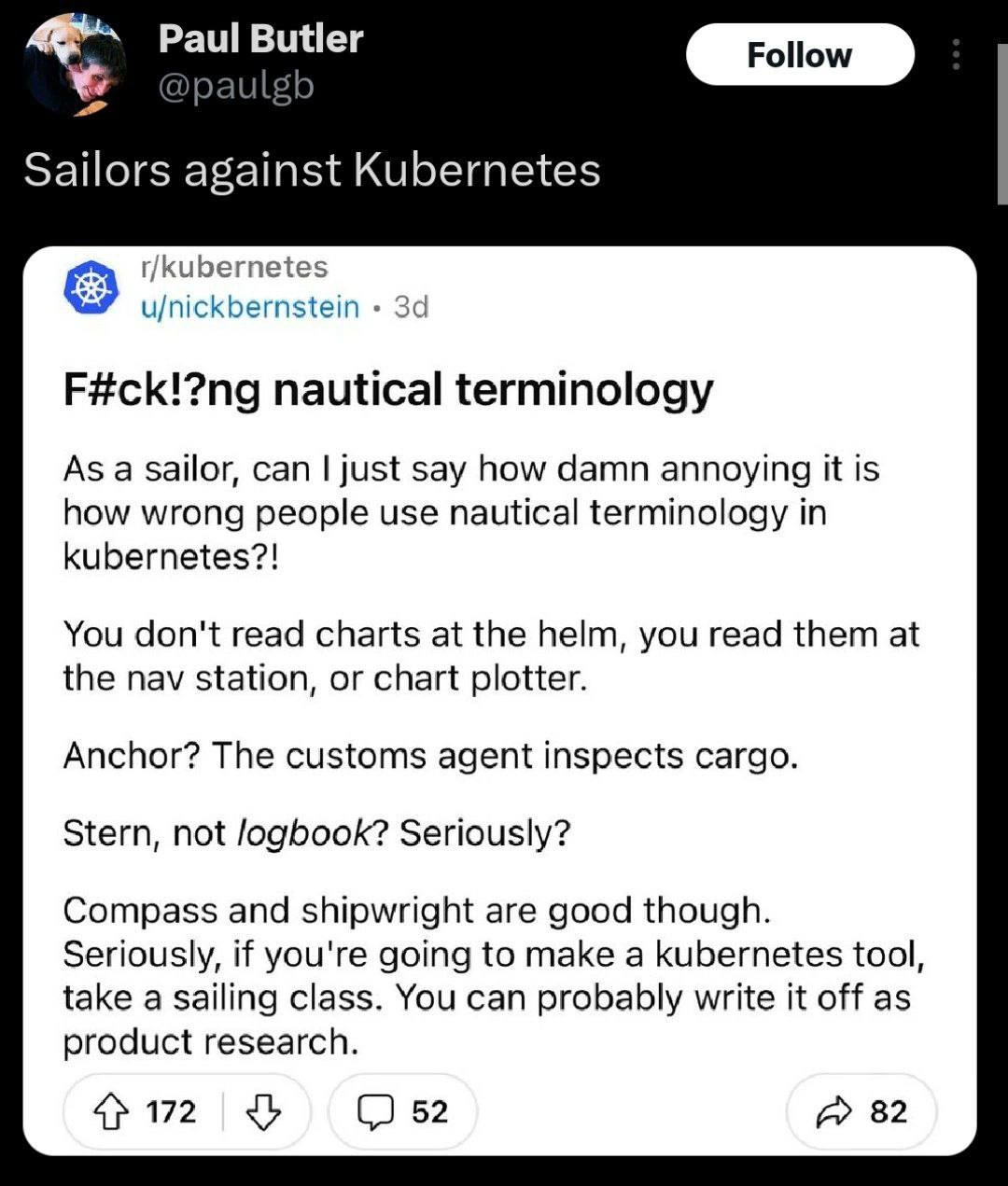
The salty (pun intended) sailor’s post – cheekily titled “F#ck!?ng nautical terminology” – reads like a bug report for Kubernetes’ theme. He basically yells: “If you’re going to name a Kubernetes tool with boat terms, at least use them right!” The rant calls out several tool names in particular. For one, “You don't read charts at the helm, you read them at the nav station.” In Kubernetes-land, we casually talk about Helm Charts all the time: Helm is the CLI “package manager” for K8s, and a Chart is a bundled set of configs (like a map for deploying an app). The metaphor was supposed to be a helmsman steering the ship using charts (maps) to navigate your app deployment. But as our sailor friend points out, on a real ship the helmsman isn’t the one poring over maps – that happens at a navigation station below decks or on a chartplotter. So the term “Helm Chart” smashes two nautical concepts together in a way that makes a mariner cringe. It’s like calling a car’s steering wheel the “GPS wheel” – sure, both are car-related, but a real driver would facepalm.
He moves on to other offenders: “Anchor? The customs agent inspects cargo.” Here he’s complaining about a Kubernetes-related tool named Anchor (likely referring to Anchore, a container image scanner for security). In real maritime operations, an anchor is just a heavy hook that keeps the ship from drifting – it has nothing to do with inspecting cargo. If anything, customs officers at the port inspect cargo. So from the sailor’s perspective, naming a security scanner “Anchor” is way off-course. It’d be as if airport security tools were named “Runway” – cool theme, but wrong job. You can practically hear this sailor muttering “Avast ye landlubbers, anchors don’t do cargo checks!” under his breath.
Next up: “Stern, not logbook? Seriously?” This one targets Stern, a popular Kubernetes log-tailing tool. In K8s, Stern lets you stream logs from multiple pods, helping you debug what’s happening in your cluster. The name fits the theme (the stern is the back of a ship, often where a ship’s name is printed), but it’s a head-scratcher metaphorically. On an actual vessel, the record of everything happening – the logbook – is kept by the crew, often near the bridge or nav station, not literally at the stern of the ship. If you were going to name a logging tool after sailing stuff, “Logbook” would’ve been the spot-on term. So the sailor is baffled that someone chose stern (rear of the ship) to represent log data. It’s as if a developer heard “logs” and thought “well, the back of the ship is kind of like the ship’s tail, and we tail logs… let’s call it Stern!” Creative leap, yes, but a real skipper would just roll their eyes. A missed opportunity for a perfect pun, indeed.
Not every Kubernetes tool name walked the plank, though. The rant even concedes, “Compass and shipwright are good though.” These got a thumbs-up from our resident sailor. Why? Because they actually align well with their functions. A compass in real life helps you find direction, so if there’s a K8s tool named Compass (and there is, used for guidance in cloud-native apps), it’s metaphorically on the right course – it likely helps devs navigate configuration or monitor direction in their cluster. And a shipwright is a person who builds ships; sure enough, Shipwright in K8s is a project for building container images (basically constructing the “vessels” that carry software). Those make sense to a sailor and a developer alike – the analogies hold water. It’s like naming a code deployment tool “Pilot” and it actually guides things – you get an approving nod instead of an eyeroll from the expert.
This whole exchange is comedic gold for the cloud-native crowd because it highlights a classic tech culture quirk: we love themed names (especially in Containerization and DevOps), but we don’t always get the semantics exactly right. It’s a shared joke about naming_pain_points. Every seasoned engineer knows the struggle of naming (and the giggle of seeing an analogy stretched too far). The meme also underscores how Kubernetes has created its own little world of terminology that outsiders might find bizarre. Here, an actual domain expert (a sailor) basically did a code review on Kubernetes’ naming scheme and filed some hilarious bug reports. The reaction was huge – hundreds of upvotes, comments, and retweets – because it resonates with anyone who’s had to explain Kubernetes terms to a newcomer or who’s thought, “why the heck is it called that?” It’s a healthy mix of DevOpsHumor and “real-world expert roasts tech nerds.”
In the end, the consensus among experienced devs is a mix of amusement and “touché”. Sure, these naming nitpicks won’t sink the Kubernetes ship – clusters won’t crash because Helm mixed metaphors – but it’s a funny reminder to DevOps/SRE folks that sometimes our clever naming might look pretty silly to outsiders. We spend so much time shipping code (pun fully intended) that we might not stop to think if our maritime-themed names would pass muster with an actual sea captain. As the frustrated poster quipped, “If you're going to make a Kubernetes tool, take a sailing class. You can probably write it off as product research.” That tongue-in-cheek advice got laughs because it rings true: understanding the source material can make our analogies better… or at least keep salty sailors off our backs! Until then, this meme will sail on as a humorous reminder that even the mighty Kubernetes can get its port and starboard mixed up once in a while.
Description
A screenshot of a tweet from Paul Butler (@paulgb) with the caption "Sailors against Kubernetes." The tweet embeds a screenshot of a Reddit post from the r/kubernetes subreddit by user u/nickbernstein, titled "F#ck!?ng nautical terminology." The Reddit post is a rant from a self-proclaimed sailor who is annoyed by the incorrect use of nautical terms in the Kubernetes ecosystem. The user points out several inaccuracies, such as reading charts at the helm instead of a nav station, and questioning the use of terms like 'Anchor' and 'Stern' instead of 'logbook'. The post sarcastically suggests that creators of Kubernetes tools should take a sailing class and write it off as product research. This meme finds its humor in the niche intersection of high-tech and traditional sailing, highlighting how tech's love for metaphors can clash with the precise terminology of the domains from which they are borrowed. It's a joke that resonates with senior engineers who appreciate domain expertise and often witness the superficial co-opting of complex concepts for branding purposes
Comments
9Comment deleted
A sailor's biggest fear is a rogue wave. A DevOps engineer's biggest fear is a rogue `helm update --force`. Both can sink the entire fleet, but only one involves 500 lines of inscrutable YAML templating
Helm may be at the wrong station, but “helm upgrade ship-of-Theseus --atomic” still perfectly describes replacing every plank in prod and pretending the vessel’s the same
After 15 years of explaining why Kubernetes doesn't need 8GB of RAM just to run a hello-world container, the real complexity isn't the YAML hell or the networking abstractions - it's explaining to actual sailors why we're steering our deployments with Helm while reading charts at the wrong station and logging to stern instead of the logbook
When your container orchestration platform appropriates an entire domain's vocabulary but gets it wrong, you've essentially created a distributed system of semantic drift. The real irony? Kubernetes' 'helm' manages 'charts' that you'd never actually read at a ship's helm - it's like naming your CI/CD tool 'Surgeon' and having it perform code 'amputations' in the 'waiting room.' At least when we have namespace collisions in code, the compiler complains; when we have them in metaphors, we just get passive-aggressive Reddit posts from domain experts
K8s already has enough drift between desired and actual state - stop adding semantic drift: Helm charts at the helm, an anchor that sinks rollouts, and Stern tailing the obituary
Kubernetes: the only fleet where Helm ships charts, anchors are YAML, and the cluster still drifts into prod
K8s nautical lingo: like approximating CAP theorem with 'eventually consistent bilge water' - close, but you'll still sink in prod
What about orchestration? Comment deleted
"good though"-tier Titanic reference Comment deleted