Skip to content
DevMeme
4671 of 7435
Vim Users and Clowns: A Corporate Investigation Finds No Difference
IDEs Editors Post #5118, on Apr 12, 2023 in TG

Vim Users and Clowns: A Corporate Investigation Finds No Difference

Why is this IDEs Editors meme funny?

Level 1: Clowning Around

Imagine you have two friends who need to do their homework. One friend just uses a normal pencil and paper, but the other friend insists on using an old-fashioned quill pen and ink bottle. The second friend says, “This is the best way to write, trust me!” He spends extra time just dipping the pen in ink and carefully writing fancy letters. It might work, but to you and everyone else, he looks kind of silly for not just using a regular pencil like everyone else. In fact, watching him, you might giggle because it’s like he’s clowning around for no reason. That’s essentially what this meme is saying. The person using the super complicated tool (the quill pen, like the old text editor) thinks he’s doing something great, but others just see him making things harder and looking funny – almost like he’s dressed as a clown when he doesn’t need to be. So the joke is that being over-the-top about a tricky way of doing something (when simpler ways exist) makes you look kinda silly to everyone else.

Level 2: Editor Wars 101

Let’s break down the joke for those new to the editor wars. First, Vim is a text editor – basically a program for writing and editing code or text. But unlike Microsoft Word or modern coding tools (like VS Code or IntelliJ), Vim runs in a terminal window (the plain text, black-and-white CLI – Command Line Interface). It doesn’t have buttons you click or menus you navigate with a mouse. Instead, you control everything with keyboard commands. Vim is famously modal: it has modes like Insert mode (for typing text) and Normal mode (for giving commands). If you don’t know what you’re doing, Vim can be confusing – for example, pressing keys may not type letters if you’re in the wrong mode. A classic newbie experience is opening Vim by accident and then not knowing how to quit it. (It’s so common that “how to exit Vim” became a programming joke in itself, with answers: “Press <Esc> then type :q!”).

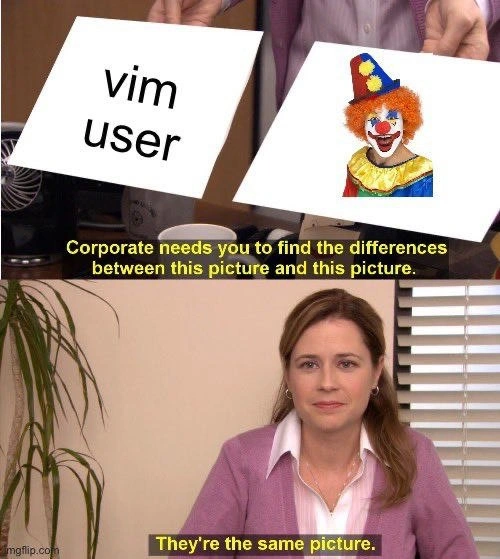
Now, what’s with the clown? In general, calling someone a clown means you think they’re being foolish or not taken seriously. The meme is saying a “vim user” and a “full clown” are “the same picture.” It uses a popular meme template from The Office TV show: in that scene, Pam (the woman in the third panel) is given two images to spot differences, but they’re identical, so she deadpans: “They’re the same picture.” Meme-makers love this format to joke that two things are essentially identical in their eyes. Here, the two things are (A) the words “vim user” on a piece of paper, and (B) an image of a clown in full costume. Pam’s quote implies she sees no difference between them. In plain terms, the joke is: someone who uses Vim (especially with a bit of fanatical enthusiasm) is effectively a clown. Ouch!

Why would anyone call a Vim user a clown? This ties into the long-running developer culture joke about “editor wars.” Developers often debate which code editor or IDE is best: Vim vs Emacs was the classic rivalry going back to the 1980s. These debates are usually light-hearted but can get surprisingly heated, almost like sports team rivalries. Vim users are known for being very proud of using a tough, old-school tool and touting its advantages (fast editing, no need for a mouse, works on any server, super customizable). However, to a lot of other devs – especially those who didn’t grow up with Vim – this pride can seem ridiculous. Modern editors and IDEs offer user-friendly features (like clicking to move the cursor, or pressing a nice GUI button to save), while Vim makes you remember arcane keyboard combos (e.g., hitting : then w then q to save-and-quit). It’s a bit like driving a stick shift sports car: if you know how, it’s powerful, but if you don’t, you’ll stall and curse. So, within developer humor, people tease Vim die-hards as if they’re making life harder just to show off.

The term “full-clown mode” in the title is informal but basically means acting completely silly. The meme artist is implying that using Vim – or at least being overly zealous about it – is as silly as dressing up in a clown costume. It’s hyperbole (most Vim users aren’t literally clowns, of course), but it exaggerates the feeling a newcomer might have: “Why is that guy in the corner using a 40-year-old text editor, looking smug about it? He might as well be wearing a funny wig and red nose!” This reflects a common early-career experience: a junior dev might encounter a senior dev who swears by Vim, and the junior is baffled. The junior is thinking, “I have a modern editor that’s so much easier, why put on this technical circus?” If you’ve ever tried to learn Vim as a beginner, it can indeed feel like performing a tricky stunt – while everyone else is simply clicking and typing normally, you’re memorizing modes and key presses like secret clown tricks. No wonder some onlookers can’t help but chuckle.

In summary, this meme uses a pop culture reference (Pam from The Office) combined with a tech in-joke (Vim enthusiasm) to create a punchy insult: equating a fervent Vim user to a clown. It relies on knowing that Vim is a beloved, but kinda intimidating, tool and that some folks get way too into it. If you’re new to programming, just know this: Vim is powerful and respected, but it’s also the butt of many jokes because of its steep learning curve and the almost fanatical vibes of some of its users. Editor wars come and go, but poking fun at them – that’s a tradition as old as software itself. This meme is just one colorful example, literally giving the Vim camp a red nose and a rainbow wig for comedic effect.

Level 3: The Editor Circus Act

In the world of developer culture, few battles are as enduring (or as absurd) as the Editor Wars. This meme throws us straight into that conflict by equating a devoted Vim user to a literal clown. To seasoned engineers, the joke lands because we’ve all witnessed colleagues go full clown mode over their favorite text editor. The setup riffs on a famous scene from The Office (Pam’s “they’re the same picture” bit), but here the two images to compare are: one simply labeled “vim user” and the other a colorful clown. Punchline: Pam can’t tell them apart. In other words, someone who zealously uses the venerable Vim editor is being portrayed as comically buffoonish.

Why would a command-line editor inspire such satire? Well, Vim is no ordinary tool – it’s a decades-old, modal text editor that hardcore users treat with religious fervor. Many of us have that battle-scarred coworker who brags about editing code at the speed of light, fingers flying over h, j, k, l to navigate, practically juggling dozens of keyboard shortcuts. From an experienced dev’s perspective, the humor comes from how over-the-top this devotion can get. It’s not that Vim isn’t powerful (it is – editing text with Vim can feel like wielding the One Ring if you’ve mastered it), but the culture around it can be intense. The meme exaggerates that intensity: picture a developer proudly showing off their .vimrc config tweaks with the same glee a clown has when pulling rainbow handkerchiefs from their sleeve. Developer humor often exposes these tribal loyalties by taking them to cartoonish extremes. Here, the terminal tribe – the Vim enthusiasts – are literally painted as clowns in a circus.

This comparison also pokes at how out of touch Vim fanatics might seem in a modern development shop. Senior devs remember the origin of this zeal: Vim (and its ancestor vi) dates back to an era of green-on-black CRT terminals and no mouse – using it efficiently was a respected art. But fast-forward to today’s world of slick IDEs and one-click build tools, and a colleague proclaiming “I only use Vim, GUI editors are for amateurs” can come off as performatively elitist. It’s as if they’re willfully enduring pain for bragging rights – a bit like a circus act where the stunt is using Vim for everything. We chuckle because we’ve seen that person: the one who spends 4 hours tuning Vim plugins to save 4 seconds on a compile, or who insists CLI editing is the only “real” way to code. The clown metaphor encapsulates the outsider’s view: all that effort and eccentricity can look foolish rather than impressive.

Importantly, this meme is all in good fun (well, unless you’re a die-hard Vim loyalist, in which case honk honk, the joke’s on us). It satirizes the zealous culture around terminal editors, not necessarily Vim’s capabilities. Experienced devs will nod knowingly at the subtext: We’ve all had tool preferences, but maybe we shouldn’t take ourselves so seriously. The humor comes from recognition – remembering that flame war thread about Vim vs Emacs where people argued like it was life-or-death, or the time a teammate literally said “Vim is life” unironically. This meme distills that craziness into a simple visual: Vim user = clown. It’s harsh, it’s witty, and it perfectly captures an industry inside joke that senior engineers have seen play out again and again, as reliably as an infinite loop.

Description

A popular two-panel meme format from the TV show 'The Office.' In the top panel, an unseen person holds up two images for comparison. The left image simply contains the black text 'vim user' on a white background. The right image is a stock photo of a person in a full clown costume, complete with a colorful outfit, red wig, and face paint. A yellow subtitle reads, 'Corporate needs you to find the differences between this picture and this picture.' The bottom panel shows the character Pam Beesly looking at the camera with a perfectly neutral, slightly smug expression, with the subtitle, 'They're the same picture.' The meme is a classic jab in the 'editor wars,' humorously and hyperbolically equating the perceived complexity and zealous advocacy of the Vim text editor with the absurdity of being a clown. It plays on the stereotype of Vim users as being overly dedicated to an arcane tool for reasons others find amusing

Comments

7
Anonymous ★ Top Pick The only real difference is that a clown knows they're putting on a performance. The Vim user genuinely believes that spending 20 minutes to save 5 seconds on text manipulation is a sound long-term productivity investment
  1. Anonymous ★ Top Pick

    The only real difference is that a clown knows they're putting on a performance. The Vim user genuinely believes that spending 20 minutes to save 5 seconds on text manipulation is a sound long-term productivity investment

  2. Anonymous

    Ops budget review: if a staff engineer burns five billable days perfecting a .vimrc to auto-indent Helm charts, do we amortize the clown wig under DevTools or CapEx?

  3. Anonymous

    The clown can exit the performance when they want to

  4. Anonymous

    After 20 years in the industry, I've learned that vim users and clowns have one critical thing in common: they both insist their elaborate performance is actually the most efficient way to do things, and they're genuinely confused when others don't immediately see the genius. The difference? At least the clown's exit strategy doesn't require memorizing :wq!

  5. Anonymous

    Call Vim users clowns, then watch them ship a hotfix through tmux on a bastion over a flapping VPN while your IDE is still "Indexing..."

  6. Anonymous

    Mock the clown all you want - when prod is on fire and SSH is your only GUI, the Vim user ships the hotfix before your IDE finishes indexing

  7. Anonymous

    Corporate hires Vim users for the same reason circuses need clowns: both escape sequences turn routine tasks into a three-ring buffer circus

Use J and K for navigation