The Developer vs. The Two-Week Task and Its Audience
Why is this ProjectManagement meme funny?
Level 1: Are We There Yet?
Imagine you’re trying to climb a really tall rope in gym class. You’ve been climbing and climbing, and your arms are getting super tired, but you’re still not at the top yet. Now picture your gym teacher standing below you, calling up, “How much longer until you reach the top?” He keeps asking you this over and over. You’re still halfway up the rope, struggling, so honestly you have no idea when you’ll get to the top! Meanwhile, all your classmates are standing around in a circle just watching you climb. They’re not helping pull you up; they’re just watching. Some of them look kind of concerned for you, and others are just waiting their turn, glad they’re not the one on the rope right now.
This is exactly the kind of situation the meme is joking about, but in a software office setting. You (the person climbing) are like a developer working on a really hard problem. The gym teacher (yelling “how much longer?”) is like your boss or manager asking, “When will you be done with that work?” And your classmates watching are like your coworkers in a meeting, listening while this happens. It’s funny because asking “Are you done yet? When will you be done?” repeatedly doesn’t help at all – it just makes the person on the rope (or the person doing the hard task) more nervous or frustrated. If you’re still in the middle of the challenge, you really can’t give a good answer to that question. It’s a bit like on a long car ride when a child keeps asking, “Are we there yet? Are we there yet?” every five minutes. The driver is thinking, “We’ll get there when we get there!” In our scenario, the manager is that impatient child in a way, and the developer is the driver trying to navigate a tricky road.
So, the heart of the joke is: someone is clearly busy struggling with something hard, and another person keeps bugging them about when it will be finished, even though it’s obvious they’re not finished yet. The rest of the people just stand by and watch this back-and-forth. We find it funny (and a little silly) because if you step back, it’s a ridiculous scene – of course the person hanging on for dear life doesn’t know exactly when they’ll be done. Constantly nagging them for a time estimate is just going to stress them out more. Anyone who’s ever been hurried up when they’re already doing their best can relate to that feeling. The meme uses this easy-to-see example (the athlete on the wall) to make us laugh about a common situation: being under pressure to finish something tough, and others not really helping, just waiting for you to somehow magically be done. It’s like, “Hey, I’m doing all I can here – I’ll be done when I’m done!”. The humor comes from recognizing that truth in a lighthearted way.
Level 2: Scrum Stand-off
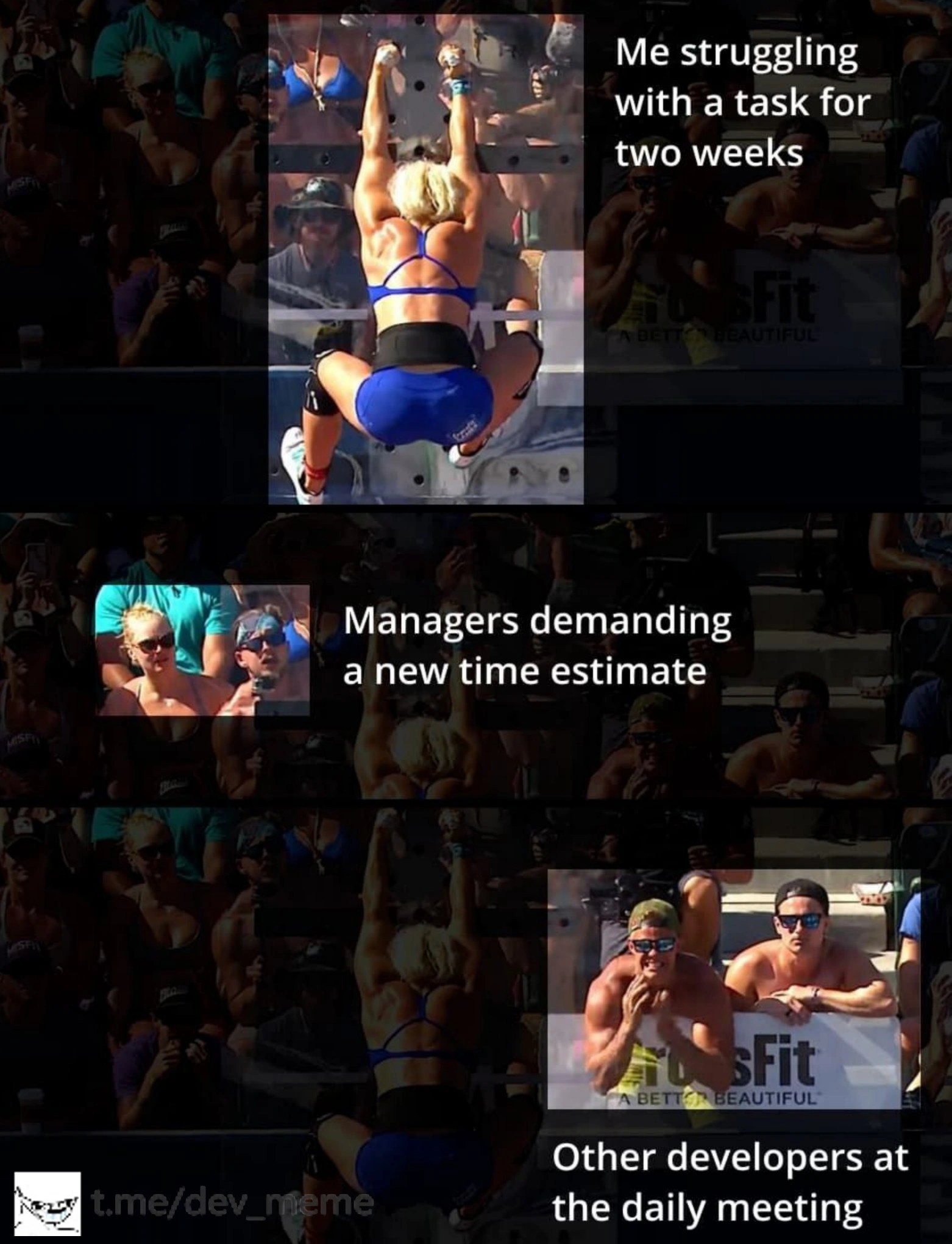
This meme uses a dramatic gym scenario to explain a day-to-day software team problem. Let’s break it down. In the top panel, we see a CrossFit athlete hanging from a pegboard wall, and the caption says: “Me struggling with a task for two weeks.” This represents a developer (the “Me” in the text) who has been stuck on the same programming task for two whole weeks. Two weeks is a long time for one task – notably, many Agile teams run in sprints that are about two weeks long. So this implies the developer might have spent an entire sprint wrestling with this one item. The image of hanging from a pegboard is a metaphor: it’s a very tough physical challenge, just like the task is a very tough mental/technical challenge. The developer is clinging on, probably exhausted, but still trying to make progress little by little (moving peg by peg, or line by line in code).
Now, look at the middle panel. It zooms in on two spectators from that gym scene (they’re shirtless, watching the athlete). The caption here is “Managers demanding a new time estimate.” In a real software team, these “managers” could be a project manager, team lead, product manager, or Scrum Master – basically anyone overseeing the project’s progress. When the meme says they demand a new time estimate, it means the bosses are asking the programmer: “Okay, you’re clearly not done yet... so when will it be done? Give us a new ETA (Estimated Time of Arrival).” This often happens in companies: if a task is running late, managers will ask for an updated estimate so they can update their plans or inform stakeholders. The spectators in the image look concerned or impatient – one has his hands near his mouth as if shouting encouragement or instructions. That fits perfectly: managers are essentially yelling from the sidelines, pressuring the dev to hurry up or at least tell them how much longer it’s going to take. They might not be literally yelling in real life, but they’ll ask in meetings or emails, “Can you provide a revised timeline for this task?” It feels just as pushy to the developer as a spectator shouting “Faster! When will you finish?”
The bottom panel shows two other guys in the crowd watching, with the caption: “Other developers at the daily meeting.” This translates to the rest of the dev team during the daily stand-up meeting (a common Agile team meeting). At a daily stand-up, each developer takes a turn to briefly say what they did yesterday, what they’re doing today, and if they have any blockers (problems). It usually lasts only 15 minutes or so. In that meeting, when one developer is having trouble (like the one stuck for two weeks), the others typically just listen quietly to their update. They’re not being apathetic; it’s just the format of the meeting – everyone shares one by one, and detailed problem-solving is usually handled outside the stand-up. So in the meme, the other devs are shown as onlookers who are simply observing. They aren’t interfering or helping during the meeting. You can imagine them on the call or around the room, hearing the manager press the struggling dev for a new estimate, and the others sort of just exchange glances or stay silent. The photo chosen (two athletic guys with shades, watching) humorously suggests they might be thinking, “Whoa, glad I’m not in her position,” or “This is awkward.” In real life, other developers might later offer help privately – like after the meeting someone might say, “Hey, I heard you’re stuck, want to pair program this afternoon and try to solve it together?” But during the daily stand-up itself, it’s often very quick and people don’t interrupt each other’s turns too much. So they do end up feeling like an audience watching a scene unfold.
Let’s clarify some terms and context for those newer to this environment. Agile is a way of managing work that emphasizes iteration, flexibility, and customer feedback. One popular Agile framework is Scrum, which involves breaking work into sprints (usually 1-2 week time boxes) and holding regular meetings (often called Agile ceremonies). A daily stand-up (also known as a daily scrum meeting) is one of those ceremonies. It’s typically every morning, very short, where each team member stands up and gives their status. The idea is to keep everyone in the loop and quickly surface issues. It’s not meant to be a lengthy status report to the boss, but rather a team synchronization point. However, sometimes managers do attend these or lead them, and they might treat it like a status check-in.
Time estimation in software is when developers guess how long a task will take. This could be in hours, days, or using story points (Scrum teams often use points as a rough measure of effort). At the start of a sprint in Scrum, the team estimates tasks and commits to doing a set of them. If one task goes way over its estimate (for example, thought it was 2 days but it’s now 2 weeks and counting), that throws off the sprint plan. The manager or Scrum Master will want to know, “Okay, we’re off track – how bad is it? Do we need another day? Another week? Should we cut scope?” That’s why they’re asking for a new estimate. It’s basically to re-calibrate the plan. In the meme, the manager demanding a new estimate is exactly that scenario: the original plan didn’t hold, so now they want a new prediction for completion.
For a junior developer, being asked for an updated estimate while you’re still stuck can be stressful. You might not know how to answer. If you say “it’ll be done tomorrow” and tomorrow comes and it’s still not done, you feel like you broke a promise. If you say “I don’t know,” that also feels bad because it might sound like you’re incompetent or have no handle on the problem (even though sometimes “I don’t know yet” is the honest truth!). Many of us learn the hard way that it’s better to be honest about uncertainty, but early on you might try to appease the manager with a guess. This can turn into a cycle where each day you optimistically say, “I think I can finish by tomorrow,” and then tomorrow you push it again – which sometimes happens several times in a row. It’s a rough spot to be in.
Now, why two weeks? Two weeks is a common length for a sprint, so it implies the entire sprint went by without finishing this task. It’s also just a long time for one task, so it emphasizes how tough that task must be. When something takes that long, it’s usually because unexpected complexities arose. For example, maybe the task sounded simple (“Add login with Google to our app”) but ended up entangling a lot of things (you discovered the auth library had a bug, or it required a backend change, etc.). New developers often encounter this: a task that seems small balloons into a big project once you dig into it. It’s part of the learning curve – you gain experience in identifying what might be hard. But even senior devs can be surprised by a tricky problem.
Consider a concrete scenario: say you’re assigned to implement a new feature where users can upload profile pictures. You estimated it as a 1-day job – just use an existing image upload component. But then you find out the image service has a bug for certain file types, you need to write a custom validator, and the front-end preview isn’t working on iPhones. Each of those issues takes time. A day slips to two, then three, then suddenly it’s been two weeks because fixing one issue uncovered another. In daily stand-ups throughout that time, each day you’re basically saying “still working on the profile upload” and everyone else is waiting on it. The project manager eventually asks, “Can you give us an ETA for when this will be done? We need to update the client.” That’s exactly the situation depicted: you (the dev) are on the metaphorical pegboard hanging, and the manager is urging “how much longer?”
What about the other developers during all this? In a stand-up, normally if someone reports they’re stuck or having an issue, the Scrum Master or team lead might say “Thanks for the update. Let’s discuss right after this meeting what help you might need.” The other team members generally don’t butt in during the round-robin of status updates. So they effectively just listen. The meme exaggerates this dynamic by showing them as literal spectators. They’re not ignoring their colleague; they’re just not actively intervening right then and there. It’s also a bit of commentary: sometimes team culture can be such that each dev only worries about their own tasks (“I finished mine, so I’m good”) and not actively help unless asked. In healthy teams, folks will chime in offering help – like “Hey, I have some experience with that API, let’s pair after stand-up.” But if that’s not happening here, the meme’s portrayal of them as passive onlookers holds true.
The manager–developer tension shown is a classic one: managers need clarity and developers need time. The manager’s job is often to report status to higher-ups or clients and to keep the project on schedule. So when things slip, they feel pressure and pass that pressure on to the dev (“We need answers!”). The developer, on the other hand, is deep in the technical weeds. They might be thinking, “I’m doing everything I can; asking me again for an estimate isn’t going to magically produce the solution.” Newer developers might not yet know how to push back or communicate that uncertainty well. They might just say “I’ll try to have it done by tomorrow” even if they’re not sure, because they feel they have to give some answer. It’s a tough situation that almost every developer experiences early in their career.
Daily stand-up meetings themselves can be a bit of an adjustment for someone new. They sound simple – just report what you’re doing – but standing there with everyone listening can feel like being under a spotlight, especially when you don’t have good news. In the meme, the developer has to basically say for the 10th time “I’m still on that same task.” Other team members might feel a little awkward hearing that; they might think “Oh man, that sucks, hope they figure it out soon,” but they won’t usually press or critique in the stand-up itself. The meeting moves on to the next person. Afterward, maybe over Slack or coffee, there might be laments like “Yeah, that task is a nightmare,” or advice given outside the formal meeting.
Let’s also quickly mention the CrossFit pegboard for those unfamiliar: in CrossFit competitions, competitors sometimes have to climb a vertical board by inserting pegs into holes and pulling themselves up. It’s very challenging, requiring a lot of upper body strength and grip. In the image, the athlete is partway up, holding onto the pegs. This represents the developer being partway through the work. It’s not an easy climb – clearly it’s taxing. The spectators in CrossFit events often cheer or coach from the sidelines (which is kind of what our “managers” are doing, though cheering in this case is more like pressuring for time). The reason this physical analogy works is you can see the struggle. In software, the struggle is invisible (just someone at a keyboard), but we feel it; by showing an athlete shaking with effort, the meme maker gives a visual form to that invisible coding struggle.
In summary, this meme is conveying: “I’m a developer stuck on a really hard task (for a long time), and while I’m still trying to get it done, my managers keep asking me when it’ll be done, and my coworkers just watch this happening in our daily Scrum meeting.” It’s poking fun at the situation many developers know too well: being under pressure to deliver, being asked for estimates when you’re not even sure what the solution is yet, and the slightly comical scene of the daily stand-up turning into a kind of spectator sport. If you’re a newcomer to the field, don’t worry – these situations happen to everyone. The meme resonates because it’s a shared experience: feeling stuck and pressed at the same time. And if nothing else, it highlights the importance of communication – maybe the real lesson is that managers and devs need to understand each other’s perspective better (managers: sometimes you have to be patient when a task is genuinely hard; devs: it helps to communicate what the blockers are so managers have something to tell others besides just “it’s not done”). But the meme keeps it light by using that funny CrossFit comparison, making us laugh at a scenario that, in the moment, isn’t very fun but in hindsight is very much part of the developer journey.
Level 3: Stand-up Standstill
At the highest level, this meme skewers a familiar Agile ritual gone awry. It paints the picture of a developer as a CrossFit athlete clinging to a pegboard – in other words, me still gripping the same tough bug for two weeks straight. You can practically feel the strain: the coder has been stuck on this one task far beyond the original estimate, desperately trying not to fall off. Now enter the spectators in the second panel: they’re labeled as managers demanding a new time estimate. These managers are like the anxious onlookers at the competition shouting, “Come on, how much longer is it gonna take?!” They see the developer struggling but their main concern is schedule. It’s hilariously tone-deaf and yet so true to life. Finally, the bottom panel shows other developers at the daily meeting as bystanders, just watching with a mix of sympathy and relief that they’re not the ones up there. It’s the perfect analogy for a dysfunctional daily stand-up: one person is figuratively (and here literally) hanging by their fingertips, the bosses are clamoring for an ETA from the sidelines, and the rest of the team is standing by like an audience to the whole ordeal.
The humor cuts deep because it captures a real AgilePainPoints scenario: the clash between manager expectations and the reality of software development. Managers often crave certainty – they want dates, updated forecasts, some solid ground to stand on. Meanwhile, the developer is knee-deep in uncertainty – debugging a nasty issue or untangling legacy code – effectively hanging in there with no quick end in sight. The text “Me struggling with a task for two weeks” says it all: this is a long-running ticket or story that blew past its original estimate. Maybe it was initially scoped as a “quick fix,” but two weeks later it’s still not done. Every experienced engineer knows the pain of that one user story that just will not die and drags on sprint after sprint. At daily stand-ups, you start feeling like a broken record: “Still working on the same task… yep, still debugging… no, not finished yet…” By week two, it’s almost dark comedy. And that’s exactly what the meme shows: the absurdity of being asked for a new timeline when you’re obviously stuck in the thick of it.
Why is this so relatable (and cringey) to developers? Because we’ve all seen this play out. The stand-up meeting, which in theory is a quick sync to share progress and blockers, turns into a stage where one poor dev has to justify why their task isn’t done. The Scrum process is meant to encourage transparency and help the team adapt, but here it’s doing so in the most uncomfortable way possible. Instead of asking “What can we do to help unblock you?” some managers default to “We need a new ETA.” It’s a subtle blame game. The developer hanging on the pegboard already knows they’re behind; having to publicly guesstimate a new completion time each day is just adding insult to injury. A senior dev watching this knows that pressure alone doesn’t magically solve technical problems. In fact, being hounded for a timeline can make things worse: you’re distracted and stressed, which isn’t exactly the state of mind that leads to brilliant problem-solving. The meme brilliantly uses the CrossFit scenario to exaggerate this – imagine if an athlete climbing a wall had a coach yelling, “Hey, when will you ring the bell at the top? Give me an exact time!” It’s absurd because the athlete (like the dev) is clearly busy just trying not to fall.
Now, the presence of other developers at the daily meeting silently watching is another spot-on aspect. In a real stand-up, when one person is getting grilled or is stuck, the rest of the team often just stays quiet. It’s a mix of empathy (“Oof, I feel their pain, I’ve been there.”) and self-preservation (“Glad it’s not me this time.”). The meme’s bottom panel shows two guys just observing – they’re not intervening, not offering to grab a ladder or a helping hand, just spectating. That reflects a common dynamic: daily stand-ups are usually not the forum for problem-solving on the spot; they’re for reporting status. So teammates often don’t jump in during the meeting beyond maybe a polite, “Let us know if you need help later.” The result is the stuck developer can feel even more isolated, like all eyes are on them each morning to see if they’ve moved from that same peg. It’s simultaneously funny and a little sad, because good Agile teams are supposed to swarm on problems and help each other – but here we just have a peanut gallery. A seasoned engineer reading this meme might nod knowingly and think, “Yep, seen that movie before.”
Let’s talk about time estimation in software, since that’s at the core of the joke. Estimating task duration in coding is infamously hard – practically a running joke in the industry. There’s even Hofstadter’s Law which states: “It always takes longer than you expect, even when you take into account Hofstadter’s Law.” In other words, even if you double your initial estimate, reality can still blow past it. Here, the developer’s task has clearly defied the original estimate (maybe it was supposed to be done in 3 days, but day 14 and counting…). When managers demand “a new time estimate,” they’re trying to pin down that squirming jello of uncertainty. From the manager’s perspective, they have stakeholders asking “When will feature X be ready?” so they feel the need to extract some answer from the dev, even if it’s likely to be wrong. From the developer’s perspective, this question can be exasperating – if I knew exactly what was left to do, I’d be done already! It’s akin to asking someone stuck in traffic, “Exactly what time will you get home?” Sure, you can guess, but you’re basically fortune-telling at that point. The mismatch between how managers and developers view estimates is a fertile ground for frustration and humor. Managers often treat estimates as promises or schedules to be recalibrated, whereas developers see them as rough guesses that can explode when encountering the unknown. This meme zooms in on that disconnect: the manager’s demand for certainty versus the developer’s messy reality of discovery.
The imagery of CrossFit pegboard climbing is a clever choice too. That athletic event is notoriously difficult – you have to haul yourself up using pegs, moving one at a time, and it’s absolutely exhausting. Sound familiar? It’s an apt metaphor for grinding through a tough programming problem step by step, inch by inch. The athlete’s muscles are burning, they might slip at any moment – that’s basically how a developer feels wrestling a complex bug or refactoring some gnarly legacy code. In the meme, the athlete (developer) is high up, clinging on, which implies they’ve put a lot of effort in already. The managers (spectators) below are probably thinking, “Why is she stuck? Just finish it!” – just like a non-technical manager might naively think a problem should have been solved by now. And the crowd watching is excited or concerned, but not directly involved – matching the daily stand-up vibe where others watch the “struggle” but often can’t do much in that moment. The meme uses this analogy to highlight the absurdity: it’s obvious to everyone that the athlete is doing something incredibly difficult, yet you have people on the sidelines effectively yelling “hurry up!” That’s a perfect stand-in for a manager asking a programmer for an ETA while the programmer is still furiously coding/debugging.
From a broader view, this touches on the culture of deadlines in software teams. Agile methodologies like Scrum were actually meant to ease the old rigid deadlines of waterfall development. In the old days (waterfall model), you’d plan a project in detail and set one big deadline months away, and usually end up wrong about a lot of it. Agile’s idea was to use short iterations and constant communication so you could adjust as you go. However, as many of us have experienced, Agile can introduce its own micro-deadlines and anxieties. Instead of one boss asking for a status at the end, you might have a mini status check every single day. Ideally, those daily check-ins are not supposed to be status reports to please bosses, but unfortunately some managers treat them that way. The meme highlights this irony: we traded infrequent big status meetings for frequent small ones. So now a developer can feel pressure not just occasionally, but every morning at 9:30 AM sharp. A veteran developer might sarcastically quip, “Agile – now with daily opportunities to feel behind schedule!” It’s funny because it’s true.
To put it in perspective, here’s a comparison of Agile in theory vs. Agile in practice as this meme portrays:
| Agile Ideal (Theory) 🏅 | Agile Reality (Meme) 🤡 |
|---|---|
| Daily stand-up: a quick team sync to share progress and help clear blockers. | Daily stand-up: a tense status check where a manager interrogates the one stuck dev for a new ETA. |
| Estimates are approximate and can be adjusted as you learn more. Adaptability is key. | Estimates are treated like deadlines, and if you slip, you’re asked to provide a fresh exact date as if you had a crystal ball. |
| Team collaboration: if someone is stuck, teammates or the Scrum Master jump in to remove impediments. | Team spectators: if someone is stuck, everyone else just watches quietly, secretly thankful it’s not them this time. |
| Focus on problems/solutions: “What’s blocking you and how can we solve it?” | Focus on timeline: “Why isn’t it done yet and when will it be done?” (which doesn’t directly solve anything). |
Notice how the meme zeroes in on the right column – the dysfunctional reality that many teams unfortunately slip into. This is why seasoned devs chuckle (or maybe groan) at it. The DeveloperFrustration is real: being asked for a new timeline doesn’t remove the blocker or write any code; it’s purely for management optics. Yet it happens all the time because managers have their own pressures. It’s a bit of a cycle of pain: the task is late, so manager gets nervous, asks dev for ETA, dev (still stuck) gives a shaky guess or tries to justify the delay, everyone feels awkward, and repeat the next day if it’s still not done. As an experienced developer, you eventually learn to give more cautious estimates or flag risks early, but even then, unexpected things happen. No one is immune to the “one week task that became one month” saga.
Historically, this tension has existed as long as software projects have existed. To give a classic reference: in The Mythical Man-Month (a famous software management book from 1975), Fred Brooks talks about how software scheduling is hard and how throwing more people or asking for constant status often backfires. One of his famous adages, Brooks’ Law, is: “Adding manpower to a late software project makes it later.” In our meme’s context, the equivalent is that pestering a developer who’s running late usually doesn’t make them finish any sooner. It might even slow them down (imagine trying to concentrate on debugging while fielding timeline questions – not helpful!). And of course, Hofstadter’s Law (quoted earlier) humorously reminds us that we chronically underestimate how long things take, even when we know we do. This meme is basically a visual punchline to Hofstadter’s Law: the task took way longer, and now everyone’s scrambling about “how much longer exactly?”
Finally, let’s not forget the human side underlying the joke. The developer in the meme (the athlete) is under immense pressure and probably feeling a bit embarrassed or stressed – nobody likes to be the bottleneck in front of their peers. The managers are frustrated too in their own way – they have to report to someone or meet a deadline, and this task is jeopardizing that, hence the not-so-helpful demands. And the other devs are likely feeling sorry for their colleague but also relieved it isn’t them at the moment. This blend of emotions is what gives the meme its punch. It’s funny because it’s true, but it also stings a little because we’ve either been that developer dangling there, or we fear we will be one day. In an ideal world, the manager would say, “Forget the estimate, how can we assist you?” and maybe another developer would step in to pair-program or solve it together. But the meme shows the real world (at least in many cases): you’re on your own, under the spotlight, and being asked to predict the unpredictable. It’s a scene every developer remembers: the stand-up that turned into an accountability squeezing session. And as much as it’s an Agile anti-pattern, it happens all the time. That kernel of truth, exaggerated with a CrossFit visual, is what makes it hilarious and cathartic for anyone who’s lived through those two-week tug-of-war tasks. We laugh, perhaps a bit bitterly, because we’ve all hung on that wall before, with management shouting up at us and everyone else just watching the show.
Description
A three-panel meme using photos from a CrossFit competition to illustrate a common developer scenario. The top panel shows a female athlete from behind, struggling to climb a wall, labeled "Me struggling with a task for two weeks." The middle panel shows two serious-looking spectators, labeled "Managers demanding a new time estimate." The bottom panel shows two other male athletes looking on with amusement, labeled "Other developers at the daily meeting." The meme humorously captures the feeling of being under pressure from management and observed by peers while tackling a difficult technical problem. The underlying context is the tension between deep, focused work and the performative nature of agile ceremonies like daily stand-ups, where progress is expected to be reported regularly, even when none has been made on a particularly stubborn issue. A watermark for "t.me/dev_meme" is at the bottom
Comments
7Comment deleted
My new time estimate is `(previous_estimate * 2) + C`, where `C` is a random variable representing the number of times I'm asked for a new time estimate before I can actually work
Stand-up in a nutshell: I’m still hanging from the 20-year-old C++ pegboard, and management says, “just re-point the story” - as if bumping the Fibonacci number will suddenly turn off gravity
The only thing more exhausting than debugging a race condition in production is explaining to stakeholders why the 'simple' feature that touches seven microservices and requires migrating a legacy database isn't actually a two-point story
The classic Agile paradox: you're two weeks deep into what was estimated as a three-day task, management wants a revised ETA by EOD, and somehow everyone else's tickets are flowing through the board like they're running downhill. Meanwhile, you're still debugging why the integration test passes locally but fails in CI, questioning every architectural decision that led to this moment, and wondering if 'it's almost done' counts as a valid story point estimate
Two-week task? More like a Fibonacci fib where each standup adds interest to the tech debt principal
Goodhart’s Law at standup: once the estimate becomes the goal, I’m on a two‑week rope climb while management asks for a fresh ETA every pull and the rest of the team optimizes for spectating
Every standup wants a fresh ETA; I’m still sampling from the same lognormal - p50 is “tomorrow,” p99 is “after the retro.”