The Astrophysics of Technical Debt: Spaghettified Code
Why is this CodeQuality meme funny?
Level 1: Mess Attracts Mess
Imagine you share a room with a really messy roommate. Your side of the room is clean and organized; their side is like a hurricane hit it – clothes everywhere, toys on the floor, spilled drinks on the desk. At first, you keep your area neat. But over time, their mess starts creeping over: a stray sock ends up on your side, their papers get mixed with yours, and you have to stretch your clean area to accommodate some of their junk. Soon, your once tidy side isn’t so tidy anymore because it’s been pulled into the chaos next door. In simple terms, that’s what this meme is saying about coding. If there’s one really messy part in a project, it can cause the nearby good parts to become messy too, just like a super messy roommate making the whole room messy. It’s a funny way of warning that one big mess can spoil everything around it, whether in a bedroom or in a codebase.
Level 2: Spaghetti vs Black Hole Code
Let’s break down the joke. First, spaghetti code is a common term in programming. It describes code that’s all tangled up and disorderly, like a pile of spaghetti noodles on a plate. Imagine a program where the flow of execution jumps in confusing ways and everything seems connected to everything else. If you’ve ever tried to follow one strand of spaghetti in a bowl, it’s tricky – that’s how messy code can feel when it has no clear structure. CodeQuality suffers in spaghetti code because it’s hard to maintain or understand; making one change might accidentally affect something far away in the code because of those tangled connections.
Now, the tweet invents “spaghettified code” as a twist on that idea. Instead of code that started out messy, spaghettified code refers to code that used to be good and well-organized but got messed up over time due to a bad influence nearby. In other words, it’s good code that unfortunately had to interact with spaghetti code – and as a result, it gradually turned into spaghetti code too. The term spaghettified is borrowed from astrophysics: in space, if something gets too close to a black hole, it can be stretched and pulled into a string (scientists literally call that “spaghettification”). Here, they’re joking that a similar effect happens in a codebase.
So what’s the “black hole” in black hole code? That’s an informal, humorous way to label a part of the code that’s unbelievably dense with complexity and technical debt. Legacy code (old code that’s still in use) often earns this nickname. For example, think of a module written ages ago with poor design. It might do 10 different things in one function, have a bunch of global variables, and lack any documentation. That part of the system feels like a black hole for developers: anyone who goes near it gets lost in confusion, and it “sucks in” a lot of development time (nothing escapes easily, not even your sanity!). When new code needs to use or integrate with this legacy system, it can’t stay completely separate and clean – it has to deal with all the oddness of the legacy stuff. The result: the new code becomes more complex and messy than it would have been if the legacy part was well-designed. That’s the “tidal force” effect from the joke – the strong influence of the bad code pulling the good code out of shape.
Let’s say you’re a newer developer on a team, and you’re assigned to add a small feature to an application. You write it neatly, using all the best practices you learned. But then you discover your feature has to interact with an older module (maybe to get some data or use a certain function). You open that old file and… oh boy. It’s 3000 lines of convoluted logic with no comments. 😞 To make your feature work, you realize you have to call one of those messy functions. Perhaps you even copy a chunk of code from there because that function isn’t easily reusable. You also add a couple of extra conditions in your own code to handle the strange outputs that function gives. Before you know it, your previously clean piece of code now has weird, non-intuitive bits — essentially code deterioration has set in. Your code got a bit “infected” by the legacy code’s issues. That’s exactly what spaghettified code means: your good code was pulled into the tangled gravity of the bad code next to it.
A few key terms to know here: technical debt is the big one. This is a metaphor where doing something quick and dirty in code is like taking on debt. It’s faster initially (just like borrowing money gives you quick cash), but you “pay” for it later with extra work and problems (like paying interest on a loan). The old messy code is full of technical debt – shortcuts and poor decisions from the past that now make the code hard to work with. When you have a lot of technical debt in a codebase, developers often have to spend time writing patches or special-case code (basically “paying interest”) whenever they touch that area.
Codebase complexity naturally increases when technical debt isn’t addressed. Think of it like clutter building up in a room. The more hacks and fixes pile on, the harder it is to see the original structure. Refactoring is the process that could help here – that means cleaning up and restructuring the code without changing what it does, kind of like tidying up the room. If the team refactors that “black hole code” (untangles it, splits it into manageable pieces, adds proper interfaces), then new code can interact with it more cleanly and won’t be forced into messy compromises. But if refactoring doesn’t happen, then the messy part remains a breeding ground for more mess.
People also use the term codebase entropy as a way to describe this tendency of code to become disorganized over time. “Entropy” in physics means the measure of disorder, and it tends to increase in a closed system. For software, high entropy means the system is disorderly (lots of spaghetti everywhere), and without active effort (like regular refactoring or cleaning up of code), any large project will gradually accumulate entropy. That’s why many teams schedule time for “code cleanup” or pay down technical debt in each sprint – to fight that entropy and prevent parts of the code from turning into black holes.
In summary, this meme is joking that if you have one really messy part of a program, it can ruin the nice parts. Legacy code (the old stuff) can drag down new code to its messy level if you’re not careful. It highlights the importance of maintaining code quality throughout the system, not just in isolated pockets. For a junior developer, it’s a funny reminder that sometimes the hardest part of adding a new feature is dealing with the existing code around it. Good code can go bad by association, which is why developers stress keeping the whole codebase healthy – so that no “black hole” of awful code is left to exert its pull on everything else.
Level 3: Gravity of Legacy Code
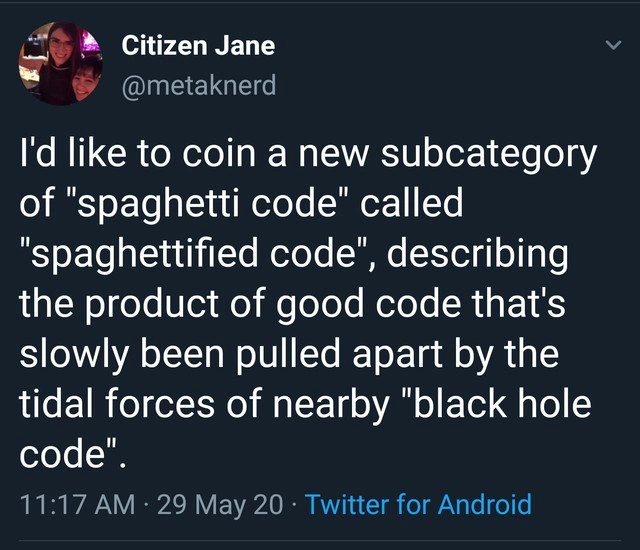
Citizen Jane (@metaknerd) gives voice to a nightmare every seasoned developer knows too well. She jokes about “good code slowly pulled apart by the tidal forces of nearby ‘black hole code’,” and it lands because it’s so true. We all wince-smile at this because we’ve watched it happen: a neat module or service starts out clean, but just maintaining it next to a huge mess of legacy code eventually drags it down into the muck. The humor works because it wraps a painful reality of TechDebt in a clever astrophysics metaphor. It’s like describing a car crash in terms of elegant orbital mechanics – darkly funny and spot on.
In day-to-day terms, picture a part of your system that’s notoriously ugly – maybe a core library or a God Object class that’s thousands of lines long. Nobody wants to touch this black hole code for fear of breaking production. It’s full of mysterious logic and “temporary” hacks from years ago (the kind with comments like // TODO: fix this later that have been there for 5 years become permanent). This thing is the archetype of spaghetti code: tangled control flow, hidden couplings everywhere – a real monster. Now imagine you’re tasked to develop a new feature right next to that monstrosity. You do your best to keep your codebase improvements modular and pristine. But as soon as you try to interface with the big mess, reality hits: you can’t get anything done without writing some ugly glue code.
Integration complete… but why does my clean code now have a dozen weird edge-case checks? 🤦♂️
Maybe your nice module must call a clunky legacy function that does 10 different things, so you have to contort your call to fit its expectations. Maybe the only way to get data is via a giant shared object, so now your code has to manage global state or copy-paste a serialization routine from the legacy side. Bit by bit, your clean code accumulates workarounds and odd dependencies purely from dealing with that neighbor. Your beautiful, decoupled design starts looking like a plate of spaghetti itself. Congratulations (and condolences): it’s been spaghettified.
This is a common lifecycle in LegacySystems. One part of the codebase – often an old, crucial module written under extreme deadline pressure – becomes a sinkhole of TechnicalDebt. It wasn’t built with maintainability in mind, but it “works,” so it stays. Over the years, every new developer who comes along to use or extend that part has two unpleasant choices: spend massive effort to rewrite or improve the black hole (and risk breaking everything), or take the path of least resistance and just adapt to it. Far too often, teams choose the second path: “We’ll refactor that nasty code later, but for now let’s just make our code handle its quirks.” (Spoiler: “later” never comes.) Each such adaptation feeds the black hole. It gets “heavier” with more patchwork, and its gravitational pull grows – meaning the next piece of code has to bend even more to accommodate it.
The Big Ball of Mud architecture is the formal name for this kind of system, and it’s essentially the end state of unchecked code entropy. A huge incoherent mass that everything plugs into. The meme paints it as a cosmic horror: the longer you leave a big ball of mud, the closer it gets to becoming a black hole. And we laugh (better to laugh than cry) because it often feels inevitable. There’s a sort of gallows humor among developers: “Yep, leave that one crappy module alone and soon the whole codebase will be crappy.” It’s the programming equivalent of a virus spreading or one bad apple spoiling the bunch. We joke about it with new jargon like “spaghettified code,” but behind the joke is real scar tissue.
Here are scenarios every senior dev recognizes as spaghettification in action:
- You design a new microservice with clean APIs, but it needs data from an old monolithic database full of weird, denormalized tables and magical constants. To work with it, your service code ends up littered with special-case handling (
if record.status == 42: // handle legacy flag). Your pure service is now married to the old database’s quirks. - You write a neat front-end component, but it calls an old back-end endpoint that returns inconsistent JSON (fields change names, types vary). So your clean front-end code winds up with a bunch of
// fix legacy responseparsing logic. The tidy separation between front-end logic and data format gets smeared with ugly patches. - Your team proudly follows modern design principles, but one core module uses global variables extensively. Any code interfacing with it has to set those globals or read them. Soon even code that was supposed to be isolated is implicitly dependent on that global state. It’s like gravity – inescapable influence pulling everything off course.
// Example of a "spaghettified" clean module interacting with black hole code
class CleanModule {
LegacySystem legacy = LegacySystem.getInstance(); // Gravitational anchor to a singleton
void process(Order order) {
// Originally, this method was simple and clean:
// validate(order); calculateTotal(order); save(order);
// But now we must deal with the legacy system's odd requirements:
order.formatForLegacy(); // Contort data to legacy's expected format
Result r = legacy.doEverything(order); // Call the monolithic legacy method
if (r.code == 42) { // Magic number from legacy indicating a special case
handleSpecialCase(r); // Extra workaround for legacy quirk
}
legacy.globalFlag = true; // Flip a global flag because legacy code needs it
// ... more spaghetti-like knots to appease the legacy system ...
}
}
Above: A once clean process() method is now peppered with weird accommodations for a LegacySystem. This is exactly “good code pulled apart by a nearby black hole code.” The new code can’t remain pristine; it has to play by the legacy’s messy rules, and thus it becomes messy too.
Cultural translation: developers share these stories with a mix of horror and camaraderie. We’ve all been the person muttering “Why on Earth does adding this feature require me to wade through 10-year-old spaghetti code?” It’s practically a rite of passage in software engineering. The meme nails it with an image of tidal forces because it often feels like an unstoppable natural phenomenon. No matter how many design patterns or best practices you know, when you’re tasked to work on that ancient, critical module from 2005, you get sucked in. The gravity of legacy code warps even the best intentions.
And that’s why this tweet is funny-sad to us. It acknowledges that writing maintainable code isn’t just about individual skill or knowledge – it’s also about context. Drop the best engineer into a dysfunctional codebase and watch the code they produce start to look… well, dysfunctional. It’s a cautionary tale: to protect your shiny new code from spaghettification, sometimes you have to pay off the technical debt at the core. Otherwise, the CodeQuality of the whole system will keep decaying. In the end, we chuckle at the meme because we’ve lived it. It’s a cosmic nod to that universal programmer experience: even stellar code can’t escape the pull of a “black hole” in the codebase. 🌠
Level 4: Event Horizon of Code
In astrophysics, spaghettification describes how objects get stretched into long noodle-like strands by intense tidal forces near a black hole’s event horizon (the point of no return). This meme cleverly maps that cosmic phenomenon to software. Here, a piece of “black hole code” represents a super-dense mass of technical debt and complexity in a codebase. Just as a black hole’s gravity can distort and pull apart objects, a monstrous blob of bad code can warp even well-designed modules that venture too close.
On a theoretical level, this analogy resonates with software entropy – the idea that a software system’s disorder tends to increase over time if we don’t actively keep it in check (much like the second law of thermodynamics). Manny Lehman’s laws of software evolution noted decades ago that as programs evolve, their complexity increases unless effort is spent to reduce it. A chunk of black hole code is like an entropy factory at the center of your system: it radiates complexity. Any pristine module orbiting this chaos may start bending its clean design just to interface with that mess.
Think in terms of coupling and system architecture. Ideally, modules have high cohesion and minimal coupling, interacting through stable, well-defined interfaces. But a black hole module often violates those ideals — it might be a gigantic function or an all-knowing object that everything else depends on. In a dependency graph, this part of the system would have an enormous number of edges going in/out, acting as a gravity well. As theoretically clean components attach to it, they experience “gravitational stress”: suddenly they must handle odd side-effects, global state, or quirky data formats from the core mess. Their code paths stretch and tangle, analogous to how intense gravity stretches objects into spaghetti.
It’s as if the normal rules of software design break down in the vicinity of this singularity of bad code. A module that was supposed to follow the Single Responsibility Principle might now be doing three extra jobs because the black hole code forces it – much like how the laws of physics get weird near an actual singularity. And just like nothing can escape a black hole beyond the event horizon, once a part of your system gets spaghettified by interacting with the big ball of chaos, it’s extremely hard to refactor it back out. The cost (in developer time and risk) to disentangle and “escape” that gravity can be astronomically high.
So on this deep level, the meme isn’t just a silly space joke – it’s pointing at a fundamental software truth. Without active counter-forces (refactoring, architectural oversight), codebase complexity naturally increases, and pockets of bad code exert a disproportionate influence. The humorous comparison to black holes underscores how inevitable and powerful this effect can feel. After all, in a sufficiently neglected system, a poorly designed core will pull everything around it into disorder, as surely as a collapsing star warps spacetime around it. The result? Clean code gets stretched and contorted beyond recognition – true “spaghettified code” on a cosmic scale. 🌌💻
Description
A screenshot of a tweet from user Citizen Jane (@metaknerd). The tweet reads: 'I'd like to coin a new subcategory of "spaghetti code" called "spaghettified code", describing the product of good code that's slowly been pulled apart by the tidal forces of nearby "black hole code".' The tweet was posted on May 29, 2020. This post introduces a clever and insightful metaphor for a specific type of code degradation. It uses the astrophysics concept of spaghettification - where an object is stretched apart by a black hole's gravity - to describe how a well-structured piece of code can become tangled and unmaintainable when forced to integrate with a large, poorly designed legacy system (the 'black hole code'). This concept is highly relatable to senior engineers who have witnessed their clean code's architecture erode over time due to the gravitational pull of technical debt in other parts of the system
Comments
7Comment deleted
Every legacy codebase has a 'black hole' module. Its gravity is so strong that not even light (documentation) can escape, and any new code that gets too close gets spaghettified into an unreadable mess
The billing module crossed its Schwarzschild radius last quarter - any well-structured PR that drifts within two directories gets spaghettified past the git-blame event horizon
The real tragedy isn't the spaghettified code itself, it's watching your perfectly abstracted service layer slowly add seventeen different workarounds for that one critical legacy module nobody's allowed to touch because Dave from 2008 hardcoded the CEO's email in it
This brilliantly captures the phenomenon every senior engineer has witnessed: you inherit a pristine microservice with clean architecture, SOLID principles, and 90% test coverage. Six months later, after 'just a few quick fixes' to integrate with that legacy monolith everyone's afraid to touch, your beautiful code has been stretched into an unrecognizable mess by the gravitational pull of the 200K-line God class with cyclomatic complexity approaching infinity. The event horizon is when you realize refactoring would take longer than a complete rewrite, but the business will never approve either
Spaghettification is what happens after three quarters of “temporary” utils, a god object, and a microservices migration that still orbits the monolith - nothing escapes the Common module’s gravity well
Our core repo is a black hole: sprints dilate at the event horizon, logs never escape, and any clean module crossing it spaghettifies into a 900-line Utils
Spaghettified code: LGTMs acting as tidal forces, turning pristine lambdas into an event horizon of untraceable side effects