Debug Logs in Production: A Public Announcement
Why is this Deployment meme funny?
Level 1: Hide-and-Seek Spotlight
Imagine you’re playing a game of hide-and-seek with your friends. You’ve found a super secret hiding spot, and you’re sure no one will find you. To keep yourself entertained while hiding, you start humming a little song or you accidentally turn on a flashlight you had. Suddenly, that quiet, dark hiding spot isn’t so quiet or dark anymore. Your flashlight’s beam shoots up like a big signal, or your humming gives away your location. All your friends hear/see it and shout, “Aha, we found you!”
This meme is like that scenario, but for a computer program. The programmer had something secret (a debug log, which is like a little note or signal inside the program just for them) that they forgot to turn off before letting everyone use the program. When the program went live for all the users (we call that production, meaning it’s out in the real world), that secret note started shining bright, kind of like the flashlight in hide-and-seek. It wasn’t supposed to be seen by others, but because the programmer forgot about it, now it’s super obvious.
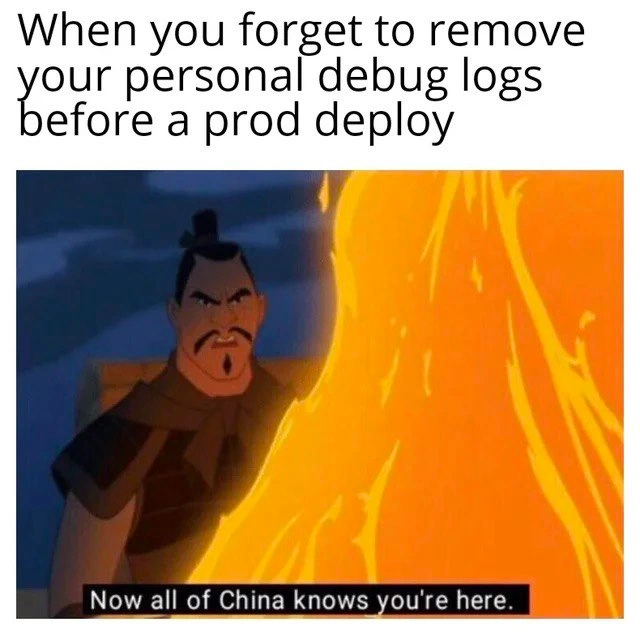
In the picture from the meme, a giant flame is shooting into the sky and a character says, “Now all of China knows you’re here.” That’s a dramatic way of saying “everyone noticed you.” It’s as if the programmer’s little mistake turned into a big blazing fire that says “HEY, I’M OVER HERE!” to the whole world. Of course, in reality it’s just the team or the people watching the program’s logs who notice, not literally all of China! 😂 But to the embarrassed programmer, it feels like the whole world found out.
So, the funny part is the exaggeration: a tiny mistake (a forgotten log message) is depicted as this huge signal fire. It’s poking fun at how a small oops can become very visible. Even though it’s a technical joke, at its heart it’s relatable to anyone: it’s like accidentally drawing attention to yourself when you were trying to stay low-key. Just like accidentally making noise when you’re hiding, the programmer’s forgotten log made a loud “look at me!” in the live system. And that is why it’s both funny and a bit cringe-worthy – we've all had moments where a slip-up became way more obvious than we ever wanted!
Level 2: Forgotten console.log
This meme is highlighting a common deployment blunder: a programmer left a debug log message in the code and deployed it to production (the live environment). The top text basically says what's going on: "When you forget to remove your personal debug logs before a prod deploy." In other words, the developer had put some temporary logging in the code (perhaps using a console.log() in JavaScript or a print() in Python) to help debug or test the program, and then forgot to take it out when publishing the app for real users. Oops!
The image below the text is from Disney’s Mulan. It shows a character staring at a huge signal flame and the subtitle, "Now all of China knows you're here." In the film, lighting such a flame is a way to alert far-away troops — basically an ancient alarm system. In the context of the meme, that giant flame is a metaphor for an overly obvious debug log left running in the app. The phrase implies that because of that one log, everyone now knows about the developer’s presence (and mistake) in the code. It humorously suggests that a private debugging message has turned into a public announcement.
Let's break down why this is a big deal in tech terms. Logging is the practice of writing out messages from an application to some output (like a file or console) to record what's happening. Developers use logs to monitor applications and to help with debugging_troubleshooting when things go wrong. Logs have different levels (categories of importance/verbosity), commonly:
- DEBUG – very detailed information, usually only useful for developers (too noisy for normal operation).
- INFO – general informational messages about application progress.
- WARN – something unexpected happened, or an issue is near, but the app is still working.
- ERROR – something went wrong; an operation failed or a serious issue occurred.
In a production environment, applications typically run with the log level set to INFO or WARN, meaning DEBUG messages are turned off and not recorded. That’s because debug logs can be extremely verbose (lots and lots of details) and may even include sensitive information. You generally don’t want debug logs in production unless you’re actively diagnosing a problem.
However, if a developer forgets a log statement in the code — especially one written as plain output like console.log("Entered function X, value =", secretValue) — it will execute in production regardless of the logging level settings (because it’s literally a hard-coded print). That means every time that part of the code runs, it will print that message in the production logs. Imagine deploying an update and suddenly your log files or monitoring dashboards start showing messages that were never there before, like:
// Example of a debug log left in the code by accident
function processOrder(order) {
console.log("DEBUG: processing orderId =", order.id, " at ", new Date().toISOString());
// ...the rest of the order processing logic...
}
If this runs on every order, your logs will now have a line for each order saying “DEBUG: processing orderId = 1234 at 2023-05-01T12:00:00.000Z”, etc. That’s a ton of noise! It’s verbosity_overload – a flood of messages that aren’t actually necessary for normal ops. Anyone watching the logs will immediately notice this strange, extra chatter. It’s like hearing a loud, repetitive clang in an otherwise smooth-running machine.
Now, consider observability and monitoring tools that many companies use. These are systems (like the Elastic Stack/Kibana, Splunk, or CloudWatch) that collect and display logs from all your servers and services in one place. They often highlight unusual patterns, spikes, or new types of log entries. The moment you deploy code with an unexpected debug print, those tools will capture it. Teammates or SREs (Site Reliability Engineers) who keep an eye on logs might see something like “DEBUG: processing orderId ...” and go, “Huh, we don’t usually log at DEBUG in prod… what is this?” Essentially, your little debug line raises a flag.
The meme jokingly says “it’s like now all of China knows you’re here” because in an engineering team, everyone could become aware of your mistake quickly: it's visible in the logs to anyone who looks. It’s common for teams to have alerts or at least conventions around logging. For example, if a service suddenly starts spewing hundreds of lines per minute more than usual, an alert might trigger, or at least people will notice the jump. Or if the content of the log is embarrassing (like containing the developer’s name, or a message like “Temporary check, please remove”), somebody will likely post it in the group chat. In any case, it draws attention.
Another aspect is sensitive_logs_exposure. Debug logs might inadvertently print out data that shouldn’t be seen outside of a secure environment. This could be user personal information, passwords, API keys, etc. Good practices and company policies usually forbid that, but a quick-and-dirty debug line added in a rush might ignore those rules. If that goes to production, even if it’s just in the logs, it’s a leak of sensitive info. It’s like writing secrets on a piece of paper and then accidentally dropping it in the town square — not good. So forgetting to remove a debug log can have stakes higher than just humor; it can become a real security or privacy problem.
In simpler terms, this meme is a funny warning. Deployment of code should include cleaning up those personal debug statements. They are meant for you when testing, not for everyone when live. The developer in the meme’s scenario learned this the hard way: one careless println and it’s as if they set off a giant signal fire in the production logs. The whole team knows something’s up, and the developer who left it in might get a gentle ribbing (and a note to be more careful next time).
Level 3: Signal Fire Logging
Picture this: it's late, you're deploying to production, and you left a sneaky debug print in your code. Next thing you know, your observability stack lights up like a bonfire. This meme nails that scenario. The top caption sets the stage: "When you forget to remove your personal debug logs before a prod deploy." The image below (borrowed from Disney’s Mulan) shows a massive flame signal and the villain snarling, “Now all of China knows you're here.” In dev terms, that towering flame is your verbose log output, and “all of China” is basically everyone monitoring the system. One stray console.log or println and suddenly your presence in the codebase is broadcast loud and clear, like a beacon on the Great Wall.
From a senior engineer's perspective, this is a classic production issue and a bit of a horror story. Modern deployments funnel logs into central systems (Splunk, ELK, Datadog — you name it), so forgotten log statements stick out like a neon orange flag. You deploy, thinking everything is fine, and then the on-call engineer’s dashboard starts flashing with an unusual message that wasn’t there before. Maybe it’s a line like DEBUG: reached orderProcessing(), hope this works spewing on every request. It's as subtle as a signal fire in a dark sky. In the movie, lighting that fire prompts Shan Yu to quip, "Now all of China knows you're here." In real life, your little debug statement basically shouts, "Now the whole team knows what you did." There’s no hiding — the logs have tattled on you.
Why is this so humorous (and painful)? Because it’s developer humor grounded in reality. We’ve all been there (even if some won’t admit it). You needed that console.log or print() to troubleshoot a tricky bug in staging. You swore you’d remove it before merging. But come deploy time, maybe you were in a rush or fighting merge conflicts, and it slipped through. Next morning, the observability_monitoring tools are showing a spike of weird log entries. Your personal, informal debug message — something meant for your eyes only — is now in the official logs. It’s like writing a secret note to yourself but accidentally airing it on the company bulletin board. Deployment pain points like this turn into team-wide entertainment (or irritation). Expect a friendly razzing on Slack: “Hey, who’s the genius behind 'DEBUG: Starting sync now 🎉' in our payment service logs?” Oof. Nothing says “professionally tested code” like shipping a line of text you never meant anyone else to see.
Beyond the embarrassment, there are real consequences. Those logs can create verbosity overload in your monitoring systems, making it harder to spot real issues amid all the noise. They might even contain sensitive_logs_exposure if you were really careless (e.g. printing out user data or secrets). In the worst case, a harmless-looking println can dump private info or flood your log storage, turning a silly mistake into a minor incident. Now you’re not only blushing in front of teammates, you’re hastily patching and redeploying to snuff out that signal fire.
The reason this meme hits home for seasoned devs is because it dramatizes a simple truth: a tiny oversight in a deployment can feel like a huge, flaming spotlight on you. It’s absurd and funny that a lone debug statement — probably added with the noble desperate intention of troubleshooting — ends up announcing itself to the whole world (or at least the whole engineering org). The combination of the Mulan reference (giant fiery beacon) with the context of logging is spot-on. It’s a tongue-in-cheek reminder to all developers: check your commits for console.log and TODO: remove comments, or you might set off an observability signal fire of your own. And trust me, once you’ve been that coder caught by their own logs, you’ll triple-check next time — because nobody wants to light the prod environment up like a Christmas tree again. 🔥💻
Description
The meme uses a scene from Disney's animated movie Mulan. The top text reads, "When you forget to remove your personal debug logs before a prod deploy". The image below shows the character Li Shang with a stern, angry expression. Next to him is a massive, brightly lit signal fire. The subtitle at the bottom, taken from the movie, says, "Now all of China knows you're here." This meme humorously captures the high-visibility mistake of deploying code to production with debug logs still enabled. These logs, intended for development, can expose sensitive information, create unnecessary noise, and make the application look unprofessional. The signal fire is a perfect metaphor for how quickly such an oversight becomes visible to everyone - users, clients, and other engineers - making it a very public and often embarrassing failure. For senior engineers, it's a relatable reminder of a simple but critical step in the deployment checklist that can have significant consequences if forgotten

Comments
7Comment deleted
My debug logs in prod are like a surprise AMA session with my application's internal monologue
Left a cheeky console.log('still alive') in the hot path - Splunk lit up like a beacon, SRE paged me, and Finance discovered the most expensive heartbeat monitor ever built
The worst part isn't the exposed logs - it's explaining to the security team why your production CloudWatch bill includes 47,000 instances of "TODO: fix this garbage before Dave notices"
The real horror isn't just that your debug logs made it to production - it's when you realize they're being aggregated in a centralized logging system that the entire company has access to, complete with your 'TODO: fix this garbage code' comments, hardcoded API keys you were 'temporarily' testing, and timestamps proving you deployed at 2 AM on a Friday. At least the PagerDuty alert about the GDPR violation will arrive before your morning coffee
Deployed with DEBUG logs? Your ELK stack just became the world's largest confessional booth - now even Shan Yu knows your merge regrets
Ship with DEBUG=true and a stray console.log('afterLogin', user.email) - congrats, you implemented planet-scale PII fan-out without Kafka and with a surprise Datadog invoice
Deploy with your personal debug logs still on and watch TRACE turn into a broadcast protocol - Security files a GDPR incident, Finance upgrades Datadog, and SRE pastes your snark in Slack