Skip to content
DevMeme
2640 of 7435
Telegram Bot Development: A Self-Fulfilling Prophecy
API Post #2919, on Apr 9, 2021 in TG

Telegram Bot Development: A Self-Fulfilling Prophecy

Why is this API meme funny?

Level 1: Robots Build Robots

Imagine you have a friendly robot helper, and whenever you want a new robot friend, you simply ask your helper to make one for you. It sounds a bit funny and magical, right? That’s what’s going on here: the developer is asking one bot (an automated chat program) to create another bot. The picture shows a big, serious-looking character (Thanos from a superhero movie) to make it feel like a dramatic big deal, even though it’s actually a playful tech joke. The funny part is realizing one robot is basically giving birth to another robot at the developer’s command. It’s like using a machine to build another machine for you. Even a kid can see the silliness: it’s a little loop of robots making robots, and that surprise twist is what makes everyone laugh and say, “Whoa, that’s clever – and kind of cool!”

Level 2: BotFather 101

So what’s actually happening here? In Telegram, if you want to create a new chatbot, you don’t fill out a form on a website or write some low-level code first – you talk to BotFather. BotFather (a playful reference to The Godfather, but for bots) is an official Telegram account that is itself a bot. It’s essentially the admin interface for creating and managing other bots on Telegram. When the meme says “using chat to set it up,” it means the developer is literally sending text commands in a chat conversation with this BotFather bot to get things done. For example, you might send BotFather a command like /newbot to start the process of registering a new bot. BotFather then asks you for a name and username for your bot, and finally it provides you with something very important: an API token (a long string of letters and numbers). This token is like the secret passcode your program will use to connect to Telegram’s servers via the Telegram Bot API. In simpler terms, the token lets your code act as your new bot in Telegram, sending and receiving messages.

Here’s a tiny peek at what that chat might look like:

You: /newbot  
BotFather: Alright, a new bot. How are we going to call it? Please choose a name for your bot.  
You: ThanosHelperBot  
BotFather: Good. Now let's choose a username for your bot. It must end in 'bot'.  
You: ThanosHelperBot_bot  
BotFather: Done! Congratulations on your new bot. You will find it at telegram.me/ThanosHelperBot.  
BotFather: Use this token to access the HTTP API: 123456:ABC-DEF1234ghIkl-zyx57W2v1u123ew11  
BotFather: Keep your token secure and store it safely, it can be used by anyone to control your bot.  

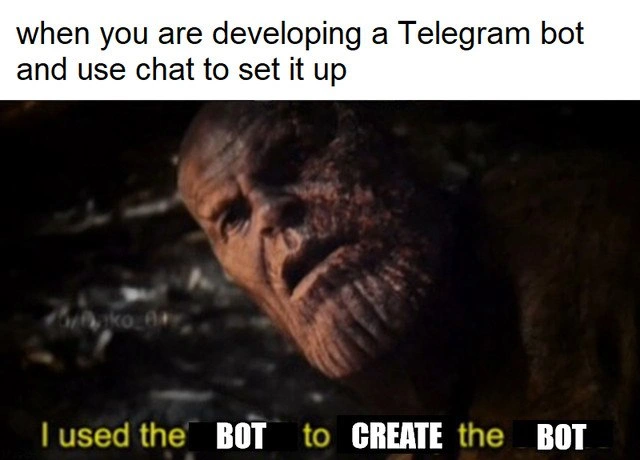
As you can see, it’s all very conversational. The developer isn’t logging into a dashboard or running a special program; they’re just chatting, as if texting a friend – except the friend is a service that sets up bots. This meme highlights that quirky reality with the line “I used the BOT to CREATE the BOT.” It’s a direct parody of a famous Infinity War quote from Marvel’s Avengers. In the movie, the villain Thanos says he “used the Stones to destroy the Stones,” talking about Infinity Stones (powerful objects in the story). The meme replaced “Stones” with “Bot” to fit our tech scenario. The image shows Thanos’s face looking serious and a bit sad, which in the film happens at a dramatic moment. By using that image, the meme makes our simple Telegram bot setup feel hilariously momentous — as if using BotFather is some grand, possibly bittersweet act.

Let’s break down why it’s funny in plainer terms: We usually think of a bot as something we create or program, right? But here, to create a bot, we’re using another bot. It’s like a small paradox. It feels almost like the system is alive and procreating on its own! For a newcomer, this might be surprising: “Wait, I have to chat with a bot… to make my bot?” But that’s exactly how Telegram designed it, and it’s actually pretty convenient. It’s a bit like going to a helpful librarian (BotFather) when you want to register a new library card (your new bot) — the librarian is part of the same system you’re joining. In developer terms, BotFather is providing a user-friendly interface (the chat) to an otherwise technical process (obtaining API credentials and setting initial settings for your bot). This resonates with anyone who’s delved into APIDevelopmentAndWebServices for chat platforms, because it’s a neat shortcut. Instead of manually copying IDs around different tools, Telegram keeps you in one familiar place (the chat app itself) to handle bot creation. The outcome is the same: you get your bot’s credentials, but the method feels amusingly self-referential. And to top it off, the meme uses a big Marvel reference which most techies recognize, mixing pop culture with programming humor — classic DeveloperHumor material.

In summary, the meme jokes that creating a Telegram bot using BotFather is like some ultimate power move. It points out the recursive loop: a bot (BotFather) giving birth to another bot (your creation). There’s no actual problem or pain here — it’s more of a “haha, isn’t it cool and kinda funny that it works this way?” moment. If you’re a junior developer just learning about Telegram bots, don’t worry: using BotFather is the intended (and straightforward) way to do it. The meme is just playfully exaggerating how ironic and meta it feels. After all, not every day do you see software creating more of its own kind in a casual chat window!

Level 3: Bots All the Way Down

At the heart of this meme is a brilliant bootstrapping paradox in the world of APIs and Automation. The developer is creating a Telegram chatbot using another Telegram chatbot – a scenario so meta it hurts (in a good way). In practical terms, you’re interacting with BotFather, Telegram’s official bot management bot, to spawn your own new bot. It’s a real-life example of recursive tooling: using a tool to create more tools. Seasoned devs see the humor because it’s like a coding matryoshka doll – one bot encapsulating the birth of another. This pattern tickles experienced engineers who’ve seen parallels in other domains, like compilers written in the very language they compile or scripts generating code on the fly. In other words, recursive_bot_creation is both powerful and slightly absurd, and that absurdity is exactly what makes it memorable.

The meme cleverly overlays a dramatic Thanos meme template to drive the point home. In the Avengers saga, Thanos gravely says, “I used the Stones to destroy the Stones,” implying a grand, ironic sacrifice. Here it’s remixed as “I used the BOT to CREATE the BOT.” The moment is exaggerated by Thanos’s remorseful face, which in the movie conveyed the weight of an inevitable act. For developers, setting up a bot via BotFather isn’t exactly saving the universe, but it does feel ironically grand in its own small way. The humor comes from that contrast: a mundane developer task framed like an epic, fate-of-the-world decision. It’s an inside joke for those who’ve juggled TelegramApp scripts and the Telegram Bot API, highlighting how far our tools have come. After all, instead of slogging through a web console or manual keys exchange, we now have a conversational interface that offers us an API token with a polite chat message. That’s both DeveloperHumor gold and a nod to how user-friendly developer workflows can be.

This meme resonates especially with API enthusiasts and chatbot creators because it captures the seriously? wow! moment when you first realize the BotFather bot is effectively the gatekeeper for your bot. It’s a bit of an inception vibe: a bot within a chat, helping you create another bot that will live in chat. Veteran developers might chuckle, recalling similar bootstraps in tech history — from compilers that compile themselves, to container systems spinning up other containers. The Telegram approach is a benign twist on ChatOps: performing operational tasks (like provisioning a new service user) through a friendly chat conversation. By using a bot to register another bot, Telegram has essentially made bot creation as casual as messaging a colleague. The irony isn’t lost on us: it’s like the platform is so confident in its automation that it consumes itself to reproduce. In a tongue-in-cheek way, we could say this is Automation so advanced, it’s turned the whole setup process into a self-serve chatbot buffet. And much like Thanos declaring himself inevitable, the rise of such recursive automation feels equally inevitable in modern development workflows.

Description

This meme uses the 'I used the stones to destroy the stones' format featuring the character Thanos from the Avengers films, but adapted for a tech context. The top text reads, 'when you are developing a Telegram bot and use chat to set it up'. The image below shows a close-up of Thanos's determined face, with the subtitle altered to say, 'I used the BOT to CREATE the BOT'. The words 'BOT' and 'CREATE' are highlighted in black boxes for emphasis. The humor stems from the meta and circular process required to create a Telegram bot. Developers must interact with a special, official bot called 'BotFather' within the Telegram chat interface itself to register a new bot, receive an API token, and configure its basic settings. This meme perfectly captures that recursive feeling of using the very system you're building for in order to build with it
Comments

9
Anonymous ★ Top Pick The original serverless architecture: convincing a bigger, angrier bot to provision your bot's soul stone, otherwise known as the API token
  1. Anonymous ★ Top Pick

    The original serverless architecture: convincing a bigger, angrier bot to provision your bot's soul stone, otherwise known as the API token

  2. Anonymous

    Using BotFather to spin up my bot feels like running terraform apply from the AWS console - sure, it works, but now the recursion has admin rights

  3. Anonymous

    The real infinity stone is realizing you've spent 15 years building sophisticated CI/CD pipelines and infrastructure-as-code, only to configure your bot by typing '/newbot' to another bot like you're playing a text adventure from 1985. Next you'll tell me the webhook configuration requires sending emojis in a specific order

  4. Anonymous

    The ultimate chicken-and-egg problem in bot development: when your deployment pipeline is literally a conversation with the thing you're deploying. It's like using git to version control the .git directory itself - technically possible, philosophically questionable, and absolutely the kind of meta-recursion that makes you question whether you're automating your workflow or just creating an elaborate Rube Goldberg machine. At least when it breaks, you can chat with it about its feelings

  5. Anonymous

    @BotFather embodies the perfect SRE bootstrap: a self-spawning service in a chat protocol, because nothing says 'cloud-native' like recursive provisioning without a human dashboard

  6. Anonymous

    BotFather is the only control plane where idempotency depends on scrolling up; /newbot is your Terraform, and screenshots are the audit log

  7. Anonymous

    Telegram’s BotFather is meta‑circular deploy: DM a bot to create a bot. Works great - right up until compliance asks for the Terraform plan

  8. @coderozie 5y

    I used the bot to create the bot that can run bots inside itself

    1. @NiKryukov 5y

      What are you doing step-botfather

Use J and K for navigation