Skip to content
DevMeme
2785 of 7435
The Audacity of Requesting IT Support During Lunch
Stakeholders Clients Post #3081, on May 11, 2021 in TG

The Audacity of Requesting IT Support During Lunch

Why is this Stakeholders Clients meme funny?

Level 1: Everybody Needs Lunch

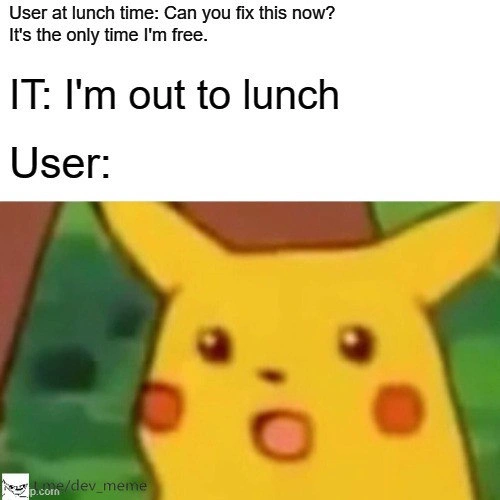
Imagine you walk up to an ice cream shop wanting a cone, but you happen to get there during the shopkeeper’s lunch break. The shop has a sign that says “Back in 30 minutes – Out to Lunch.” You really wanted ice cream right now because it’s the only free moment you have. But the shopkeeper is a person who needs to eat lunch too, right? You might feel surprised or a little annoyed that you can’t get what you want exactly at that moment. That’s basically what this meme is showing, but in an office setting. The “user” is like you wanting ice cream, and the “IT person” is like the shopkeeper who stepped away to eat. The user asks for help fixing something at the exact time the IT person is having lunch. The IT person says, “I’m out to lunch,” which means “I can’t help you right now.” The funny part is the user’s face – the surprised Pikachu cartoon – looking all shocked. It’s silly because, of course, the IT person is taking their lunch break; everybody needs to eat! The meme makes us laugh because the user looks as astonished as if something unbelievable happened, when really it’s the most normal thing in the world. In simple terms: someone asked for help at a bad time and was shocked to find out the helper wasn’t available – and we’re reminded that even the people who fix our computers need their sandwich time.

Level 2: Expectations vs Boundaries

Let’s break down what’s happening in simpler terms. In a typical workplace, IT support (the folks who fix computers, software issues, and other tech problems) have working hours just like everyone else – and that includes a lunch break. In this meme, a user (an employee who needs help) asks, “Can you fix this now? It’s the only time I’m free.” And when does he ask? Right in the middle of lunch time. The IT person replies, “I’m out to lunch,” which is a common phrase meaning “I’m on my lunch break and not available to work right this minute.” The funny part is the next bit: the user is shocked – represented by the big Surprised Pikachu face, an image commonly used online to show someone looking completely surprised. The humor comes from the fact that the user really shouldn’t be surprised here. Why? Because it’s perfectly normal (and expected) that the IT person wouldn’t be immediately available while taking a lunch break. It’s a classic case of misaligned expectations: the user assumed help would be instant, but the IT staff assumed they could eat in peace.

Let’s clarify a few terms and ideas. The user is basically a stakeholder in this scenario – meaning they have a stake in getting something fixed (it’s important to them). The IT person is providing a service (tech support). Normally, offices have some process for these requests: often you’d open a ticket or schedule a time to get help, especially if it’s not an emergency. That helps avoid situations like this one. Here, the user didn’t follow a formal process; instead, they just approached the IT person at a time convenient for them (the user) without considering if it’s convenient for IT. That’s where the communication breakdown happened. The user says “It’s the only time I’m free,” implying they’re busy all other times – but they didn’t stop to think that the IT support might also have a schedule (and a need to eat!). The IT person’s response, “I’m out to lunch,” is basically them communicating, “I can’t help you right now.” It’s not a flat-out “No, never,” it’s a “Not at this very moment.” However, the user in the meme reacts with surprise, as if this response was totally unexpected.

This scenario is very relatable in WorkplaceHumor because many of us have experienced something similar. For a junior developer or anyone new in a tech environment, the lesson here is about expectations vs. boundaries. Expectation: The user expected that if they’re free and need help, the IT person would jump in immediately. Boundary: The IT person has a reasonable boundary – lunch time is personal time, not to be booked for ad-hoc work (unless it’s truly urgent). There’s an unwritten workplace etiquette that you generally shouldn’t demand someone’s work help during their break unless it’s an emergency. And usually, “the only time I’m free” for the requester might still not be an acceptable time for the person providing the help. This is why scheduling and communication are key. If the user had communicated earlier (“I have a problem; can we fix it sometime today?”), the IT support could’ve said, “Sure, let’s do it at 1:00 PM after lunch.” Both would be happy. Instead, asking at 12 noon sharp puts the IT person in a tough spot.

Now, about that big Pikachu image labeled “User:” at the bottom – that’s the meme’s way of showing the user’s facial expression without words. Surprised Pikachu is a well-known meme originating from the Pokémon cartoon, where Pikachu has this blank, astonished look. Online, people use it to poke fun at situations where someone is unexpectedly surprised by an outcome that was actually quite obvious. In our context, the obvious thing is: if you ask for help while the helper is on their lunch break, you might get told “please wait” – and yet the user is depicted as wide-eyed with shock about it. It’s a playful jab at the user for not anticipating something so normal. Developers and IT workers share this meme because it’s a lighthearted way to say, “Hey, we need our lunch break, and it shouldn’t be surprising that we can’t always drop everything for you at any moment.” It encapsulates a small Communication issue in a funny, very Relatable image. In short, the user’s stakeholder expectations (instant help on their schedule) clashed with the IT person’s boundaries (lunch break is off-limits), and the result was a comical misunderstanding captured perfectly by that Pikachu “:O” face.

Level 3: SLA vs BLT

This meme captures a classic IT support standoff where stakeholder expectations collide with real-life boundaries. On one side, the user (likely an employee who needs something fixed) casually drops a request during lunch: "Can you fix this now? It's the only time I'm free." On the other side, IT support responds with a perfectly reasonable "I’m out to lunch." The punchline? The user’s reaction is the famous Surprised Pikachu face – a wide-eyed, open-mouthed look of shock at this completely predictable outcome. It’s a comedic portrayal of MisalignedExpectations: the user assumes instant service at their convenience, while the IT person asserts a basic personal need (a lunch break). The humor hits home for developers and IT folks because we’ve all seen this too real scenario where someone is astonished that tech support isn’t available on-demand 24/7.

At a deeper level, this image riffs on workplace culture and the unsung importance of respecting schedules. The Surprised Pikachu format is internet shorthand for “Act surprised when the inevitable happens.” Here, it highlights the user’s naive disbelief that an IT staffer might be unavailable at lunchtime. It’s essentially saying: User makes an inconvenient, last-minute demand; IT declines due to totally normal reasons; User is shock-faced. For those in the industry, this is a wink at all the times we’ve encountered a “fire drill” request born from someone else’s poor planning. In IT and software teams, there’s a well-worn adage:

“Lack of planning on your part does not constitute an emergency on mine.”

This meme is that proverb in action. The user’s “It’s the only time I’m free” line exposes a communication gap — they’re prioritizing their schedule without considering the support team’s schedule. In a well-run environment, urgent fixes are handled through proper channels (like filing a ticket or paging on-call) and non-urgent requests respect working hours and breaks. Dropping a request at noon because it’s convenient for you is a one-way ticket to a CommunicationBreakdown. The IT reply, “I’m out to lunch,” is basically a polite HTTP 503 status for humans: Service Unavailable (please try again later). It sets a boundary. The meme’s comedy stems from the user reacting with genuine surprise – as if saying, “Wait, you’re not here to serve me at my beck and call?” The RelatablePain here is palpable; IT professionals chuckle (or groan) because they’ve lived this moment of awkward disbelief.

To seasoned devs and sysadmins, the scenario is painfully familiar. We’ve juggled StakeholderExpectations, often dealing with folks who assume IT has infinite availability (spoiler: we don’t). The user’s perspective is, “This is my free time, so shouldn’t it be your free time to fix things for me?” Meanwhile, the IT perspective is, “Lunch break = personal time. Not the best moment for unscheduled tech support.” There’s an implicit guilt trip in “It’s the only time I’m free,” which experienced IT workers recognize as a red flag – an attempt to make their lack of planning into your urgent problem. The Pikachu face nails the absurdity: the user is effectively stunned that the IT staff are humans who need to eat. It’s funny because it’s true – some users unconsciously treat IT like vending machines that should dispense fixes any time you push the button. This meme draws that parallel with tongue-in-cheek clarity.

From a senior perspective, it also hints at how corporate culture should work versus how it often does. Ideally, companies have policies so that support teams aren’t skipping meals to appease ad-hoc requests. Many IT departments set up on-call rotations or Service Level Agreements (SLA) that outline response times – and you can bet “dropping everything during lunch” isn’t in the standard SLA. (In other words, no SLA covers forfeiting your BLT mid-bite! 🍔) But not every organization enforces those boundaries. The humor cuts a bit deep because plenty of IT folks have indeed been pressured to solve “one quick thing” during their lunch, or right at quitting time. Here, though, the IT person simply says “I’m out to lunch,” asserting a healthy boundary. The user’s Pikachu-like shock suggests they’re not used to hearing “not right now.” It’s a mini culture clash: one side values personal well-being and workflow, the other side is blindsided that the world doesn’t revolve around their schedule.

Technically speaking, you could liken the IT support’s unavailability to a planned downtime in a system. Just as servers have maintenance windows, people have lunch breaks. If you call an API when the service is down, you get an error; if you ask IT for help when they’re on break, you get a polite “try again later.” In code form, it might look like:

def request_fix(time_of_day):
    if time_of_day.is_between("12:00", "13:00"):  # lunch hour window
        raise ServiceUnavailable("IT is out to lunch. Please try again later.")
    else:
        return "Sure, let's fix it!"

In this snippet, if someone requests a fix during the lunch hour, a ServiceUnavailable exception is raised – exactly analogous to the IT person saying they can’t help at that moment. The user's Surprised Pikachu reaction is like catching an exception they should have seen coming. Seasoned developers smirk at this because it’s a gentle reminder that even in our meticulously engineered systems with zero-downtime deployments, the human element (like a lunch break) is non-negotiable. The surprise is inherently funny: it spotlights how one party failed to anticipate a totally normal condition. In short, DeveloperHumor at its finest – highlighting a real workplace friction with a bit of meme-flavored irony.

Description

A two-part meme using the 'Surprised Pikachu' format. The top section contains a dialogue in plain black text on a white background. It reads: 'User at lunch time: Can you fix this now? It's the only time I'm free.' followed by 'IT: I'm out to lunch' and 'User:'. The bottom section features the well-known image of Pikachu with its mouth agape in a look of utter shock. A watermark for 't.me/dev_meme' is visible in the bottom-left corner. The meme humorously captures the frustratingly common scenario where a user, only free during their own lunch break, expects an IT professional to be on-demand, completely disregarding that the IT person also needs a break. The user's surprised reaction highlights a comical lack of self-awareness and is relatable to anyone in a technical support or on-call role
Comments

8
Anonymous ★ Top Pick Some users seem to think IT's availability is a globally accessible singleton instance that doesn't have a garbage collection cycle for lunch
  1. Anonymous ★ Top Pick

    Some users seem to think IT's availability is a globally accessible singleton instance that doesn't have a garbage collection cycle for lunch

  2. Anonymous

    Thinking of adding MTBL - Mean Time Between Bites - to the SLA, since users assume a zero-downtime hotfix, a blue-green deploy, and a miracle can all fit between my forkfuls

  3. Anonymous

    The same person who schedules their printer issues around their lunch break somehow never discovered the ticket system we've been evangelizing for five years - but they did find my personal cell number within two days of joining

  4. Anonymous

    The classic P0 incident: 'Production is down!' Severity: User can't access their personal email during their lunch break. Root cause: IT staff also require sustenance. Resolution: Implement SLA that includes basic human needs. Estimated time to fix: 30 minutes plus however long it takes to explain that 'urgent' doesn't mean 'convenient for me specifically.'

  5. Anonymous

    Humans aren’t preemptive; my lunch has the mutex - open a ticket unless it’s a non‑maskable interrupt (prod down)

  6. Anonymous

    Classic priority inversion: user's low-priority ticket preempts IT's critical path - lunch

  7. Anonymous

    Unless it’s Sev1, lunchtime requests get 503 Service Unavailable with a Retry-After header - call it human backpressure

  8. @akhmadjonpulatov 5y

    😂😂😂

Use J and K for navigation