Skip to content
DevMeme
2786 of 7435
Java vs. Kotlin: A Classic JVM Standoff
Languages Post #3082, on May 12, 2021 in TG

Java vs. Kotlin: A Classic JVM Standoff

Why is this Languages meme funny?

Level 1: Schoolyard Standoff

Imagine you have an older kid and a younger kid at school who are both good at doing class projects. The older kid, let’s call him Java, has been the go-to helper for the teacher for a long time – he’s reliable and everyone knows him. One day, a new kid named Kotlin joins the class. Kotlin is super smart and has some cool new tricks to get projects done faster and maybe with more style. Now, it’s like there’s a little competition: Kotlin starts to steal the spotlight, showing off some fancy, efficient ways to do the assignments that impress the teacher. You can picture Kotlin’s shadow looming over Java, meaning people are paying a lot of attention to this newcomer. This is kind of like when a new kid shows up and suddenly everyone’s talking about them – it doesn’t mean the old kid did anything wrong, just that the new kid is exciting and different.

But Java, the older kid, isn’t just going to disappear or give up. He’s still in class every day, doing a solid job like always. In fact, Java stands up and says, “Hey, I can do great stuff too!” Maybe he even learns a couple of new tricks after seeing Kotlin (just like a kid might start using a new gadget or method they saw the new kid use). Java essentially fires back, reminding everyone that he’s still very capable. It’s like Java is saying, “I might be older, but I’m not out of the game yet!”

Now imagine this scene like an old-timey cowboy duel on the playground:

  • Kotlin is the new cowboy in town, quick and flashy.
  • Java is the old cowboy with lots of experience.
    They face off to see who’s the best. All the other kids (the bystanders) are watching. Kotlin might pull off a cool move that makes a big shadow (wow factor), but Java still has some tricks and might shoot a can off the fence to show he’s not to be underestimated. In the end, it’s kind of funny because you realize both can exist together in the school or town. The rivalry makes a good story (and a funny picture), but in real life, they often end up working on different projects or even together.

The emotion of the joke comes from this idea: we often cheer for the new hero (because new things are exciting and can make life easier), but we also recognize the old hero who’s been dependable for so long. It’s funny because we imagine them as cowboys in a showdown, when really in a classroom or a project they’d probably just sit next to each other and use their strengths where appropriate. So, the meme is like a playful cartoon of a real situation: a new thing becoming popular while the older thing is still around and kicking. Everyone who knows these two “kids” (or languages) can chuckle at how it’s portrayed as a Wild West duel – because sometimes that’s exactly how tech discussions feel, a bit dramatic like a schoolyard or cowboy showdown, even though we all know there’s room enough for both in the end.

Level 2: A New Sheriff in Town

Let’s break down the meme and the tech terms in a simpler way. This meme is comparing two programming languages, Java and Kotlin, by imagining them as cowboys in a Wild West duel. Java is like the long-time sheriff of the town (he’s been the main language for many projects for decades), and Kotlin is the new gunslinger who just rode in with fancy new tricks, possibly becoming the new sheriff. The big joke is that there’s a “showdown” (a competition) between these two languages for popularity and use, especially in making Android apps and back-end systems.

First, who are these two duelists?

  • Java is a very popular programming language that’s been around since 1995. It’s used everywhere – from huge enterprise servers to Android apps (Android was originally mostly Java-based). Java code runs on the Java Virtual Machine (JVM), which is like a special computer that translates Java code into instructions a real computer can execute. One key thing about Java: it’s known to be verbose, meaning you often have to write a lot of code to do simple things. It’s also static and strict; for example, you have to declare the type of each variable (like String name = "Alice";). Java didn’t originally have modern conveniences like quick ways to handle collections or concise syntax for common tasks – those were added slowly over time. But Java’s biggest strength is that it’s stable and has a massive ecosystem of libraries. There are millions of Java developers and code that’s been built up over many years. Think of Java as a well-established, older hero – reliable but maybe a bit old-school in style.

  • Kotlin is a newer programming language (first released in 2011, but really gained popularity around 2017). It was created by a company called JetBrains (they make IntelliJ IDEA, a popular code editor). Kotlin was designed to run on the same JVM that Java uses, which means Kotlin and Java can work together in one project. You can call Java code from Kotlin and vice versa. Kotlin is often described as more concise and expressive than Java. “Concise” means you write less code to get the same job done. “Expressive” means the code can more directly express what you intend, often in a clearer or more flexible way. How does Kotlin achieve that? It has a bunch of nice language features:

    • Type inference: You don’t always have to specify types explicitly; for example, in Kotlin you can write val name = "Alice" without saying it’s a String – Kotlin knows it from the value. In Java, until recently, you’d have to write String name = "Alice";.
    • Null safety: Kotlin helps prevent the infamous null pointer errors. In Java, if you have a variable that’s null (no value) and you try to use it (like call a method on it), the program crashes with a NullPointerException. Kotlin’s type system makes you declare if a variable can be null or not, and if it can be, Kotlin forces you to check if it’s null before you use it. This way, a whole class of bugs is caught by the compiler before the program even runs. It’s like Kotlin’s way of saying, “I’m not going to even compile your code unless you handle this potential null – I’ve got your back!”
    • Data classes: Kotlin can generate a lot of boilerplate code for you. If you want a simple class to hold data (fields), you can just mark it as a data class and Kotlin will automatically make things like the equals() method, hashCode(), and toString() for you under the hood. In Java, you’d have to write those manually or use an IDE plugin or Lombok library to generate them.
    • Lambdas and functional style: Both modern Java and Kotlin support lambda expressions (basically inline functions or blocks of code you can pass around), but Kotlin’s syntax for it tends to be cleaner. For example, iterating or transforming lists is very succinct in Kotlin.
    • Extension functions: Kotlin lets you kind of "add" new functions to existing classes. For instance, you could add a new function to the String class as if it was built-in. It’s a neat way to make code read more naturally. Java doesn’t have this (you’d usually make a utility class with static methods instead).
    • Coroutines: This is Kotlin’s modern solution for dealing with asynchronous tasks (like doing network calls without freezing the app). It’s very developer-friendly compared to Java’s older ways of threading. (This might be a bit advanced for a newcomer, but it’s a big selling point in Android development because it simplifies writing code that does work in the background and updates the UI afterward.)

So, in simpler terms, Kotlin is like Java’s cooler younger sibling who learned from Java’s mistakes and added some sugary syntax to make coding more fun and safe. Developers often call these nice-to-have language features “syntactic sugar” – they don’t add new capability to what the machine can do, but they make it sweeter for the programmer to write/read the code.

Now, the Wild West duel imagery in the meme is saying: Kotlin and Java are in a shootout for dominance. Why Wild West? Because it’s a fun way to visualize competition – one trying to overtake the other. The meme’s text labels do the storytelling:

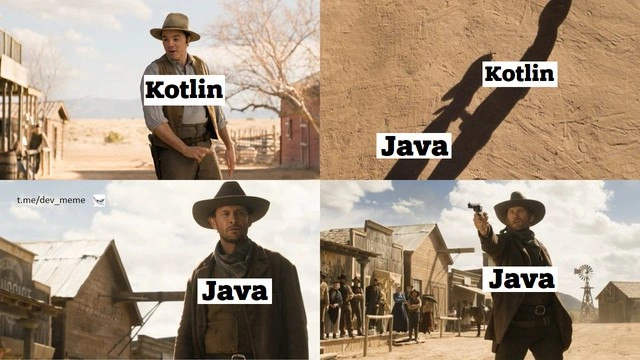
  • In the first panel, the cowboy labeled “Kotlin” is reaching for his gun. This represents Kotlin getting ready to battle or challenge Java. In real life, this “battle” means more developers are starting to use Kotlin and suggesting Kotlin for new projects. It’s like Kotlin is saying “I’m ready to be the new main language around here.”
  • The second panel is an overhead view of the ground. We see a big shadow labeled “Kotlin” being cast on the ground, and the ground itself is labeled “Java.” This is a visual metaphor for Kotlin overshadowing Java. Essentially, Kotlin’s influence or popularity is starting to loom over Java’s long-standing position. It’s like saying “Kotlin’s shadow is now falling on Java’s territory.” In the world of programming, it’s true that by around 2021, many people in Android development were so excited about Kotlin that Java felt a bit “in the shadows” for new Android work. The shadow being long and large suggests Kotlin’s presence is significant and hard to ignore. Yet note: the shadow exists because of light on Kotlin – meaning Kotlin owes its shape to something; one could interpret that as Kotlin needing Java’s environment (the JVM) to exist. (That’s an extra nuance: Kotlin’s success is partly because it can reuse all of Java’s frameworks and libraries. If Kotlin were a completely standalone thing without the Java ecosystem, it wouldn’t have grown so fast. So Kotlin stands tall, but on a foundation that Java built.)
  • The third panel shows the other cowboy labeled “Java.” He’s standing, staring down presumably at Kotlin. He looks like a determined, seasoned gunslinger. This represents Java’s stance – Java is not gone or defeated; it’s facing Kotlin head-on. In real terms, Java is still heavily used, maintained, and even improved continuously. Many teams stick with Java because it’s what their systems are written in, and it’s still a officially supported language by Google for Android as well (just not the shiny new favorite).
  • The fourth panel has the “Java” cowboy firing his revolver towards a crowd of people (the bystanders). The caption “Java” is again on this cowboy to remind us it’s Java shooting. This is a comedic exaggeration saying: Java is still firing shots, meaning it’s still actively used and even aggressive in a way. It could also imply that Java sometimes causes unintended problems (those bystanders could be developers or projects that get caught by issues in Java). For instance, a common joke is how many Java programs have hit errors like the aforementioned NullPointerExceptions (that’s Java “shooting” us in the foot), or how maintaining a large Java codebase can feel like dodging bullets (lots of legacy complexity). But more straightforwardly, it’s showing that Java’s not out of ammo – it’s still a player in this duel and is “shooting back” at Kotlin’s challenge. And indeed, Java has responded to competition by incorporating new features (as mentioned, Java got some Kotlin-like features in recent versions). Plus, Java’s community is huge, so there’s a bit of “Don’t you forget, I still run the enterprise world” bravado in that gunfire.

The context of this meme is especially relevant to Android developers and anyone interested in language popularity trends. Around the time this meme was posted, Kotlin had become the “new default” for Android app development in many minds. Google actually declared Kotlin their preferred language for Android development a couple of years prior. That was a big deal: imagine the town’s mayor (Google) announcing a new deputy as the future sheriff 😃. Still, Java was (and is) far from obsolete. It’s like half the town’s buildings are still made of Java. You can’t just replace them overnight. In back-end server development, Kotlin has been adopted in some places (it works well with frameworks like Spring Boot, which added Kotlin support), but Java is still extremely common in big companies. When a codebase has millions of Java lines, you don’t rewrite that on a whim just because a new language is prettier. Companies care about reliability, and Java’s track record gives management confidence (they might be risk-averse to a full switch). So the duel might be long and drawn-out, not an instant “Kotlin wins”.

For a junior developer or a student, the key takeaway is: Kotlin and Java are two tools you might use for similar jobs (especially if you get into Android programming or any JVM-based projects). Kotlin is newer and often nicer to write (less code, safer code), and Java is older but very established (lots of existing code and jobs). This meme encapsulates that situation in a funny way. It’s relatable because if you’ve started learning Android development recently, you’ve probably heard people say “use Kotlin, not Java.” Ten years ago, nobody had that choice – it was Java or nothing for Android. So those who learned with Java might feel a bit defensive or attached (hence Java “shooting” in the meme, metaphorically defending its turf). And those learning Kotlin feel like they have this shiny new weapon that makes them more productive, possibly “casting a shadow” over older Java techniques. This competitive yet comical dynamic is exactly what the meme is poking fun at.

To illustrate the difference in verbosity (amount of code), here’s a quick comparison that a junior dev can appreciate. Imagine we want a simple class to hold a user’s name and age. In Java, it might look like this:

// Java: A simple model class requires a lot of code
public class User {
    private String name;
    private int age;

    public User(String name, int age) { 
        this.name = name;
        this.age = age;
    }

    public String getName() { return name; }
    public void setName(String name) { this.name = name; }

    public int getAge() { return age; }
    public void setAge(int age) { this.age = age; }

    // You might also override toString(), equals(), and hashCode() for good practice
    // which adds even more lines of code...
}

In Kotlin, the equivalent could be done in one line:

// Kotlin: The same model can be a one-liner data class
data class User(val name: String, val age: Int)

This single line in Kotlin automatically provides a constructor, name and age properties, and it will generate toString(), equals(), hashCode(), and some other helpful methods for you. This example shows why people say Kotlin is more concise and has a lot of built-in convenience – that’s the syntactic sugar we talked about. Java isn’t quite that concise (though with tools or newer features it can reduce some boilerplate, it’s still more manual).

So, in the “duel,” one gun (Kotlin) is powerful partly because it’s just easier to wield (you can do fancy tricks with it without exhausting yourself writing a lot of code). The other gun (Java) might be an older model – heavier and needs more effort (more code), but it’s sturdy and extremely reliable, and almost every sheriff’s department (tech company) already owns a bunch of them 😉.

The meme uses the Wild West metaphor in a fun way:

  • Cowboy duel = Competition between technologies (here, programming languages).
  • Shadow = One’s influence or popularity dominating the area of the other.
  • Guns firing = Taking action or fighting back (Java releasing new features, or Java code still “running the show” in many projects).
  • Bystanders = Possibly developers or projects that are “caught in the crossfire,” meaning they have to deal with the consequences of this tech choice battle (like deciding which language to learn or use, or maintaining mixed codebases with both languages).

Ultimately, this meme is a slice of developer humor that you’ll appreciate more and more as you see such rivalries play out in tech. It’s showing that even though Kotlin is awesome and gaining ground, Java still has a lot of life left. The scene is relatable: it’s like when a new, hyped technology comes along, there’s excitement, but also resistance or at least a reality check from the existing tech.

If you’re a newer dev, you might be learning Kotlin as the “cool new language,” but don’t be surprised if you end up working on a project that uses Java – that old cowboy might be your boss! And if you know Java already, picking up Kotlin isn’t too hard, since their ecosystems are intertwined. Many teams actually use both: they add new features in Kotlin but keep old Java code that already works (why rewrite something that isn’t broken?). So the two cowboys often wind up working side by side after that showdown, which is an outcome not shown in the meme but often seen in real life.

Level 3: Six-Shooters & Syntactic Sugar

At the senior developer perspective, this meme elicits a knowing grin. It captures the legendary showdown in the programming languages saloon: Kotlin vs Java. For those of us who’ve been around the developer campfire, this is a familiar scene. We remember earlier language wars – the hype of a “Java killer” or the next big thing – and here we are again, but with cowboy hats. The humor comes from dramatizing a real industry trend: Kotlin is often hailed as the modern, expressive gunslinger coming to clean up the town (with concise syntax, safety features, and a cooler swagger), while Java is the old sheriff who’s not ready to retire (with decades of runtime under his belt, a huge ecosystem, and plenty of firepower still). The meme format frames it literally as a Wild West duel, which is perfect because sometimes the debates in team meetings about adopting Kotlin or sticking with Java can feel like a tense standoff at high noon. 🔫🤠 (Cue the tumbleweed rolling by when someone says “But our entire backend is already Java, we can’t just drop it.”)

The first panel, with Kotlin reaching for its holstered gun, represents Kotlin gearing up to challenge the status quo. This hits home for many Android and backend developers who, around 2017-2021, saw Kotlin rapidly draw from its holster. Google announced Kotlin support for Android in 2017 and later outright recommended it for new projects. That was the moment a lot of us felt Kotlin’s hand twitch at its six-shooter: “Is Kotlin going to take over now?” The meme’s second panel – Kotlin’s shadow looming large on the ground labeled Java – nails a feeling in the dev community: Kotlin’s influence and popularity were starting to overshadow Java, especially in Android development. It’s a clever visual metaphor: even without Kotlin “shooting” yet, its mere presence casts a big shadow on Java’s ground. It suggests that Kotlin might eclipse Java as the language of choice, at least in that domain. Many seasoned devs chuckle here because we’ve lived through similar hype cycles (remember when people said Ruby on Rails would end Java’s reign in web backends? Or when Scala was the cool JVM language? There’s always a bigger shadow until the sun moves). The shadow also hints at the reality that Kotlin stands on Java’s foundation – its shadow falls on Java. Underneath all of Kotlin’s cool features, it’s still running on Java’s virtual machine and often wrapping Java’s libraries. It’s like the meme quietly acknowledges, “Kotlin may outshine Java, but it exists because Java paved the way.” That layered meaning is chef’s kiss for those who appreciate nuance in developer humor.

Then we get the third and fourth panels introducing Java as the second cowboy. In panel 3, Java stands upright, stern-faced, labeled clearly – he’s the veteran gunfighter who’s seen his share of duels. By panel 4, this Java cowboy is firing a revolver wildly towards bystanders. Now, why bystanders? This is a tongue-in-cheek jab at how Java, despite being “old,” is still actively used everywhere, sometimes to the point of causing collateral damage. Maybe those “bystanders” represent unsuspecting new devs or projects that get hit by Java’s quirks or the sheer inertia of legacy systems. Picture a scene: a newbie developer innocently joins a project expecting to use Kotlin, only to catch a bullet – “Surprise! The core library is pure Java from 2005, have fun deciphering it.” The meme humorously acknowledges that Java still has plenty of fight left. It might not be as sleek as Kotlin, but it’s far from a dead language; it’s more like a sometimes-unwieldy gunslinger that might accidentally shoot the piano player in the saloon along with the outlaw 🙃. In real terms, Java powers gigantic portions of enterprise software and backend systems. Even in 2021, many corporations and products run on Java. It has performance optimizations, extensive tooling, and a huge talent pool. So while Kotlin is quick on the draw with fancy features, Java is the grizzled veteran who’s been in countless battles and still isn’t afraid to pull the trigger. The meme captures that balance of power – Kotlin looms large, but Java actively fires back, refusing to go quietly.

This all resonates strongly with developers because it mirrors our lived experience of technology adoption. Kotlin’s modern syntax and conciseness are a relief after years of writing ceremonial Java boilerplate. For example, writing a simple data class or POJO in Java often meant dozens of lines (fields, getters, setters, toString, equals, hashCode – or trusting an IDE plugin to generate them). In Kotlin, a one-liner data class covers it all. Many of us felt like the Kotlin cowboy rolled into town offering a better way to do the everyday chores. “Tired of writing public static void main(String[] args) and endless NullPointerException checks? Give Kotlin a try!” It was like a traveling merchant selling a miraculous elixir in the Old West. And indeed, when teams adopted Kotlin for Android or even for new backend microservices, it often boosted developer happiness and productivity – fewer bugs related to null, more readable code, and interoperability meant we could still use our trusty Java libraries.

Yet, any senior dev will tell you there’s no absolute silver bullet in tech (even silver bullets might not kill these vampires 🧛‍♂️ of legacy code). Java wasn’t sitting idle: it’s been evolving too. Modern Java (Java 8 and beyond) introduced lambda expressions, the Streams API for collection processing, var for local type inference (in Java 10), and even Records in Java 16 to reduce boilerplate for simple classes. These were clearly responses to pressures from languages like Kotlin and Scala. So in the duel, Java has been reloading its revolver with new bullets. The meme’s depiction of Java firing could also imply that Java is still actively “shooting” out updates and keeping itself relevant. Senior devs find this amusing because we often see debates framing one technology as “dead” when a new one gains steam, but reality is usually more nuanced. Java’s huge existing codebases (some call it technical debt, others call it investment in stability) mean it’s not disappearing overnight; migrations are costly and risky. There’s a shared understanding (almost PTSD 😉) among experienced engineers that legacy systems have a way of sticking around. We’ve all known a system that “nobody dares rewrite from Java to Kotlin completely because it’s mission-critical and working fine.” So Java’s like that old gunslinger who might have a limp but can still nail a target at 50 paces – you respect him, even if you’re excited about what the new kid can do.

In summary, level 3 exposes why the meme is so relatable: it humorously exaggerates the Kotlin vs Java situation but stays true to core realities:

  • Kotlin is the rising star, loaded with sweet features (syntax sugar, null-safety, coroutines for async programming, extension functions, data classes – a whole arsenal that makes coding feel more expressive and succinct). It’s the cool cowboy who can shoot the rope to save the day with a single well-aimed shot (or single elegant line of code).
  • Java is the old guard, battle-tested with many scars (decades of runtime, a gazillion libraries, tried-and-true performance). Sometimes clunky or verbose (the old cowboy muttering “back in my day…” while adjusting his dusty coat), but undeniably dependable and still dominating much of the programming frontier (market share).

The language comparison being framed as a Western duel is a nod to how developers sometimes form camps. One side cheers “Kotlin is the future!” while the other retorts “Java isn’t going anywhere!” – akin to two cowboys scowling at each other in a one-street town. The meme playfully captures that standoff. And like any good spaghetti Western, the tension is humorous because, at the end of the day, we suspect both protagonists will ride off into the sunset together (since in real projects, Kotlin and Java coexist and likely will for a long time). The watermark t.me/dev_meme in the corner suggests this meme circulated in developer groups (Telegram’s dev meme channel), spreading the inside joke among many in the field. Seeing it, a senior dev chuckles not just at the joke but at the truth behind it: we’ve seen these showdowns before, and we know the town ain’t big enough for only one – it usually ends up with an uneasy alliance in the saloon after the shooting stops.

Level 4: High-Noon on the JVM

At the most technical level, this meme highlights a showdown on the Java Virtual Machine (JVM). Both Kotlin and Java ultimately compile down to JVM bytecode, meaning under the hood they speak the same "machine language" when running. Kotlin might wear a newer hat, but it's riding Java's horse – it was deliberately designed to interoperate with Java seamlessly. This is why Kotlin can call Java libraries directly and vice versa: they share the same runtime environment. In a sense, Kotlin is casting a long shadow within Java's territory, because every Kotlin .kt file turns into Java bytecode .class files that the JVM executes. The meme’s shadow image (Kotlin’s shadow over “Java” on the ground) cleverly reflects this idea: Kotlin’s new syntax casts its influence over the Java platform itself.

From a language design perspective, Kotlin vs Java can be seen as a type-safety shootout. Kotlin’s type system introduces things academics have advocated for years. Notably, null safety is baked into the language – Kotlin’s type checker forces developers to handle the possibility of null at compile time, effectively eliminating a huge class of runtime errors (the dreaded NullPointerException, often abbreviated NPE). In type theory terms, Kotlin’s Nullable types act like the Option/Maybe monad from functional programming, ensuring you explicitly account for absence of a value. Java, born in the mid-'90s, didn’t have this initially (null could sneak in anywhere), and that “billion-dollar mistake” (as computer scientist Tony Hoare famously called the concept of null references) has haunted Java codebases with countless NPE crashes. Kotlin’s approach is a theoretically sound remedy, bringing a bit of formal proof-like guarantee to everyday programming – a very modern high-noon resolution to an old bullet wound in Java.

Another technical frontier in this duel is generics and type erasure. Java uses type-erased generics (for example, a List<String> at runtime just sees List without knowing it should contain Strings), which is why you can’t easily get the type of generic parameters at runtime in Java. Kotlin rides into this problem with a clever trick: inline functions with reified type parameters. In certain cases, Kotlin lets you ask “what type am I working with?” inside an inline function, something Java would normally erase. It’s like Kotlin drawing a hidden weapon to overcome a JVM limitation – by inlining (essentially copying function bytecode at call sites) and attaching actual types, it can reify generics for those functions. This advanced feature shows Kotlin’s designers balancing on the razor’s edge of JVM’s design constraints to give developers more firepower. It’s a direct response to Java’s limitations, illustrating how Kotlin’s rise is built on deep understanding of Java’s internals.

Despite these modern enhancements, Kotlin and Java share the same low-level reality: garbage collection, the Java Memory Model for concurrency, JIT compilation optimizations – all the gritty details of how code runs efficiently on hardware are handled by the JVM for both languages. There’s no magic performance bullet in Kotlin’s holster; a well-written Kotlin program runs about as fast as an equivalent Java program because the JVM (with its just-in-time compiler and optimizations) is doing the heavy optimization work. In practice, expressiveness vs performance becomes a false dichotomy here – Kotlin lets developers express intent with fewer lines, but it doesn’t sacrifice the runtime efficiency that Java developers rely on. It’s like two duelists using the same gunpowder in their cartridges. The outcome (performance) depends more on the JVM’s “firearm” than on whether the shooter shouted “val!” or “final!” while coding.

This high-level showdown is a classic example of evolution in programming languages. History shows that new languages often gain adoption by building on their predecessors’ ecosystems. Just as Java itself once ran on the JVM alongside older languages like Groovy or Scala, now Kotlin is the quick-draw artist in town, leveraging the solid foundation laid by Java. The meme’s Wild West imagery fits surprisingly well: the JVM ecosystem is like a frontier town, and Kotlin is the upstart promising justice (i.e., concise, safer code) in a town long ruled by Java’s law (established conventions and wide usage). But under the surface, Kotlin’s strength comes from standing on Java’s shoulders – or casting a long shadow on Java’s ground, as the meme depicts. In other words, Kotlin’s rise isn’t about destroying Java; it’s about extending and refining the JVM legacy. The humor of the meme’s second panel – Kotlin’s name as the shadow labeled over Java – nods to this truth: Kotlin’s identity is inextricably linked to Java’s presence, even as it tries to eclipse it.

Description

A four-panel meme using stills from the TV series Westworld to depict the relationship between Java and Kotlin. In the top-left panel, a somewhat naive-looking cowboy is labeled 'Kotlin'. The top-right panel shows the ground labeled 'Java', with a shadow cast upon it labeled 'Kotlin', symbolizing that Kotlin runs on the JVM, which is Java's foundation. The bottom-left panel features the formidable 'Man in Black' character, labeled 'Java', representing the language's long-standing, powerful, and intimidating presence. The final panel shows 'Java' as the Man in Black, drawing his gun for a duel. A watermark for 't.me/dev_meme' is visible in the bottom-left panel. The meme humorously captures the dynamic in the software world, especially in Android and backend development, where the modern, streamlined Kotlin is a popular choice but must still contend with the massive, deeply entrenched, and ever-evolving Java ecosystem. It's a classic 'newcomer vs. the old guard' narrative


Comments

39
Anonymous ★ Top Pick Kotlin brought null safety and coroutines to the duel, but Java just reminded everyone that it owns the entire town, the saloon, and the JVM itself
  1. Anonymous ★ Top Pick

    Kotlin brought null safety and coroutines to the duel, but Java just reminded everyone that it owns the entire town, the saloon, and the JVM itself

  2. Anonymous

    Kotlin saunters in boasting coroutines and null-safety; Java just spins the cylinder on its 500-jar Maven revolver and mutters, “Cast all the shadows you want, kid - prod still targets 1.8.”

  3. Anonymous

    Kotlin walks into town with null safety and coroutines, but Java's still there collecting rent on 90% of the enterprise infrastructure while muttering about how real cowboys use synchronized blocks

  4. Anonymous

    Kotlin walks into the JVM saloon thinking it's the new sheriff in town, only to realize Java's been running the whole operation for 25+ years, has the entire enterprise ecosystem on speed dial, and Kotlin's just compiling down to Java bytecode anyway. Sure, Kotlin's got null safety and coroutines, but Java's got Spring Boot, legacy codebases that will outlive us all, and every Fortune 500's backend. It's not a duel - it's more like Kotlin asking Java for permission to exist on the same runtime

  5. Anonymous

    Kotlin quickdraws with data classes, but that Java posse still ambushes with unchecked exceptions at high noon

  6. Anonymous

    Call it Kotlin if you like, but the casing on the ground still reads .class

  7. Anonymous

    In the Kotlin vs Java showdown, Kotlin brings null-safety; Java hands it a platform type from a 2011 JAR and watches java.lang.NullPointerException do the shooting

  8. @Tenoooo 5y

    Is it true? 😂

  9. @AlexSokolov88 5y

    https://t.me/sendmegifs/269

  10. @angrydavin 5y

    Ахахпхахах

  11. @angrydavin 5y

    I'm sorry, hahahahaha

  12. Deleted Account 5y

    Нужна пояснительная бригада

    1. @kulikov0 5y

      Java is old, but gold

      1. Deleted Account 5y

        Kotlin is new and even golder

        1. dev_meme 5y

          And super sweet, thanks to tons of sugar!

          1. Deleted Account 5y

            nice

      2. @glcky 5y

        ++

      3. @p4vook 5y

        Java is bad but kotlin is worse

        1. @Supuhstar 5y

          Kotlin is better than Java, worse than Swift

          1. @p4vook 5y

            You can get sugar diabetes from kotlin

            1. @Supuhstar 5y

              Lolwut

          2. @caesar_84 5y

            I wouldn't say Swift is better, especially when switching between Kotlin and Swift in a KMM project :)

            1. @Supuhstar 5y

              What's KMM?

              1. @caesar_84 5y

                Kotlin Multiplatform Mobile https://kotlinlang.org/lp/mobile/

        2. @kulikov0 5y

          Hail scala

    2. @RiedleroD 5y

      please only use English in this chat, @pidgin1

      1. @iammaxus 5y

        We need an explanatory crew*

        1. @RiedleroD 5y

          yeah, no, sorry. I don't understand the meme either.

        2. dev_meme 5y

          That’s about Kotlin (well, devs who use it) always insulting Java devs and Java in overall

    3. @p4vook 5y

      *cohort

    4. Deleted Account 5y

      old but gold

      1. @affirvega 5y

        nice username

  13. Deleted Account 5y

    What

  14. @kulikov0 5y

    Say it to legacy

  15. @p4vook 5y

    And java is 🐔

    1. @Supuhstar 5y

      Yeah, Java cocked things up

  16. @shoh_januzakov 5y

    What's the movie?

    1. Deleted Account 5y

      A Million Ways to Die in the West (2014) • Movie ​​1h56min ⭐️6.1 IMDB    Director: Seth MacFarlane Actors: Seth MacFarlane, Charlize Theron, Liam Neeson, Amanda Seyfried Genres: 🤣 Comedy, 🌵 Western A Million Ways to Die in the West is a movie starring Seth MacFarlane, Charlize Theron, and Liam Neeson. As a cowardly farmer begins to fall for the mysterious new woman in town, he must put his newly found courage to the test when...

      1. @shoh_januzakov 5y

        Thanx

Use J and K for navigation