Error: Purchase the Extra Data Types DLC to Use Float
Why is this GameDev meme funny?
Level 1: Letters for Sale
Imagine you’re writing a story for school, and you suddenly get a pop-up message on your notebook that says: “Oops! You used the letter E. To use this letter, you need to buy the Extra Alphabet pack.” Sounds ridiculous, right? You’d have to pay money just to use a common letter like “E” in your own writing! How would you even finish your story if A, E, I, O, U were locked behind a paywall? You might end up with sentences like “Th quick brown fox jumps ovr th lazy dog” because you couldn’t afford the letter “e”. It would be frustrating and silly.
That’s exactly the kind of absurd situation this meme is joking about, but for computer programming. In programming, using a float is like using a normal number with decimals – it’s very common, like using the letter “E” in English. The meme pretends that the software is asking the programmer to pay extra money to use a float number type. It’s funny (and a bit scary) to programmers because it’s like saying something super basic suddenly has a price tag. Just as you shouldn’t have to buy vowels to write words, a coder shouldn’t have to buy basic tools to write code. The joke makes us picture a world where greedy companies charge for every little thing, and that clear mental image – of something normally free now costing money – is what makes it humorous. We laugh because it’s so exaggerated and we hope it never becomes real.
Level 2: Pay-to-Code 101
Let’s break down what’s happening here in simple terms. We have a piece of code in C# (a popular programming language, especially for making Unity games). In the code, there’s a line:
private float _animationTime;
This line is declaring a variable named _animationTime that is meant to hold a number with a decimal point. In programming, the word float stands for floating-point number – basically a number that can have a fractional part (like 3.14 or 0.5). It’s one of the basic data types in many languages, including C#, C++, Java, etc. These basic types (we call them primitives) like int (for integers), float (for decimal numbers), bool (for true/false) are normally built into the language. Using them is as natural and free as using letters in a sentence.
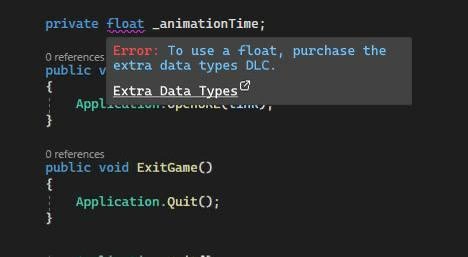
Now, the meme shows that when the programmer hovers their mouse over that line, an error message pops up. It says: “Error: To use a float, purchase the extra data types DLC.” There’s even a suggestion link labeled “Extra Data Types” as if you could click it to go buy something. This is not a real error you’d ever see – it’s a joke. Normally, if there’s an error with a float, it might be something like “Syntax error” or “Type mismatch”, not a request to purchase DLC! So what’s DLC? DLC stands for Downloadable Content. That term comes from video games – for example, a game might offer extra levels, new characters, or costumes as DLC that you pay money to download and add to the game. It’s basically bonus material that isn’t in the base game, often costing a few dollars. The meme is playing with that concept by pretending that a programming tool (the compiler/IDE) is asking you to buy extra content just to use a fundamental feature (float). In short, it’s joking that programming could become “pay-to-win” or rather pay-to-code.
Why is that significant? Well, in real life, when you’re coding, you don’t expect to pay every time you use a certain command or type. Once you have your development tools set up (which are often free or one-time purchases), you can use all language features freely. The idea of a paywall (something that requires payment to access) appearing in your code editor is crazy and silly. It’s mixing the idea of microtransactions (small payments for small in-game benefits, common in mobile and video games) with coding. For a newcomer: imagine typing an essay in Microsoft Word and suddenly a pop-up says, “Error: To use the letter ‘E’, please buy the Extra Alphabet Pack.” You’d be like, “What!? ‘E’ is a basic letter!” That’s exactly the feeling here with float for programmers.
Let’s point out some details visible in the image that confirm it’s a coding environment (IDE). It’s a dark-themed window (many developers prefer a dark background when coding to reduce eye strain). The code snippet has syntax highlighting: notice private, float, public void are in different colors. Keywords like public, private, float appear in blue, whereas custom names like _animationTime, StartGame, ExitGame are white. This is typical of editors like Visual Studio or Rider or VS Code with a C# extension. The lines Application.OpenURL(main); and Application.Quit(); are likely calls to Unity engine’s API (to open a URL or quit the game). Under each method definition, it says “0 references” in gray – that’s an IDE feature telling the developer how many places in the codebase call those methods. It’s a quick way to see if a function is being used. So this setting is very much a real coding scenario, except for that hilarious fake error.
Now, compilers and IDEs do show error tooltips like that normally. If you wrote something truly invalid in C#, you might hover and see an error message in a similar gray box with red text. For instance, if you wrote private flott _animationTime; (misspelling float), the compiler would show an error like “flott is not a recognized type” or something along those lines. The meme takes that very familiar interface – an error tooltip – and replaces the message with a joke line about DLC. It’s funny because it’s so out-of-place. There’s no such thing as “Extra Data Types DLC” in programming; that’s a completely made-up concept making fun of how some software companies try to charge for everything nowadays.
Think of SaaS (Software as a Service) and subscription models that are everywhere. For example, Adobe Photoshop moved to subscription, Microsoft Office encourages you to pay yearly, even some development tools like JetBrains IDEs are subscription-based. Developers often feel a bit of “subscription fatigue” – that tired feeling of “oh great, one more thing I have to pay for monthly.” The meme exaggerates this: What if even a coding language had a subscription DLC model? It’s basically saying “Welcome to pay-to-code.”
For a junior dev or someone new: don’t worry! You do not need to pay to use a float in C# or any normal language. This image is poking fun at a trend, not describing reality. In fact, C# and its compiler (Roslyn) are open-source and free to use. Unity, mentioned in the tags, refers to the Unity game engine (also free for personal use, though they sell add-ons and have paid tiers for larger companies). Unity developers write a lot of C# code with floats for things like animation time, movement speed, etc., so the variable _animationTime is very plausible in that context. That’s why the meme particularly resonates with game developers: they’re used to DLCs in games, and many use Unity/C#, so it’s a perfect storm of inside joke for them.
To sum up this level: The meme shows a compiler error claiming you need to buy a DLC to use a common data type (float). It’s a parody of how modern software often tries to charge extra for features. The reason it’s funny is because using a data type in code is such a basic thing – making it paid content is like a restaurant charging you extra to use the salt and pepper. It just shouldn’t happen, and if it did, it would cause both laughter and outrage. This joke plays on that feeling in a harmless way, using a scenario every coder can imagine and chuckle (or groan) about.
Level 3: Nickel-and-Dimed Syntax
This meme strikes a chord with every developer who’s watched the software industry pivot to “monetize all the things.” Here we have a C# code snippet – likely a Unity game script given the StartGame() and ExitGame() methods – and the code is perfectly normal except for one outrageous twist: the compiler is yelling that float requires a DLC purchase. It’s the collision of two worlds: the nickel-and-dime monetization strategy of modern gaming, and the foundational tools of programming which have always been free to use once you have them. The humor (and horror) comes from the feeling of, “Oh no, they’ve finally come for our code!”
Why is this funny to seasoned devs? Because it’s a parody that feels uncomfortably plausible given current trends. We’ve gone from paying once for an IDE or compiler (or not at all, thanks to open source) to subscriptions for cloud services, then to in-app purchases for developer tools (hello, paid VS Code extensions), and even AI assistants that charge per month. The meme pushes this to an extreme: what if even basic language features were behind a paywall? It’s a exaggeration of subscription fatigue. Every other week, it seems some vendor announces that a feature we took for granted will now require a monthly plan. People joke that eventually Git will charge per commit or that Stack Overflow will bill you per question view – this meme fits right into that gallows humor. We laugh, but only to mask the pain of how real it’s getting.
The use of the term DLC (Downloadable Content) is a direct transplant from video game culture. In games, DLCs are extra levels or content you pay for beyond the base game. Seeing a compiler error essentially say “Buy the Extra Data Types DLC to use this basic type” is absurd. It mocks the idea of a “base programming language” and then premium add-ons. A senior dev likely remembers a time when the biggest cost in coding was maybe buying a textbook or a one-time software license, not continuously feeding a meter. We’re all thinking, “What’s next, a $0.99 charge every time I use an if statement or a loop?”
This meme also satirizes vendor lock-in and SaaS creep. If a company controlled a popular language or engine (imagine if Unity Technologies or Microsoft went completely evil mode), they might introduce “premium tiers” of development. It’s funny because it’s so evil — like a dystopian sci-fi novel for programmers. The meme implicitly asks: how far-fetched is this, really? Consider that Unity (the game engine) actually did stir outrage by changing its pricing model, and developers joked “what if they charge per line of code next?” This image nails that sentiment by showing a basic data type behind a pay gate. It resonates with the Compilers crowd and the CodingHumor folks because it’s universally understood: no matter what programming language you use, you rely on fundamental types like float. The thought of them being premium content is both hilarious and blood-boiling.
From a senior perspective, there’s also an element of “I’ve seen this pattern before.” Maybe not as a literal compiler DLC, but in other guises:
- IDE Editions: Remember how Visual Studio had Community (free) vs Professional vs Enterprise? Certain advanced features (code profiling, architecture diagrams) were only in paid versions. That was the old-school “pay for premium tools” model. This meme just applies that concept to the language itself for comedic effect.
- Frameworks and Libraries: Many tools start free, then introduce pro licenses for extra features. Databases have “enterprise” add-ons, libraries have pro tiers. We’ve swallowed that, albeit reluctantly. The meme asks, what if basic syntax fell into that category?
- License Hell in Enterprise: Seasoned devs have fought the pain of license servers and feature keys. Some compilers (especially for embedded systems or proprietary languages) won’t enable optimizations or 64-bit builds unless you have the right license. We’re used to “Error: license not found” in niche cases. The meme leverages that familiarity – “license not found for float” is so outrageous it hits the sweet spot of satire. It’s basically license hell turned up to 11.
There’s definitely a dark joke about the “creeping SaaS mindset”. Software companies love recurring revenue. Imagine a world where even a programming language becomes a subscription service with in-app purchases. A battle-scarred engineer might quip, “Give it time, kid. In 10 years we’ll be swiping credit cards to add new database columns in production.” It’s funny because it’s a defensive laugh – we see the slippery slope. The meme is our way of coping: by joking that even our compiler might someday extort us, we’re highlighting how ridiculous and unwelcome that future would be.
Finally, let’s appreciate the small UI details which add to the humor for those of us who live in IDEs. The screenshot looks like Visual Studio or a similar editor with the dark theme (gotta protect those eyes during late-night coding). The float keyword is highlighted in blue (standard syntax coloring for keywords in many IDEs), and the variable name _animationTime is in white. Everything looks legit until that gray tooltip with red error text pops up. It’s styled exactly like a real compile error message, except the content is pure parody. There’s even a blue underlined hyperlink “Extra Data Types↗” as if you could click it to go buy the feature – a perfect imitation of how an IDE might offer help or a download link for missing components. A seasoned developer chuckles at that link text. It’s a deadpan presentation of the joke: the error isn’t yelling or making a meme of itself; it looks plausibly real. That subtlety is golden. It requires you to know that float is a completely normal thing that should never trigger any error, let alone a purchase prompt. In other words, it’s a joke that only works in a community that knows its way around Compilers and IDEs – exactly the folks reading this. It’s a wink and nod: “you know how ridiculous this is, I know how ridiculous this is, and that’s why it’s funny.”
Level 4: Syntax as a Service
In a compiler’s architecture, the idea of paywalled keywords is both technically fascinating and horrifying. Normally, when the compiler’s lexer encounters the token float in code, it confidently classifies it as a valid primitive data type. The parser then builds an AST (Abstract Syntax Tree) node for that float variable declaration. Under standard conditions, there's no concept of “licensed” or “unlicensed” syntax – the language grammar is static, and every developer from junior to veteran gets the full set of keywords for free. To enforce a pay-to-use float, the compiler’s design would need a deliberate hook in its semantic analysis phase: essentially a conditional check that says, “if the user didn’t buy the Extra Data Types package, then throw an error on any float usage.” This means the compiler’s code might include something as absurd as:
// Deep in the bowels of a hypothetical C# compiler:
if (token.Value == "float" && !LicenseManager.HasFeature("ExtraDataTypes")) {
ReportError(token.Position,
"Error: To use a float, purchase the Extra Data Types DLC.");
// Perhaps suggest a link to the store:
SuggestUpgrade("Extra Data Types");
}
That ReportError call produces exactly the tongue-in-cheek tooltip we see: an error squiggle under float with a message demanding a purchase. The fact this is a syntax error due to licensing – not a typo or misuse of the language – turns our understanding of compilers on its head. It’s as if the language’s grammar itself has become feature-gated content.
From a theoretical standpoint, this violates a core assumption in language design: that all syntactic constructs are available to all users. Languages are defined by specifications (the C# standard, in this case) that enumerate types like int, float, double as fundamental. Introducing an external license check effectively creates two dialects of the language: one where float exists and one where it doesn’t. This would wreak havoc on code portability and team collaboration. Imagine half your team can compile float-using code (they have the DLC), and the other half gets compiler errors – it’s a recipe for insanity. In academic terms, it’s almost like creating a context-sensitive grammar where the context is your paid entitlements. The compiler’s correctness and completeness are compromised by an outside economic concern, which is deeply heretical to compiler theory. We usually optimize compilers for speed and correctness, not revenue extraction logic embedded in the parsing phase.
Historically, there have been cases of hardware and software features requiring extra purchase, offering a faint precedent for this parody. Early computer systems sometimes had optional floating-point units – literally a hardware co-processor for math – that you had to buy separately if you wanted fast float calculations. But even in those days, the programming language itself (like C or Fortran) still included float as a type; if you lacked the hardware, the operations just ran slower in software. The idea of a compiler outright refusing to handle float unless you pay is a modern dystopian twist. It merges the worst parts of DRM (digital rights management) with language design. One could envision a license file or online verification the compiler checks at startup: no valid subscription token, no floating-point support. It’s a grotesque inversion of how open language ecosystems work.
What’s extra uncanny is that modern IDEs (like Visual Studio shown here) and compilers are powerful enough to implement something like this. The C# compiler, Roslyn, is open-source and even pluggable; a rogue plugin or a specially packaged “freemium” version could inject such checks. The tooltip in the meme – “Extra Data Types ↗” – looks just like a hyperlink you’d see for more info, or in this case, a purchase page. The mechanism to display that exists: compilers can output errors with links (for documentation or downloads). In enterprise tools, license-managed features aren’t new – e.g., some professional compilers limit optimizations or code size in free editions. But pay-per-keyword is so granular it satirizes the concept of microtransactions at the compiler level. It’s as if the compiler’s EULA grew teeth and crawled into your code editor, ready to charge 99 cents for each forbidden keyword. Behind the scenes, this hypothetical system would need a network call or license verification step whenever certain syntax is encountered. Now your build pipeline could fail not due to logic errors, but because “Account Balance Low: Please deposit $5 to enable float this month.”
In summary, the meme’s “pay-to-use float” error message is an absurdist inversion of compiler design principles. It highlights how deeply the SaaS mentality could corrupt even the fundamental layers of coding. The compiler – traditionally our impartial translator of code to machine language – is imagined here as an opportunistic toll booth, monetizing what should be an inviolable part of the language. The humor lands because implementing this would require intentionally crippling the compiler’s grammar recognition, something that feels almost sacrilegious to computer science folks. It’s a deeply technical inside-joke: what if the very syntax of our code became a DLC item? The laughter (tinged with horror) comes from recognizing just how possible – yet how profoundly wrong – that scenario is.
Description
A code editor screenshot showing C# or Unity code with 'private float _animationTime;' and 'public void ExitGame() { Application.Quit(); }'. A fake error tooltip appears on the float declaration reading: 'Error: To use a float, purchase the extra data types DLC. Extra_Data_Types' (with an external link icon). The meme satirizes the gaming industry's DLC (downloadable content) monetization model by imagining a dystopian future where even basic programming data types require paid add-ons
Comments
29Comment deleted
Unity 2027: 'To use int, subscribe to the Integer Premium Plan at $9.99/month. double is available in the Enterprise tier. void is still free - because that's what your wallet will be.'
If the language vendor starts charging per primitive, I’m rewriting the whole stack in brain-teaser assembly - bytes are still free, for now
Next Unity update: 'Premium Plus' subscription required for semicolons, 'Enterprise Elite' tier unlocks the ability to compile without warnings, and don't even ask about the pricing model for accessing null reference exceptions - they're billing per stack trace now
Ah yes, the classic Unity business model evolution: first they made the engine free, then introduced per-install fees, and now apparently they're taking notes from EA by paywalling primitive types. Next quarter's roadmap probably includes 'int' as a premium feature and 'bool' in a loot box. At least they're being transparent about their monetization strategy - unlike their shader compilation times
When the IDE sells primitives as DLC, architecture reviews become cost - precision tradeoffs: ints in community, floats on subscription, and doubles bundled with SSO in the enterprise plan
Unity's latest innovation: primitives as microservices - subscribe to unlock 'float' in prod
Enterprise workaround: skip the Float DLC, store values as scaled ints, reinvent a fixed-point library, and file the rounding-induced outage under 'procurement-driven architecture'
To quit Vim, purchase quit functional DLC. Comment deleted
Ah didnt know ea made vim :3 Comment deleted
but why do you need to exit vim? Comment deleted
To rebuild Gentoo Comment deleted
but you can do it actually from vim Comment deleted
:!emerge -vuDN --with-bdeps=y @world Comment deleted
yesterday i just installed an extension for php in vscode then suddenly for a simple code completion it requested to buy premium while it was using another free code completion package Comment deleted
Jetbrains vibes Comment deleted
Type gacha, for every 1000 lines of code successfully compiled, you get 1 pull for a new type float is a 3-star type, long long is a 4-star and so on Comment deleted
duplicates of types get converted into new operator overloads for types Comment deleted
you don't get to Vector3 * Quaternion until you have pulled 3 upgrades of both types Comment deleted
If this happens I will just kms right at the moment Comment deleted
I love kernel modesetting 😊👍 Comment deleted
I am utterly disgusted by the subscription models lately Comment deleted
Be grateful for what isn't on subscription yet. It'll never be less than today. Owning something gets more and more of a luxury. They didn't tax air yet, right? Comment deleted
in my country I think the only thing we dont pay tax is the air Comment deleted
emission taxes Comment deleted
In Spain 🇪🇸 there was a period where they taxed for the sun ☀️ until someone realised they would end up like Nepal 🇳🇵 has recently ended Comment deleted
DON'T GIVE THEM ANY IDEAS!!!!! Comment deleted
1000 usd dlc for floats Comment deleted
Wtf Comment deleted
Its not even a double😭 Comment deleted