Skip to content
DevMeme
1696 of 7435
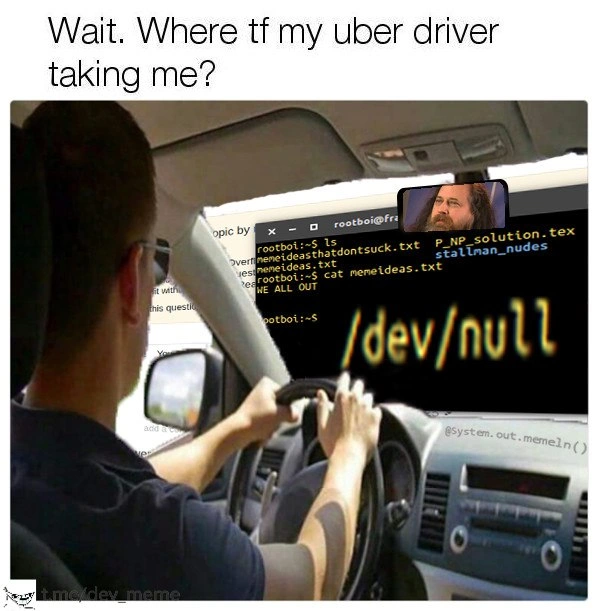
When your Uber ride’s destination shows up as /dev/null on the dash
CLI Post #1892, on Aug 10, 2020 in TG

When your Uber ride’s destination shows up as /dev/null on the dash

Why is this CLI meme funny?

Level 1: Driving into a Black Hole

Imagine you hop into a taxi and tell the driver where you want to go. But instead of heading to a real place, the driver says, “Alright, next stop: the big trash void!” and points at a route that leads to nowhere. You’d probably laugh nervously or panic, right? That’s what’s happening in this picture, but in computer language. The car’s destination is shown as “/dev/null,” which to a computer geek means “the nothing place” – kind of like a black hole or a magical trash can where anything thrown in disappears forever.

For a kid-friendly analogy: it’s as if the passenger asked to go to a fun candy shop, and the driver started driving them straight into a giant garbage dumpster named “NO CANDY.” The passenger is looking up and saying, “Wait, where are we going?!” It’s funny because it mixes something very normal (an Uber car ride) with something totally silly (going to a place that doesn’t really exist except as a way to throw stuff away). The big joke is that the driver is taking the poor rider to nowhere at all.

So the meme feels like a cartoon: the destination on the GPS isn’t a real place – it’s like if the GPS said “next stop: the void.” The passenger’s expression (or caption) shows they’re super confused and a bit scared: “Where on earth is my Uber driver taking me?!” The answer, for those who understand the tech lingo, is basically “to Nowhere-ville, population: nothing.” Even if you don’t get the exact tech reference, you can understand the silly idea of a taxi driving into oblivion. It’s this mix of everyday situation with a goofy impossible destination that makes it funny.

In short, the meme is laughing at the idea of an Uber ride that literally goes to no place. It’s like a little story where a computer concept (the special trashcan place called /dev/null) is turned into a real-world road to nowhere. Even if you’ve never used a computer terminal, you can chuckle at the passenger’s plight: nobody wants their driver to say, “We’re going to Dump-it-all Land!” 🗑️ It’s a playful way to show what happens when a piece of geeky computer humor leaks into real life, and the result is both absurd and amusing.

Level 2: Terminal Trip for Newbies

Let’s break down what’s going on in this meme in simpler terms. The image shows an Uber ride, but with a twist: the car’s windshield has been edited to look like a Linux terminal (the text-based interface where developers type commands). The passenger is looking at the driver’s dashboard in confusion. The caption says, “Wait. Where tf my uber driver taking me?” which in less slang might be, “Wait, where on earth is my Uber driver taking me?”. The reason for the passenger’s confusion is that the destination on the screen isn’t a normal address – it’s /dev/null. To a developer, that’s hilarious because /dev/null is a well-known computer concept meaning “nowhere” or “nothing.”

In the black terminal window, you see some text that looks like what you’d see on a programmer’s screen:

  • rootboi:~$ – This is the shell prompt. It typically shows the username (here rootboi, which is a playful take on “root”, the all-powerful admin user on Linux) and the ~ means the current directory is the user’s home folder. The $ indicates it’s ready for a command. So basically, someone named “rootboi” is running commands on a Linux machine, almost as if the car’s computer is a Linux system.

  • The command ls is typed next. ls stands for “list” and it lists files in the current directory (folder). In the meme, the output of ls shows four file names:

    • memeideasthatdontsuck.txt – likely a text file of good meme ideas (the name suggests “meme ideas that don’t suck”).
    • p_NP_solution.tex – looks like a document (probably LaTeX, a format for writing scientific papers) that claims to solve the P vs NP problem (a famously unsolved math/computer science problem). It’s a joke file – as if the driver casually has the biggest solution in computer science chilling in his files.
    • stallman_nudes – a shock-joke file name referencing Richard Stallman, a famous programmer. “Nudes” implies something very personal or embarrassing; it’s thrown in as a wild, humorous wildcard. It’s not serious – just meant to be absurd (no one actually wants to open that file!).
    • memeideas.txt – another text file presumably listing meme ideas. The presence of two files about meme ideas (one specifically “that don’t suck” and one general) is already a clue this meme is self-referential (it’s joking about the making of memes itself).
  • Next, the command cat memeideas.txt is run. cat is short for “concatenate” but effectively it just prints the contents of a file to the screen. So this command is asking the computer to show what’s inside the file memeideas.txt. The output shown is WE ALL OUT. In plain English, that line reads as “We’re all out” – likely meaning “we’re all out of meme ideas.” It’s like checking the fridge and finding it empty. The computer file that’s supposed to have meme ideas literally says there are none left. This is the meme poking fun at itself – implying the creator has run out of fresh ideas.

Now, why is the destination shown as /dev/null? On a Linux system, /dev/null is a special location (often called the “null device”) where you can send data, and it just disappears. Think of it as a trash can or a shredder: if a program outputs something and you point it at /dev/null, that output gets thrown away immediately. It’s a way to say “discard this; I don’t need it.” For example, if a developer has a program that won’t stop printing annoying messages, they might run program >/dev/null to ignore all that noise.

So, in the context of an Uber ride, seeing /dev/null as the destination is like the driver’s GPS saying “we’re going to No-Place” or “Destination: Void.” It’d be super unsettling and bizarre to a normal person, but to a developer, it’s also ironically funny: it implies the Uber driver is taking the passenger to a place where everything is lost (e.g., the middle of nowhere, or a black hole). It merges the idea of a car ride with a computing joke:

  • In computing, sending something to /dev/null means throw it away.
  • In the meme, the poor passenger is effectively being “thrown away” or taken to oblivion.

The phrase “Wait. Where tf my uber driver taking me?” is written in a jokey, informal internet style (tf = “the freak” in polite terms, expressing shock). This matches the typical meme format: a top text expressing a setup or confusion, and then the image provides the context for the punchline. The punchline here is that wild /dev/null path on the windshield. If you’re not familiar with coding, /dev/null might look like gibberish, but now you know it basically means “nothing to see here” in a technical sense.

The categories here (like CLI – Command Line Interface, and Operating Systems) are referenced because the humor involves using a command-line terminal from an OS in an absurd way. The meme is filed under Developer Experience (DX) because it leans on knowledge that developers pick up through experience. For instance, a new coder might not immediately know what /dev/null is, but after a bit of nix experience, they’ll recognize that “oh, that’s the thing that eats unwanted output.” The tags like UnixCommands, Linux, CLI point to the specific tech context of the joke. This is very much developer humor: it’s funny to those of us who have opened terminals, listed files, dealt with odd file names, and used /dev/null to make annoying stuff go away.

One could say the meme’s also joking about being creatively empty. The file said “WE ALL OUT” about meme ideas, then the next image is literally the car heading to the trash (since /dev/null is like a trash bin). It’s as if the meme itself says: “No good ideas left… time to dump the whole thing!” There’s even a tiny image of Richard Stallman visible on the terminal window in the meme (he’s the guy referenced by that file name). Stallman’s presence is like an Easter egg for those who know him – maybe a nod to the free software world or just another layer of wacky tech inside-joke (he’s a very recognizable figure in programming circles, often appearing in memes himself).

In summary, on a newbie level: the meme is funny because it shows a crazy impossible destination (a computer’s null device) for an Uber ride, and it uses nerdy computer commands as the setup. You have to know that /dev/null means “dumping ground for data” to get why that’s a ridiculous place to go. The whole thing is a big goofy mashup of real life and tech life:

  • Real-life scenario: an Uber driver and a concerned passenger.
  • Tech twist: the driver’s dash looks like a coder’s screen, and the address is a tech joke.

It’s the kind of humor you start to appreciate as you dive into programming and pick up these little tidbits like the usage of the command line and special OS features. Once you’ve run a few terminal commands yourself, you’ll wink at jokes like this, because you know exactly what /dev/null signifies – and it’s certainly not a place you’d want to end up on your ride home!

Level 3: Bit Bucket Bound

Experienced developers will smirk at how this meme blends a mundane scenario (riding in an Uber) with a quintessential piece of command-line humor. The top caption sets the stage: “Wait. Where tf my uber driver taking me?” – a phrase you’d expect from a passenger noticing a bizarre route. Then comes the payoff: the driver’s “GPS” is a Linux terminal showing the destination /dev/null in glaring, glowing text across the windshield. It’s a perfect inside joke: in developer culture, sending something to /dev/null means discarding it forever. We’ve all done things like my_program > /dev/null 2>&1 to suppress output when we don’t care about it. It’s the command-line equivalent of a blackhole or a shredder. So if your Uber is heading to /dev/null, you’re effectively on a road to nowhere – the ride (and you, the passenger) might as well vanish into the ether.

The terminal overlay in the image shows actual commands being run, which is chef’s kiss for CLI nerds. First, the prompt rootboi:~$ suggests the user is named “rootboi” and is at their home directory (~). They run ls, a Unix command to list directory contents. The output lists some hilarious files:

rootboi:~$ ls  
memeideasthatdontsuck.txt   p_NP_solution.tex   stallman_nudes   memeideas.txt
rootboi:~$ cat memeideas.txt  
WE ALL OUT

Notice the mix of absurd and witty file names:

  • memeideasthatdontsuck.txt and memeideas.txt – implying our meme creator had a brainstorm folder. Perhaps memeideasthatdontsuck.txt was supposed to hold quality ideas, but who knows if it’s empty.
  • p_NP_solution.tex – a playful nod to the legendary P vs NP problem in computer science. A .tex file suggests a LaTeX document, as if this person has the written solution to one of the biggest unsolved problems in CS casually sitting in their home directory. That’s some top-tier nerd cred (or humor) right there. It’s the kind of “ultimate file” a geek might joke about having.
  • stallman_nudes – an outrageous entry clearly there for shock value and laughs. This references Richard Stallman, the famous (and sometimes infamous) founder of the GNU project and free software movement. The idea of “nudes” of Stallman is both absurd and a bit horrifying (most devs chuckle and shudder at the thought). It’s a deliberately over-the-top file name to catch our attention.

Finally, they cat memeideas.txt, i.e., display its contents. It says: “WE ALL OUT” – a grammatically off-kilter way of saying “We’re all out (of meme ideas).” This is meta-humor: the meme itself jokes that no new meme ideas remain, so the only destination left is /dev/null. In other words, bad or overused meme ideas belong in the trash. The giant glowing /dev/null on the windshield drives that point home visually. It’s like the meme creator is admitting, “Alright, we’ve exhausted our clever ideas – time to dispose of the rubbish ones.” It’s a self-deprecating nod to how many developer jokes get recycled until they’re ready to be dumped. Developer humor often thrives on these self-referential moments. Even the watermark in the corner (“system.out.memeIn()”) is a Java-themed code pun on printing memes, reinforcing the developer inside-joke vibe.

What makes this so funny to those in the know is the collision of contexts. In a developer’s day-to-day, /dev/null is a very real concept – a utility we use to silence programs or ignore outputs. It’s mundane, even. But imagine if that concept leaked into real life: your Uber driver’s navigation instructs them to drive to /dev/null. That’s equivalent to a GPS saying “please drive off the edge of the known universe” or “take the next exit into oblivion.” It’s absurdist humor born from mixing a digital concept with reality. We laugh because we picture ourselves in that back seat, seeing that familiar file path where a street address should be, and thinking, “Oh no… this ride is literally going nowhere good!” It also cheekily implies the Uber driver is a superuser hacker. After all, who else would have a Linux terminal up on their dash, running as root? Perhaps this driver decided the passenger’s destination wasn’t worth going to – maybe all the passenger’s meme ideas were so bad that the only suitable drop-off point is the Null Destination. This winks at the collective experience of developers trashing bad code or crappy ideas: “straight to /dev/null with that nonsense!”.

There’s a subtle layer of developer experience (DX) commentary: new devs eventually learn about /dev/null when they’re told to pipe unwanted output there. The first time you discover you can do ls > /dev/null, it feels like a magic trick (or a convenient dumpster). With experience, it becomes second nature to say “just send it to /dev/null” for anything you want gone. We’ve perhaps grown cynical about the endless stream of logs or errors – sometimes the easiest fix during crunch time is not to solve it, but to hide it! (Not a best practice, but hey, at 3 AM oncall, the null device is your friend.) This meme pokes fun at that impulse: instead of debugging or coming up with better ideas, just dump everything and bail. The inclusion of “we all out” suggests a shared exhaustion of creativity – a feeling many devs know too well after long weeks. And where do burnt-out ideas go? The bit bucket.

In essence, the meme encapsulates a scenario every seasoned coder can relate to:

  • Imaginative absurdity: crossing a command-line concept with a real-life situation.
  • Jokes within jokes: hidden gems like the file list that seasoned Linux users appreciate (the dual meaning of “driver,” the Stallman reference, the P vs NP flex).
  • A hint of truth: after all, how many times have we jokingly “sent” our problems to /dev/null rather than dealing with them? It’s the programmer’s equivalent of sweeping dirt under the rug.

All these layers make the meme “too real” and cleverly hilarious to the developer community. It’s the kind of joke that makes you both laugh and nod, recognizing the shared culture of CLI hacks and OS knowledge. After years of using the command line, the phrase “headed to /dev/null” takes on a humorous new meaning – one that we’d probably never have imagined in our novice days. Now excuse me while I confirm my Uber driver isn’t secretly a kernel module ready to yeet me into the void. 😅

Level 4: Device Driver to Nowhere

At the deepest technical level, this meme is riffing on a classic Unix concept: the special file /dev/null. In a Linux/Unix operating system, everything is treated as a file – including hardware devices and pseudo-devices. The path /dev/null is a null device, sometimes nicknamed the “bit bucket.” It’s essentially a black hole for data: any bytes written to this device are simply discarded, and if you try to read from it, you get nothing (EOF immediately). Under the hood, the OS implements /dev/null via a trivial device driver that accepts whatever you send and does absolutely nothing with it. There’s no storage hardware behind /dev/null; it’s a virtual sink within the kernel.

From an operating systems perspective, /dev/null exists for good reasons. It provides a universal discard mechanism for programs. Need to silence command output or dispose of unwanted data streams? Redirect them to /dev/null and poof, they disappear. This is baked into the design of Unix-like systems as a convenient stream consumer that won’t block or overflow – a sort of data event horizon for unwanted output. The concept dates back to early Unix (1960s), demonstrating the elegance of treating devices uniformly as files. Even other OSes have equivalents (Windows has NUL). The meme brilliantly literalizes this idea: an Uber driver’s destination is shown as “/dev/null,” implying a trip to nowhere. It’s a tongue-in-cheek collision of real-world navigation with an OS internals joke. For seasoned devs, the phrase “send it to /dev/null” is everyday lingo – whether it’s about dumping debug logs or joking that someone’s suggestion should be tossed in the trash. Here, that lingo becomes a visual gag: the Uber’s GPS might as well be a kernel driver routing the car into the void. It’s a nerdy operating system pun – the “driver” (ha!) is literally taking you to the null device, an address that simply swallows whatever goes there. You can almost imagine the OS’s device driver for /dev/null sitting in the car’s driver seat, grinning as it absorbs data (or passengers) into oblivion. This deep-cut reference to OS design gives the meme an extra layer: it’s not just a random string of characters on the dash, it’s the legendary data sink every developer knows, now turned into a physical destination. The absurdity of a real journey to an imaginary system location tickles the brain of anyone who’s had to explain “No, /dev/null isn’t a real folder, it’s a mechanism.” The meme exploits the fundamental property of /dev/null – that it’s a one-way trip for information – and imagines what that means if taken literally. Essentially, it’s evoking an event horizon: cross that /dev/null boundary, and neither you nor your data will be seen again!

Description

The meme combines a POV photo from a car’s back seat showing a driver at the wheel with a giant Linux terminal window composited over the windshield. A top caption reads, “Wait. Where tf my uber driver taking me?” In the terminal, the prompt “rootboi:~$ ls” lists files: “memeideasthatdontsuck.txt p_NP_solution.tex stallman_nudes memeideas.txt”. The next command “rootboi:~$ cat memeideas.txt” outputs “WE ALL OUT”, followed by an enormous glowing yellow path “/dev/null” that fills the windshield, implying the car is literally headed there. The humor relies on developers knowing that /dev/null is the Unix special device that discards everything written to it, making the rider’s destination a black-hole for lost data - and, apparently, for bad meme ideas

Comments

6
Anonymous ★ Top Pick “When finance said to migrate to a ‘lower-cost, infinite-scale data sink,’ Ops just booked us an Uber straight to /dev/null.”
  1. Anonymous ★ Top Pick

    “When finance said to migrate to a ‘lower-cost, infinite-scale data sink,’ Ops just booked us an Uber straight to /dev/null.”

  2. Anonymous

    After 20 years of debugging production issues, I've finally found where all those missing log entries went - they're being driven around town by Uber drivers who pipe everything to /dev/null. No wonder our observability metrics show 100% success rate with zero data

  3. Anonymous

    When your Uber driver is a senior Unix admin and takes 'redirect all output' a bit too literally. At least the fare will be /dev/zero and you'll arrive in O(1) time - because you're already nowhere. Pro tip: next time specify a valid file descriptor, or you might end up in /proc/self/fd/404

  4. Anonymous

    When your SRE pager finally gets routed to /dev/null, but the trip there still wakes you at 3AM

  5. Anonymous

    Nice - he’s taking the same path as our observability budget: a priority-0 route to /dev/null with infinite throughput and a zero-day retention SLA

  6. Anonymous

    Destination: /dev/null - the only datastore with infinite write throughput, zero storage cost, and instant GDPR compliance. Our CFO calls it the “data lake.”

Use J and K for navigation