Skip to content
DevMeme
1695 of 7435
Sliding my questionable commit to the senior dev with a smile
CodeReviews Post #1891, on Aug 10, 2020 in TG

Sliding my questionable commit to the senior dev with a smile

Why is this CodeReviews meme funny?

Level 1: Innocent Offering

Imagine a little kid who just baked their first batch of cookies all by themselves. The cookies came out a bit burnt, lumpy, and maybe there’s eggshell in the batter – in short, not the greatest cookies. 🍪😅 Now picture that child, a bit nervous but with a big hopeful smile, bringing a tray of those imperfect cookies to a parent or an older sibling who’s a skilled baker. The child says cheerfully, “I made these, please try one!” even though they suspect the cookies might taste bad. The parent (like the senior dev) takes the tray and thinks, “Oh boy… these look… interesting,” but they smile back because they appreciate the effort and they’re going to help the child get better at baking.

This is exactly what’s happening in the meme, but with computer code instead of cookies. The junior developer is the child who created something (wrote some code) for the first time or without much experience. They’re proud they got it to work, but also a bit nervous because they know it might not be quite right (just like the kid knows the cookies might be burnt). They offer it to the senior developer with a polite “Review please” – which is like “Please taste my cookies and tell me what you think.” The senior developer is like the kind parent/mentor: they’ve seen many “first tries” and know these attempts can be messy. The humor (and sweetness) comes from the junior being so innocent and upbeat about handing over something flawed. We find it funny and cute because we’ve all been that kid at some point, offering our not-so-perfect creation with the best intentions. The senior, like the parent, will gently figure out how to give feedback: maybe spit out the burnt cookie discreetly and teach the kid how to adjust the recipe next time (in coding terms, they’ll review the code and then help the junior fix the mistakes).

So, the meme is like a little life lesson wrapped in humor: it’s scary to put your work out there for someone more experienced to judge, but it’s also how we learn. And doing it with a smile (even if you’re unsure about your work) is something many of us do, because it makes the whole situation a bit easier and friendlier. Just as a parent would chuckle and say “Aww, you made this? Let’s see how we can make it even better,” a good senior developer will review the “shitty code” and say “Alright, nice try! Now let’s clean it up together.” The funny anime picture with the smiling kid and the patient adult captures this feeling perfectly in a single glance, which is why it makes developers laugh and say “Haha, that’s so true!”

Level 2: Junior Jitters

Stepping down to a more introductory view, let’s break down what’s happening in this meme for a junior developer or someone new to the process. In software teams, when you finish working on some code changes, you commit them (save a snapshot of your changes in the version control system, often Git). Usually, you then open a pull request (also called a merge request) to ask colleagues to review your code before it gets merged into the main codebase. This practice is called a code review: other developers (often a Senior Dev or at least someone who didn’t write the code) will look through your changes line by line, check if it works, if it follows the team’s standards, and suggest improvements or fixes. It’s like turning in a homework assignment and having a peer or teacher mark it up with red pen comments – except here the goal is to catch issues before the “homework” becomes part of the final project.

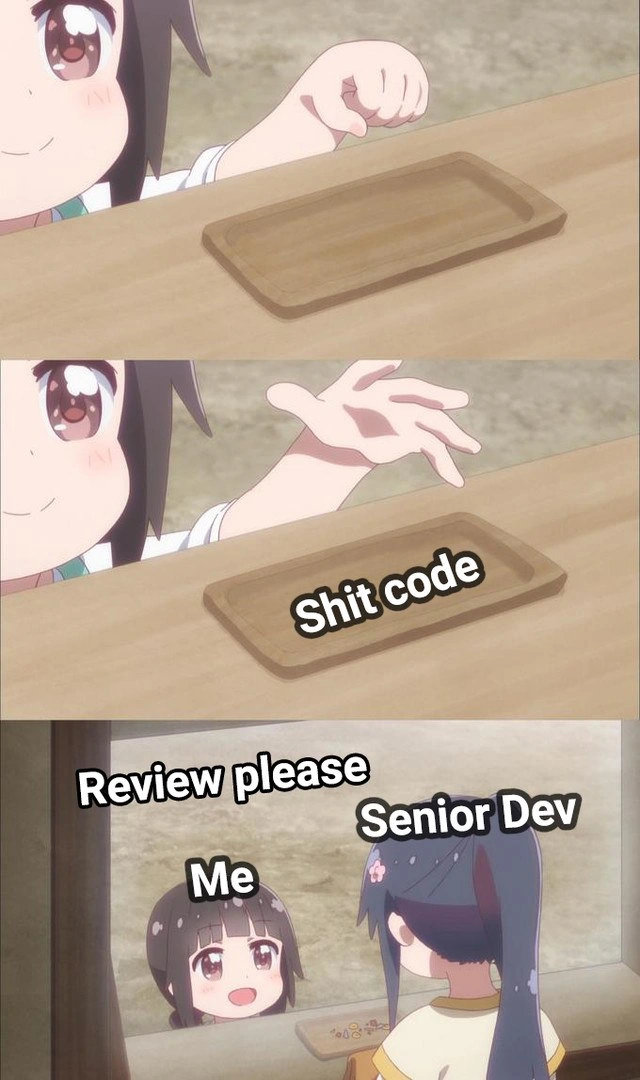
Now, the funny scenario in the meme: a junior developer (depicted as a cute anime-style kid labeled "Me") is handing over a tray through a window with the words "Shit code" on it, saying "Review please." The tray represents the batch of code changes (the commit or pull request) the junior is submitting. The text "shit code" is the junior cheekily admitting that their code might be of low quality (in other words, “I think my code might be bad”). The Senior Dev on the other side of the window is the experienced team member about to receive and review this code. This panel setup humorously visualizes a fairly common feeling among newer developers: nervousness mixed with hope when asking a senior to review their work. It’s an anime meme format being used to convey a workplace situation, which makes it extra playful and relatable (developers often use pop culture or cute images to soften the stress of serious tasks).

Let’s define a few terms and concepts to make sure everything’s clear:

  • Shit code (slang, very informal): Developers sometimes bluntly call code "shit" if it’s poorly written or full of problems. Here it’s self-deprecating – the junior dev is calling their own code “shit” to humorously acknowledge it probably has issues. This is a form of DeveloperHumor and humility. It’s like saying, “I’m not proud of this code, I know it’s kinda bad.” Using such a phrase among team members is usually done jokingly or to show “I know this isn’t my best work.”

  • Code review: This is the process where the senior dev is about to examine the junior’s code. The senior will check things like: Does the code run correctly? Does it handle errors? Is it written in a clear and maintainable way? Are there any bugs or potential problems? In a code review, the reviewer leaves comments on specific lines of code if something looks off. For instance, they might write, “Hey, what if this input is empty? This code might crash, maybe add a check for that.” Or “This function is too long, maybe break it into smaller functions for clarity.” The goal is to make the code better and to help the junior learn better practices.

  • Senior Dev: This is the experienced developer who has likely seen a lot of code (good and bad). They often mentor juniors. In many teams, a senior dev’s approval is needed to merge code changes. They have a big-picture view of the project and know the standards. So they’ll be looking to ensure the junior’s code fits well into the existing system and doesn’t introduce new problems (bugs, security issues, performance slow-downs, etc.). They also try to uphold CodeQuality by enforcing things like coding style (e.g., “Use meaningful variable names and proper indentation”) and completeness (e.g., “Did you also update the documentation or add unit tests for this new function?”).

  • Junior dev anxiety: When you’re new to coding in a team, it’s normal to feel anxious about code reviews. You worry that your code might be all wrong or that you missed something obvious. This meme is a lighthearted take on that anxiety – the junior is smiling outwardly (“Here you go!”), but by calling the code “shit,” they reveal their internal fear that the code isn’t good. It’s a bit like a student saying, “I probably messed this up, but please grade it.” The reason many juniors feel this way is because everything is a learning process; when reading others’ code or listening to reviewers, they might realize their approach wasn’t ideal. Also, when a senior points out a lot of issues, it can feel a little overwhelming. But every developer goes through this! Over time, you learn from those reviews and start writing cleaner code.

  • CodeQuality: This refers to how good or bad the code is, in terms of readability, correctness, efficiency, and maintainability. “Shit code” obviously implies low code quality: maybe the code works, but it’s written in a confusing way or it’s brittle (breaks easily if something changes). Common examples of low-quality code might be: functions that are too long or do too many things, unclear variable names (e.g., naming a variable x instead of something descriptive), repetitive code that could be simplified, or not handling important cases (like not checking if a file exists before trying to open it, leading to errors). In a CodeReview, improving code quality is a main objective. The senior dev will request changes to turn "shit code" into decent code: for example, “Please remove this hard-coded password and use a config value,” or “This loop is very slow for large inputs; can you use a more efficient method?”

The anime-style panels soften the scenario with humor. The junior being depicted as a cute child implies a kind of innocence – they might not fully realize how bad the code is, or they do realize it and are hoping for kindness. The senior being a taller character ready to take the tray suggests an authority figure who’s seen this many times. If you’ve ever asked a more experienced friend or colleague to check something you did, you might relate to that mix of hope and fear: hope that they’ll say “Looks good!” but fear that they’ll find a lot of mistakes. The asking_for_review text “Review please” is something developers literally do in chat or in the pull request description when they tag someone: “Hey @SeniorDev, could you review my PR when you have time? Thanks!” Often, juniors will add a smile or a note (“I’m not sure about this part, please let me know if it’s okay”) – basically just like the meme’s polite smile.

This meme is widely relatable in the programming community because it turns a potentially stressful experience into a comedic, exaggerated scene. It’s common to see juniors joke that their code is awful (to show they’re aware it needs improvement). And seniors often joke about bracing themselves before reviewing newbie code. The CodeReviewPainPoints tag and DeveloperPainPoints tag are on point: code review can be painful if the code is poor, but it’s a pain we go through for the greater good of the project and the developer’s growth. In summary, at this level, the meme is explaining: “When I (a junior) hand my code to the senior dev for review, I feel like I’m handing over something really bad... so I do it very nicely and hope for the best!” It’s funny and endearing because we’ve all been there in some form, and we know the only way forward is to face the review with a smile.

Level 3: Gift-Wrapped Garbage

At the highest technical perspective, this meme highlights the code review process as a quality gate in software development. In professional workflows (using Git, pull requests, and CI/CD), every commit must pass through a senior developer’s scrutiny before it’s merged. Here, the junior dev (the child in the anime panel labeled "Me") cheerfully slides a tray labeled "shit code" across the counter and says, "Review please." It’s a tongue-in-cheek portrayal of a pull request containing questionable changes being handed off for review. The humor comes from the stark contrast: the code’s poor quality is blatantly acknowledged (literally labeled as shoddy code), yet it’s offered with a smile and polite optimism. This exaggeration captures a DeveloperSelfDeprecation culture where programmers playfully call their own work "garbage" before anyone else can – a preemptive strike born of imposter syndrome and code quality anxiety.

In real development teams, Senior Devs act as gatekeepers of code quality. They review commits for CodeQuality issues: bugs, bad naming, missing tests, or any code smell that could cause maintainability problems. The service window in the image is a perfect metaphor: the junior is effectively serving up the code like a dish, and the senior is on the other side as the seasoned chef/critic ready to inspect it. A senior engineer has likely seen their share of hastily written fixes and technical debt dressed up as finished work. They can spot the telltale signs of crappy suboptimal code at 10 paces – much like an experienced chef instantly recognizing an undercooked meal. The meme resonates because every experienced dev remembers the days of sliding their own dubious code to a mentor, and every senior has at times received a gift-wrapped mess with a polite “PTAL” (Please Take A Look) note.

This specific combination of elements (a cute anime child presenting something labeled "Shit code" to an older character) is funny because it dramatizes an otherwise tense professional ritual in a harmless, cartoonish way. The anime_meme_format adds an innocent, lighthearted tone to what can be a nerve-wracking experience in real life. It’s the adorable visual equivalent of a junior developer saying, “I know this code is probably awful, but could you please review it?” with big puppy eyes. The senior’s role as the taller character ready to receive the tray mirrors how senior team members must maintain patience and guidance, even when presented with less-than-stellar contributions. Their inward reaction might be a resigned sigh or a facepalm (the classic “oh no, not again” feeling every code reviewer gets upon seeing shit_code in a PR), but outwardly they’ll put on a supportive smile and get to the business of constructive critique.

From an industry perspective, this meme nails a common DeveloperPainPoints scenario: Code reviews can feel like sliding your work under a microscope. The junior dev’s “questionable commit” likely contains things a senior will flag. For example, imagine a pull request diff with changes like:

# A quick 'fix' by a junior developer
try:
    dangerous_operation()  
except Exception:
    pass  # swallow all errors (bad practice - senior dev will surely comment on this!)

A seasoned reviewer will cringe at such code (catching broad exceptions is a big no-no because it hides real errors). They might leave review comments about missing error handling, lack of logging, or suggest using specific exception classes. The junior, aware that this patch is not ideal, still submits it hoping for approval or at least guidance. It’s a situation every dev team experiences: balancing CodeReviewPainPoints (making sure bad code doesn’t slip into production) with mentoring and keeping the team morale positive. The meme exaggerates the junior’s upbeat “nothing to see here, it’s fine” attitude, which many of us adopt ironically when we know our code is janky. It’s funny because we recognize that optimistic veneer over our internal cringe.

Ultimately, the meme pokes fun at the JuniorVsSenior dynamic. The junior is essentially saying, “I did my best, but I suspect it’s not great. Please be gentle.” The senior dev, as the quality gatekeeper, must inspect and probably request changes, but they remember being that newbie once. The shared understanding is that code reviews are an opportunity for learning: the junior gets feedback to improve, and the codebase stays clean (or at least less crappy). In practice, good seniors approach such reviews constructively:

  • They’ll highlight what’s good (maybe the idea or approach) to encourage the junior.
  • They’ll pinpoint the problems (inefficient algorithm, poor variable naming, missing edge-case handling) which make the code “shit” so the junior can fix them.
  • They might even pull the junior aside for a quick pair programming session to refactor the code together, turning a scary review into a teaching moment.

The meme’s comedic honesty – literally labeling the code as junk – reflects how dev teams often communicate informally. It’s not uncommon to see a PR description saying, “This is a quick hack, sorry for the mess, please review.” Everyone knows it’s a messy solution, but sometimes you need to push something and improve it iteratively. DeveloperHumor like this lets us vent those feelings: we laugh at the scenario because it’s a cathartic acknowledgement that writing perfect code isn’t easy, and we all produce shit code occasionally. In short, this meme hilariously captures a CodeReview rite of passage: delivering a sloppy first attempt with a smile, and trusting that the senior will help polish it (after a facepalm or two). It’s both a parody and an affectionate tribute to the mentor-mentee relationship that helps turn crap code into quality code over time.

Description

Three - panel anime-style meme. Panel 1 shows a smiling child reaching toward an empty wooden tray on a counter. Panel 2 is identical, but the tray now has bold white text reading "Shit code." Panel 3 pulls back to show the child (head captioned "Me") pushing the tray through a small service window while saying "Review please"; on the opposite side a taller character (captioned "Senior Dev") stands ready to receive it. The humor comes from a junior engineer cheerfully submitting obviously low-quality code for peer review, highlighting the self-deprecating anxiety many developers feel during code-review cycles and the quality gatekeepers role of senior engineers

Comments

6
Anonymous ★ Top Pick Junior’s PR title: “Quick null-check.” Diff: 1,347 lines, new global singleton, and a circular dependency that turns the service graph into a Klein bottle - then the comment: “Mind giving this a speedy LGTM? Prod’s blocked.”
  1. Anonymous ★ Top Pick

    Junior’s PR title: “Quick null-check.” Diff: 1,347 lines, new global singleton, and a circular dependency that turns the service graph into a Klein bottle - then the comment: “Mind giving this a speedy LGTM? Prod’s blocked.”

  2. Anonymous

    The real senior dev move is knowing that 'shit code' that works and ships is infinitely more valuable than perfect code stuck in an endless refactoring loop - we've all been there, pushing that MVP with a //TODO: refactor this entire module comment

  3. Anonymous

    The real tragedy isn't the shit code - it's that the senior dev knows exactly what's in that PR before even opening it, because they wrote the same garbage 15 years ago. They'll approve it anyway with 'LGTM, but let's refactor this in Q3' knowing full well Q3 is when that code becomes production-critical legacy that nobody dares touch

  4. Anonymous

    When 'simple refactor' means nesting 17 ternaries in a 2k-line god function that hallucinates on leap years

  5. Anonymous

    Me: Review please. Senior dev: Rename "shit code" to "legacy", hide it behind a feature flag, add metrics - congrats, it's now architecture

  6. Anonymous

    Senior dev translation layer: 'review please' => 1,200-line diff, 0 tests, cyclic dependencies, and a 'minor fix' title - an expedited refactor disguised as feedback

Use J and K for navigation