Skip to content
DevMeme
2467 of 7435
The TypeScript Self-Sabotage Cycle
Languages Post #2741, on Feb 10, 2021 in TG

The TypeScript Self-Sabotage Cycle

Why is this Languages meme funny?

Level 1: Your Own Rules

Imagine you and your friends decide to play a game, and you make a new rule to keep things fair. At first, you’re happy because the rule is supposed to help everyone play better. But later on, that same rule makes you lose the game, and you get really upset and say “This rule is so stupid!” It’s kinda silly, right? Because you’re the one who came up with the rule!

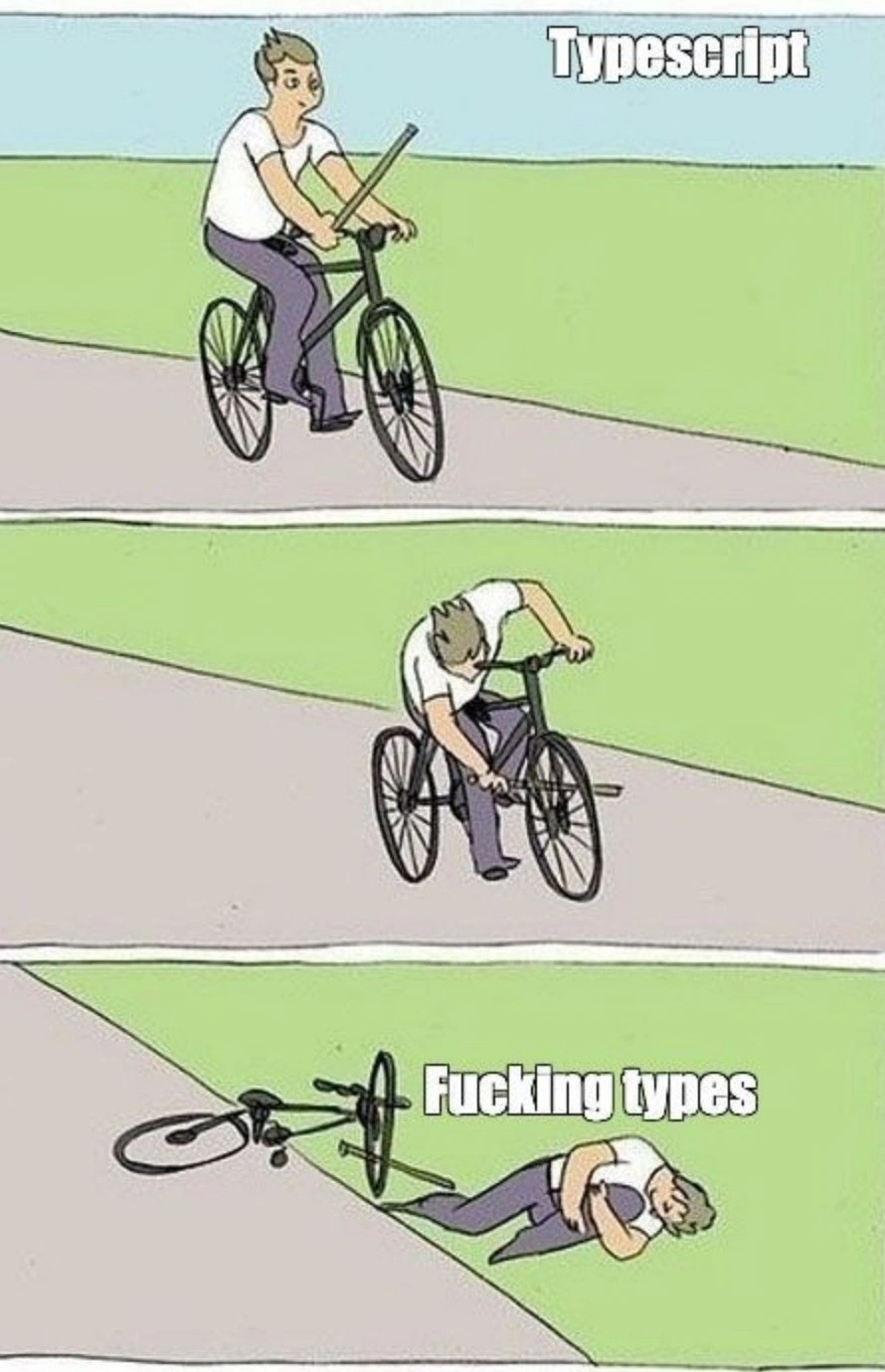
That’s exactly what’s happening in this picture. The person was riding a bike and he himself put a stick in his wheel, which made him crash. Then he got angry and blamed “the stick” (or in the coding world, the “types”). It’s like blaming your own idea for causing a problem. The joke is funny because the person is complaining about something he did to himself. It reminds us of times when we make things harder for our own good and then grumble about it. In simple terms: don’t curse the rules you made – especially when those rules were supposed to help you in the first place!

Level 2: When Types Attack

Let’s break down the humor in simpler terms. TypeScript is a programming language (actually a superset of JavaScript) that adds static typing to JavaScript. Static typing means you have to declare what “type” of data (number, string, object, etc.) is expected in different parts of your program, and the compiler will complain if you mess up. This is great for catching mistakes early: for example, if a function is supposed to get a number and you try to give it a string, TypeScript will throw an error before you even run the code. That’s what we call type safety – it helps prevent certain bugs. The type system is basically the set of rules that decides what’s a valid type in your program (like "User must have a name that is a string" or "this function returns either X or Y, but nothing else"). Developers often write these rules themselves by defining interfaces, classes, or advanced type aliases in their code. In other words, with TypeScript you create a bunch of self-imposed rules describing how your code should work.

Now, the meme shows a well-known “stick in bike wheel” comic. This comic format is typically used to joke about someone causing their own problem and then complaining about it. In our version, the cyclist is labeled “TypeScript” (which really stands for a TypeScript developer or the project using TypeScript). In the first panel, the dev on the bike is happy – just like we are when we decide to use TypeScript to improve our project. The “stick” he’s holding represents those strict type rules we add to our code to make it safer. In the second panel, the cyclist deliberately jams the stick into his own bike wheel. That’s exactly like a developer writing an extremely narrow or strict type definition. For example, imagine a developer defines a type for allowed status values in their app but leaves something out:

type Status = "success" | "error"; 

function handleStatus(s: Status) {
  if (s === "success") {
    console.log("Yay, it worked!");
  } else {
    console.error("Uh oh, something went wrong.");
  }
}

handleStatus("pending"); 
// Error: Argument of type '"pending"' is not assignable to parameter of type 'Status'.

In this TypeScript code, the developer wrote the Status type to only allow "success" or "error". Later, when they try to use "pending", the TypeScript compiler throws an error. That’s a self-inflicted problem: the code is doing exactly what the developer told it to do by disallowing any status besides those two. It’s as if the cyclist put a stick in the wheel – the rules (stick) we created cause the program (bike) to stop with an error (crash).

In the third panel of the meme, the bike has crashed and the TypeScript dev is on the ground, clutching his knee in pain. The caption over him says “Fucking types” (excuse the language, but that’s the joke’s wording). This represents the developer angrily complaining about the types – in other words, cursing at the strict type system. It’s funny because he’s essentially blaming the very rules he chose to add. A developer using TypeScript might similarly groan, “Ugh, these types are so frustrating!” after the compiler yells at them. But those types (the rules) were set up by the developer or their team in the first place!

To someone new to this, here’s why developers both love and curse TypeScript:

  • Love it: Static typing catches mistakes in your code before you run it. For instance, if you’re trying to access a property that doesn’t exist on an object, TypeScript will warn you. This can save you from runtime errors (bugs that crash the program while it’s running) and make big codebases easier to manage. It’s a bit like having a spell-check for your code.

  • Curse it: Sometimes the type system feels like it’s in your way. You might know what you’re doing, but the compiler keeps complaining until you appease it by tweaking types or adding extra definitions. It can slow down experimentation or make simple tasks take longer because you have to “fit” everything into the strict structure. In a JavaScript project without TypeScript, you’d just run the code and see what happens. In TypeScript, you might spend time wrestling with the compiler to get the code to compile at all. That can be frustrating, especially if the rules are very strict.

So, the meme’s humor comes from that frustration. The TypeScript developer in this scenario has created a very strict type system for their project (inserted the stick), and when it inevitably causes something to break or not compile (the crash), they yell at the “stupid types” (the stick) as if it’s not their fault. It pokes fun at us developers because we do this a lot: we blame the tools or languages (“TypeScript is being dumb!”) instead of admitting that sometimes we wrote the code or config that’s making it act that way. It’s a lighthearted take on developer humor where the tools meant to help us end up being the ones we complain about. In reality, TypeScript is doing its job – the code didn’t meet the rules, so it refused to run. But in the moment, a frustrated programmer might not want to hear that logic and instead just grumbles about “those dang types.”

In summary, this meme is illustrating frontend developers’ frustration with TypeScript’s strictness, in a goofy, exaggerated way. It reminds us that while static typing in a language can greatly improve our programs (that’s why we endure it), it also introduces a new kind of headache — one that, as the meme jokes, is often of our own making. It’s a funny nod to the idea that sometimes our efforts to write better code end up making our coding life harder, at least in the short term. And the next time you hear a teammate swearing at a compile error, remember this comic: they might just be the cyclist who stuck a stick in their own wheel and is now mad about the fall! 😅

Level 3: Tripping on Types

At the highest level, this meme highlights a classic paradox in modern JavaScript development: TypeScript gives us the safety of static typing, yet we developers often become the architects of our own frustration. In the three-panel stick-in-bike meme, the bicyclist labeled “TypeScript” cheerfully rides along (just as we eagerly adopt strict typing for better type safety). Then, like a developer writing overly rigid type definitions, the cyclist jams a stick into their front wheel – a perfect metaphor for self-inflicted errors. The inevitable crash represents the codebase grinding to a halt on a compile-time error. Finally, our fallen rider clutches his knee and curses “Fucking types.” This punchline lands because senior engineers recognize the irony: we demand strict static types to catch bugs early, but then blame the type system (which we configured) when it “unfairly” complains. It’s developer humor gold because it satirizes our love-hate relationship with strong typing in a frontend codebase. We want those extra guard rails for reliability and better Developer Experience (DX), but oh boy, do we gripe when the compiler yells at code that we told it to be picky about.

On an industry level, this hits home due to the widespread adoption of TypeScript in large JavaScript projects (especially in frontend frameworks). Many experienced devs remember the wild west days of dynamic typing—no compile checks, just runtime TypeErrors waiting to happen. TypeScript was introduced to tame that chaos by acting as a helpful “language cop”. But here’s the catch: we configure that cop. We write interface definitions, union types, and generics that form the very type system enforcing rules on our code. This meme exaggerates the scenario where a developer creates a super strict set of types (like a complex Interface or a narrow Union of allowed values), effectively inserting the stick of rigid rules into their project’s wheels. When they later hit a compile-time error (the equivalent of a faceplant), they exclaim in frustration, blaming “these damn types” – conveniently ignoring that they asked for this strictness. Seasoned programmers recognize this comedic self-own: it’s like implementing strictNullChecks, noImplicitAny, and a bunch of custom generic types across a codebase, and then complaining that writing code has become too restrictive or verbose because of all the types. We’ve all seen that co-worker (or the reflection of ourselves in the monitor at 2 AM) cursing at a TypeScript error message that is technically the direct result of our own design decisions.

There’s also an element of communal trauma being poked at here. TypeScript’s static typing can get very sophisticated – with mapped types, conditional types, etc. – to the point that a codebase’s type definitions almost become a second codebase to maintain. Ever refactored a large app where the TypeScript compiler throws a 20-line error because one obscure type doesn’t line up? It’s both impressive and infuriating. This meme resonates especially with senior frontend engineers who have wrestled with TypeScript’s powerful type system. They’ve experienced how a clever generic type or an imported .d.ts file can suddenly break half the code with red squiggly lines, prompting a heartfelt “Why is TypeScript doing this to me?!” 👀. In reality, we gave the compiler that stick to throw in our wheels: maybe by insisting on super strict interfaces or by upgrading to a new TypeScript version that enforces tighter rules. The humor lives in that absurd blame shift. It’s akin to complaining “My unit tests keep failing” when you’re the one who wrote those tests to catch your mistakes. In short, the meme is making fun of our tendency to curse the very safeguards we put in place. It’s a gentle roast of the TypeScript community’s quirk: we simultaneously praise static types for preventing production bugs and curse them for slowing us down during development. Just as the cyclist’s injury is technically self-inflicted, those maddening compile-time errors are the product of our own quest for robust code. This contradiction is what makes the joke land so well among developers – it’s a shared “ugh, I’ve been there” moment that blends exasperation with a nod of respect to the strict language rules we imposed on ourselves.

Description

This is a three-panel comic strip using the 'Bicycle Fall' meme format. In the first panel, a man is riding a bicycle, and the scene is labeled 'Typescript'. He is holding a stick, representing the strict type system he has opted into. In the second panel, the man deliberately shoves the stick into the spokes of his own front wheel, causing an immediate problem. The third panel shows him crashed on the ground, clutching his knee in pain, with the caption 'Fucking types'. The humor comes from the self-inflicted nature of the problem. It satirizes developers who choose to use TypeScript for its safety and predictability but then become frustrated and blame the type system itself when it enforces the very rules they agreed to, often when their own code is inconsistent or incorrect. It’s a relatable feeling for developers who've spent hours fighting the compiler over a complex type issue, only to realize the error was in their own logic
Comments

11
Anonymous ★ Top Pick TypeScript is that friend who you invite to the party for being responsible, and then get mad at when they stop you from doing a third Jägerbomb at 2 AM. You chose this
  1. Anonymous ★ Top Pick

    TypeScript is that friend who you invite to the party for being responsible, and then get mad at when they stop you from doing a third Jägerbomb at 2 AM. You chose this

  2. Anonymous

    Enabling strictNullChecks, plastering every red squiggle with “as any,” and then filing a Sev-1 titled “TypeScript broke prod” is just the statically-typed way of jamming a `const stick: never` into your own spokes

  3. Anonymous

    After 15 years of wrestling with production type errors, you realize the real bug was thinking 'any' was a temporary solution rather than technical debt with compound interest - but at least your IDE autocomplete works now

  4. Anonymous

    TypeScript is like that friend who insists on being technically correct about everything - sure, they prevent you from making mistakes, but sometimes you just want to ship code without explaining why `string | undefined` isn't assignable to `string` for the fifteenth time today. The real tragedy is when you realize the crash happened because you forgot to add `as const` to an object literal three files ago, and now your entire type hierarchy has collapsed like a house of cards built on `any`

  5. Anonymous

    Adopt TypeScript, set strictNullChecks=false, cast everything as any, then write a Sev-1 RCA blaming “types” - the stick in the spokes was your tsconfig

  6. Anonymous

    Most “TypeScript slowed us down” postmortems translate to: we jammed any into the inferencer, face‑planted on variance, then filed a ticket against the type system

  7. Anonymous

    TypeScript: Where 'any' promises freedom, but the type checker ensures spectacular build-time wipeouts

  8. @deerspangle 5y

    But.. Types are wonderful!

    1. @illia_sahaidak 5y

      true

  9. @f3rr0us 5y

    This meme was made by the Tcl gang

  10. @Jeffeek 5y

    the same situation with dynamic lol

Use J and K for navigation