One Does Not Simply 'Just Add a Small Feature'
Why is this ProjectManagement meme funny?
Level 1: Birthday Party for Homework
Imagine you finished your homework and gave it to your teacher, but your teacher took three years to check it. That’s such a long time that the homework might even have a birthday by then! So, as a joke, you bake a cake and write “Happy 3rd Birthday to my homework!” on it. Instead of getting mad that you waited so long, you turn it into something funny.
This meme is like that, but with a coding twist. A programmer wrote some code and asked for it to be added to a big project. The people in charge didn’t review (look at) the code for three years. That’s an incredibly long wait. So the programmer decided to be silly and celebrate the “third birthday” of the code change with a cake. It's funny because normally you would never have a birthday party for work that’s just sitting there! By doing this, the programmer is basically saying, "Wow, I've been waiting forever for this," but in a playful way. It shows they were a bit frustrated about the delay, but instead of getting angry, they used a goofy celebration to cope with it. Even if you're not a programmer, you can understand that waiting a really long time for something can be frustrating — and having a little birthday party for the thing you’re waiting on is a silly way to make the best of the situation.
Level 2: Pull Request Party
To understand this joke, let's break down the scenario in simpler terms. GitHub is a popular website where developers share and collaborate on code using version control (specifically a system called git). When a developer wants to contribute changes to a project, they open a pull request (PR). A pull request is like saying, "I made some changes on my copy of the project; could you please review and add them to the main project?" Before a PR gets accepted and merged into the main codebase, other developers (often project maintainers) need to look at the changes. This is the code review process: they check if the code works, if it follows the project's guidelines, and if it won't introduce new bugs. Only when the code reviewers approve will the PR be merged (meaning the changes become part of the official project).
Now, TypeScript is a large open-source project – it's a programming language that adds static types to JavaScript, and it's maintained by Microsoft with help from the community. "Open-source" means the source code is publicly available and anyone can propose improvements or fixes. Because TypeScript is widely used by developers, lots of people have ideas to make it better. This means the TypeScript GitHub repository gets a lot of pull requests. The maintainers (the core team in charge of the project) have to go through each one carefully. They need to be cautious, because a change in a programming language can affect many thousands of developers' code. If maintainers are busy or a proposed change isn’t a top priority, a PR might have to wait in line for a long time.
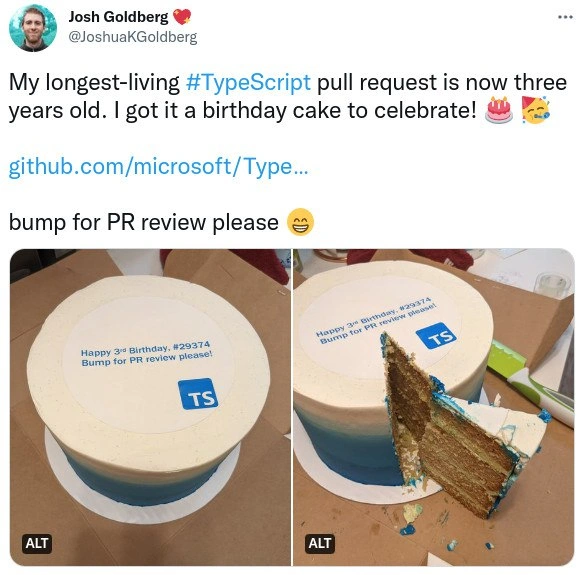
In the tweet pictured, a developer named Josh had created a pull request to the TypeScript project and it sat open, waiting for three whole years! That is extremely long for a PR to stay open. To give a sense of time: in three years, TypeScript itself probably had numerous updates and new versions released, yet this PR (which has the ID number #29374 on GitHub) was still pending, neither merged nor officially closed. Usually, if a PR stays open for months or years with no activity, it might get marked as stale (meaning "is anyone still working on this?") by a bot and eventually closed to keep the project tidy. The fact that PR #29374 was still open after three years means the contributor must have kept it alive — perhaps by updating the code whenever the main project changed, or by occasionally commenting to let the maintainers know it's still important.
To playfully bring attention to this unusually long wait, Josh got a real cake made. The cake has the blue TypeScript logo on top and a message written in icing: “Happy 3rd Birthday, #29374 – Bump for PR review please!” It looks just like a birthday cake you'd have at a party, but it's for a piece of code instead of a person. Let's break down that message: "#29374" is the pull request's number on GitHub (every PR gets a unique number). The phrase "bump for PR review please" is what someone might say in a comment to politely remind the team, hey, this is still here — could someone take a look? In online forums and project discussions, to "bump" something means to post a new comment on a thread that has been quiet, which pushes it back into people's attention. So by literally putting bump for PR review please on a cake, Josh is humorously nudging the TypeScript maintainers to notice his long-lived PR, but in a fun and friendly way.
This is obviously not a normal thing to do – it's a funny, exaggerated response to an uncommon situation. Normally, a pull request wouldn't have a birthday because it would be reviewed and resolved much sooner. By celebrating the PR's "3rd birthday," the developer is joking about how ridiculously long it has been waiting. The second photo even shows a slice cut out of the cake, proving it’s a real cake that got eaten, not just a Photoshopped image. It's a mix of sincere and silly: sincere because they're genuinely still waiting and hoping for a review, and silly because they're treating a software issue like it's a birthday boy at a party.
All the terms and tags associated with this meme connect to this story. It’s about code reviews in an open source setting, and the pain of a pull request stuck in limbo on GitHub. The phrase code review pain points pretty much sums it up: one big pain point is having to wait forever for someone to give you feedback or approval. But instead of getting upset, the developer used humor (even edible humor!) to deal with it. This resonated with a lot of people in the developer community, because many have experienced something similar on a smaller scale. In short, the programmer had a code change waiting for review for so long that they treated the wait time like the age of a person and threw a birthday party for it. It’s a lighthearted way to say "this has been pending for way too long," and it made other developers laugh and nod in sympathy.
Level 3: Stale Branch Celebration
In veteran open-source circles, this meme hits home because it captures a code review saga taken to absurd lengths. We're looking at a TypeScript repository pull request that’s been open for a whopping three years without being merged – so long that the contributor literally bought it a birthday cake. This scenario is a tongue-in-cheek reflection on real open source dynamics: popular projects like TypeScript (maintained by Microsoft) often have hundreds of pending PRs, and some changes languish in review purgatory due to limited reviewer bandwidth and shifting priorities. The humor lies in treating a piece of code waiting for a review like a living being aging year by year.
But it's not just the duration – it's how the contributor highlights it. The cake is frosted with the TypeScript logo and the words “Happy 3rd Birthday, #29374 – Bump for PR review please!”. In GitHub parlance, bumping a PR means posting a reminder comment like bump for review 🙏 after a long silence, hoping maintainers notice it. Combining that plea with a literal cake is a brilliant mix of developer absurdity and gentle prodding. Seasoned devs chuckle because they've been there – maybe not baking a cake, but definitely posting polite pings on forgotten PRs after months (or years). It's a coping mechanism and an absurd celebration rolled into one.
For a TypeScript PR to remain open three years, a perfect storm of factors hit. Perhaps it touched a tricky part of the language or proposed a feature the team wasn’t ready to merge. Large projects prioritize stability; every external change must be carefully evaluated for impact on thousands of downstream developers. So a PR can sit if it's not deemed urgent, conflicts with current roadmaps, or needs extensive revision. Meanwhile, the contributor might faithfully update their code whenever conflicts arise with the main branch (imagine regularly rebasing or merging upstream changes over three years!). That dedication is both admirable and a little heartbreaking. The cake, with its neatly layered slices, almost symbolizes the layers of updates and iterations that PR must have gone through as the underlying code evolved.
In the world of version control on GitHub, there's even the concept of items going stale: if a PR is inactive for too long, automated bots may mark it as stale or close it. The fact that this PR survived to its third birthday means someone (either the author or a maintainer) kept it alive, resetting that stale clock occasionally. Experienced devs know this dance: to avoid your hard work being auto-closed, you might leave a comment or push a tiny update just to show "still interested!" It's practically an open-source rite of passage to have at least one contribution that takes eons to get merged (or even reviewed).
Seasoned contributors also recognize a crucial reality: maintainers are often swamped. The TypeScript team at Microsoft likely has a massive backlog of community-submitted PRs, and only so many core team members to review them. Ironically, the more popular the project, the harder it can be to get your PR reviewed promptly. Everyone assumes big projects have plenty of maintainers, but often it’s a handful of overworked folks juggling thousands of issues and PRs. In theory, every PR would be promptly addressed to keep contributors happy; in practice, triage happens and many PRs sit idle. This gap between the ideal (quick, thorough reviews) and the reality (weeks, months, or years of silence) is exactly where developer humor finds its mark. Instead of a rant, the contributor chose a lighthearted approach: the absurdity of a birthday party for a forgotten piece of code highlights those code review pain points without any bitterness.
And funny enough, stunts like these can actually get attention. A tweet featuring a cake and this story spread through developer communities, indirectly pinging the maintainers in a friendly way. It's a clever, positive spin on the frustration – better than angrily complaining, it invites everyone to share a laugh. Many veteran devs have joked "this patch is so old, it's going to start school" or "I'll be retired by the time they merge this!". Here, someone actually turned that joke into reality with frosting and candles. The result is a meme that’s both hilarious and painfully relatable. It underscores how an innocent pull request can turn into a long-running saga, and how engineers sometimes cope with delays through creativity and humor. It's funny because it's true – and because sometimes laughter (and cake) is the only way to deal with a never-ending code review queue.
Description
This meme uses the 'One Does Not Simply Walk into Mordor' format, featuring the character Boromir from 'The Lord of the Rings'. The text overlay reads, 'One does not simply... just add a small feature.' The meme humorously captures the reaction of an experienced developer when a project manager or client underestimates the complexity of a feature request. The phrase 'just add a small feature' is a classic red flag for developers, as it often signals a lack of understanding of the underlying codebase and the potential for cascading changes, bugs, and unforeseen technical challenges. This meme is highly relatable to senior engineers who have learned through painful experience that there is no such thing as a 'small' change in a large, complex system
Comments
7Comment deleted
The project manager says, 'It's just a small change.' The senior dev hears, 'I've scheduled a surprise refactoring of the entire monolith for you, and the deadline was yesterday.'
A TypeScript PR that lives long enough for a third-birthday cake isn’t awaiting review - it’s quietly transitioning from feature branch to legacy system
Three years waiting for a TypeScript PR review? That's actually faster than migrating our legacy jQuery app to React - we're still debating whether to use class components or hooks
After three years in review, this PR has officially outlived most JavaScript frameworks, survived multiple TypeScript major versions, and accumulated enough merge conflicts to require archaeological excavation. At this point, the cake's frosting has better type safety than the original code submission - and both are equally likely to get consumed before the PR merges
When your TypeScript PR turns three, it qualifies for LTS - the flaky dependency is reviewer bandwidth, not CI
At three years old, a PR graduates from stale-bot to legacy - by the time CODEOWNERS rotates again, the rebase diff is longer than the design doc, and the only thing to hit production is the cake
This PR has more tenure than some SREs at Microsoft - promote it to main before it demands a corner office