Skip to content
DevMeme
4303 of 7435
Explaining the Logic of a 10-Year-Old Legacy System
LegacySystems Post #4703, on Jul 29, 2022 in TG

Explaining the Logic of a 10-Year-Old Legacy System

Why is this LegacySystems meme funny?

Level 1: Trick Question

Imagine your school just started a brand new club this year – say a robotics club that never existed before. Now picture the teacher in charge saying, "Anyone who wants to join needs at least 5 years of experience in this robotics club." 🤔 That sounds crazy, right? Nobody could have 5 years experience in a club that only started this year!

But here's why the teacher might say that: it's like a trick question or a trap to catch anyone who would lie. A truthful student will say, "Uh, that's impossible – none of us have been in it before." But suppose one student raises their hand and claims, "Oh, I've been doing this club stuff for 5 years!" Immediately, the teacher would know that kid is making it up. The requirement was impossible, so anyone who says they meet it must be fibbing.

In the meme's story, the job posting asking for 10 years of Carbon programming experience is just like that teacher's impossible rule. It's so unrealistic that the only people who would say "Yes, I have that!" are those who are not telling the truth. So it's a funny way of suggesting the company could catch résumé liars by asking for something nobody could honestly have. Essentially, they put a big "no liars allowed" sign in the form of an impossible requirement. That’s why it’s funny – it's like using nonsense to outsmart the people who might make up stories.

Level 2: New Language, Old Trick

Carbon is a brand-new programming language introduced by Google in 2022. At the time of this meme, Carbon had only been around for a few weeks. So asking for 10 years of Carbon experience is literally impossible – no one could have used Carbon for a decade when it just came out!

Yet, tech job postings often include lines like "X years of experience in [Technology]" as a standard format. It's a way of saying how skilled or senior they want the applicant to be. For example, asking for "10+ years in Java" means they want someone who’s been coding in Java for a long time. But sometimes the people writing these listings (often HR or recruiters) don't double-check if those numbers make sense for newer technologies. This leads to unrealistic_job_requirements – like demanding years of experience in something that only just appeared. It's a common source of HiringHumor among developers because it shows a funny disconnect between hiring practices and reality.

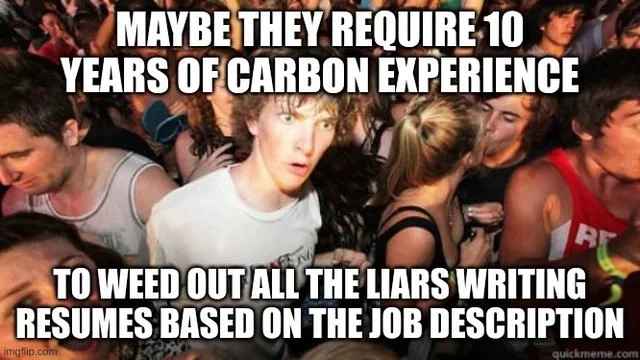
The image is using the "Sudden Clarity Clarence" meme template – the guy in the middle of a party suddenly looking shocked as he realizes something. The text he "realizes" is split into two parts. At the top: "Maybe they require 10 years of Carbon experience..." and at the bottom: "...to weed out all the liars writing resumes based on the job description." In plain terms, he's thinking: "What if the reason the job ad asks for 10 years in Carbon (which is impossible) is so they can catch people who lie on their résumé?"

Here's why that's the joke: Some job seekers do resume_fudging – meaning they exaggerate or lie on their resumes to match the job posting. If a listing mentions a specific skill, a dishonest applicant might add it to their resume even if they only briefly used it or just heard of it. People sometimes literally copy keywords from the job description into their résumé to get past filters. It's a known issue in hiring.

So the meme proposes an amusing idea: the company might be one step ahead. By asking for something outrageous (10 years in Carbon), they create a trap. An honest person will realize "Wait, nobody can have that, it's a new language!" and either ignore that requirement or admit they don’t have it. A dishonest person, on the other hand, might claim they do have those 10 years just because they see it listed – essentially lying to seem qualified. The phrase "weed out" means to filter out or eliminate, like pulling weeds from a garden to leave only the good plants. So by including an impossible requirement, the company can easily identify who the liars are (anyone claiming to meet that requirement must be making it up) and cut them from consideration. It's a stealthy sort of filter because it's hidden in the job criteria itself, not an obvious test.

This joke also touches on hype around new tech and how people react. Carbon was getting a lot of buzz as a new language (being backed by Google gave it extra attention), but no company should realistically expect applicants to have deep experience in it right away. Usually, it takes years for a language to gain a community of experienced users. So a sensible job ad wouldn't require Carbon expertise yet; instead it might ask for strong C++ skills and an interest in Carbon. By exaggerating the scenario, the meme highlights how silly it is to treat language adoption like an overnight thing.

In short, the humor comes from the absurd mismatch. It's a CareerHumor snapshot of the hiring world: a job posting asks for something impossible, and the punchline is "maybe they did that on purpose to catch the people who would fib." It's pointing out both the hype-driven silliness of listing a brand-new language as required experience and the idea of using an obviously impossible ask as an honesty test in the hiring process.

Level 3: The Carbon Filter

Carbon is hardly ten minutes old in the programming world (Google introduced this experimental C++-successor in mid-2022), yet some job listing out there is boldly demanding 10 years of experience in it. This meme gives voice to the collective eyeroll of seasoned developers encountering such absurd HiringPractices. The top caption imagines a conspiratorial twist: maybe the company isn't clueless after all, but deliberately requiring an impossible tenure with Carbon as a stealth filter to trap dishonest applicants.

Dive deeper, and it's both hilarious and painfully familiar. Tech industry job descriptions have a notorious pattern of listing impossible requirements — like asking for 8+ years in a framework that only launched 4 years ago. It's a running IndustryIrony gag: we've seen "5 years of Swift experience" barely a year after Swift came out, or "expert in Kubernetes" when even Kubernetes itself was still new. There's even a famous anecdote where the creator of a popular framework joked he couldn't qualify for a job because the HR checklist demanded more years in his own tool than the tool had existed. This “10-year Carbon experience” requirement is cut from the same cloth, dialing the absurdity to eleven. In fact, this scenario is basically the classic "X years of experience" joke made real. In developer circles, there's an expectation that as soon as a new tech is released, a ridiculous job listing asking for 10+ years in it will pop up. This Carbon example is exactly that 10_years_experience_meme manifesting in record time.

So what's going on here? Some possibilities:

  • Out-of-touch HR: The likely case is a non-technical HR person or hiring manager copy-pasted a standard senior developer template: "10 years experience with [hot new language]" without realizing Carbon was announced just recently. Many HR departments insist on quantifying everything (years of experience, degrees) as a crutch to filter candidates. Unfortunately, that rigid formula falls apart when a new_language_hype emerges.
  • Overenthusiastic management: Perhaps someone high up read about Carbon (Google's touted “C++ successor”) and decided "We need Carbon developers, stat!" It's the classic TechHypeCycle reflex — jumping to hire for a technology that's barely out of the incubator. In their rush, they don't stop to consider that genuine experts literally do not exist yet. They just imagine if it's the future, they want the future on the team now (never mind that pesky time-travel problem).
  • The stealth filter theory (meme's jest): Imagine they actually know nobody has 10 years with Carbon. In this scenario, the absurd requirement is a clever trap. It's like a built-in lie detector: anyone who claims to meet it is automatically suspect. An honest developer would either laugh or shrug it off, whereas a dishonest one might go "Sure, 10 years, why not!" and out themselves. It's almost like HR implementing a bogus Turing test for honesty. This test isn't subtle at all — it’s more like a giant neon sign saying "Let's see who lies."

What’s funny is how plausible that last scenario sounds in jest, precisely because the alternative (HR being clueless) is so routine. The meme’s humor lives in that sudden, almost hopeful thought: perhaps behind the madness, there’s genius. Of course, reality is usually less strategic. HiringHumor like this thrives because developers have all seen ridiculous requirements or interviews where HR asked something nonsensical. It's a coping humor for the disconnect between HR checklists and real-world timelines.

For veteran engineers, this triggers equal parts laughter and exasperation. Laughter, because the idea of using an impossible ask as an honesty test is both clever and absurd. Exasperation, because it underscores how disconnected hiring filters can be from actual tech reality. The CareerHumor here comes from that shared “are you kidding me?” moment we all recognize. It's one of those “laugh so you don't cry” scenarios — either you find the joke in it or you start worrying how many great candidates will be scared off by such nonsense.

In truth, this kind of requirement might backfire. Honest candidates could see "10 years of Carbon" and simply self-select out ("I don't qualify, guess they want someone else"), whereas more unscrupulous ones won't be fazed ("Sure, I'll just claim I did Carbon at my last job, who'll know?"). So if it were a filter, it's an awfully coarse one. Ironically, it's as unrealistic as those unrealistic_deadlines where a project timeline expects a time machine – here the resume expects one! Unless a candidate has a DeLorean with a flux capacitor (to go fetch a Carbon manual from 2012), this criterion isn't getting met legitimately.

To be fair, any applicant brazen enough to boast "10 years of Carbon experience" would raise immediate red flags with a technical interviewer. It's as straightforward as:

# HR's stealth honesty filter (hypothetical)
if candidate.years_experience("Carbon") >= 10:
    print("🤨 Liar detected: Carbon hasn't existed that long.")
    reject(candidate)

That snippet captures what the meme implies: the requirement is a quick script to flush out fibbers. It’s tongue-in-cheek, because real hiring doesn’t usually involve such deliberate trickery (and if it does, it might be a bit dysfunctional). Organizationally, this highlights a common communication gap: often the engineering team would catch such an issue in the job post, but sometimes they see it too late or not at all. It's not uncommon for dev teams to cringe at the job reqs that get posted in their name. If questioned, HR might defend it with "We want to ensure we attract senior people," not realizing they've effectively asked for a unicorn that can't exist.

So, this meme resonates as truth disguised as a joke. We’ve all seen an absurd job listing and had that same sudden clarity: either somebody in hiring has no clue, or they’re playing 4D chess. And since the former is far more common, the humor comes from entertaining the wild idea that maybe — just maybe — they meant to do that on purpose.

Description

This meme features Giorgio A. Tsoukalos from the TV show 'Ancient Aliens', known for his wild hair and conspiratorial hand gestures. The text overlay reads: 'I'm not saying this legacy code was written by a madman... but it was a madman.' This meme humorously captures the feeling of a developer trying to understand a complex, poorly documented, and seemingly illogical legacy system. The comparison of the original author to a 'madman' is a relatable exaggeration for anyone who has spent days or weeks deciphering code that defies all modern conventions and best practices. It's a lighthearted take on the frustrations of maintaining and modernizing old software

Comments

9
Anonymous ★ Top Pick The original developer wasn't a madman, they were a genius who solved a problem you don't understand, with constraints you can't imagine, on a deployment target that has since been decommissioned and is probably now a bird bath
  1. Anonymous ★ Top Pick

    The original developer wasn't a madman, they were a genius who solved a problem you don't understand, with constraints you can't imagine, on a deployment target that has since been decommissioned and is probably now a bird bath

  2. Anonymous

    Listing “10 years of Carbon” is basically a distributed-systems filter: only the résumés that violate causal consistency between 2025 GA and 2015 experience get dropped from the cluster

  3. Anonymous

    The real 10x developer is the one who can accumulate 10 years of experience in a language that's been public for 2 years - it's just simple time complexity optimization, O(1) where 1 equals whatever the recruiter needs it to be

  4. Anonymous

    Ah yes, the classic '10 years of experience required' for a framework that launched 3 years ago. At this point, I'm convinced HR departments are just running a distributed Turing test to see who can craft the most convincing fiction while maintaining a straight face during the interview. The real senior engineers are the ones who can read between the lines and realize that 'required' actually means 'we copied this from another job posting and have no idea what half these acronyms mean.' Bonus points if you can explain to the hiring manager why their requirement for 15 years of Kubernetes experience is asking for someone who started using it before it existed - that's when you know you've found a company that truly values time travel as a core competency

  5. Anonymous

    Finally, a req I nailed before my first 'Hello World' - unlike those '15+ years in a 10-year-old framework' traps

  6. Anonymous

    Adding '10 years of Carbon' to the JD optimizes precision but sets recall to zero - classic ATS ROC curve failure

  7. Anonymous

    Posting “10 years of Carbon” is property-based testing for resumes - any candidate that passes has already violated causality

  8. @RiedleroD 3y

    …that's actually a reasonable explanation

  9. @azizhakberdiev 3y

    I'm looking for Carbon++ release

Use J and K for navigation