When the Friday Deployment Breaks Production Over the Weekend
Why is this Deployment meme funny?
Level 1: Are We There Yet?
Imagine you worked really hard on a school project and you gave it to your teacher to check. Now you’re waiting for your teacher’s okay so you can put it on the classroom wall. You wait… and wait. It’s like sitting in a car on a long trip, constantly asking, “Are we there yet?” but instead you’re asking, “Did the teacher look at it yet?” You even poke your friend sitting next to the teacher, “Hey, can you ask if they saw my project?” At first you ask nicely, but as time goes on you get impatient and a little upset. This meme is just like that, but for programmers. The developer is waiting for their teammate to say “Good job, your code is fine.” They keep asking in different ways – “Hey, are you there? Can you please check?” – just like a kid repeatedly asking if it’s time to arrive or if their parent has signed a permission slip. Each song title in the picture is one of those asks, turning the waiting into a funny little story. In the end, it’s poking fun at how frustrating it feels to wait for someone else’s approval. It’s silly and exaggerated, but anyone can understand that feeling of waiting for an answer and wanting to shout, “Come on, pleeease hurry up!”
Level 2: Slack Ping Soundtrack
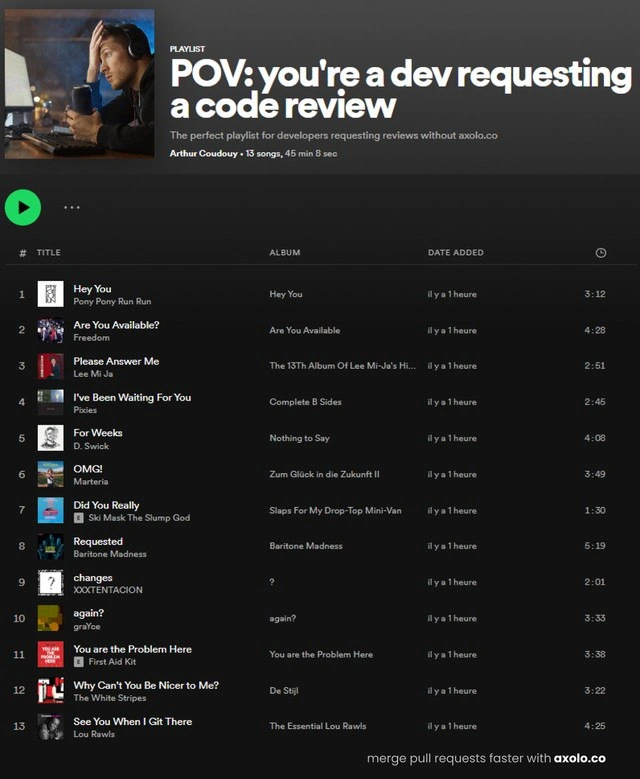
Let’s break down what’s happening in this meme. Code review is the process where another developer checks your code changes (often via a Pull Request on platforms like GitHub or GitLab) before those changes can be merged into the main codebase. This is crucial for catching bugs and improving quality, but it introduces a waiting period – you need someone’s approval. In the meme’s scenario, a developer has submitted a pull request and is now anxiously waiting for a colleague to review and approve it. The twist is that this situation is presented as a Spotify playlist, as if the developer curated a series of songs to express their feelings while waiting. It’s essentially a musical Slack conversation. Each song title is chosen to match something a dev might message their reviewer on Slack or Teams over time:
- “Hey You” – The dev’s first nudge, like saying “Hey @Reviewer, could you take a look at my PR?”
- “Are You Available?” – A follow-up message when there’s no response, checking if the person is free.
- “Please Answer Me” – Now the dev is getting impatient, basically begging for a reply.
- “I’ve Been Waiting For You” / “For Weeks” – Exaggeration of how long it feels (even if it’s been a day or two, it feels like ages).
- “OMG!” – The dev’s reaction when finally something happens – but it might be shock or frustration.
- “Did You Really Requested changes again?” – Here the context is the reviewer finally responded but asked for changes (maybe for the second time!). The phrasing mimics a real GitHub action: a reviewer can mark a review as “Changes requested,” meaning the code isn’t approved yet. The dev is astonished: “Did you really request changes again?” implying this has happened before.
- “changes” and “again?” – These two tracks split the phrase “requested changes again?” for comedic timing, driving home the disbelief.
- “You are the Problem Here” – Ouch! By now the developer is venting. This title suggests the dev blames the reviewer for the holdup or nitpicking. It’s the kind of thing you’d never say out loud at work (hopefully!), but as a song title it humorously voices that inner frustration.
- “Why Can’t You Be Nicer to Me?” – This likely refers to the tone or strictness of the code review. Maybe the reviewer left harsh comments or keeps sending the code back for minor issues, and the developer’s feelings are a bit hurt. Code reviews involve human communication, and tone can be hard to convey in text – a blunt “This is wrong, fix it” can come off as mean. This track title encapsulates that emotional response.
- “See You When I Get There” – This sounds like the developer giving up for now, possibly thinking “I’ll see you later, I guess, whenever you finally get around to it.” It has a feeling of resignation. It might also imply the dev will just catch the reviewer in person or in a meeting (“when I get there”) to finally resolve the issue, since digital nudges didn’t work.
All these song titles are lined up as if they were tracks in an album or playlist. The meme even shows the Spotify interface in dark mode UI (a favorite theme mode of many developers for coding tools and apps – eyes strain less in dark mode during those long screen sessions). In the top, it says “POV: you’re a dev requesting a code review”. “POV” stands for Point Of View, a popular meme format where you imagine yourself in a certain scenario. Here, you imagine being the desperate dev waiting for your code to be reviewed. The subtext under the playlist title jokingly says: “The perfect playlist for developers requesting reviews without axolo.co”. This is a tongue-in-cheek way of saying: if you don’t have this Axolo thing, you’re going to need a playlist to survive the wait. Axolo.co is mentioned along with a small banner “merge pull requests faster with axolo.co”. This indicates that Axolo is a service or tool aimed at speeding up the code review process – likely by improving notifications or integrating with Slack to ensure reviewers see requests promptly. So the meme doubles as a bit of marketing: Are your code reviews painfully slow? Here’s a funny playlist… and by the way, maybe check out Axolo to fix that! It’s an advertisement wrapped in relatable humor.
Visually, the meme is pretty detailed. It has the Spotify playlist layout: on the left, there’s a cover image (we see a developer at their desk, possibly with headphones or a tired face, matching the theme of waiting/frustration). On the right, the list of tracks with their titles, album names, and timestamps “il y a 1 heure” (French for “1 hour ago”, implying each song was added an hour ago, which is just part of the Spotify UI for recently added playlist tracks). The song lengths are visible (from around 1:30 to 5 minutes each). The creator likely searched for real song titles that fit these messages. For example, “Hey You” is indeed a song title (by Pony Pony Run Run, as listed), “Are You Available?” by Freedom, “Please Answer Me” by Lee Mi Ja, etc. It’s possible they curated actual songs so the playlist could be real (13 songs, 45 min is a believable length). This level of detail makes the meme feel authentic – at first glance someone might think it’s just a funny playlist, but then realize it’s a narrative in those titles.
For a junior developer or someone new to PullRequests, the humor becomes clear once you know the context: When you submit code for review, you often have to wait for someone to give feedback or approval. If it takes too long, you might ping them on chat. The longer it takes (or the more times you have to go back and fix things), the more exasperating it gets. This meme basically scripts that whole waiting game as if it were a dramatic album you could listen to. It’s relatable because most devs remember their first few PRs – constantly checking notifications, heart skipping a beat when there’s a new comment, and feeling a mix of hope and dread when the reviewer’s name pops up in Slack. Did they approve it… or are there more changes requested? That kind of developer anxiety is perfectly summarized by the progression of these song titles.
Also, notice the social/communication aspect: The developer in the meme isn’t silently waiting – they’re actively messaging (“Are you available?”, “Please answer me”). This reflects a healthy impulse to communicate, but sometimes it turns into over-communication. There’s a balance: you want to remind your teammate, but you also don’t want to annoy them. The meme exaggerates it for comedic effect – by the end, our imaginary dev is basically shouting at the reviewer through song titles. In real life, a junior dev might not actually write “You are the problem here” to a coworker (that could be a career-limiting move!), but they might feel that frustration internally.
In summary, at this level we can see the meme is combining developer humor with everyday work reality. It uses a familiar platform (Spotify) and a creative format (a playlist story) to poke fun at a specific pain point: waiting on code reviews. Anyone who’s worked on a team software project can recognize each stage of this “song”: the polite ping, the second follow-up, the waiting, the shock at getting more changes requested, and the eventual anguish. And it lightly suggests: hey, if this is you, maybe tooling like Axolo could help – since it bills itself as a way to “merge pull requests faster”, likely by reducing that wait time through better communication and integration. It’s a meme that new developers can laugh at once they’ve gone through the code review cycle a few times and felt how agonizing a stalled PR can be.
Level 3: Pull Request Purgatory
In the realm of code reviews, this meme hits a nerve by transforming the agonizing wait for a pull request approval into a Spotify playlist. It’s a brilliant satire of the CodeReview process and developer communication failures. Each song title in the list reads like a desperate Slack message from a developer to an unresponsive reviewer, escalating from polite pings to frustrated pleas:
“Hey You” → “Are You Available?” → “Please Answer Me” → “I've Been Waiting For You” → “For Weeks”... eventually “Did You Really Requested changes again?” and “You are the Problem Here”.
This progression humorously mirrors the emotional rollercoaster of waiting on a code review. At first, the dev is cautiously asking for attention, then gradually panicking and even calling out the reviewer. It’s funny because it’s true: many developers have found themselves in this pull request purgatory, stuck waiting while their code (and possibly a release) is in limbo. The meme exaggerates a common scenario in DeveloperExperience_DX where slow reviews become a bottleneck.
Technically, a code review approval is a gating step – merging code requires someone else’s green light. In an ideal world, continuous integration and clear process make this quick, but reality often looks like a backlog of PRs and a lot of “gentle pings.” The communication overhead is real: the playlist’s faux Slack thread (“Hey, are you there? Please review my PR!”) highlights how asynchronous workflows can torment developers. Each additional track (“changes… again?”) hints at multiple review cycles. Reviewers requesting changes repeatedly can feel like two-phase commit in databases – multiple rounds of agreement before final commit – except drawn out by human schedules. The result? A frustrated dev humming the “Merge Blocked Blues.”
Beyond the humor, there’s an underlying commentary on team culture and process. Good teams treat code review as a collaboration, but here it’s become adversarial – notice the shift to “You are the Problem Here.” That speaks to CodeReviewPainPoints: when feedback isn’t delivered constructively or timely, frustration builds and DeveloperAnxiety spikes. The meme even sneaks in a bit of dark truth with “Why Can't You Be Nicer to Me?”, pointing at how tone in code review comments can strain relationships. We’ve all seen code review threads that feel like endless nitpicking, stretching what could be a 5-minute fix into a week-long saga.
Interestingly, the image is a Spotify dark-mode UI, which itself is a wink at developer life (dark mode everything!). The custom playlist title “POV: you’re a dev requesting a code review” immediately sets the scene. Even the cover art – a weary programmer at their desk – captures the look of despair we know too well at 5 PM Friday when that one approval still hasn’t come. The fact this playlist is 13 songs (~45 minutes) long is comically optimistic: in reality, some PRs sit for days or weeks (you might need a playlist 100 songs long!). The real punchline comes in the tiny footer: “merge pull requests faster with axolo.co”. Aha – it’s not just a meme, it’s also a cheeky ad. The creator turned a universal dev woe into marketing for a tool aimed at speeding up reviews. It’s a savvy move because every engineer stuck in PR backlog hell is thinking, “Yes, please, I do want to merge faster!”
On a serious note, this meme resonates with senior devs because it underscores why developer experience matters. Slow review cycles kill momentum: context gets lost, releases delay, and devs start dreading the code review process. It’s essentially highlighting a process anti-pattern – when review turnaround is so slow that developers resort to spamming chat (or curating playlists out of desperation). This is why modern teams invest in solutions like dedicated reviewers, DevOps metrics to track PR turnaround, or Slack bots (like Axolo) to nag reviewers in a less painful way. The humor works on multiple levels: if you’ve been in the industry, you nod knowingly at the absurdity of begging for a simple GitHub PullRequest approval, and you might even chuckle (or cry) at how a playful playlist sums up weeks of stalled progress.
Ultimately, “Pull Request Purgatory” is a tongue-in-cheek reflection of real DeveloperHumor and pain. It’s funny because it captures that mix of impatience, powerlessness, and mounting irritation every dev feels when their code is ready to ship but stuck in review. As one knows from experience, waiting on a code review can feel longer than compiling a gentoo kernel on a 90s machine – at least you get a progress bar with the compile! Here, all the dev gets is silence… and perhaps this playlist on loop. It’s a relatable scene that prompts both laughter and a wince, because we’ve all been there (some of us, far too often).
Description
This meme uses the 'Surprised Pikachu' format, featuring the Pokémon Pikachu with a wide-eyed, open-mouthed expression of shock. The accompanying text reads: 'Dev: *deploys to production at 5 PM on a Friday* / Also Dev: *gets paged on Saturday*'. The meme humorously depicts a developer's feigned surprise when a late-week deployment causes issues over the weekend. It's a well-known, almost sacred, rule among experienced developers to avoid Friday deployments precisely because of the high risk of causing weekend outages and being on-call to fix them. This meme is a lighthearted jab at the overconfidence or naivete that leads to this classic, and entirely avoidable, self-inflicted wound
Comments
7Comment deleted
The only thing more certain than a Friday deployment causing a weekend outage is the sprint board having a ticket for 'Improve deployment processes' that's been in the backlog for three years
Pro tip: if your 13-track “please approve my PR” playlist finishes before someone hits LGTM, congratulations - you’ve just validated Little’s Law in production and identified the bottleneck: a human named Dave
The real merge conflict here is between your need for timely reviews and your reviewer's 47 unread Slack notifications from the last standup where they promised to 'get to it right after this meeting.'
This playlist perfectly captures the five stages of grief in a pull request lifecycle: denial ('Are You Available?'), bargaining ('Please Answer Me'), depression ('For Weeks'), anger ('You are the Problem Here'), and finally acceptance ('See You When I Git There'). The real tragedy? By the time you get approval, you've already context-switched three times, forgotten what the PR was about, and the merge conflicts have evolved into a distributed systems problem. At least the 45-minute runtime gives you enough background music for your daily standup where you'll awkwardly mention 'still waiting on that review from last sprint.'
Code reviews without Azero: the slowest API endpoint where latency scales with reviewer coffee breaks, not Kubernetes pods
Code review as distributed consensus: quorum is CODEOWNERS=1, replica’s on PTO - so we run exponential backoff via Spotify while the merge queue starves
We automated everything except the human semaphore: acquire(reviewer) blocks until “changes?” returns, and cycle time scales superlinearly with each nit