Two-Factor Auth Meets Floating Point
Why is this Security meme funny?
Level 1: Wrong Warning
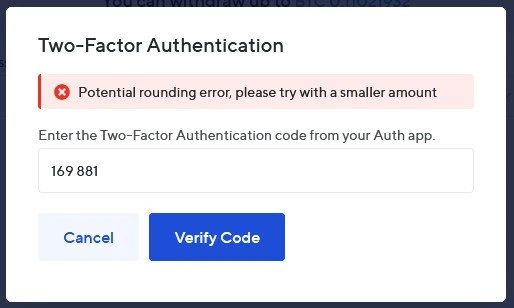
This is funny because the box asks for a security code, but the warning complains about a number being too big or rounded wrong. It is like a cashier asking for your ID, then suddenly saying your sandwich has too many decimal places. The user came prepared to prove who they are, but the computer is upset about math somewhere else.
Level 2: Code Then Confusion
Two-factor authentication, or 2FA, means the user needs a second proof besides a password. In this image, the second proof is a code from an auth app. Those codes are usually time-limited, so the user has a short window to enter them and press Verify Code.
Floating-point precision is a common source of bugs when computers represent decimal numbers in binary. For everyday apps, a tiny rounding difference may not matter. In FinTech, it can matter a lot because balances, fees, minimums, and transfers must match exactly. That is why financial systems usually use integer minor units or decimal-safe numeric types instead of casual floats.
The meme is funny because the modal combines two unrelated worlds. The visible UI is asking for an identity check, but the warning is about an amount being too large or imprecise. For a developer, that hints at a leaky abstraction: an internal validation failure escaped into the wrong user-facing step.
For newer developers, the lesson is that error placement matters. If the amount is invalid, tell the user while they are editing the amount. If the code is wrong, tell them in the 2FA form. When those messages cross wires, the interface starts sounding like the backend is talking directly through the screen.
Level 3: Auth Meets Arithmetic
The modal is titled:
Two-Factor Authentication
but the red warning banner says:
Potential rounding error, please try with a smaller amount
Below that, the form asks:
Enter the Two-Factor Authentication code from your Auth app.
with 169 881 typed into the code field. The absurdity is that a security ceremony is being interrupted by a numeric precision problem. The user thinks they are proving identity; the system is apparently still arguing with an amount calculation somewhere behind the curtain.
This is the kind of bug that makes experienced developers stare quietly at the wall. Two-factor authentication should be a narrow step: verify the code, bind it to the pending action, and either approve or reject. If an amount-related validation error appears inside that modal, it suggests the flow is mixing concerns. The authentication UI is now carrying a business-rule failure from a transaction layer, possibly because the backend validates the whole request again after the user reaches the 2FA step.
The phrase "Potential rounding error" points toward the classic FinTech problem: money should not be handled casually with binary floating-point arithmetic. Values like 0.1 are not represented exactly in many floating-point formats, and repeated conversions between display strings, decimal amounts, fees, balances, and minimum withdrawal rules can create tiny mismatches. In a financial flow, tiny mismatches matter. The user does not care whether the backend lost one fractional unit in a conversion pipeline; they only see an auth modal telling them to "try with a smaller amount" while holding a one-time code.
The deeper UX failure is sequencing. Error messages should appear where the user can act on them. A rounding or limit issue belongs near the amount field before the 2FA challenge, not after the user has opened an authenticator app and copied a code. Security already adds friction; mixing it with unrelated validation makes the product feel arbitrary. Nothing says "trust us with your funds" like discovering the transaction pipeline and the authentication modal are sharing a haunted clipboard.
Description
A white Two-Factor Authentication modal is shown over a dark background, with a red warning banner that says, "Potential rounding error, please try with a smaller amount." Below it, the prompt reads, "Enter the Two-Factor Authentication code from your Auth app." and the input contains "169 881" above Cancel and blue Verify Code buttons. The joke is that a security confirmation step is blocked by a numeric precision or finance-calculation error, exposing backend transaction validation in the wrong part of the user flow.
Comments
8Comment deleted
Nothing says high-assurance authentication like discovering your TOTP flow depends on IEEE 754 staying calm.
type OtpRequest struct { Code MoneyAmount json:"code" } Comment deleted
I don't quite understand: they are at the same time blatantly ignorant to store an integer code in a floating-point variable, but careful enough to check and display a warning about possible rounding error? Comment deleted
yes. Comment deleted
Legacy core decorated with cosmetically appealing frontend? Comment deleted
doubt it, probably just shit javascript code Comment deleted
make bad use of some good library Comment deleted
And to all that, values from html inputs are strings... Comment deleted