EV Charging Like a Magic Mouse: Flipped Upside Down in the Garage
Why is this UX UI meme funny?
Level 1: The Upside-Down Turtle
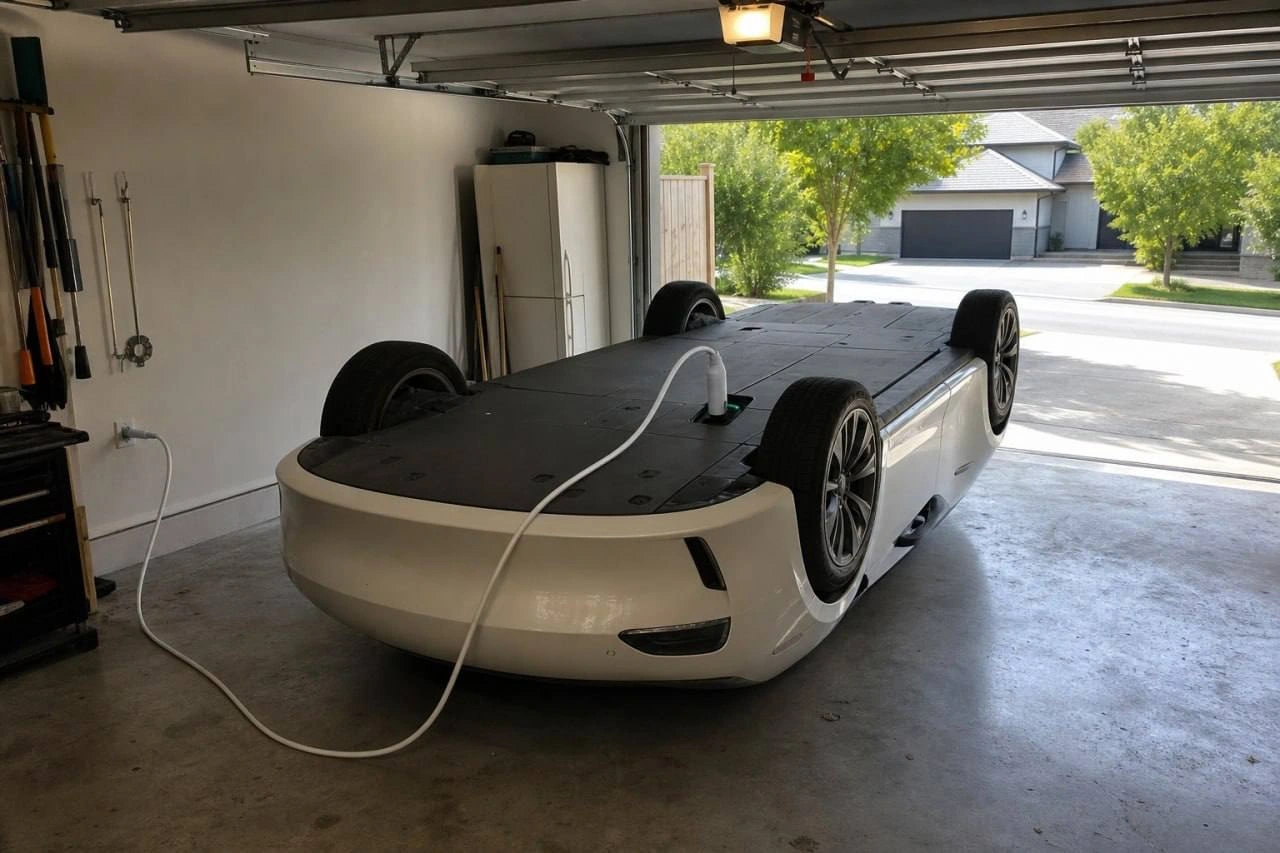
You know how some toys can only be wound up if you turn them over, so they wiggle uselessly on their backs while you do it? Now imagine someone built a car that way: to charge it, you have to flip the whole car onto its roof, wheels in the air, like a turtle that can't get up. The picture shows exactly that, in a perfectly normal garage, with a perfectly calm little white cable — as if this is fine, as if everyone does this. It's funny because the picture never admits anything is wrong. The joke is about grown-ups who make something gorgeous but silly to use, and then act like you're the strange one for asking why.
Level 2: The Trade-Off, Spelled Out
- The Magic Mouse problem — Apple's wireless mouse charges through a port on its belly. While charging, it cannot be used; it lies upturned like a beached crab. The fix (a port on the front edge, like every other mouse) was never adopted, making it a standing symbol of stubborn design.
- Form over function — prioritizing how a product looks over how it works. A little of this is taste; too much produces doorless cars and, well, this garage.
- UX (user experience) — the discipline of designing around what people actually do. Its first commandment: the common task (charging) must never require the absurd action (vehicle inversion).
- Charging port placement — in real EVs, a genuinely fussed-over decision (front fender? rear quarter? which side of the parking row?). The meme exaggerates a real category of debate into slapstick.
- AI-composited imagery — the photoreal-but-impossible style; the giveaway is everything being slightly too clean, including the physics of a sedan resting daintily on its roofline with zero damage.
The junior-designer takeaway hiding inside: every "elegant" constraint you add is an instruction to your users. Make sure it's not "go flip your car."
Level 3: When the Design Language Escapes the Lab
A white electric car lies flipped completely onto its roof in a tidy suburban garage, all four wheels in the air, with a slim white charging cable — unmistakably styled like an Apple Lightning cable, right down to the white plastic plug — rising from a port in the middle of its exposed flat underbody and snaking across the concrete to an ordinary wall outlet. Garden tools hang neatly on the wall; the open garage door frames a sunny, manicured street. Nothing about the scene is alarmed by itself. That serenity is the joke.
This is the Magic Mouse charging port, scaled to two tons. Apple's mouse, since 2015, has carried its charging port on the underside, meaning it must be flipped helpless-turtle-style and taken out of service to charge — arguably the most mocked single design decision in modern consumer hardware. The image performs the satirist's classic move: take the principle at face value and extrapolate. If the design philosophy says the charging port must never disturb the product's visual purity, then the car gets its port on the underbody, and the user dutifully rolls the vehicle over each night. The deadpan domesticity — the composed garage, the casually draped cable, no owner in sight wondering how they'll flip it back — is what elevates it from gag to critique. (The image is almost certainly AI-generated or composited, which is itself fitting: the only place this design ships is in a diffusion model's imagination.)
The deeper target is form-over-function as an institutional failure mode, one developers know intimately because it has a software twin. The defenders of the mouse design note it was a deliberate trade-off — Apple reportedly didn't want it used wired, preserving the "wireless object" identity — which makes it the hardware version of opinionated design: the framework that won't let you eject, the API that hides the escape hatch because you "shouldn't need it," the minimalist UI that buried the one button users actually press. The pattern generalizes: a constraint chosen for elegance, defended as intentionality, experienced as hostility. Engineers laugh at this image the way they laugh at chmod 777 jokes — because they have personally shipped, or been overruled into shipping, a beautiful thing that fights its own users, and the meeting where someone said "but users only charge it at night" felt reasonable at the time.
Description
A photorealistic (likely AI-generated or composited) image of a white electric car flipped completely upside down on a suburban garage floor, wheels in the air, with a white charging cable plugged into a port on its exposed flat underbody and running to a wall outlet. The garage door is open, revealing a tidy neighborhood street, trees, and another house; garden tools hang on the left wall next to a white cabinet. The image parodies Apple's Magic Mouse, infamous for its bottom-mounted Lightning port that renders it unusable while charging - scaled up to an entire vehicle, it skewers design decisions where aesthetic purity defeats basic usability
Comments
10Comment deleted
Apple's automotive division never shipped a car, but its design language clearly escaped the lab: beautifully unusable for exactly as long as it charges
Apple cyber car? Comment deleted
With lightning 2.0 connector Comment deleted
Apple Magic Car™ Comment deleted
iCarus Comment deleted
Innovation at peak Comment deleted
This mouse is really the peak UX of Apple product. Comment deleted
Lacks apple logo Comment deleted
What has he done? 😭 Comment deleted
Just cause he's a 'nese? Comment deleted