Skip to content
DevMeme
4582 of 7435
Engineer jokes about overnight backend rewrite after Elon takeover, fueled by Red Bulls
CorporateCulture Post #5028, on Nov 23, 2022 in TG

Engineer jokes about overnight backend rewrite after Elon takeover, fueled by Red Bulls

Why is this CorporateCulture meme funny?

Level 1: From Boredom to Excitement

Imagine you usually spend your day at work doing something very dull – like having long talks about changing the tiniest thing on a drawing. It’s so boring that you almost fall asleep, and you feel like, “Why am I even here?” That was this engineer’s life: sitting in boring meetings about little icon pictures, day in and day out. Now suddenly, a new boss (Elon) comes in and everything changes. It’s like the boss said, “Enough talk, let’s do something big right now!”

So one night, instead of going home, the engineer grabs a bunch of energy drinks (like super-strong sodas that make you hyper) and stays up all night doing a huge job – rebuilding the machine that runs Twitter’s private messages. Think of it like this: before, he was debating what color to paint a tiny corner of a room; now he’s remodeled the entire house in one night! He’s exhausted, his heart is pounding from all the caffeine, but he’s also excited. He actually feels alive and proud because he did something that really matters (even if it was crazy to do it so fast).

When he says “I haven’t felt this alive since CS 301,” he’s basically saying, “I haven’t had this much fun doing something difficult since I was a student working on a really hard school project.” It’s like remembering the last time you built an awesome science fair project overnight – tiring but kind of thrilling.

And the final line, “thank you elon,” is him cheekily thanking his boss for this wild adventure. It’s a bit sarcastic and a bit genuine. He’s like, “Wow, that was insane… but also awesome. Thanks, I guess?” He’s smiling (in a tired way) because the new boss shook things up and, even though it meant a crazy all-nighter, it reminded him of why he loves being an engineer.

So the meme is funny because it shows someone going from bored to excited in the most extreme way. One day he’s bored in a meeting about a tiny icon, the next day he’s a caffeinated superhero who saved the day by fixing something big overnight. It exaggerates real feelings – being frustrated with boring tasks and then the rush of doing something meaningful under pressure. Even if you’re not a coder, you can relate to that contrast: it’s like first you’re doing chores, then suddenly you’re on an adventure. It makes us laugh and maybe cheer a little for the guy who finally got to do something cool, even if it took a whirlwind of chaos (and a lot of Red Bull) to get there.

Level 2: Crunch Time 101

Let’s break down the meme in simpler terms, as if explaining to a junior developer or someone new to the software world. We have a Twitter engineer humorously describing his experience after Elon Musk’s takeover of the company. Here’s what’s going on:

  • “Used to attend meetings about tweaking the icons” – This means that before Elon took over, a lot of this engineer’s time was spent in meetings discussing very small, superficial changes, like adjusting icons in the app. In big companies, it’s not uncommon to have multiple meetings even for tiny design changes (MeetingHumor comes from how ridiculous this feels to engineers). It implies the culture was a bit bureaucratic or slow, focusing on minor cosmetic details of the product (the icons are the little graphical symbols/buttons in the Twitter app). The engineer saying this is highlighting how unexciting and perhaps frustrating that was for him. It’s a nod to CorporateCulture where there might have been committees and careful processes to change even a pixel on the screen.

  • “Last night I drank 8 Red Bulls and rewrote the worst parts of our direct messages backend” – Now things have changed drastically. Elon Musk is now in charge (November 2022 was right after he bought Twitter) and he’s famous for pushing a “hardcore” work style. So in one night, this engineer downed eight Red Bull energy drinks (a huge amount of caffeine, basically pulling an all-nighter) and rewrote critical code that runs Twitter’s direct messaging feature. Let’s unpack that:

    • The direct messages backend refers to the server-side code and systems that handle Twitter’s private messages (DMs). The backend is everything behind the scenes that users don’t directly see – databases, servers, logic that makes features work. When you send a DM on Twitter, the backend makes sure it gets stored and delivered to the recipient. It’s complex because it must handle a lot of users and data.
    • “Rewrote the worst parts” suggests there were parts of that system known to be really bad – perhaps slow, buggy, or outdated code (what developers call technical debt). Instead of just tweaking small things, he went in and refactored (rewrote) a big, important piece of the software to improve it. Doing that in one night is an incredible (and somewhat crazy) feat – normally this would be a planned project taking days or weeks, with testing. Here it sounds like a crunch time situation: urgently doing a lot of work under pressure and with little sleep.
    • 8 Red Bulls is an obvious sign of CrunchTime / LateNightCoding. Red Bull is a popular energy drink, and drinking eight of them indicates he probably stayed up all night intensely focused. Developers joke about running on caffeine; here it’s almost literal fuel for coding. It’s funny because it’s such an exaggeration – it gives a mental image of a bleary-eyed programmer at 4 AM surrounded by empty cans, frantically typing away. Definitely not your healthy, everyday work scenario!
  • “I haven’t felt this alive since CS 301” – CS 301 is likely a college course code, presumably a tough computer science class (maybe an advanced programming or systems course) that the engineer took. When he says he hasn’t felt this alive since then, he’s comparing the adrenaline rush of this all-night coding marathon to the excitement (and stress) he last experienced as a student working on intense projects. For many developers, college is when they first pull all-nighters coding something ambitious – it’s exhausting but also thrilling when you finally get it to work. So he’s basically saying, “I haven’t had this level of excitement and challenge in my work for a long time.” It implies that his job had become kind of monotonous or boring (like those icon meetings) and now suddenly it’s insanely challenging again, which weirdly feels good in a nostalgic way.

  • “Thank you elon” – This is the punchline. He’s (perhaps sarcastically) thanking Elon Musk for shaking things up. Elon’s arrival led to the scenario where this guy is chugging Red Bulls and coding like mad. It’s a bit tongue-in-cheek: he’s grateful because he finally got to do something meaningful and hardcore (fixing important backend code) instead of sitting in boring meetings. But there’s also irony, because working under such extreme conditions is not exactly healthy or sustainable. The thanks could be genuine to a degree – maybe he really did enjoy the burst of purpose – but it’s mostly humorous. It’s like saying “Thanks (I guess) for the crazy night; I actually feel energized by it, even though it was wild.”

To sum it up more straightforwardly: the meme is a DeveloperHumor story of an engineer who went from a slow, bureaucratic work life (nitpicking UI changes in endless meetings) to a high-octane, startup-like crunch mode (drinking lots of caffeine and fixing major code) because Elon Musk took over the company. It’s funny to developers because it highlights extremes we recognize:

  • RelatableDeveloperExperience: Many developers have sat through trivial meetings and wished they could just focus on real important coding work.
  • CrunchTime absurdity: We also know the crazy feeling of rushing to meet a deadline or fix a critical issue overnight – it’s stressful, a bit ridiculous, but can be exhilarating when you succeed.
  • The meme exaggerates both for comedic effect: trivial “icon tweaking” vs. massive “backend rewrite,” and normal work hours vs. guzzling 8 Red Bulls in one night.

Even if you’re a junior dev, you can appreciate the contrast: imagine spending your whole week talking about tiny changes no user might even notice, then suddenly in one night you build something huge that impacts everyone. The engineer is joking that this drastic change made him feel more alive than he’s felt in years – pointing out how corporate culture sometimes mutes the excitement of coding, whereas a good old-fashioned coding spree (even an insane one) brought that joy back. It’s a humorous take on DeadlinePressure and how sometimes being pushed to the extreme reminds you why you liked coding in the first place. Just… maybe don’t actually drink 8 Red Bulls, okay? That part we hope is an exaggeration. 😅 (Eight Red Bulls is A Lot – please, future coders, stick to coffee or get some sleep!)

Level 3: Icons vs Infrastructure

This meme hits home for any senior developer who’s endured the absurdity of CorporateCulture where trivial tasks get more attention than core problems. The tweet’s author sets up a stark contrast: “i used to attend meetings about tweaking the icons” vs “last night i… rewrote the worst parts of our direct messages backend”. It’s a classic satire of priorities in big companies. On one side, we have endless design reviews and meetings on microscopic UI details – the color of a button, the shape of an icon. These are the kinds of MeetingHumor moments engineers joke about: spending an hour in a boardroom discussing whether the logo should be 5px to the left. On the other side, we have real backend engineering grunt work that actually impacts performance and reliability, work that often gets postponed because it’s invisible to product managers and users… until it breaks catastrophically.

By saying “I still work at Twitter,” the engineer sets the stage: this is shortly after Elon Musk’s takeover of the company in late 2022, a time when Twitter’s internal atmosphere did a 180° turn. Elon famously despises what he sees as bloated bureaucracy and was rumored to demand that engineers show what tangible code they’ve written recently or face layoffs. In this new elon_crunch_culture environment, many managers and layers of approval vanished overnight; suddenly, coders found themselves with both the freedom and the DeadlinePressure to make big changes very quickly. That context makes the leap from “tweaking icons” to “all-night backend refactor” especially hilarious and relatable. It’s an extreme version of what many developers have fantasized about: “If only I could ignore these pointless meetings and fix the damn system properly!”

Let’s unpack the key elements of the humor from a seasoned developer’s viewpoint:

  • The Drudgery of Endless Meetings: Large tech companies often fall into a trap of having meetings about meetings, especially for front-end changes that executives or designers obsess over. A developer can end up in weekly syncs about UI pixel tweaks, button colors, or whether the icon should have 20% or 30% corner radius. It’s MeetingHumor because it’s painfully common; these meetings feel soul-crushing when you know there are bigger fires burning. The tweet mocks this by choosing “tweaking the icons” – about as low-stakes as it gets – as the thing he used to spend time on. Senior devs reading that line are already smirking, because we’ve all been there, polishing trivial features while the core system rots due to neglect.

  • The All-Night Heroic Refactor: The second part – drinking 8 Red Bulls and rewriting the worst parts of the DM backend in one night – is an exaggerated wish-fulfillment and a jab at CrunchTime culture rolled into one. On one hand, it satirizes the macho “late night coding” mythos: the lone hacker on a mission, fueled by caffeine and a sense of urgency, swooping in to save the day. This is familiar DeveloperHumor territory. We chuckle because many of us have done a micro version of this: maybe not rewriting a whole subsystem, but staying up absurdly late to refactor a hairy module or fix a production bug, and secretly feeling proud (and exhausted) afterward. It’s the adrenaline high of coding with purpose, something developers both celebrate and lament.

  • “I haven’t felt this alive since CS 301”: This line seals the joke for those in the know. CS 301 implies a challenging university class – perhaps a notoriously tough programming project course or an operating systems class – where the last time the engineer pulled an all-nighter and felt a true coding rush was back in college. It’s hyperbolic and self-deprecating. A senior engineer reading this might flash back to their own college all-nighters, the mixture of panic and exhilaration finishing a big assignment at 5 AM. The tweet humorously suggests that working under Elon’s chaotic regime has regressed the professional developer to a college hacker mindset. And amusingly, he’s grateful for it (“thank you elon”). That gratitude drips with irony: is he really thankful? Or is this a tongue-in-cheek way of saying “Elon turned my work life upside down, but at least I’m coding like I care again”? It’s likely a bit of both – a sarcastic thank-you that also carries a kernel of truth about rediscovering passion through chaos.

  • Tech Debt finally addressed: The phrase “worst parts of our direct messages backend” will make any senior dev grin and wince at the same time. We all know those worst parts — the clunky legacy code that everyone is afraid to touch. Maybe it’s an old module with no tests, or a super inefficient service written a decade ago that just barely handles today’s load. In normal times, trying to rewrite it would require convincing managers, product teams, and probably getting it on a roadmap somewhere – a long process with many meetings (and oh no, icon tweaks take priority!). But in this scenario, new leadership (with a flamethrower) means all bets are off. The engineer had the green light (or felt emboldened enough) to just do it in a marathon session. Experienced folks laugh here because it’s simultaneously heroic and foolhardy. On one hand, finally fixing that darn thing is cathartic. On the other, doing it under severe time pressure, hopped up on caffeine, without the usual safety nets (design docs, code reviews, QA testing) is a recipe for new bugs or a 6 AM rollback. It’s the classic trade-off of speed vs. stability. The humor comes from recognizing the absurdity of being pushed (or inspired) to such an extreme that you actually attempt this.

To illustrate the “before vs after” contrast that’s making us chuckle, consider this tongue-in-cheek comparison of Twitter life pre- and post-Elon:

Before (Old Twitter) After (“Hardcore” Twitter)
Daily 2pm meeting to debate icon shapes 2am deploy fixing database queries
Weeks spent on A/B tests for button color Overnight rewrite of a messaging service
“Let’s schedule another meeting next week” “Ship it now, we might all be fired tomorrow”
Measured pace, plenty of sleep Plenty of no sleep, break-neck pace
Tech debt tickets backlog for months Tech debt nuked in a single caffeine binge

In other words, the company went from a steady, perhaps over-cautious development cycle to a chaotic, deadline-driven hackathon mode. The meme gets its comedic bite from this whiplash change in CorporateCulture. It’s BackendHumor colliding with CorporateCulture satire: suddenly the boring status quo is upended, and the engineer is simultaneously complaining and bragging about it.

There’s also an undercurrent of dark humor: “I haven’t felt this alive in years (because I haven’t taken such risks or had such fun at work in ages).” Senior engineers know that feeling – when a project actually ignites your passion and you push yourself to the limit to see it through. It’s often followed by a crash or a sober realization that maybe it wasn’t healthy, but in the moment you feel like a wizard wielding code at 3 AM. The meme captures that conflicted sentiment perfectly. DeadlinePressure and chaos can oddly energize those of us who secretly miss the days of banging out code all night in college. We laugh because it’s true: trading mind-numbing meetings for a high-stakes coding sprint does make one feel alive – albeit in a dangerously addictive way. And the cherry on top is the sarcastic “thank you elon,” as if this upheaval is a twisted gift. Engineers with a bit of professional scar tissue will read that with a smirk, interpreting it as: “Thanks, I guess, for lighting a fire that both terrifies and exhilarates us.”

In summary, Level 3 perspective uncovers the shared experiences and ironies behind the tweet. It lampoons a suddenly imposed CrunchTime culture (the kind many veterans know all too well from death-march projects) and contrasts it with the previous slow-moving bureaucracy. The humor lands because it’s a RelatableDeveloperExperience: a lot of us have yearned to ditch the bureaucratic sludge and just code – though maybe not quite in this extreme Red Bull-chugging fashion. It’s funny, it’s a bit tragic, and it’s oh-so-satisfying to see those “worst parts” finally get what they deserve.

Level 4: The Over-Caffeinated Overhaul

At the heart of this joke lies a backend engineering frenzy, the kind of all-night refactoring that would make a professor nod in reluctant admiration. Twitter’s direct messages backend isn’t some simple chat toy – it’s a globally distributed system that must handle millions of private messages swiftly and reliably. Under normal conditions, overhauling “the worst parts” of such a system would involve careful design, code reviews, and staged rollouts. But here our intrepid engineer does it in one caffeine-fueled sprint. This implies tackling serious computer science challenges on-the-fly:

  • Data model and queries: Perhaps the old code fetched messages with an inefficient O(n) scan or unindexed database queries, making the DM service lag under load. Our overnight hero might replace that with properly indexed queries or a new storage structure. For example, instead of iterating through every message in memory, the refactored code could query a database by conversation ID, using an index to find relevant messages in logarithmic time. The difference is like night and day in terms of scalability. In pseudocode, the improvement could look like:
# Old approach (inefficient)
for msg in all_messages:              # scanning every message in the system
    if msg.conversation_id == current_conversation_id:
        results.append(msg)
# This naive scan is O(N) per lookup, choking on large volumes of messages
# New approach (efficient)
results = message_db.query("SELECT * FROM messages WHERE conversation_id = ?", current_conversation_id)
# Uses a database index or key partition to fetch only relevant messages, e.g., O(log N) or better

Here the refactor eliminates a performance bottleneck – replacing brute-force iteration with a direct query. An experienced engineer reading the meme instantly envisions such changes, knowing that the “worst parts” of a mature system are often kludgy code or outdated algorithms begging for replacement.

  • Concurrency and consistency: Twitter’s DM system must allow users worldwide to exchange messages in real time. That means dealing with concurrent writes (multiple people sending DMs simultaneously) and ensuring messages appear in the correct order for each conversation. The backend likely has to lock or sequence messages by conversation, or use a sequencer service so that “Alice’s message #101 arrives after Bob’s #100” even if processed on different servers. Rewriting a chunk of this overnight suggests our coder might have introduced a more robust locking mechanism or switched to an idempotent job queue to handle retries without duplication. These are non-trivial changes – they venture into the territory of distributed systems theory. A rushed fix could easily violate the CAP theorem (trading consistency for availability or vice versa), but the meme implies success through sheer adrenaline.

  • Reliability and technical debt: The phrase “worst parts of our direct messages backend” hints at accumulated technical debt – perhaps legacy code from an earlier era of Twitter that was known to be fragile or inefficient. In large systems, such code is usually left in place because it “mostly works” and no one has time to rewrite it under normal circumstances. It might be a gnarly stored procedure, a monolithic class thousands of lines long, or a tangle of microservices with flaky integration. Our engineer, turbocharged by eight cans of Red Bull, dove in to pay down that debt overnight. This is like ripping out an old engine from an airplane mid-flight and swapping in a new one: risky and requiring deep knowledge. A veteran developer reading this imagines hairy details like migrating data schemas at 3 AM, invalidating caches without bringing down the site, and debugging race conditions with bleary eyes. It’s equal parts horrifying and impressive.

On a theoretical level, this scenario underscores the tension between planned engineering and adrenaline-fueled improvisation. In computer science education (think CS 301 or an upper-level systems course), you learn about elegantly solving complex problems – say, implementing a efficient messaging protocol or optimizing a database – often through all-nighter coding sessions. Here, real-world Twitter engineering suddenly mirrors that classroom intensity. The meme humorously suggests that under Elon’s chaotic mandate, production code is now being written like a last-minute semester project. It’s an absurd collision of enterprise-scale software with hackathon-style development. And yet, the result worked (at least in the story), giving the engineer a jolt of pride and adrenaline reminiscent of youthful coding triumphs.

The caffeine element is not just a funny detail – it’s practically a unit of measurement in developer lore. Eight cans of Red Bull (with ~80mg of caffeine each, that’s around 640mg; more than enough to make one’s hands shake) is a tongue-in-cheek exaggeration of how programmers rumble through CrunchTime. In serious distributed systems work, you’d ideally replace caffeine with careful thinking and sleep, but here caffeine is the catalyst that powers our hero through a marathon refactor session. The subtext is clear to senior engineers: this is not sustainable, but boy is it nostalgic. The code may be held together by sheer force of will (and sugar), but for one magical night, the LateNightCoding rush produced tangible results, skipping months of bureaucratic dithering.

Description

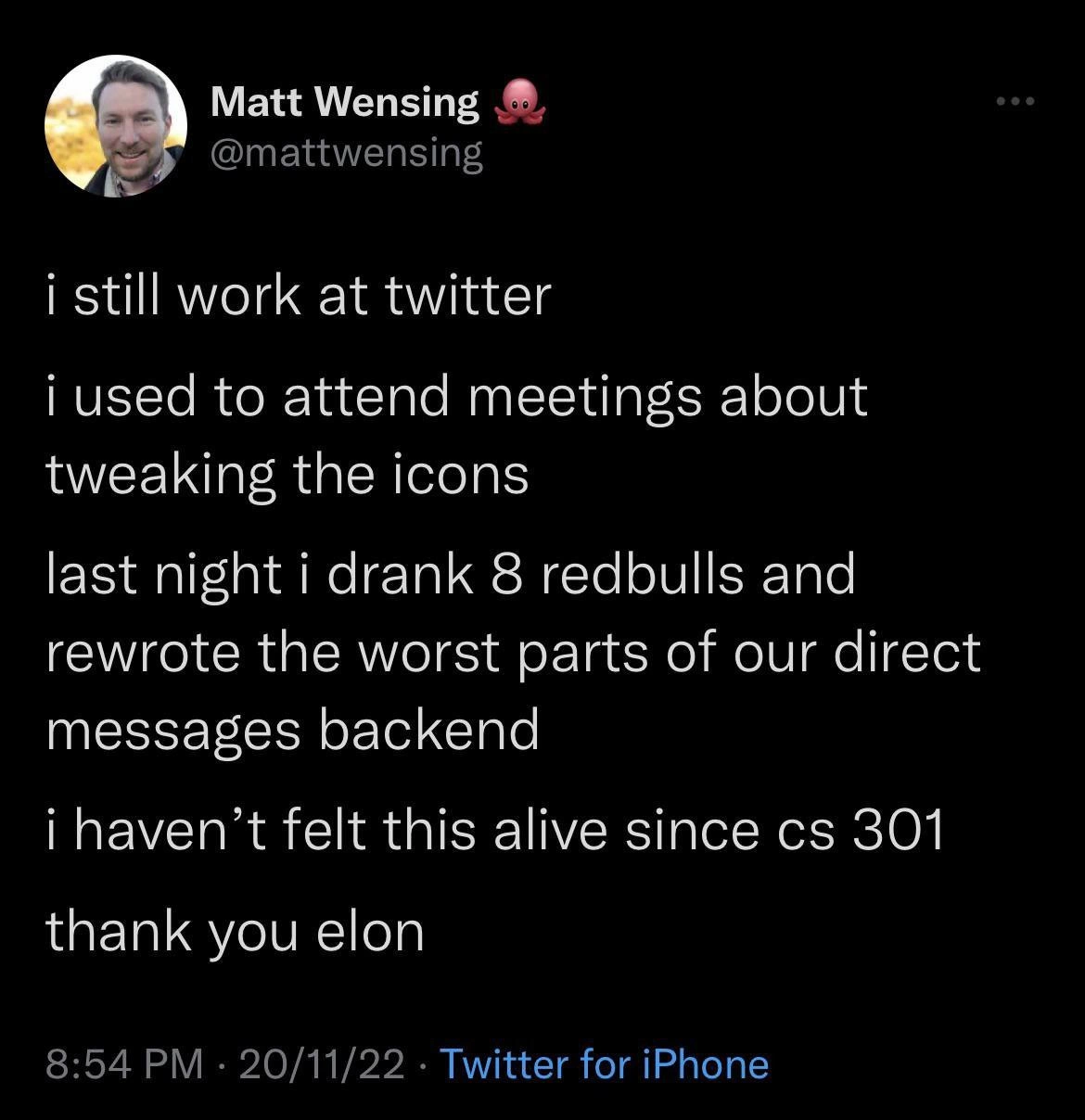
Screenshot of a tweet shown in Twitter’s dark-mode UI on a solid black background. In the upper left is a circular profile picture (face blurred) beside the name “Matt Wensing 🐙” and handle “@mattwensing”. The tweet text appears in white, all lowercase, and reads: “i still work at twitter i used to attend meetings about tweaking the icons last night i drank 8 redbulls and rewrote the worst parts of our direct messages backend i haven’t felt this alive since cs 301 thank you elon”. Below, light-gray metadata shows “8:54 PM · 20/11/22 · Twitter for iPhone”. The humor contrasts trivial icon-tweaking meetings with an all-night, caffeine-driven refactor of Twitter’s direct-message backend after organizational upheaval, poking fun at crunch culture, backend firefighting, and developer adrenaline familiar to senior engineers

Comments

6
Anonymous ★ Top Pick Eight Red Bulls, no design doc, 3 a.m. merge-to-main - Twitter just adopted eventual consistency as both a storage strategy and an HR policy
  1. Anonymous ★ Top Pick

    Eight Red Bulls, no design doc, 3 a.m. merge-to-main - Twitter just adopted eventual consistency as both a storage strategy and an HR policy

  2. Anonymous

    Nothing says 'architectural review process' quite like 8 Red Bulls and the sudden realization that you can finally fix that message queue implementation that's been haunting your on-call rotations since 2019 - because who needs a JIRA ticket when you have caffeine-induced enlightenment and zero meetings about icon kerning?

  3. Anonymous

    Nothing says 'organizational transformation' quite like going from bikeshedding icon pixel alignment in committee meetings to solo midnight backend rewrites fueled by enough caffeine to violate several Geneva Conventions. It's the engineering equivalent of being released from corporate purgatory into production chaos - terrifying, exhilarating, and somehow reminiscent of that one semester where you discovered you could survive on energy drinks and spite while implementing a compiler. The real question: did the DM backend rewrite introduce fewer bugs than the number of Red Bulls consumed, or are we looking at a 1:1 ratio of stimulants to race conditions?

  4. Anonymous

    Trading icon-bikeshedding for an 8‑Red Bull midnight rewrite of the DM backend is peak move‑fast - right up until the SLOs file a bug report on your heart rate

  5. Anonymous

    Elon turned Twitter's tech debt into Red Bull debt: same interest accrual, way more velocity

  6. Anonymous

    From bike-shedding icon kerning to YOLO-rewriting the DM backend at 2am - apparently the new architecture is hero mode with caffeine-backed SLAs

Use J and K for navigation