Skip to content
DevMeme
4583 of 7435
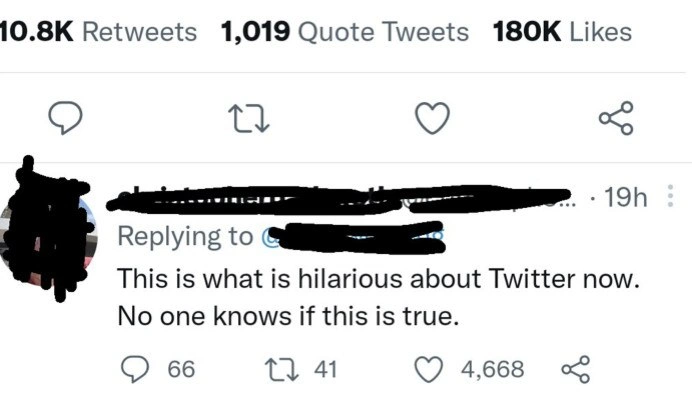
Twitter reply meme on uncertainty and trust after verification changes
DevCommunities Post #5029, on Nov 23, 2022 in TG

Twitter reply meme on uncertainty and trust after verification changes

Why is this DevCommunities meme funny?

Level 1: The Boy Who Cried Tweet

Imagine you have a special badge that proves who you are – like a school ID or a name tag that only the real teacher can wear. Now picture that suddenly anyone in school could get a fake teacher’s badge from the store. One day, a kid with that fake badge announces, “School is canceled tomorrow!” A bunch of students hear it and start cheering and sharing the news. The announcement spreads really quickly (just like a tweet getting thousands of likes). At first glance, it seemed true because the kid had what looked like an official badge. But pretty soon, everyone is also saying, “Wait, is this for real?” because now nobody can tell if that badge means anything. It turns out the kid was just joking, and school isn’t canceled. You can imagine the mix of laughter and frustration when the truth comes out. This meme is joking about a very similar feeling on Twitter. The blue check mark on Twitter was like that teacher’s badge – it used to mean “this person is the real deal.” But after changes, since anyone could have a blue check without really being verified, a lot of people started playing pretend. They would tweet crazy “news” or statements, and even if tens of thousands of people liked or shared it (because either they fell for it or found it funny), everyone was left wondering, “No one actually knows if this is true.” It’s as if the whole class heard a wild story but isn’t sure who the storyteller really is. The meme finds humor in how upside-down things became: something important-looking pops up on your screen, and your first reaction is to doubt it completely. It’s funny in the way a goofy prank is funny, except it happened on a huge scale. Essentially, the picture is saying: “Twitter used to have a way to know if stuff was real, and now it’s kind of lost – so we’re all just shrugging and laughing because any tweet might be a tall tale.” It’s a simple reminder that when the usual trust clues disappear, everyone feels a bit like, “Okay... is anything on here for real anymore?”

Level 2: Blue Check Basics

Let’s break down what’s going on in this meme in simpler terms. First, Twitter verification: originally, Twitter gave a blue check mark badge next to an account name if that account was the real person or organization it claimed to be. For example, if you saw a blue check next to a famous developer’s name, it meant Twitter checked that it’s not an impostor – it’s the actual person. This was meant to build trust: you could believe announcements or news from that account were genuinely from the real source. Now, what happened (around late 2022) is Twitter changed this system so that anyone could get a blue check mark by paying for a subscription (Twitter Blue). The key point: they didn’t verify your identity for most accounts anymore; the badge just meant you paid. This led to a lot of misinformation and confusion. Suddenly, someone could create an account pretending to be, say, a big tech company or a celebrity, pay for a blue check, and then tweet something outrageous. People who saw it might think it’s true for a moment because the account looked official. This is what we mean by the post-verification era – the time after the old identity verification was essentially gone. The meme shows a reply saying: “This is what is hilarious about Twitter now. No one knows if this is true.” That person is commenting on the whole situation. It’s funny (in a pointed way) because it’s true: after those verification changes, whenever we see a big claim on Twitter, we have to ask ourselves, “Is this real or just someone pulling a prank?” even if it’s been retweeted or liked thousands of times. Those numbers you see – Retweets, Quote Tweets, Likes – are called Twitter engagement metrics. They show how many people shared or liked a tweet. Normally, if a tweet has, say, 180K likes (which is huge), you’d assume it was important or accurate, because so many people saw and appreciated it. But in this new chaotic Twitter, a tweet could go viral because it’s sensational or funny, even if it’s totally false. So high numbers no longer guarantee something is trustworthy. This is what the reply is chuckling about: the once useful signals (a verified badge or big engagement numbers) are no longer reliable signs of truth. In terms of DevCommunities (developer communities) and tech folks: many developers use Twitter to share tips, announce new software releases, or read tech news. They also joke around there, which is part of TechHumor culture. But with verification messed up, even devs have to be extra cautious. For example, imagine a tweet that says “Breaking: Python 4.0 released!” from an account that looks like the official Python organization, with a blue check and thousands of retweets. Before, you’d get excited and believe it. Now, you’d need to double-check that news on the official Python website or a trusted blog, because it could be someone faking that announcement. This situation is basically a communication breakdown on a massive platform: the cues we used to trust for authenticity (like the check mark) aren’t there or mean something different, and even popularity (likes/retweets) doesn’t equal truth. It’s a big lesson in trustIssuesInTech: whether in social media or software, when you remove safeguards that help people trust what they see, things can get confusing fast. The meme is highlighting that confusion in a humorous way that many people in the tech community immediately understood, because we all experienced that “wait, can I trust this tweet?” moment around that time.

Level 3: Verified Chaos

For seasoned developers and tech observers, this meme hits close to home because it mocks a real meltdown in our online communication infrastructure. In late 2022, Twitter – a platform many in DevCommunities rely on for quick updates and announcements – underwent a drastic change: the meaning of the coveted blue verification badge flipped overnight. What was once a hard-earned mark proving “this account is authentic” became something anyone with a few dollars could buy. The immediate result? Impersonation comedy and tragedy. People created fake accounts of CEOs, brands, even Twitter’s own company accounts, and with a paid check mark they looked credible at first glance. It was a communication breakdown of epic proportions: imagine an official-looking tweet from “@BigFamousCompany” declaring outrageous news – you’d normally trust it because of the blue check and familiar name, right? Suddenly you had to double-check the handle spelling, the follower count, or whether that account was created last week. This was hilarious and horrifying at the same time. Developers on Tech Twitter watched in half-amusement, half-panic as misinformation and pranks spread like wildfire. The reply shown in the meme — “No one knows if this is true.” — perfectly sums up that shared sentiment. It’s funny because it’s true: trust was so broken that a tweet with 180K likes and a sky-high retweet count could be based on a total lie, and we all knew it. That high engagement, which usually implies “this resonated, maybe it’s important,” was suddenly a false friend. Technically inclined folks recognize an anti-pattern here: removing a validation check (identity verification) in a live system without an adequate replacement. It’s like deploying to production without tests or like disabling a linters and expecting things to just work – of course chaos ensues. The meme’s humor also has a bit of “I told you so” from those who foresaw the verification fiasco. Many senior devs and engineers value integrity and content_moderation systems because they prevent exactly this kind of nonsense. When those systems are stripped down (due to business decisions, layoffs of moderation teams, or a philosophy of “let it all run free”), you get a perfect storm where misinformation flourishes. It’s darkly comic to see Twitter – a place where we got real-time tech news, official security alerts, and sometimes lifesaving info – turn into a stage for trolling and doubt. The mention of Twitter API metrics in the context tags is a reminder that third-party devs often use Twitter’s data (like those retweet and like counts, or whether an account is verified) in their own tools. After the changes, even those signals became unreliable. If you were building, say, a dashboard to surface important tweets for a client or for a community, you couldn’t just trust “verified = trustworthy” or “high retweets = important” anymore. Code that once filtered signal from noise via the verified flag or assumed a high-like tweet from a known handle is genuine suddenly might surface pure parody or hoax content. In other words, a lot of the informal algorithms human and machine readers used to judge credibility were rendered useless. The TechTwitter crowd found themselves constantly fact-checking and sharing a collective facepalm that said, “this is the new normal, huh?” The meme crystallizes that feeling: it’s absurd and laughable that we’ve come to a point where “No one knows if this is true” has to be said about what we see on a platform once considered a source of news. It was a moment of collective gallows humor for developers and techies: we expect bugs in code, not in our public discourse platform – yet here we are, treating every tweet like untrusted data.

Level 4: Byzantine Blue Checks

In a fascinating parallel to distributed systems theory, the chaos on Twitter’s platform after the verification changes resembles a Byzantine fault-tolerant network gone wrong. In a reliable system, we have trust anchors – similar to how Twitter’s old verification badges functioned as a central certificate authority (CA) confirming an account’s identity (much like a digital certificate vouches for a website’s identity in HTTPS). When Twitter started selling blue check marks to anyone, it effectively removed the trust anchor. This is akin to a CA suddenly issuing certificates to unverified parties, or a blockchain network suffering a massive Sybil attack where one entity can spawn countless identities that all look legitimate. Without a robust identity verification mechanism, Twitter’s user base encountered a social version of the Byzantine Generals Problem: how do you agree on what’s true when some “generals” (accounts) might be dishonest or imposter nodes? Normally, consensus algorithms (like Paxos or Raft in distributed databases) or cryptographic proofs (like digital signatures) help solve this in tech systems – but Twitter’s trust model became “trust nothing, verify elsewhere.” The meme’s humor comes from applying that computer science chaos to our daily information feeds. The reply “No one knows if this is true” highlights an information entropy problem: the state of truth on the platform became highly disordered. Even the API-surfaced metrics – those retweet and like counts – lose meaning as truth signals because automated bots and misled users can massively boost a false tweet’s engagement. It’s a bit like observing a database that returns high popularity for a piece of data that might be completely wrong; the integrity constraints (moderation, verification) were dropped, so the data quality (truthfulness) can’t be assumed. In essence, Twitter unintentionally created a trustless system (in the worst way): one with no built-in verification of authenticity. For developers and security engineers, it’s a real-world reminder that removing validation (be it input validation in code or identity checks in a network) can lead to catastrophic inconsistency. The situation was so absurdly textbook that senior devs joked it’s like turning off SSL certificate checks on the web and then marveling that phishing sites ran wild. In the realm of theory, we know a system can only tolerate a certain percentage of malicious actors before truth or consensus breaks down. Twitter’s verification upheaval essentially invited all actors to potentially be malicious (or at least unvetted), exceeding any sane threshold for trust. The result? – a living, viral example of the post-truth era in tech, where every tweet is a potentially untrusted node and verification has to happen out-of-band (in newsrooms, in follow-up posts, or via external fact-checks). The meme captures this complex collapse of a trust architecture in one punchy, ironic observation that even a highly engaged tweet might be pure fiction, and no one (human or algorithm) on the network can be sure.

Description

The image is a cropped screenshot of the Twitter mobile UI in light mode. Across the top are bold interaction metrics reading "10.8K Retweets 1,019 Quote Tweets 180K Likes." Beneath the standard retweet, heart, and share icons, a reply tweet is shown; the avatar and usernames have been heavily black-scribbled for anonymity. The visible text of the reply reads: "Replying to @█████ - 19h This is what is hilarious about Twitter now. No one knows if this is true." Under the reply are smaller grey counters "66", "41", and "4,668" beside the reply, retweet, and like icons respectively. The meme humorously highlights the post-verification era where developers, users, and the broader tech community struggle with information authenticity on social media platforms, touching on themes of trust, content moderation, and the reliability of API-surfaced metrics
Comments

6
Anonymous ★ Top Pick Twitter post-verification is basically multi-leader gossip replication: high availability, zero consensus, and truth only shows up once the TTL on outrage expires
  1. Anonymous ★ Top Pick

    Twitter post-verification is basically multi-leader gossip replication: high availability, zero consensus, and truth only shows up once the TTL on outrage expires

  2. Anonymous

    Twitter's verification system now has the same trust model as a distributed system with eventual consistency - except the "eventual" part never arrives and nobody knows which node holds the truth

  3. Anonymous

    The real distributed consensus problem isn't Byzantine fault tolerance - it's achieving agreement on Twitter about whether anything actually happened. We've built systems that can handle network partitions and node failures, but nobody architected for a platform where the CAP theorem stands for 'Can't Authenticate Posts.' At least with eventual consistency, you eventually get consistency; here we've achieved eventual uncertainty at scale

  4. Anonymous

    Twitter runs on gossip pretending to be consensus - once a post hits 180K likes the cluster treats it as “eventually true,” even if it just converged on wrong

  5. Anonymous

    Post-verification Twitter is an eventually consistent gossip network with Byzantine faults - great for alerting, terrible for truth

  6. Anonymous

    Feels like debugging minified production JS - no source maps, just vibes and speculation

Use J and K for navigation