A Sobering Reminder of Tech's Human Cost
Why is this MentalHealth meme funny?
Level 1: Life Over Work
Imagine you have a favorite game you love to play. You play it all day and all night without ever taking a break – you skip meals, you don’t sleep, you don’t even go outside to see the sun. What do you think would happen to you? Soon, you’d get very sick because your body and mind can’t go on like that without rest. This meme tells a very sad story of a man who worked too much and forgot to take care of himself, and it made him so sick that he died. He was a computer programmer who kept working and stressing every day, like a machine that never got turned off. It’s like if you have a phone and you never, ever stop using it or recharge it – eventually the battery just dies for good. In real life, we need to recharge our bodies and minds by sleeping, relaxing, and spending time with people we love. The message here is simple: your life and health are more important than your work. Jobs are important in our lives, just like school is important, but nothing is as important as being alive and well. If you don’t take care of yourself, you can’t enjoy anything – not friends, not family, not games, not even the job you worked so hard on. So remember, it’s okay (and absolutely necessary!) to rest and have fun. Think of yourself as a candle: if you burn it at both ends – meaning you work from early morning until late night without a break – that candle will use up twice the wax and melt down fast. We don’t want to melt down! We want our candle (our life) to shine for a long time. The sad story in the meme teaches us that no matter how important something seems, nothing is worth losing your health or life over. So always take time to sleep, eat, laugh, and do things you enjoy. Your work will be there when you come back, but your life is one-of-a-kind and precious, and you have to protect it.
Level 2: All Work, No Life
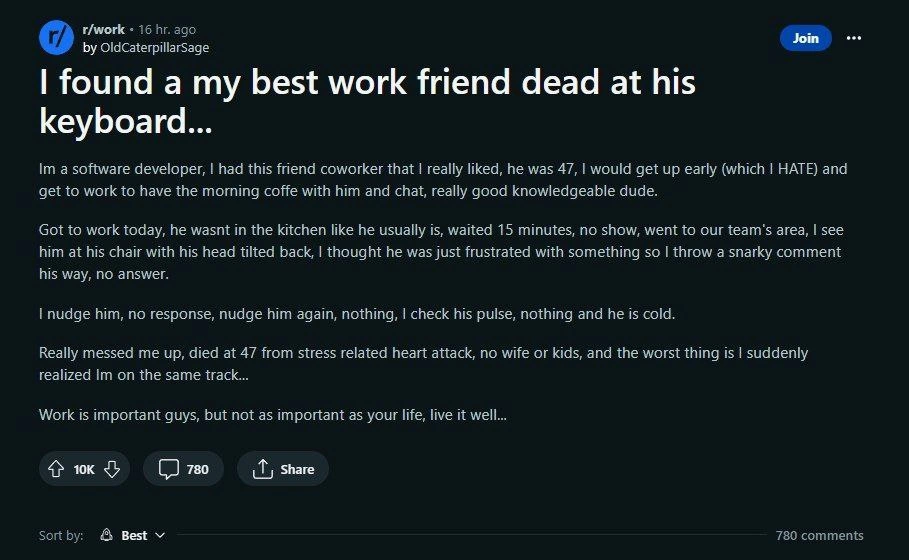
This meme highlights a painfully real issue in tech: burnout from overwork and stress. The image is a screenshot of a Reddit post where a developer recounts finding his close coworker dead at his keyboard due to a heart attack. The coworker was only 47 years old. The shock of that discovery made the author realize, “Oh no, I’m heading down the same path.” It’s a wake-up moment about how a workaholic lifestyle – endless overtime, constant deadline pressure, and zero work-life balance – can actually be deadly. The meme isn’t “funny” in a traditional sense; instead, it resonates as a stark cautionary tale among developers. It went viral (over 10,000 upvotes) because so many people in tech relate to the feeling of being crushed by crunch time and chronic stress. It’s basically the tech community collectively saying, “This could happen to any of us if we aren’t careful.”
Let’s break down some terms and why this scenario hits home for developers, including those just starting out. Burnout is exhaustion – mental, physical, emotional – caused by prolonged stress. Imagine debugging code for weeks on 4 hours of sleep each night; eventually you just can’t function and you feel detached and drained. In software jobs, burnout often comes from toxic hustle culture – an environment where working extremely long hours is praised as being a “passionate hard worker.” You’ve probably heard stories (or boasts) like, “I pulled an all-nighter to finish this feature” or “I haven’t taken a day off in months.” That’s hustle culture, and it can be really dangerous. Here, it likely contributed to a literal heart attack. A heart attack happens when excessive strain (like constant high blood pressure and stress hormones) causes the heart’s blood supply to get blocked. Stress alone – especially chronic stress from a high-pressure job – can be a significant risk factor for heart problems. When the post says “stress related heart attack,” it implies the demands of the job (and perhaps neglecting health) led to a fatal medical event. It’s a scary reminder that our bodies have limits.
Work-life balance is the idea that you split your time and energy between work and your personal life in a healthy way. In an ideal situation, you work hard and then you relax, spend time with family or friends, have hobbies, exercise, and sleep enough. In this story, the 47-year-old didn’t seem to have that balance – the friend notes he had no wife or kids, and he was the kind of colleague who’d come in early just for a morning coffee chat before diving into work. That detail suggests work was a huge part of his life, maybe too huge. For younger developers, it’s a caution: don’t neglect your personal life and health for the job. Deadline pressure refers to the stress of having to finish projects by a set date, no matter what. In tech, deadlines can lead to crunch time – those periods where everyone works ridiculous hours (late nights, weekends) to deliver a product or fix an urgent issue. Juniors might first encounter this during a big release or emergency bug fix, when your team orders dinner to the office and you’re there till midnight. It feels exciting at first, but doing that continuously can wreck your health. This meme is the extreme outcome of crunch culture gone unchecked: the body simply gives out.
The term toxic hustle culture is used to describe a work environment that glorifies overworking. “Hustle” means working energetically, but a toxic hustle culture means people feel guilty or left behind if they aren’t constantly grinding. In some companies, if you leave at 5 PM or don’t come in on a weekend, you might get side-eye or remarks like “Half day today?” Jokes aside, that creates pressure to sacrifice rest. New developers can be especially vulnerable to this – eager to prove themselves, they might mimic seniors who stay late. But as this story shows, all work and no rest is a recipe for disaster. There are well-known examples globally: in Japan, there’s even a word “karoshi” which literally means “death by overwork.” It’s happened in finance, in manufacturing, and yes, in tech too. We’ve seen reports of game developers collapsing after 14-hour days during crunch time, or engineers developing serious anxiety and heart issues because they’re never truly off-duty (constant on-call alerts or fear of missing an urgent email).
In the Reddit post, after the shock, the author writes the lesson clearly: “Work is important guys, but not as important as your life, live it well.” This is essentially a plea for work-life balance and taking mental health seriously. In the tech industry nowadays, there are increasing conversations about MentalHealthInTech and DeveloperBurnout – these are often hashtags or topics in conferences, because people are recognizing it’s a widespread issue. Companies might offer things like counseling, stress management workshops, or encourage using your vacation days. But the corporate culture doesn’t change overnight. Often, it’s still up to the individual to set boundaries. If you’re a junior dev, it’s vital to learn early: taking breaks, having hobbies, and maintaining your health will actually make you more productive and a better developer in the long run (not to mention, keep you alive and happy!). No project or line of code is worth sacrificing your well-being. Deadlines come and go, but you only get one body and one life. As blunt as it sounds, this meme is a dramatic reminder: don’t work yourself to death. If you ever catch yourself constantly exhausted, depressed, or getting physical warning signs (like chest pains or migraines) from stress, speak up and step back. No one will remember that you fixed a critical bug in record time if you’re not around anymore – but your family, friends, and colleagues will definitely feel your absence. So the takeaway for less experienced developers is clear: balance your drive with self-care. It’s admirable to be dedicated, but it’s more important to be alive and well. After all, you can’t code if you’re six feet under.
Level 3: Dying for a Deadline
In the pantheon of programmer nightmares, literally dying at your keyboard is the darkest punchline imaginable. This meme isn’t serving up the usual cheeky code humor – it’s a sobering screenshot from Reddit’s r/work that hits veteran developers like a gut punch. The original post describes a 47-year-old software engineer found slumped in his chair, head tilted back in that all-too-familiar “I’m frustrated with this bug” pose. Only this time, it wasn’t just frustration – he had died at his desk from a stress-induced heart attack. It’s a scene we half-joke about in late-night deployment war rooms (“This project is gonna be the death of me!”), now playing out in reality. The existential dread is palpable: thousands of tech workers upvoted this post because they see themselves in that story. It’s the ultimate cautionary tale of developer burnout where the usual satire gives way to shock and self-reflection.
What makes this simultaneously horrifying and darkly relatable is how routine it initially looks. The friend recounts thinking the guy was just zoning out or exasperated by yet another impossible ticket. After all, we’ve all seen a colleague lean back, eyes closed, in crunch time agony or post-release exhaustion. That posture has practically become a badge of deadline pressure in tech offices. The tragic irony is that extreme overwork and chronic stress were so normalized that a lifeless body at first blended into the everyday office background. A senior dev reading this can almost feel the déjà vu: the early mornings with strong coffee, the late nights fueled by stale pizza and caffeine, the buddy you rely on to survive the on-call rotation. It’s so normal until it’s not. This meme forces a seasoned engineer to confront the uncomfortable fact that the phrase “work yourself to death” can be literal, not just hyperbole tossed around during crunch-time grind.
From an industry perspective, the post shines a harsh spotlight on toxic hustle culture and the grim endgame of treating 80-hour weeks and constant context-switching as a heroic norm. In tech (and especially startup culture), there’s often an unspoken corporate culture expectation to be the always-on rockstar developer – the one who crushes deadlines and answers midnight production pages without complaint. Promotions and praise often flow to those who sacrifice the most personal time. But here we see the ultimate sacrifice: a man’s heart gave out, alone at his desk, with commit logs likely still open on his screen. Veterans have seen the signs before: the workaholic colleague who skips every vacation, the teammate who jokes about subsisting on energy drinks and stress. We’ve watched friends get hospitalized for extreme exhaustion or panic attacks after back-to-back releases. This meme is basically a horror story for the seasoned engineer because we recognize how easily it could happen. The victim was 47 with “no wife or kids” – a line that reads like an epitaph for someone who gave everything to the job and had little outside of it. It underscores a bitter truth: if your entire identity and support network revolve around work, the mental health toll hits even harder when work goes poorly – and there’s nothing else to catch you.
The technical world often prides itself on being hyper-rational and data-driven, yet it routinely ignores the human metrics. We instrument our servers and applications with meticulous care – CPU usage, error rates, uptime SLA’s – but we don’t set up alerts for when an engineer hasn’t slept in 36 hours or when someone’s blood pressure is through the roof. There’s no Grafana dashboard for stress levels, no PagerDuty alert for “engineer on verge of breakdown.” This meme surfaces the absurdity of that disconnect. The friend’s realization “I’m on the same track…” is a chilling moment of clarity that many seasoned devs have faced in quieter ways. Perhaps it was a fainting spell after a prod incident, or a doctor warning about hypertension, or noticing you haven’t seen friends in weeks due to a big sprint. The difference here is the realization came by literally checking his best friend’s cold pulse. Talk about a wake-up call for devs – you almost expect a monitoring alert: ALERT: DevOps001 heart_rate = 0 (critical).
The corporate response to these situations can be its own kind of dark comedy. A grizzled engineering veteran can imagine the scenario after this tragedy: HR sends a somber email about “valuing employee well-being” and maybe offers a workshop on meditation, all while the project deadline remains immovable next week. There’s bitter laughter in that contrast – companies often pay lip service to WorkLifeBalanceTips like “take care of yourselves,” even as the workload makes it virtually impossible. It’s reminiscent of those “post-mortems” we do after a system failure – except this time it’s a literal post-mortem for a colleague. In tech lingo, the man experienced a final fatal exception in his own operating system (his heart), and there’s no hotfix for that. The team loses a deeply knowledgeable dude, and the codebase loses a caretaker. The cynical old-timers among us can’t help but think of the bus factor – usually a morbid joke about “what if so-and-so gets hit by a bus?” as a measure of project risk. Well, here the “bus” was stress and overwork, and it hit without warning. And you can bet some manager somewhere immediately thought, “How do we redistribute his tasks?” It’s grim, but this is how dysfunctional priorities can get when deadlines are worshipped like gods.
Ultimately, this meme’s “funny” part – if we call it that – is how it forces us to acknowledge an insane reality we usually try to laugh off. It says: Hey devs, remember all those jokes about dying during deployment or living at the office? Well, here’s the real outcome of that lifestyle. It’s a confrontation with mortality that slices through the usual tech bravado. For seasoned developers, the post is both terrifying and validating. Terrifying, because we’ve all danced on the edge of this cliff, running on coffee fumes and cortisol. Validating, because it confirms what the burned-out voice in our head has whispered at 3 AM during yet another crunch: No deliverable, no uptime metric, and no amount of stock options are worth your life. The community’s intense response (10k upvotes, hundreds of comments) is essentially a collective “Press F to pay respects” and an Amen to the lesson: Work is important, but not as important as your life. Even the most cynical coder would agree it’s better to miss a deadline than to meet the Grim Reaper at your desk. This dark meme has no punchline – just a final commit message we can’t ignore.
Description
A screenshot of a Reddit post from the 'r/work' subreddit, titled 'I found a my best work friend dead at his keyboard...'. The post is a tragic and serious account from a software developer who discovered his 47-year-old colleague had passed away at his desk from a stress-related heart attack. The author describes the man as a knowledgeable friend he enjoyed morning coffees with, and shares the chilling realization that he himself is on a similar high-stress path. The post concludes with the poignant advice, 'Work is important guys, but not as important as your life, live it well...'. This is not a meme, but a stark and sobering cautionary tale about the real-world consequences of burnout and high-pressure work environments prevalent in the tech industry. For experienced developers, it's a powerful memento mori that cuts through the usual humor to force a reflection on mental health, work-life balance, and the industry's often-ignored human toll
Comments
30Comment deleted
We're so obsessed with 99.99% uptime for our services that we forget to monitor the health metrics of the most critical component in the system: the engineer
We’ve got liveness probes on every microservice, yet the team’s most critical node passed away without even a PagerDuty alert
The only time a developer should experience a fatal exception is in their code, not at their keyboard. After 20 years in this industry, I've debugged countless core dumps, but nothing prepares you for when the human system crashes with no recovery mode
The most tragic 'keyboard not found, press F to continue' error. This isn't just technical debt - it's a life debt we're all accumulating. We optimize algorithms and refactor code, but forget to refactor our own lives. The real production incident isn't when the servers go down at 3 AM; it's when we realize we've been running our own systems at 100% CPU utilization for years with no health checks, no circuit breakers, and no graceful degradation strategy. Sometimes the most critical bug isn't in the codebase - it's in how we've architected our entire existence around sprint velocity instead of sustainable throughput
Treat yourself like prod: define an SLO and spend the error budget on sleep - no number of green Grafana panels is worth a redlined EKG
The ultimate unhandled exception: stress overflow crashing the heart process - no restarts possible
We set SLOs for services but treat engineers as best-effort, eventually consistent resources - then act surprised when the health check fails
trash Comment deleted
smart, regular heartbeat ping requests in the messengers Comment deleted
Wrong conclusions, you guys shold care about your health, at a certain age heart and blood vessels around it are not that strong, just get checked yearly and follow instructions and you will most likely not end up like this Comment deleted
this guy does cardio Comment deleted
i don't, i have a grandma who has heart problems but with cardiomagnyl she's fine past 15 years, also i have a friend who is only 29 and taking it because of recommendation, take care of yourselfers Comment deleted
well then you should, because of exactly that! jogging, climbing, cycling, boxing, just plain damn walking around the block makes a HUGE difference on heart rate and general well being. the older you get the more it's needed. take care of yourselves indeed! Comment deleted
perks of being unemployed Comment deleted
is it daily distance of delivery guy? Comment deleted
Perfect post trailing the one with people shilling for spending free time doing open source stuff for free. Go outside and stop sitting all day when not at work. Exercise and enjoy life away from the screen. Comment deleted
Exercises lack elements of enjoyment, which is why people tend to avoid them. Comment deleted
I mean if you're weak yeah. Go ahead and shrivel under the fluorescent lights Comment deleted
you just have to find something you like. climbing/bouldering is very popular among engineer types because it involves a lot of focus and problem solving Comment deleted
I'm over 40. There was a period in my life when I could push 150kg 15 times, and another when I ran a half-marathon. I've practiced various martial arts. Of course, I've tried climbing, as well as laser tag and softball. The one commonality among all these activities over the years was their boredom. There wasn't even a slight sign of enjoyment. Oh, there was enjoyment: every time I decided I had enough and quit. Now, I reflect on the time I wasted on these attempts to "be healthy." Here's my short list of unsuccessful endeavors: Yoga resulted in a spinal injury. Martial arts left me with a broken left hand and lingering mobility issues. Running caused a foot injury that left me nearly immobile for a month. Heavy lifting led to joint damage in my knee and right hand. I've also sustained dozens of other temporary injuries that were quite painful. I always prioritized safety and consulted instructors or trainers about anything that seemed risky to me. Yet, I still ended up injured. So, perhaps it's just my luck, but ask yourself - why recommend activities that are potentially dangerous and could even be lethal? Comment deleted
I'm close to 40 as well and not sure how this is relevant, and I also did try everything you've listed apart from heavyweight lifting because I find it unnecessarily dangerous and yeah, boring. And you're right - it's just your luck or I would guess your eagerness to be profficient directly from the start without putting any effort into longevity and stamina. Stemming most probably from your dissatisfaction of whatever sports you're doing. My damage list is nothing compared to yours - overstretched a thigh in yoga once, overloaded a finger in climbing and broke my nose several times in martial arts but that doesn't even count. I'm sorry for your health issues, but mate - safety should always come first whatever you do. So, thanks for your input of course, but ask yourself - is it better to die of heart attack as a fat slob at 47 or just have a light jog or half an hour bouldering session two times a week and feel great physically and mentally? Comment deleted
that is just wrong Comment deleted
You can also train your heart while sitting and watching at the monitor, you know? 1-2 times a day is enough. Comment deleted
Sounds fake, but ok Comment deleted
You may live longer within marriage, but there's a significant chance you'll have regrets. Comment deleted
Did not get joke Comment deleted
R.I.P. Comment deleted
Rest in peace. Comment deleted
bro that really freaks me out, even though I'm in my 20s Comment deleted
F Comment deleted