Skip to content
DevMeme
5138 of 7435
Admin Privileges: The Ultimate Job Security
DevOps SRE Post #5623, on Nov 2, 2023 in TG

Admin Privileges: The Ultimate Job Security

Why is this DevOps SRE meme funny?

Level 1: You Can’t Fire Me

Imagine you’re trying to fire the mailman by mailing him a letter that says “You’re fired.” Sounds silly, right? Since the mailman is the one who delivers the mail, he could simply choose to never deliver that particular letter to himself. If he doesn’t deliver it, he never officially “gets” the message that he’s fired. In the end, he’s still doing his job as if nothing happened, because the letter that was supposed to fire him never arrived.

This meme is making fun of a similar kind of goofy situation, but with computers. It’s like the company tried to use its own e-mail or document system to send a “you’re fired” notice to the one person who runs that system. Of course, that person can just intercept or ignore the notice, just like the mailman tossing away his own firing letter. The joke is funny because it’s obvious that you can’t expect someone to kick themselves out. It’s a loop that makes no sense: the method for firing someone is under that person’s control. In everyday terms, it’s as if the boss said, “Please hand this note to yourself on my behalf and then leave the building.” You just know that’s not going to work! The humor comes from realizing how absurd it is — the person who’s supposed to be fired ends up effectively saying, “Nope, I’m not firing myself,” and carries on. It’s a lighthearted reminder that whether in regular life or tech, you shouldn’t put someone in charge of their own pink slip.

Level 2: No-Op Pink Slip

Let’s break down the humor in simpler terms. Imagine a company uses its own product, DocuSign, to handle HR paperwork like hiring and firing documents. Now, DocuSign (the service) is basically a way to send someone a file that they can electronically sign instead of using pen and paper. The term “pink slip” is old corporate slang for a termination notice (it comes from when employers would literally give you a pink piece of paper to let you know you’re fired). In this meme, the “pink slip” is digital – a document sent through DocuSign for the employee to sign acknowledging they’re being let go.

Now, here’s the catch: the person being fired works in IT and actually administers the DocuSign system at that company. The IT department are the people who keep all the company’s tech running – servers, databases, internal software – and they often have the highest level of access to those systems. In this scenario, the IT admin has complete control over the database where all these e-signature documents are stored and managed (because, well, that’s his job). In other words, he has the keys to the kingdom.

So think through the firing process step by step:

  1. HR creates a termination document (the digital pink slip) and sends it to the employee through the DocuSign system. They expect the employee to receive an email or notification and open the document to sign it.
  2. That document now lives in the company’s DocuSign database, waiting for the employee’s electronic signature. It’s essentially in a pending state: “Sign here to officially acknowledge you’re fired.”
  3. But the employee in question is the IT admin. He literally manages that database. He can access the document’s entry directly. He has the power to modify data, change statuses, or even delete records.
  4. What’s to stop him from just not signing it? Nothing, really. Unlike a regular employee who might have no choice but to deal with the form sent to them, this guy can simply decide to ignore it indefinitely. There’s no technical enforcement that “you must sign within X days” that he can’t override or just shrug off.
  5. Worse (for HR), because he has administrative privileges, he could go a step further and tamper with the record. For instance, he could mark the document as “completed” without actually signing (effectively faking it out), or just outright delete the termination request from the system as if it never existed. Remember, he has internal_database_control – meaning direct access to the database where the document is stored.
  6. From HR’s perspective, if they’re relying solely on DocuSign’s process, they’re stuck. The document they sent is either sitting unsigned forever (an incomplete process), or it’s vanished from the records. Either way, the termination workflow via the normal channel doesn’t succeed. The pink slip might as well have been thrown in a shredder.

In programmer jargon, this failed firing becomes a “no-op.” A no-op (short for “no operation”) is an instruction that does nothing. For example, a line of code that doesn’t change any behavior is a no-op. Here, sending a termination document to someone who can utterly nullify that action means the action has no effect. The pink slip did nothing — it was effectively canceled out by the IT admin’s powers. So when we say HR’s pink slip is a no-op, we mean the attempt to fire the person didn’t accomplish anything.

Why is this funny? It’s the irony of the situation. Companies put systems in place to make processes like signing documents easy and secure, but in this case the system backfired. Access control mechanisms are supposed to stop people from doing unauthorized things, yet the admin is authorized to do everything! It’s like setting up a security system and giving the master code to the person you’re trying to guard against. Usually, if a regular employee tried to avoid being fired by messing with company data, they couldn’t — they simply wouldn’t have the permissions. But an IT admin is exactly the person who does have those permissions. It’s a loophole large enough to drive a truck through.

In simpler terms, the company’s HR team attempted to use a high-tech, automated method to carry out something sensitive (firing someone), without thinking about the human factor. The CorporateCulture joke here is on the company: they were maybe a bit too “clever” or complacent by relying entirely on their own product and internal trust. And the DeveloperHumor angle is that we techies find it comical (in a face-palming way) when a process fails because of a glaring oversight like this. Even a junior developer or someone new to IT can appreciate that if you give someone control over a system, you shouldn’t be surprised when they can also control edge cases that involve themselves. The meme is basically a cheeky reminder that sometimes technology isn’t a magic solution — especially when the people running the tech can bend it to their will.

Level 3: Fox Guards the Henhouse

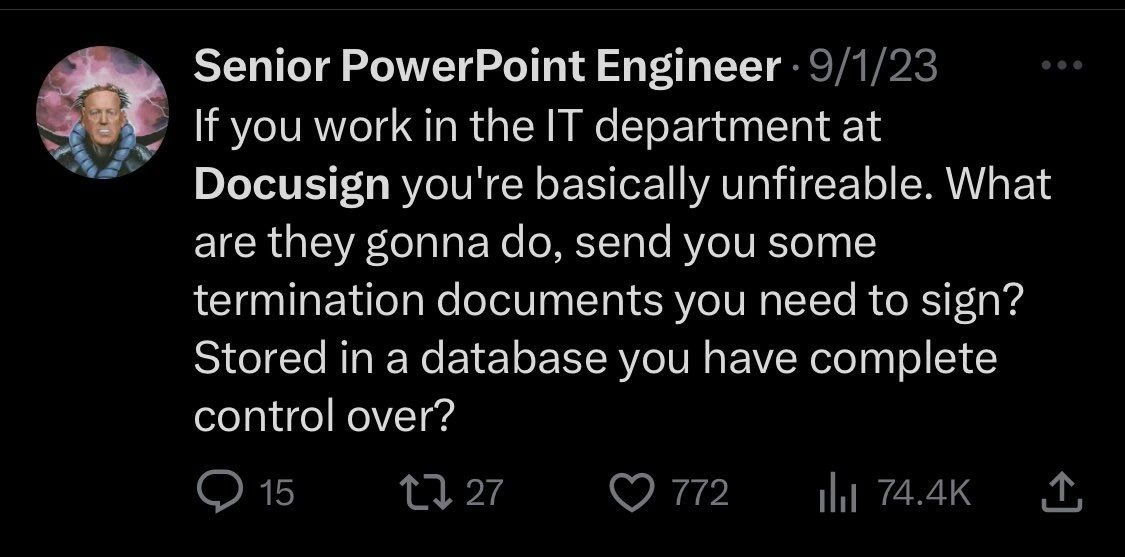
For seasoned engineers and IT veterans, this meme prompts a knowing, slightly pained laugh. It’s depicting the classic “fox guarding the henhouse” scenario in a tech company. The tweet (from an aptly tongue-in-cheek handle “Senior PowerPoint Engineer”) quips: “If you work in the IT department at DocuSign you’re basically unfireable. What are they gonna do, send you some termination documents you need to sign? Stored in a database you have complete control over?” Everyone who’s dealt with corporate IT or security immediately gets the punchline. The person in charge of the system effectively has veto power over that system’s outputs. HR wants to send a termination notice via DocuSign? Well, the IT admin is running the DocuSign database and services, so that notice will accomplish precisely nothing without his cooperation. In coder lingo, that pink slip becomes a no-op — an operation that executes but results in no change. The tweet’s rhetorical “What are they gonna do?” is answered by the obvious: They can’t do a darn thing! The usual power dynamic (HR firing an employee) is completely flipped because of a technical loophole.

This is hilarious (and a bit frightening) to experienced folks because it’s a textbook segregation-of-duties failure. In a well-run company, you’d never give someone sole control over a process that could involve their own discipline or termination. Here, hypothetically, DocuSign’s internal process wasn’t thought through: they trusted their own product and staff hierarchy so much that the IT guy ends up effectively holding HR hostage. It’s a perfect storm of CorporateCulture meets Security. There’s an implicit roast of management here: “Whoops, you digitized and automated your HR workflow so thoroughly that you forgot the IT admins administering that workflow could use their powers when it involves them.” It’s an insider_threat_joke wrapped in irony. The very tool meant to streamline and secure company paperwork (including firing documents) can be rendered useless by an internal admin who controls that tool.

Real-world sysadmins and senior developers have seen flavors of this before. There’s a dark humor in it because it echoes true stories. Seasoned folks remember anecdotes like the disgruntled network engineer who, when he sensed he was about to be fired, changed all the passwords and literally locked out his bosses (a true story in San Francisco’s city government). Or the legend of the BOFH (Bastard Operator From Hell) — the fictional sysadmin who always finds a way to twist situations to his advantage. In practice, companies have learned (sometimes the hard way) to take precautions: you don’t rely on the person’s own accounts to notify them of termination, and you certainly don’t let someone with root access politely continue working between “you’re fired” and their last day. Best practice is to cut access immediately. Often IT is told last during layoffs — sometimes you see those scenes where someone from security is literally standing by while HR gives the news, and the person’s accounts get disabled in real-time. Why? Because if you give a privileged tech user even a few minutes of unsupervised access after letting them go, who knows what buttons they might press (drop databases, scramble backups, send company-wide emails – you name it).

That’s why this tweet strikes a chord — it’s taking that serious scenario and flipping it into a laughable “what-if”: What if the company was so naive that they tried to fire their all-powerful IT admin through the very system he controls? It’s absurd, it’s a TechHumor exaggeration, but it tickles engineers because it pokes fun at a kernel of truth. It’s also a sly nod to JobSecurityInTech folklore: some IT folks jokingly try to make themselves “unfireable” by being the only one who knows how a legacy system works or by literally having keys no one else has. Here, the admin didn’t even need to engineer that scenario — the company handed it to him on a silver platter by not thinking through their AccessControlMechanisms. The tweet’s popularity (look at those likes and retweets) shows that many in tech read it and went, “Ha! Classic.” It’s the kind of joke you immediately share with your team, often with a comment like, “Sounds like something our place would accidentally do,” followed by groans. In short, it resonates because it’s a perfect satire of an internal_control facepalm: when the very safeguards meant to enforce rules can be nullified by the person those rules would discipline.

And technically speaking, the admin truly could nullify it. With full database privileges, they might do something as simple as:

-- HR: "We sent your termination paperwork via DocuSign, please sign it."
-- IT Admin, who has database access, thinks otherwise:
DELETE FROM Documents 
WHERE doc_type = 'TerminationNotice' AND employee_id = 'EMP123';
-- Poof. The termination document record is gone from the system.

That SQL snippet is essentially the admin saying “What termination? I don’t see any termination.” The termination record vanishes, and with it goes HR’s official proof of “you’ve been notified.” It’s tongue-in-cheek, of course — in real life, HR would catch on and find another way (like, you know, a face-to-face meeting with a paper document!). But the e_signature_irony here is golden: the company trusted an electronic process so much that they forgot the human loophole, and the one person who shouldn’t have power over a firing ends up with all of it.

Level 4: Root of Trust Paradox

At the deepest technical level, this joke highlights a fundamental security architecture quirk: the system’s root of trust is undermined by an insider. A platform like DocuSign relies on cryptographic guarantees — hashing, digital certificates, audit logs — to ensure that once a document is signed and stored, it’s tamper-proof and authentic. In theory, an electronic signature provides non-repudiation (the signer can’t later deny it) because the document is secured in a database and sealed with encryption. But all those guarantees assume one critical thing: that no malicious admin with god-level access is fiddling behind the scenes. Here, that assumption collapses. The very person being fired is the one who administers the e-signature system and its database. It’s a root of trust paradox — the guardian of the system’s integrity is the subject of the action, so the usual trust chain melts away.

In security design, we have the principle of separation of duties precisely to avoid this scenario. No single individual should have complete control over a critical process from start to finish. For example, one employee can request a financial transaction, but another must approve it; that way, you don’t let the fox guard the henhouse. DocuSign’s internal workflow (at least in this joke scenario) violates that principle spectacularly. The IT admin is both the initiator and the approver/gatekeeper of their own termination process. Academically, this is reminiscent of a self-referential problem — a bit like trying to prove a statement using the statement itself. The system is waiting for a confirmation from the very entity who has every incentive (and the power) to withhold or alter that confirmation. It’s almost a corporate version of a software deadlock: the process can’t move because the one who needs to provide the signal (the signature) has decided to block it.

From a DatabaseSecurity and AccessControlMechanisms standpoint, it’s an insider nightmare. Insider threat is one of the hardest problems in security: you can encrypt data, enforce strict authentication, and log every action, but if the administrator of those systems themselves turns adversarial (even just to save their own job), all bets are off. They have the master keys. They can often disable logging, alter records, or use maintenance tools to manipulate data directly. In a well-designed system, even admins have some checks (like requiring multiple approvals for critical changes, or tamper-evident logs that alert others). But if the organization hasn’t set up those checks, an admin can effectively perform a digital sleight-of-hand. The meme paints exactly that picture: the admin could, say, reach into the database and delete or modify the very row that represents their termination document, as if it never existed. All the fancy cryptographic signing in the world won’t help if the guy who runs the database can just go in and say, “No record of that document here!” It’s a comically pointed illustration of why advanced security models always caution: who watches the watchers? In this case, nobody is watching the watcher, and the watcher sure isn’t about to fire himself. The result is a high-tech stalemate born from a bad security model, encapsulated in one punchy tweet.

Description

A screenshot of a tweet from a user with the handle 'Senior PowerPoint Engineer'. The tweet presents a humorous thought experiment about job security. The text reads: 'If you work in the IT department at Docusign you're basically unfireable. What are they gonna do, send you some termination documents you need to sign? Stored in a database you have complete control over?'. This meme is a classic 'keys to the kingdom' joke, highlighting the immense power held by IT administrators and DevOps engineers who control a company's core infrastructure. The humor lies in the paradoxical situation where the very process of firing someone relies on the systems that person manages, creating a theoretical invulnerability. It resonates deeply with senior engineers who understand that access control is the ultimate form of power within a tech organization

Comments

13
Anonymous ★ Top Pick Their offboarding Jira ticket would be permanently stuck in the 'Pending Infrastructure Approval' column, with the only approver being the person getting fired
  1. Anonymous ★ Top Pick

    Their offboarding Jira ticket would be permanently stuck in the 'Pending Infrastructure Approval' column, with the only approver being the person getting fired

  2. Anonymous

    Classic lesson: never let the same team that grants row-level ACLs be the one signing the separation agreement - otherwise the only thing getting revoked is HR’s IAM token

  3. Anonymous

    The ultimate privilege escalation: when your sudo access extends to the HR termination workflow and the audit logs are just another table you can DROP. It's like being root on the server that hosts your own performance reviews - technically possible, ethically questionable, and definitely not covered in the SOC 2 compliance training

  4. Anonymous

    The ultimate proof that separation of duties isn't just a compliance checkbox - it's the only thing standing between your DBA and immortal employment. This is why mature organizations implement least privilege access and why your termination workflow should never route through systems controlled by the person being terminated. It's the database equivalent of asking someone to lock themselves in prison and hand you the key through the bars

  5. Anonymous

    This is why GRC insists on separation of duties: when the e-signature workflow and the IAM tables share the same DBA, 'terminate employee' becomes a no-op with a spotless audit trail

  6. Anonymous

    Pro tip: when RBAC, SoD, and PAM all report to the same admin, the termination workflow is a self‑signed cert with write access to its own audit log

  7. Anonymous

    DocuSign IT layoffs: the ultimate RIF where term sheets hit 'pending signature' in your own DB you admin

  8. @decide_later 2y

    They should have a special old printer somewhere in their main office's basement just for such occasions. A mere sound of this printer working should scare the shit out of employees nearby bzzzt of doom

    1. @endisn16h 2y

      😭😭😭

      1. @decide_later 2y

        also imagine mass layoffs going through this single printer "Anonymous employee warns about 'The Printer of Doom' working overtime after DocuSign reporting 8% in losses and shares going down by 17%; our experts predict layoffs"

  9. @Algoinde 2y

    Or they have a dedicated employed typist in a black robe of doom. When it appears in the office, frigid air starts seeping out of the ACs. Moments later, a dreadful sound emanates from the basement: "clack, clack, clack, clack-clack, clack... DING", sending shivers down the spine of everyone who is a rank lower than CEO. They look at each other; they've yet no idea who the typewriter dings for.

    1. @Algoinde 2y

      The seniors are visibly calmer, though. They've accustomed to it; they know how many clacks long their legal names are. A man glances at his table. Jonathan is written on a plaque sitting upon it. He hears eight clacks. DING.

  10. @decide_later 2y

    the night of corporate horror stories, just right after Halloween

Use J and K for navigation