From feral goto to domesticated goto: control-flow evolution in modern languages
Why is this Languages meme funny?
Level 1: Wild Wolf vs Pet Dog
Imagine you have a wild wolf running around versus a pet dog living in your house. The wild wolf is unpredictable and can be very dangerous – it might attack you out of nowhere. The pet dog, on the other hand, has been domesticated (tamed). It’s much safer to be around, though it might still cause some trouble like knocking over a lamp or peeing on your shoes. The meme is joking that an old programming command called “goto” used to be as chaotic and dangerous as the wild wolf. It could make a huge mess in a program, causing big problems (hard to fix, might “bite” the developer by causing errors). Nowadays, programming languages have a gentler, more controlled version of that command – kind of like a pet dog that’s mostly well-behaved. This newer goto won’t “rip your face off” (won’t completely wreck your project) because it’s only allowed to do limited things, but it can still be a naughty little thing if not watched (like a dog that might still have an accident on the carpet). The reason this is funny is that programmers are comparing something in coding to a wolf and a dog – it’s a silly yet clear way to say “we took something wild and made it safer, but not totally perfect.” Even if you’re not a programmer, you know that a wolf is scary and a dog is usually nice, and that idea carries over to how we think about this coding trick called goto.
Level 2: From Spaghetti to Structure
Let’s break down what this meme is talking about in more straightforward terms. It’s all about the goto statement – a programming command that literally tells the program to go to another line of code (marked by a label). This was common in old languages. For example, in BASIC or early C, you might see something like:
10 PRINT "Hello"
20 GOTO 10
This would jump back to line 10 and create an infinite loop printing "Hello". As you can imagine, using GOTO everywhere with numeric labels can get very confusing very fast. Code that heavily uses goto tends to lose any logical structure; it’s all jumps and labels scattered around. We call such tangled, hard-to-follow code “spaghetti code.” (Think of a bowl of spaghetti – the noodles twist and cross in a chaotic way. In a spaghetti code program, the flow of execution twists and turns unpredictably, just like those noodles.) Spaghetti code is bad for CodeQuality because when you (or someone else) try to read or modify it, you keep getting “lost” following the jumps. It’s easy to introduce bugs or overlook something, because the normal top-to-bottom reading order is constantly interrupted by “go to this label here, then jump there.”
The meme jokes that an old-fashioned, traditional goto is like a wild wolf – untamed and dangerous. Why dangerous? Because an unrestricted goto lets you jump to almost any part of the program, which can wreak havoc on program logic. For instance, imagine if you could just jump into another function without calling it normally – you’d skip the code that sets up that function’s environment, possibly bypass important checks or resource allocation. That could crash the program or corrupt data. Thankfully, modern languages do not allow that kind of cross-function jump with goto. This is what the caption means by “the inability to cross function boundaries.” In C, C++, C#, Go, and many others, a goto can only jump to a label within the same function. It’s as if the goto is on a leash, limited to running around in its own yard (the function). It cannot hop over the fence into a neighbor’s yard (another function). This restriction preserves a fundamental rule of structured programming: one function must finish and return normally before another begins (except if you use defined mechanisms like function calls or exceptions).
So, what’s a “domesticated goto” then? It’s basically these modern, limited versions of goto that still exist but under tight rules. Many popular languages decided that completely banning goto might be too extreme, so they keep a tamer version for rare cases. Here are some examples:
- C – one of the oldest still-used languages (since the 1970s) – has
gotobut you can only use it to jump to a label in the same function. It’s often discouraged in regular application code. However, you will see it used in low-level code (like operating system kernels or device drivers) for things like error handling. For example, a C function might usegoto cleanup;to jump to a cleanup section at the end, releasing resources in one place. This avoids duplicating cleanup code in manyifbranches. It’s a controlled, intentional use of goto. But you won’t see it jumping wildly around the program, because that’s not allowed. - C# – a modern language (from Microsoft, part of .NET) – also has a
gotostatement. In C#, it’s mainly used in switch statements (you cangoto case Xto jump to another case label), or occasionally to break out from deeply nested loops. Again, C#’s goto cannot take you out of the current method. It’s confined, so it can’t undermine the overall program structure. Most C# coding standards will tell you not to use goto unless absolutely necessary, as it can still make code confusing. - Go (Golang) – a relatively new language (first released around 2009) – surprised some people by including a
goto. The designers of Go felt that sometimes a goto is the simplest way to make certain loops or error-handling logic clear, as long as it’s used sparingly. They explicitly restrict Go’sgototo prevent misuse: you cannot jump into a new local variable scope that you would skip over (meaning you can’t skip the initialization of a variable), and of course you can’t jump out of the function. The result is that Go’s goto, while present, doesn’t permit the really crazy jumps that would break program logic. It’s a domesticated feature – there if you need it, but not as powerful (or dangerous) as it once was.
On the other hand, some languages chose to eliminate goto entirely for the sake of clarity and code quality. For example, Java and Python have no goto statement at all (Java even keeps “goto” as a reserved word, essentially just to forbid anyone else from using it as a name!). These languages force you to use structured loops (for, while) and other constructs like break/continue (which are like mini-gotos but very limited in scope). If you want to exit multiple levels of loops or do something fancy, you might have to rethink your approach or use exceptions. The idea is that by not providing a goto, the language guides developers towards writing clearer, more maintainable flow of control. It’s like saying: “we don’t even trust you with a tamed wolf, so we’re not having that animal in our house at all.” This can make certain tasks a bit less straightforward, but many believe it’s worth the trade-off to avoid even the temptation of spaghetti code.
Now, structured programming is the alternative to using goto. This just means using the constructs that create a clear structure in code: sequences of statements, loops, conditionals, and functions. Here’s a very simple illustration. Suppose we want to print numbers 0 through 9. Using goto (in C-style pseudocode), it might look like:
int i = 0;
start:
if (i >= 10) goto end;
printf("%d\n", i);
i++;
goto start;
end:
This works, but you can see it jumps around: it goes “start -> end -> start” in a loop via those labels. The same logic written in a structured way (without goto) would be:
for (int i = 0; i < 10; ++i) {
printf("%d\n", i);
}
Much cleaner, right? The for loop construct handles the looping internally, so we don’t need to manually jump. Under the hood, the compiler will generate some jump instructions for the loop, but as programmers we don’t see them – we just see a nice loop that starts at 0 and ends at 9. This structured version is easier to read and reason about: you know exactly the start and end of the loop, and there’s no risk that execution will suddenly break out of this pattern except by the normal loop rules. In the goto version, if you weren’t careful, you might accidentally add code after the goto start that never executes, or jump into the middle of something unintentionally. It’s easy to make a mistake.
The meme caption mentions “The inability to cross function boundaries means it can still pee on your shoes, but it probably won’t rip your face off.” In plainer terms: modern gotos can still cause problems (pee on your shoes). For example, even within one function, misuse of goto can lead to messy, confusing logic — maybe skipping over important lines of code or creating loops that are hard to follow. That’s the “pee on your shoes” part: it’s irritating and kind of gross (bad code smell!), but it’s usually a localized problem. It won’t “rip your face off” because it can’t do the most dangerous thing, which would be to jump out into another function’s context and wreak havoc on the entire program’s flow. Not ripping your face off means that the overall structure of your program (like how functions call each other, how the stack unwinds, etc.) remains intact and predictable. Any damage a goto does is contained to the current function. This is analogous to a pet making a small mess versus a wild animal causing life-threatening harm.
To connect it to CS fundamentals: functions are meant to be like black boxes – you call a function, it does its job, and returns control to you. If a goto could ignore that discipline, it would break the fundamental call and return mechanism. Modern languages simply don’t allow that: the only way out of a function is to return normally (or throw an exception, which still follows strict rules). So a goto is tamed by these rules. It’s still a "jump statement" (a term for any command that moves execution to somewhere else, like break, continue, return – those are all controlled jump statements), but it’s regarded warily. When people talk about language quirks or comparisons, goto often comes up as an interesting historical quirk: “Did you know language X still has goto?” It’s almost a litmus test of language design philosophy. A language that has a goto says, “we give the programmer rope (hopefully not to hang themselves 😅) for the sake of flexibility,” whereas a language with no goto says, “we don’t even present that rope, to keep things clean by design.” Both approaches aim for good code quality in the end, just via different paths.
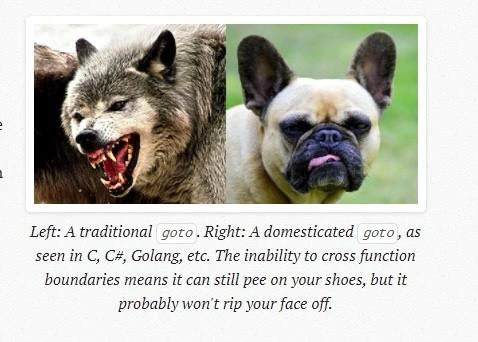
In summary, the meme is comparing unstructured vs structured control flow using a funny animal analogy (wolf vs bulldog). The left side (wolf) is the old-school, wild goto that could jump all over, leading to spaghetti code. The right side (bulldog) is the modern, house-trained goto or equivalent (within C, C#, Go, etc.) that is limited in scope. Developers find it funny because it’s a creative way to depict a serious lesson from programming history: we domesticated a once-dangerous feature. The wolf might be nearly gone from our homes, but a little bulldog version still lives with us, for better or worse. And just like a real bulldog, it’s usually friendly but you wouldn’t trust it completely – it might still chew up your slippers (or your logic) if you turn your back on it. 🐶👞
Level 3: Domesticated Danger
For seasoned developers, this meme hits on a classic shared memory: the long-running saga of the goto statement in programming culture. It’s common knowledge in dev circles that goto has a notorious reputation – mention it in a room of experienced engineers and you’ll get head shakes, war stories, or dramatic gasps as if you just spoke of summoning a code demon. This meme taps into that inside joke by picturing the original goto as a snarling wolf and the newer, restricted goto (or its cousins) as a squishy-faced bulldog. We immediately get the reference: the wolf-like goto from the wild old days of programming (think 1970s C or even earlier assembly and BASIC code) was dangerous, leading to the dreaded spaghetti code that could “rip your face off” in terms of debugging and maintenance nightmares. In contrast, the modern “domesticated” version – the bulldog goto seen in languages like C, C#, or Go – is still a bit ugly and messy (💩), but it’s generally contained: it can’t leap out of its yard (function) and wreak total havoc on your entire codebase. In other words, it might pee on your shoes (cause local problems or ugly code in one function), but it (hopefully) won’t tear apart your whole program’s structure.
Why is this funny to a developer? Because it’s so true. We’ve all been taught – or learned the hard way – that indiscriminate use of goto is a hazard to code quality. The meme humorously acknowledges that, despite decades of structured programming preaching, many modern languages still haven’t completely neutered goto. Instead, they’ve put it on a leash. 😅 The caption even explicitly notes the “inability to cross function boundaries” as the leash. Any senior engineer knows why that detail matters: a goto that could jump from one function into the middle of another would be insanity – it would bypass all the normal rules of function calls, likely corrupting the stack or leaving resources hanging. By confining gotos to within a single function, languages like C and Go ensure that the worst a jump can do is make one function’s internals confusing, rather than breaking the entire program’s call structure. That’s the equivalent of keeping the beast in its pen. It’s a language design trade-off: they didn’t extinct the beast entirely (some argue there are legitimate uses for a local goto), but they declawed and declawed it to reduce the carnage. The meme jokingly implies that perhaps completely banning goto (like some languages did) would be like never owning a wolf at all – but instead, we’ve chosen to domesticate it into a dog that occasionally misbehaves.
Historical context adds to the humor for veterans. The phrase “goto considered harmful” is practically legend in software engineering lore. Many senior devs recall it being cited in textbooks or by mentors as a stern warning. It’s the programming equivalent of a scary campfire story: “I once inherited code with hundreds of GOTOs… it took me weeks to untangle!” 😱. Indeed, back in the day, some of us debugged BASIC or older C code that was essentially a dense forest of goto labels – the origin of the term “spaghetti code.” Trying to trace logic in such code feels like chasing a wild wolf through a tangled forest: you think the code is executing sequentially, then BAM! a goto leaps out and you’re suddenly somewhere completely else in the file. If you’ve ever stepped through a program in a debugger and hit a goto, you know the feeling – one moment you’re at line 50, the next you’ve jumped to line 200 with no warning. It’s disorienting and prone to error. Senior devs share a kind of goto PTSD from those experiences. The meme’s exaggerated analogy (“rip your face off”) playfully nods to that trauma – yes, a wild goto can metaphorically rip a developer’s face off by causing severe headaches, if not outright pain, when maintaining such code.
Now, enter modern practice: even though structured programming won the philosophical battle (we write loops and ifs, not arbitrary jumps, in virtually all new code), goto never fully vanished. Why? Because sometimes, pragmatism wins. There are niche cases where a well-placed goto can actually improve clarity or performance – for example, error handling in C can be made cleaner with a single goto cleanup label at the end of a function, to avoid repetitive cleanup code. In the Linux kernel and other systems code, you’ll see this pattern often: it’s an accepted idiom, proving that not all gotos are written by newbie programmers; sometimes experts use them as a controlled tool. This is the domesticated goto in action: it lives indoors with us and we trust it in small doses. Similarly, languages like C# include goto mostly for completeness (and for scenarios like jumping between cases in a switch or breaking out of deeply nested loops). Go (Golang), despite being a modern 21st-century language that generally encourages clean code, explicitly provides a goto. Why would the Go designers do that, given goto’s bad rep? Because they know that forbidding something outright might force even worse hacks. By allowing a constrained goto, Go gives developers an escape hatch for rare situations (like breaking out of multi-level loops or implementing state machines) without resorting to more convoluted code. It’s a bit like giving the wolf some obedience training and letting it guard the house: under watchful eyes it serves a purpose, but you’re always aware it is a wolf at heart.
The quip about peeing on your shoes is a tongue-in-cheek reminder: even a “safe” goto can lead to messy code if abused. Sure, it won’t instantly destroy program structure like a cross-functional jump could, but overusing goto within a function can still produce logic that’s hard to follow (just a smaller-scale mess, maybe limited to one file or function). Seasoned devs might chuckle here because we’ve seen junior colleagues (or unfortunate legacy code) misuse even the tame goto and end up with mini-spaghetti in one function. It’s the difference between systemic failure and localized ugliness. A local goto is like a contained spill – annoying, potentially smelly, but you can clean it up; an unrestricted goto is like a dam breaking – total flood of chaos.
Finally, the meme’s underlying irony isn’t lost on experienced eyes: after decades of preaching that “gotos are evil” in terms of CodeQuality and maintainability, we still find ourselves dealing with them in modern codebases, albeit in constrained form. It’s a gentle poke at language designers and us developers – we think we’ve learned from the past, but instead of completely eliminating the bad practice, we sometimes just rebrand it or fence it in. Labelled breaks, exceptions, continuations – these are all, in a sense, controlled jumps (you could call an exception a “domesticated wolf” too – it can unwindingly jump out of multiple functions, but in a structured, pre-defined way). The meme humorously acknowledges that evolution: we went from a wild goto roaming free (left image) to a sorta-tame goto sitting by our side (right image). The senior dev inside us finds it funny because it rings true: the more things change, the more they stay the same – we still have that darn goto (or something like it), but at least it’s house-trained enough that it usually won’t bite our heads off during a code review!
Level 4: Formal Flow Taming
At the lowest machine level, all control flow is ultimately governed by jump instructions (the hardware-level cousins of goto). Early high-level languages like old FORTRAN and BASIC essentially gave programmers a feral freedom to jump anywhere in the code using line numbers or labels. This led to programs being essentially arbitrary directed graphs of execution paths, which is as wild as it sounds. In theoretical computer science terms, an unrestricted goto turns your program’s control-flow graph into a free-form spaghetti bowl. Verifying correctness or understanding such a graph is extremely difficult because there’s no structured nest of loops or function calls – anything could jump to (almost) anything. Formal reasoning about program behavior (like proving correctness with induction) becomes a nightmare when the code can hop around with no constraints.
Mathematicians and computer scientists tackled this chaos in the 1960s. In 1966, Böhm and Jacopini proved a seminal result (often called the structured program theorem) which states that any computable program can be written using just three structures – sequence, selection (if/else), and iteration (while/for loops) – without needing a goto. In other words, given any flowchart (no matter how tangled its arrows via gotos), you can refactor it into a structured form using those constructs (possibly introducing helper variables). This theorem put a theoretical muzzle on the wild goto by showing it’s not necessary for expressiveness or Turing-completeness. You could always build an equivalent “domesticated” program that’s easier to understand and prove correct.
Just two years later, in 1968, Edsger W. Dijkstra wrote his famous letter titled “Go To Statement Considered Harmful.” This was a rallying cry to the programming community, leveraging the new theoretical results and practical experience. Dijkstra argued that unbridled use of goto makes code virtually unreason-able: a programmer (or a verifier) can no longer mentally trace the program because the flow of control doesn’t follow a neat, block-structured, hierarchical pattern. Instead, it becomes a mash of jumping arcs. With structured programming, code forms something like a well-formed nesting of blocks (think of nicely matching braces or indentations forming a clear in-out structure). With wild gotos, you break that nesting arbitrarily – like a wolf smashing through fences between yards. Dijkstra’s letter (backed by theory and lots of anecdotal evidence of buggy “spaghetti code”) cemented the notion that goto was the big bad wolf of code quality.
Language designers took these ideas to heart. Many modern language design tradeoffs since the 1970s involve either eliminating goto entirely or tightly restricting its abilities (essentially domesticating it). For example, some languages like Pascal and Ada introduced structured looping and exceptions to replace most goto uses; they still allowed a form of goto but with strict rules (you couldn’t jump out of the current function or procedure, and often not into deeper scopes either). The inability to cross function or scope boundaries is crucial: it means the goto stays local to its fenced area, preserving the integrity of the call stack and structured blocks. In formal terms, this keeps the control-flow graph reducible (no crazy snarled cycles that compilers and proofs can’t handle). An unrestricted jump that crosses function boundaries would effectively be like performing a non-local jump without unwinding the stack – akin to letting the wolf loose in a completely unrelated neighborhood. Modern languages avoid that scenario; if they need non-local control transfer, they implement it in a structured way (e.g. exceptions or continuations) that still ensures some order (like unwinding stack frames, running cleanup code, etc.). This way, even when we do need to abruptly change course across functions, it’s done with a structured protocol (not a raw goto tearing through call frames).
From a compiler and OS perspective, taming goto also has benefits: structured code allows optimizations and analyses (like data-flow analysis or proving absence of certain bugs) to be simpler and more effective. In fact, many optimizations rely on predictable structures (loops with single entry/exit, well-nested scopes). Unstructured jumps can introduce “irreducible” control flow that even optimizing compilers handle by essentially adding their own hidden structure to make sense of it. The CPU’s branch predictors also prefer repetitive loop patterns over completely unpredictable jumps. So even at the hardware level, a well-behaved bulldog on a leash (e.g. a loop with a clear pattern) is easier to predict than a wolf that could dart to any instruction address.
In summary, the feral goto of the early days was brought to heel by a mix of theoretical proof and practical evidence. Structured programming caged the wild beast, turning chaotic jumps into disciplined constructs. Modern languages still have the genetic memory of goto (after all, under the hood every loop compiles down to machine jumps), but they present it to developers in a much more controlled form. The meme’s joke that a domesticated goto “won’t rip your face off” alludes to this very real evolution: thanks to academic insights and decades of language design, we’ve transformed the goto from an untamed predator in our code into a mostly obedient pet – one that might still make a mess on the carpet if you’re not careful, but one that’s far less likely to destroy the entire house.
Description
The meme is split into two square photos side-by-side, framed by a thin white border. On the left is a high-contrast image of a snarling grey wolf with its mouth open, fangs exposed, ears back, and an aggressive posture. On the right is a close-up of a tan French bulldog with wrinkled face, protruding tongue, and relaxed expression. Beneath the images, the caption reads in full: "Left: A traditional goto. Right: A domesticated goto, as seen in C, C#, Golang, etc. The inability to cross function boundaries means it can still pee on your shoes, but it probably won’t rip your face off." The joke compares the notorious, unstructured goto of early C to the safer, scoped goto-like constructs available in modern languages, framing them as dangerous versus household pets. For developers, it highlights historical debates around control-flow, structured programming, and readability, while poking fun at how contemporary languages try to tame - rather than fully eliminate - problematic features

Comments
14Comment deleted
We spent decades banning goto as a rabid wolf, then slipped it back in as async/await state machines - now the beast wears a cute bulldog hoodie while still chewing up our stack traces
The real domestication of goto happened when language designers realized that letting developers jump anywhere in code was like giving a toddler both matches and gasoline - sure, they might just light a candle, but why risk the entire codebase when you can sandbox the chaos to a single function?
The goto statement's journey from feral menace to house-trained nuisance perfectly mirrors our industry's approach to dangerous features: we don't eliminate them, we just add enough guardrails that they can only cause localized chaos. Modern goto is like that reformed bad boy in a rom-com - still has the edge, still makes you nervous, but at least it won't jump to your ex-girlfriend's function and wreak havoc on her stack frame
Go's goto: leashed to one function, so it can't hunt across the call stack - face-ripping averted, just occasional scope leaks on your shoes
We domesticated goto at the language level, but the compiler still emits a pack of jmp instructions - the wolf just moved into your control‑flow graph
“Domesticated” goto doesn’t cross function boundaries - it just encourages 1,000‑line functions with a single cleanup: label, so the wolf never has to leave the yard
which brings me to the fact that I'd like to have a goto in python. Maybe in 3.11. Comment deleted
But why?! Comment deleted
to replace some more complicated loops where the exit condition changes depending on in-loop stuff. Right now, the best way to do those is a while True and breaks, which is suboptimal. Comment deleted
but where's goto helping then? Comment deleted
Most people would show something like this while(){ while(){ goto endLoop; } } endLoop: whatever Never needed this though Comment deleted
Well I don't think anyone needs it, I just think it'd be neat to have. Comment deleted
well, return from IILE should work Comment deleted
And they say php programmers are bad...... Comment deleted