Skip to content
DevMeme
2818 of 7435
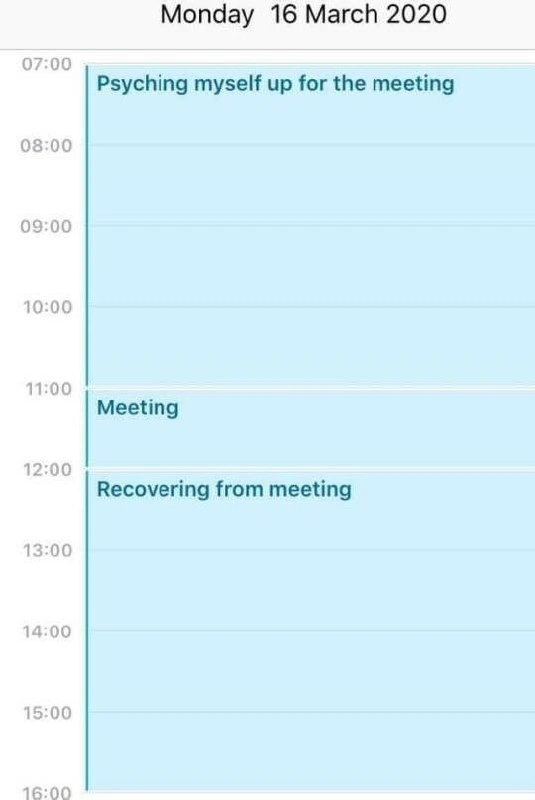
Calendar day consumed by preparing for, attending, and recovering from one meeting
Meetings Post #3114, on May 15, 2021 in TG

Calendar day consumed by preparing for, attending, and recovering from one meeting

Why is this Meetings meme funny?

Level 1: One Hour, Whole Day Gone

Imagine you have a big test at school right in the middle of the day. You spend all morning feeling nervous about it – you can’t really focus on your other classes because you keep thinking about that test coming up. Then you take the test (it lasts about an hour) and try your best. After it’s over, you feel so relieved and tired that you don’t want to do any more school work for the rest of the day. In the end, that one-hour test ended up affecting your whole day at school. That’s just like what this funny picture is showing: the programmer has a one-hour meeting in the middle of the day, and they spend the whole morning worrying about it and the whole afternoon recovering from it. Even though the meeting is short, it spoils the entire day for getting any other work done.

Level 2: Meeting Hangover

If you look at the meme’s calendar, it’s highlighting how a single one-hour meeting can end up dominating an entire workday. On the screen, Monday March 16, 2020 has a meeting scheduled from 11:00 AM to 12:00 PM. But here’s the funny (and painful) part: the person filled their calendar with two big blocks around that meeting — one from 7:00 to 11:00 labeled “Psyching myself up for the meeting” and another from 12:00 to 4:00 labeled “Recovering from meeting.” Basically, they jokingly marked off the whole morning and whole afternoon as lost time due to that single meeting. The calendar is all one color (a solid block of blue) from 7 AM to 4 PM, with nothing else scheduled. This is a form of developer workplace humor that rings true: it feels like even a short meeting in the middle of the day can break your momentum so badly that you might as well kiss the entire day goodbye. It’s illustrating MeetingOverload in a tongue-in-cheek way.

Let’s unpack those calendar entries. “Psyching myself up for the meeting” means mentally preparing for the meeting. Before a meeting, you might gather your notes, think about what you’re going to say, or just brace yourself if you’re a bit anxious. Developers often need to switch gears before going from quiet coding mode to speaking in a meeting. For example, if you have to present your progress or explain a problem to the team, you’ll spend some time planning how to do that. Also, if a meeting is coming up soon, many people hold off from starting any deep work. Imagine it’s 9:30 AM and you know you have a meeting at 11. You might say, “Is it worth starting to code this complex feature now? I’ll just get interrupted when I’m in the middle of it.” So instead, you do some smaller easy tasks, check emails, or just wait. In other words, you’re psyching yourself up – consciously or unconsciously preparing and not fully focusing on other work because the meeting is looming.

Then there’s the actual Meeting at 11:00 – the one-hour video call or discussion that everything is revolving around. After that, the calendar shows “Recovering from meeting” from 12:00 to 4:00. This is poking fun at the fact that when the meeting is over, you don’t instantly go back to being productive. You often feel like you need time to recover. We sometimes call this a meeting hangover. It’s that sluggish, drained feeling you get after sitting through a long meeting or an intense discussion. Maybe in the meeting you learned about a bunch of new issues that now your brain is chewing on. Or maybe you had to be actively listening and speaking for an hour, which can be tiring (especially for folks who are more introverted or not early-morning people). So after the meeting, you might take a break, grab a snack, or just have trouble getting your head back into your code. In the meme, they jokingly blocked off the entire afternoon for “recovery” time – as if the meeting was so exhausting that they can’t do any real work until tomorrow. It’s an exaggeration, but it definitely captures the feeling of a MeetingFatigue that lingers even once the call has ended.

What this meme is really highlighting is the cost of context switching. That term “context switching” refers to how changing tasks has a mental cost. When developers are programming, they hold a lot of details in their head – variables, logic, what they’ve done, what to do next. If you abruptly switch to a meeting, you have to drop all those details for an hour and focus on something else. Later, when you return to coding, you can’t instantly pick up where you left off; you have to reload those details into your memory. It’s like if you were in the middle of reading a thrilling story, and someone made you stop right at a crucial chapter to go do something else. When you come back to the book, you might have to skim the previous chapter to remind yourself what was happening. That lost time and momentum is the “context switch tax.” For developers, a short interruption can cause a surprisingly big delay in getting back to full speed. In practice, if you have one meeting in the middle of the day, you often lose not just that hour, but time on either side as well – time spent preparing to switch tasks, and time spent recovering your focus afterwards. So even though the meeting is only from 11 to 12, the funny calendar in the meme shows 7 to 4 as basically a wash due to that interruption. It’s a dramatized example of how a single event can disrupt DeveloperProductivity far more than you’d expect.

Now, consider the context: the date on the calendar is March 2020. This was the start of many people working from home full-time due to COVID-19. Suddenly, in-person meetings turned into video calls for everyone. RemoteWorkCulture really took off, and with it came a flood of online meetings. People quickly coined the term Zoom fatigue (or video call exhaustion) to describe how tiring it is to be in video meetings back-to-back. If you’ve ever had online classes or lots of Zoom calls in a day, you might have felt this – your brain feels fried and you didn’t even move from your chair! That’s because video meetings require more intense concentration in some ways: you’re trying to pick up on tone and cues through a screen, sometimes talking over each other due to lag, and you’re often looking at your own face which can make you self-conscious. All that can make one hour on Zoom feel like two hours of normal work. So in the meme, when the person has to “recover” from a meeting, it’s reflecting that video call fatigue. After signing off a long remote meeting, many of us just need to sit quietly or step outside for a moment to get our mental energy back.

The joke of the meme is a bit of MeetingHumor mixed with truth: it’s funny because it’s true. Developers (and others who need concentration to do their work) often complain that a single meeting can mess up their whole day. It’s a shared frustration in many workplaces. The meme exaggerates the timeline (most of us wouldn’t literally block out 4 hours before and after on our calendar), but it uses that exaggeration to make a point. We’ve all had days where a one-hour meeting in the middle meant we felt we accomplished almost nothing else. It’s also a gentle jab at how companies sometimes don’t realize the cumulative toll of all these meetings on time management and actual work. In short, the meme uses a simple calendar joke to highlight meeting overload and meeting fatigue – showing how one little meeting can blow up an entire day’s worth of coding progress, leaving the developer frustrated at how unproductive the day ended up being.

Level 3: Productivity Black Hole

A one-hour meeting acting like a black hole that warps the entire workday around it – every senior developer has been pulled into this gravity well. The meme’s digital calendar (set to Monday, 16 March 2020, ironically the dawn of full remote work for many) shows the dreaded timeline: 07:00–11:00 blocked out as “Psyching myself up for the meeting,” then 11:00–12:00 for “Meeting,” and 12:00–16:00 reserved as “Recovering from meeting.” In other words, an ostensibly quick sync has swallowed the whole day. It’s a classic case of meeting overload where a tiny one-hour event triggers outsized context switching costs and leaves the developer’s actual tasks languishing. This comedic exaggeration hits painfully close to reality: a single meeting becomes a productivity black hole that bends time and focus, leaving no escape for actual coding work.

Why is this so relatable? Because developer productivity depends on long, uninterrupted stretches of deep work (getting “in the zone” to write code or debug). A sudden meeting smack in the middle of prime coding hours disrupts that flow. The mental overhead of context switching from writing code to discussing sprint updates is huge. Imagine your brain as a CPU: jumping from a complex algorithm to a status meeting forces a cache flush of all the intricate details you were juggling. There’s a known term for the developer’s plight here – the difference between a maker’s schedule and a manager’s schedule. Managers slice their day into neat one-hour blocks (meeting after meeting – it’s their normal). But for makers (like programmers), you need half-day or full-day chunks to create anything substantial. One meeting at 11:00 AM acts like an interrupt that fragments what could have been a solid morning of coding into unusable slivers. It’s like memory fragmentation in a computer: the one-hour meeting is a small allocated block that splits the morning and afternoon into two chunks too small for any real work.

To a battle-hardened dev, the context_switch_cost depicted here is all too familiar. It’s not just the hour of the meeting itself – it’s the MeetingFatigue before and after. Beforehand, you’re “psyching yourself up”: reviewing notes, bracing to speak, or simply unable to dive into a complex code task knowing you’ll be interrupted soon. After the meeting, you experience the meeting hangover – your concentration siphoned away, plus new to-dos or ideas from the meeting now cluttering your mind. Especially during remote work in 2020, this got worse: that calendar date hints at early pandemic video call exhaustion. Back then, suddenly every discussion became a Zoom call. (Even asking “Got a minute to chat?” often turned into “Here’s a Zoom link.”) And we quickly learned that video calls can be more draining than in-person chats. There’s even research explaining why a video call meeting saps your energy: constant eye contact on screen, staring at your own tiny face in the corner, the awkward delays – it all adds cognitive load. So that “recovering from meeting” block in the meme might include rubbing your eyes after an hour of staring at a screen, stretching your legs after sitting still, and trying to regain the mental context of your work (which is easier said than done at 2 PM when your brain is fried).

This meme perfectly satirizes corporate culture and its love affair with meetings. Many companies preach about productivity and “flow”, yet saddle developers with calendars full of status calls, “quick syncs,” and endless check-ins. The tragic humor here is that the MeetingCulture itself often defeats its own purpose. A meeting intended to boost alignment or solve a problem can end up derailing the very work it’s supposed to facilitate. It’s the shared pain behind DeveloperFrustration: coming back from a meeting only to realize you’ve lost your coding groove entirely. The meme’s joke schedule (psych-up, meeting, recover) is basically a developer’s internal monologue written onto the calendar. It’s tongue-in-cheek, yet it’s capturing something very real. We’ve all procrastinated on a big coding task in the morning because “well, I’ll be interrupted at 11 anyway,” and then procrastinated after the meeting because “ugh, that meeting totally drained my motivation.” A one-hour meeting can sometimes knock out hours of actual work – a fact both hilarious and depressing to those of us who live it.

In true veteran fashion, we can’t help but grin at how accurately this meme nails the experience. The whole day was essentially sacrificed at the altar of one measly meeting. Sure, it’s a bit exaggerated – not every meeting nukes an entire day – but it sure feels that way sometimes. And of course, during many a pointless meeting, every developer has the same thought flashing through their mind:

“This meeting could have been an email.”

That single sentence encapsulates the dark humor here. We laugh because it’s true: so much of our time gets wasted in meetings that didn’t really need to happen (or didn’t need to be so long), and it’s time we’ll never get back. If only we could reclaim those lost hours and use them to actually build something, instead of watching the day disappear into a meeting black hole.

Description

Screenshot of a digital calendar set to Monday 16 March 2020. The time column on the left shows hourly slots from 07:00 to 16:00. Three blue blocks fill almost the entire schedule: 07:00-11:00 is titled “Psyching myself up for the meeting,” 11:00-12:00 is simply “Meeting,” and 12:00-16:00 is “Recovering from meeting.” Apart from these entries, no other events exist, leaving the impression that a single 1-hour meeting monopolizes the whole workday. The meme pokes fun at developer productivity lost to meeting culture and the mental overhead of context switching, a pain amplified during the 2020 shift to all-day video calls

Comments

14
Anonymous ★ Top Pick That 11 a.m. stand-up is basically a stop-the-world GC - four hours to pause all threads, one hour to talk about pausing them, four hours to warm the caches back up
  1. Anonymous ★ Top Pick

    That 11 a.m. stand-up is basically a stop-the-world GC - four hours to pause all threads, one hour to talk about pausing them, four hours to warm the caches back up

  2. Anonymous

    The real distributed systems challenge isn't achieving consensus across nodes - it's achieving consensus on whether this meeting could have been an async Slack thread while maintaining exactly-once delivery of actual decisions

  3. Anonymous

    This calendar perfectly captures the hidden O(n²) complexity of meetings: where n is the meeting duration, but the actual cost is n + 4n + 4n. Senior engineers know that 'just a quick sync' has the same computational overhead as a full context switch - you're not just losing the hour in the meeting, you're losing the entire mental stack trace you'd built up that morning, plus the time to rebuild it afterward. It's the engineering equivalent of a cache miss that triggers a full system reboot

  4. Anonymous

    That one-hour ‘quick sync’ triggers a four-hour warmup and a four-hour stop-the-world GC - textbook manager-schedule DoS on throughput

  5. Anonymous

    Meetings: O(n²) context preload where n=attendees, with recovery phase amortizing the action item bloat nobody commits to

  6. Anonymous

    Our calendar implements two‑phase commit: 4h of prepare(), 1h commit, and an afternoon of rollback/GC - strong consistency, near‑zero throughput

  7. @p4vook 5y

    Haha nice meme loser. Too bad, saw it in Profunctor 2 days ago. I bet you feel like a fucking idiot now.

    1. dev_meme 5y

      I mean, and what? It was copied from there

    2. dev_meme 5y

      You know that they copied memes from dev_meme many times too, right?

    3. Deleted Account 5y

      Ok but who asked

  8. @san4es_francito 5y

    Any meetings this day! I have birthday 16 of March!!!

  9. @Vlasoov 5y

    every sprint review

    1. @kseniadumpling 5y

      lol

  10. Deleted Account 5y

    So true

Use J and K for navigation