An iMac is Now Thinner Than the First iPhone
Why is this Hardware meme funny?
Level 1: Bigger but Thinner
Imagine you have an old phone from when your parents were younger – it was one of the first iPhones, and back then it was considered pretty slim, but in your hand today it feels kind of thick. Now imagine your big computer at home (the iMac, which is basically a large screen that has a computer inside) is actually thinner than that old little phone. Sounds funny, right? You’d normally think a big thing should be thicker than a small thing. This meme is pointing out exactly that surprise: the big new Apple computer is skinnier than the small old Apple phone.
It’s like putting a modern flat-screen TV next to an old chunky cellphone and realizing the huge TV is flatter than the tiny phone. Or think of it this way: suppose you had a thick comic book from years ago, and today you have a huge encyclopedia printed on super-thin paper – the giant encyclopedia ends up thinner than that old comic book! You’d probably laugh and say, “Wow, how did they manage to make it so thin now?” The feeling this picture gives is just that – a mix of surprise and amazement at how far technology has come.
In simple terms, over time our gadgets have gone on a diet. Engineers found ways to make the insides of computers and phones much smaller and more efficient. So new devices can be really powerful but not take up much space. The result: something that used to be big and heavy (like a desktop computer) can now be built so slim that it’s thinner than something that used to be small (like the first iPhone). It’s a funny reminder that in tech, newer often means thinner and lighter. This makes us smile because it’s a little bit mind-bending – kind of like seeing a big adult who somehow weighs less than a young kid. It just shows how quickly technology can advance, turning yesterday’s cutting-edge gadget into today’s bulky antique!
Level 2: Shrinking the Desktop
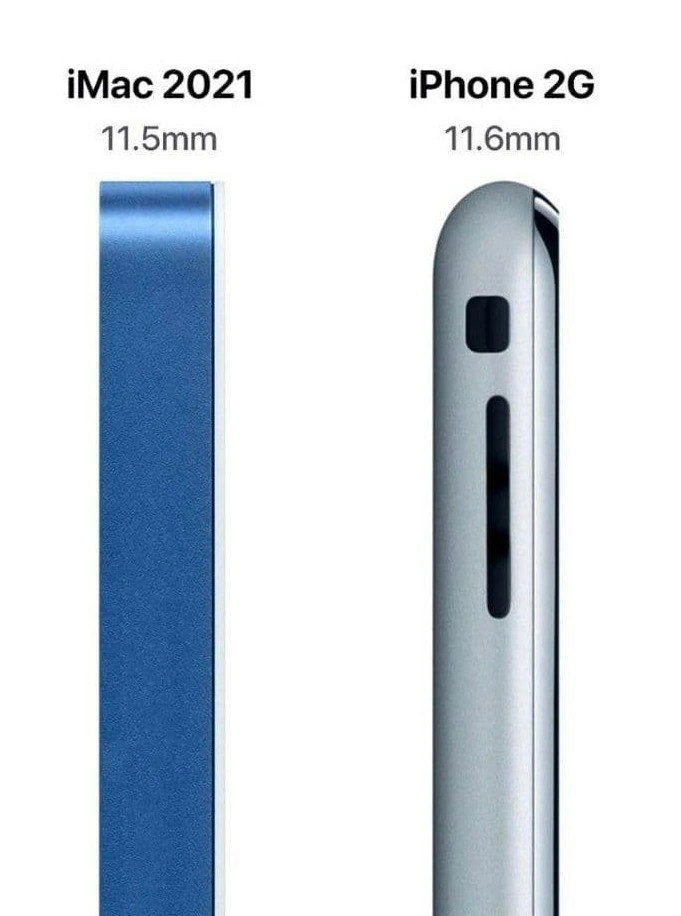
This meme shows a new Apple computer and an old Apple phone side by side, and points out something surprising: the iMac 2021 (a big desktop computer that looks like a monitor) is only 11.5 mm thick, while the iPhone 2G (the very first iPhone from 2007) is 11.6 mm thick. In other words, an entire modern iMac is actually a tiny bit slimmer than the first-generation iPhone! This is meant to be both funny and amazing. Usually, you’d expect a desktop computer to be large and a phone to be small and thin. But here, the big device (the iMac) has a thinner body than the small device (the old iPhone). It’s a clear sign of how much technology and design have improved in a bit over a decade.
Let’s break down what these devices are:
The iMac 2021 is an all-in-one desktop computer. That means the computer’s guts (processor, memory, storage, etc.) are built into the display. In 2021, Apple released a redesigned iMac with a 24-inch screen and their new Apple Silicon chip (the M1). This iMac is incredibly thin—about 11.5 millimeters front to back—giving it a very sleek, almost tablet-like side profile. Apple actually made it so slim by redesigning its internal parts and also by moving some things out of the main body (for example, the power supply is a separate brick on the floor, not inside the monitor).
The iPhone 2G (2007) is the original iPhone, often just called the first iPhone. It’s a smartphone with a 3.5-inch screen. Back in 2007, a phone that was 11.6 mm thick seemed quite slim and high-tech. This model had a rounded aluminum body with a black plastic section at the bottom (that was for the antennas). It used what was then modern hardware: a Samsung ARM-based processor, some memory, a camera, and a relatively large battery to power it. All that made it a bit chunky by today’s phone standards. We call the first iPhone legacy hardware now, meaning it’s old and outdated, even though it was cutting-edge in its time.
The meme’s joke or observation is essentially saying: “Look how far we’ve come! The modern Apple desktop is thinner than the legacy Apple phone.” This highlights hardware evolution in a very visual way. Over roughly 14 years, technology has advanced so that a much more powerful device can be made physically slimmer than a much less powerful older device. It’s like progress at a glance.
One key to this progress is the shift to Apple Silicon in the iMac. Apple Silicon refers to Apple’s own custom-designed chips, like the M1 chip used in the 2021 iMac (and also in recent MacBooks and even the iPad Pro). These chips are extremely efficient. They do a lot of computing while using very little power and they produce less heat than the older Intel chips Apple used to use in desktops. Less heat and power usage mean you don’t need big fans or a bulky case to keep the computer cool. In the iMac, the M1 chip is a SoC (System on a Chip), which means many components (CPU, graphics, memory) that used to be separate are all combined into one small chip. By contrast, older computers or phones often had multiple chips and parts spread out, which took up more space. For example, the 2007 iPhone had a separate CPU, separate chips for things like network radio, and so on, plus a sizable battery — all of which needed a certain thickness. The new iMac’s single M1 chip handles computing tasks very efficiently, and its storage is just a few chips (solid-state memory) rather than a big hard drive.
Another factor is Moore’s Law-style improvements. Moore’s Law is an observation that roughly every two years, engineers manage to double the number of transistors (tiny electronic switches) on a chip. More transistors can make a chip more powerful. Over 14 years, that exponential improvement means today’s chips are many times more powerful and also more energy-efficient than chips from 2007. In practical terms, the original iPhone’s processor was made with transistors that were much larger (tens of nanometers in size), whereas the M1’s transistors are incredibly small (just 5 nanometers). Smaller transistors and better chip designs mean you get much more power in the same area and much less heat wasted. So modern chips let devices be thinner and/or more powerful.
Apple’s industrial design (the physical design of their products) has also played a big role. Apple has always loved making devices slim and simple-looking. Think of how iPhones kept getting thinner and lighter from one generation to the next (until recently when they balanced battery life and stopped shrinking so much). In the case of the iMac, Apple removed or minimized anything they could to keep it thin. For instance, the new iMac doesn’t have an internal DVD/CD drive (those were removed from iMacs years ago to save space). It uses a compact solid-state drive for storage (no bulky spinning disk). The logic board (the main circuit board) inside the iMac 2021 is very small – almost like what you’d find in a laptop or tablet, not a big desktop board. Even the form factor of the power supply was dealt with by moving it outside the iMac’s casing (into that small external box on the power cord). All this means the iMac’s screen panel could be extremely thin. In fact, the designers even had to put the headphone jack on the side of the screen because the machine is just 11.5 mm thick – a typical 3.5 mm audio plug is a bit longer than that, so if they put the jack on the back, the plug would literally poke out! It’s a funny detail that shows how far they pushed the slimness.
For a junior developer or tech enthusiast, this meme is a neat illustration of modern vs. legacy hardware differences. It connects to experiences like discovering an old gadget in your drawer and marveling at how heavy or clunky it feels compared to new devices. You might recall using an older smartphone or iPod and being amazed at the time, and now when you hold it, it’s like a brick next to today’s slim phones. This iMac vs iPhone thickness comparison is the same kind of eye-opening contrast. It’s saying: even the design elements we take for granted now (like super-thin screens and tiny powerful chips) were unthinkable a decade or two ago. It’s a quick lesson in how technology advances: things generally get smaller, lighter, and more powerful. And in the Apple ecosystem especially, there’s a trend of unifying technology across devices. In fact, the 2021 iMac is powered by what is essentially a beefed-up iPad/iPhone chip, showing how what Apple learned from making millions of slim iPhones and iPads has now been applied to make a super-slim desktop. That’s some full-circle tech evolution!
Level 3: A Tale of Two Edges
At first glance, this side-by-side comparison is an almost unbelievable snapshot of Apple hardware evolution. On the left, we have the new iMac 2021 with an edge thickness of just 11.5 mm. On the right, the original iPhone 2G (launched in 2007) is 11.6 mm thick. Yes, an entire all-in-one desktop computer in 2021 is slimmer than Apple’s first smartphone from 14 years prior. Engineers and tech historians can’t help but smirk at this reversal of expectations. It’s a witty illustration of modern vs legacy hardware: the big device (a desktop Mac) has grown so thin that it undercuts the small device (an old iPhone) in the one dimension that defined portability – thickness.
From a senior developer’s perspective, the humor here stems from how form factor minimization has progressed in over a decade. Apple is famous (perhaps notorious) for its relentless drive to make devices thinner and more integrated. We remember how in the late 2000s, an 11.6 mm phone felt impressively sleek, and desktop computers were chunky machines with plenty of room for fans, hard drives, and expansion boards. Fast forward to the Apple Silicon era: that entire computer now hides behind a 24-inch display that’s as thin as a few stacked credit cards. It’s a testament to advances in chip design and component integration — a kind of Moore’s-Law-on-steroids scenario where not only do transistors get denser, but whole System-on-Chip (SoC) designs let us pack more functionality into less space. The original iPhone’s CPU was manufactured on a process around ~90 nm (nanometers), while the M1 chip in the iMac 2021 is built on a cutting-edge 5 nm process. In plain terms, the fundamental features on the silicon got about 18× smaller, allowing billions more transistors and far greater efficiency. No wonder the iMac can be this slim — its brains are unbelievably tiny and cool (thermally speaking) compared to the tech inside that 2007 iPhone.
There’s also a rich historical irony appreciated by seasoned Apple observers: Apple’s design ethos has come full circle. The first iPhone (iPhone 2G, sometimes just called the original iPhone) was a breakthrough handheld device, but by today’s standards it’s practically a chunky relic. Meanwhile, the iMac line has transformed from the bulbous CRT iMac G3 of 1998, to the flat-panel iMac G5 in 2004 (which still had a bulging behind), to now this 2021 iMac which looks like a giant iPad Pro on a stand. In 2007, the contemporary desktop Mac was a thick aluminum iMac (with an Intel CPU, a spinning HDD, and even a built-in DVD drive – all adding bulk). Back then, the phone was the stunningly slim gadget. Now in 2021, thanks to Apple’s innovations, the roles have flipped: the desktop is the razor-thin marvel, and that once-sleek iPhone is basically tech nostalgia. It’s a one-image story of rapid progress, provoking a chuckle about how yesterday’s breakthrough quickly becomes today’s legacy hardware.
This meme cleverly points out how Apple’s industrial design progress and engineering choices made this possible. The 2021 iMac’s svelte profile is enabled by the switch to Apple Silicon and an obsession with minimalism. The iMac’s internals are no longer a collection of large, separate components like in older desktops. Instead, it’s built around the Apple M1 SoC — essentially a single small board doing the job of what used to be a motherboard full of chips. Everything from the CPU to the GPU and memory is integrated into one compact package. The result? Way fewer parts to accommodate and much less heat to dissipate. In fact, the M1 iMac barely needs any cooling (just two small fans) because the M1 chip is so power-efficient. Apple even offloaded previously internal components to preserve thinness: the power supply (and even the Ethernet port) moved to an external brick. Long-time engineers grin at details like this, because it shows the almost comical lengths Apple will go for design. The iMac is so thin that a standard 3.5mm headphone jack can’t even fit straight through the back — Apple had to put the headphone port on the side! (When a desktop is essentially too slim for a headphone plug, you know you’ve reached an extreme of design minimalism.) It’s both absurd and impressive, and it perfectly captures the Apple design philosophy that “thin is in.”
Let’s break down why an iMac can now be this thin and how it contrasts with the old iPhone’s bulk:
- System-on-Chip Integration: The iMac’s M1 chip packs CPU, GPU, and RAM all together on one die. The 2007 iPhone also had a system-on-chip for its CPU, but it was far less powerful and still needed more support chips. The M1 eliminates many auxiliary components, dramatically shrinking the main board.
- Thermal Efficiency: Apple Silicon delivers high performance per watt. The M1 can do in a few watts what older chips did with tens of watts. Less power draw means less heat, which means no large heatsinks or big fans. The original iPhone’s ARM11 chip was slow enough that heat wasn’t an issue, but its battery and older components took up room. The iMac 2021, despite being way more powerful than any 2007 computer, runs cool enough to exist in a slim fan-cooled slab.
- Solid-State Storage: The 2021 iMac uses flash storage (soldered SSD chips). There’s no 2.5” hard disk or optical drive inside — those were standard in early iMacs and even the iPhone 2G had a relatively bulky flash storage board by today’s standards. Removing spinning disks and DVD drives removes huge thickness constraints.
- Externalizing Components: To keep the display unit ultra-thin, Apple put the power transformer and even the Ethernet jack in the external power adapter. Fewer bulky components inside the screen = slimmer profile. It’s an example of moving the “problem” out of the device to achieve that seamless look.
- Advances in Display Technology: The iMac’s 24-inch screen is an LCD with LED backlighting that can be incredibly flat. Compare that to older screens (the original iPhone’s 3.5-inch LCD, or older desktop displays) which required thicker lamps or cathode backlights. Modern screens plus the removal of a thick cover glass (Apple uses a laminated display) make the front of the iMac only a few millimeters thick.
All these factors combined to let Apple shave the iMac down to 11.5 mm thin without sacrificing capability. That’s why this image is so striking – it’s highlighting a very real engineering achievement with a dash of humor. It reminds experienced folks of how far we’ve come. We’ve gone from a world where a phone was revolutionary for being pocket-sized, to a world where that phone looks downright chunky next to today’s ultra-sleek desktop computer. It’s a bit absurd, a bit awe-inspiring, and definitely hardware humor that resonates with anyone who’s followed tech trends. In essence, the meme compresses 14 years of progress into one visual punchline, and the punchline lands because it’s true. Technology sometimes advances in leaps and bounds, and here we literally see one of those leaps measured in millimeters.
Description
A simple, side-by-side comparison image against a white background. On the left, a profile view of the thin, blue chassis of the 2021 iMac is shown, with the text 'iMac 2021' and '11.5mm' printed above it. On the right, a profile view of the original 2007 Apple iPhone 2G, showing its silver and black body, with the text 'iPhone 2G' and '11.6mm' above it. The image visually highlights the remarkable progress in hardware engineering and miniaturization over 14 years. The joke is a mind-bending realization for tech veterans: a complete desktop computer, including its display and processing units, is now slightly thinner than the first-generation smartphone that revolutionized the industry. It's a powerful statement on the relentless pace of innovation, particularly Apple's long-standing obsession with thinness

Comments
26Comment deleted
By 2030, the iMac will be a 2D object that only exists when you're looking at it, and the dongle to connect a USB-A device will require its own power supply
Apple’s latest feat: a desktop thinner than the 2G iPhone. Too bad the React bundle that renders its product page still outweighs both devices - turns out Moore’s Law doesn’t apply to node_modules
When your desktop is thinner than your phone from 2007, you know you've either solved Moore's Law or just moved all the actual computing to a $2000 external GPU dock that's thicker than both combined
When your 24-inch desktop is thinner than a 3.5-inch phone from 2007, you know Moore's Law has been working overtime - or Apple's thermal engineers have made a pact with physics itself. The real question is: how many dongles do you need to make the iMac as thick as the iPhone 2G?
Hardware got thin (11.5mm iMac vs 11.6mm iPhone), but our “thin client” shipped as a 12MB SPA inside a 1.6GB Docker image - turns out thickness migrated to node_modules
A desktop thinner than the original iPhone (11.5mm vs 11.6mm) while my desktop app ships a 900MB Electron runtime - progress clearly skipped node_modules
iMac 2021 hits iPhone 2G thinness: because in Apple's architecture, ports are legacy debt and dongles are the microservice mesh
Lmao. Comment deleted
I don’t have any Comment deleted
Isn't that cool Comment deleted
I have only one question. Why i need thin imac? I understand iphone or MacBook, because you can carry with you it, but why i need thin computer? Comment deleted
Well, its complicated. And doesn't matter. Just buy it please Comment deleted
Does it have a charger in a box? Comment deleted
Much. Better. You can buy it as a separate product. Comment deleted
You are right. It's pure marketing. Comment deleted
Then why you need pic 2 instead of pic 1? Comment deleted
thinnes wasnt the goal. thats just how it is. Comment deleted
Well, there is nothing surprising. New iMac is more like iPad, but with macOS Comment deleted
I've heard one of Apple's plans is to have macos on phones and desktops Comment deleted
those rumors will celebrate anniversary soon Comment deleted
Never had anything from apple and never going to buy something. So idc. Comment deleted
If 1 pic will be more productive or cost less with same productive, i buy 1 Comment deleted
Piece of shit Comment deleted
What's up with all this apple ads lately on this channel? Comment deleted
the developer conference was last week or so, people who like mac are geeking a bit Comment deleted
lmao Comment deleted