Skip to content
DevMeme
220 of 7435
Improving Runtime with Malicious Concurrency
Interviews Post #267, on Mar 25, 2019 in TG

Improving Runtime with Malicious Concurrency

Why is this Interviews meme funny?

Level 1: Cheating Time for a Laugh

Imagine you’re asked to run a race faster. Instead of actually running faster, you come up with a silly trick: you start the race with a friend running alongside you (so it looks like you have help), and then you set the clock backwards so it shows you finished before you even started! 🏃⏱️ Of course, in real life you can’t really do that – you can’t have negative time, just like you can’t finish a task before you start it. In this meme, the interviewer asks the programmer to make a function go faster. The programmer does a goofy fake “improvement”: they try using an extra thread (like an extra pair of hands) and then tell the program to “sleep” for a negative amount of time (basically pretending to go back in time). It’s a totally absurd way to “speed up” something, which is why it’s funny. The interviewer giving a thumbs-up and saying “Outstanding move” is a joking way to applaud this crazy cheat. It’s like a teacher laughing and saying “Brilliant!” when a student jokingly stops the classroom clock to make it look like they finished an exam in zero minutes. Everyone knows it’s not a real solution, but that’s the whole point – we laugh because it’s so over-the-top and impossible.

Level 2: The Negative Sleep Trick

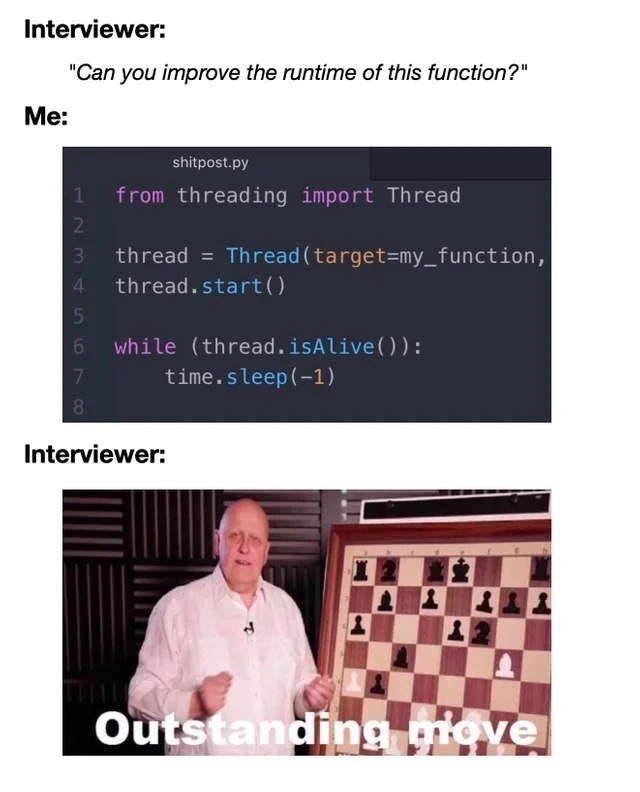
Let’s break down what’s happening in this code and why it’s funny, in simpler terms. The scenario is an interview and the question is: “Can you improve the runtime of this function?” – meaning can you make the function run faster. Normally, to improve a program’s speed, you might use a better algorithm or avoid unnecessary work. But in this meme, “Me” (the interviewee) tries a very unorthodox method involving threads and a weird sleep command. Here’s what the code does:

from threading import Thread

thread = Thread(target=my_function)
thread.start()

while thread.is_alive():
    time.sleep(-1)  # <- ??? Sleeping for a negative amount of time (nonsense!)
  • First line: from threading import Thread – This imports Python’s threading capability. A thread is like a mini-program running inside your program. Threads let you do tasks asynchronously, meaning you can start a task and keep doing other things without waiting for it to finish.

  • Next, thread = Thread(target=my_function) creates a new Thread object that will run the function my_function in parallel to the main program. Calling thread.start() actually launches that new thread. So now, my_function is running in the background. In a real scenario, you might do this if my_function is slow or waiting on something (like downloading data), so you can do other work at the same time. This is a form of AsynchronousProgramming or concurrency.

  • Then we have a while thread.is_alive(): loop. thread.is_alive() (formerly isAlive() in older versions) returns True as long as the thread is still working. The code is using a loop to wait for the thread to finish. This is basically polling: continuously checking if the thread is done.

  • Inside that loop is time.sleep(-1). time.sleep(x) is normally used to pause the program for x seconds. For example, time.sleep(5) would make the program wait 5 seconds. But here we see time.sleep(-1). Sleeping for a negative amount of time doesn’t make sense – you can’t pause for “minus one” seconds! In Python, this line will actually throw an error (because the time.sleep() function expects a non-negative number). It’s as if the code is trying to trick time and skip waiting altogether by using a negative delay. In a joking way, it implies “wait for -1 seconds”, which would mean “finish 1 second before now” – essentially attempting time travel in code!

So, why would someone write this crazy code? The humor is that the interviewee is doing a silly, trolling answer. Instead of genuinely making the function faster, they:

  1. Run it in a separate thread (perhaps thinking “If I put it on another thread, maybe the main program will think it’s faster”).
  2. Then immediately keep checking if it’s done, but with a negative sleep which is basically saying “don’t actually wait, or wait a negative time”.

It’s like they’re trying to cheat the system: create a new thread so the main program isn’t held up, and then pretend to wait “negative” time so it looks like it finishes instantly. Of course, in reality this doesn’t work – you can’t have negative wait time. If you tried to run this code, it would likely crash or just hammer the CPU with constant checks (if Python ignored the negative and treated it as zero).

For a junior developer or someone new to Python:

  • Threads can be confusing. They let a program do multiple things at once (kind of like multitasking). But Python has some limitations (like the GIL – a global lock) that mean threads won’t always speed up processing, especially if it’s CPU-heavy work. Often, beginners think “I’ll use a thread, that will make it faster!” but that’s not always true.
  • time.sleep() is meant to pause. You normally give it a positive number of seconds. A negative value isn’t valid. It’s a bit like saying “Hey, hold on for -5 seconds” – that instruction just doesn’t make sense in real life or in code.
  • In an interview setting, when asked to improve runtime, the expectation is you identify inefficiencies or use a better algorithm. What the meme’s code does is a parody – it doesn’t truly improve the code’s logic or efficiency. It’s more like a magician’s trick: hiding the work on another thread and using an impossible sleep to give the illusion of speed.

Finally, the bottom part of the meme shows the interviewer reacting with “Outstanding move”. This image of the man by the chessboard with a thumbs-up is a well-known humorous meme. It usually signifies a sarcastic approval of a very bold or goofy action. In context, the interviewer isn’t actually impressed in a real sense – it’s a jokey way to say “Well, that’s one way to do it… outstanding (ly crazy)!” Everyone in on the joke knows that this solution is bad, so the thumbs-up is ironic.

In summary, this meme takes a jab at the technical interview process and coding humor by showing a purposely absurd answer to a performance question. It’s funny to programmers because it combines a real scenario (optimizing code in an interview) with an obviously ridiculous hack (threads plus negative sleep) that no one would seriously use. It highlights how sometimes people look for shortcuts or tricks in code that feel smart but aren’t genuinely helpful – and it makes us laugh because we’ve all seen or written code that, in hindsight, was a bit of a “what was I thinking?” moment!

Level 3: Negative Sleep Gambit

In this meme, a developer pulls a wild stunt in an interview by spawning a thread and calling time.sleep(-1) to "optimize" a function’s runtime. Seasoned developers immediately recognize this as tongue-in-cheek InterviewHumor and a parody of misguided PerformanceOptimization. Why? Because everything about this code is hilariously wrong in a way only a programmer could love:

  • Misusing Threads for Speed: The candidate creates a new thread with Thread(target=my_function) and starts it. In a serious TechnicalInterviewProcess, an interviewer expecting algorithmic improvements (like lower Big-O complexity) would be baffled if you answered with AsynchronousProgramming magic. Adding threads can sometimes improve throughput (especially for I/O tasks), but it won’t magically make a single calculation finish faster. In Python, the Global Interpreter Lock (GIL) means only one thread runs Python bytecode at a time, so CPU-bound tasks won’t run in parallel. Launching a single background thread here is essentially offloading work without real gain – a bit like trying to win a race by taking a detour. Experienced devs see this and chuckle: “Sure, just throw concurrency at the problem!” – a classic novice move when asked to speed up code.

  • Polling with an Impossible Sleep: The code then enters a while (thread.isAlive()): loop, continuously checking if the thread is still running. Instead of a proper synchronization (like thread.join() which would wait for the thread to finish), it uses time.sleep(-1). A negative sleep call is utterly nonsensical – in Python this will raise a ValueError because you can’t sleep for a negative amount of time. It’s as if the developer is attempting to sleep backwards in time to achieve a negative wait. 🤯 Technically, if time.sleep() accepted negative values as "sleep zero", this loop would busy-wait like crazy, pegging the CPU while constantly polling thread.isAlive(). That’s the opposite of a real optimization – it’s runtime_improvement_trolling at its finest. This is an absurd twist on performance tuning: normally you might increase speed by avoiding sleeps or doing more work in parallel, but here we’re specifying a negative duration for sleep, an obvious logical fallacy. It’s a deliberate coding humor tactic: any real interviewer or senior engineer would facepalm at this outstandingly bad practice.

  • The “Outstanding Move” Punchline: The final panel – the interviewer giving a thumbs-up with the subtitle “Outstanding move” – is a famous reaction from the outstanding_move_meme template. It’s usually used ironically to applaud a bold but foolish strategy. By pairing it with this code, the meme mocks both the Interview setting and the interviewer. The interviewer’s exaggerated approval (“Outstanding!”) underscores the sarcasm: No sane interviewer would actually praise this hack! Yet, many developers have felt that pressure to impress interviewers, sometimes resorting to ridiculous tricks. This meme taps into that shared experience. It’s poking fun at the idea that any code, no matter how absurd, might get praise if it looks clever on the surface. The chess reference (since the meme image comes from a chess commentator reacting to a crazy move) adds another layer: in chess, a gambit is a risky opening strategy. Here the “Negative Sleep Gambit” is an outrageously risky (and invalid) move in coding. The humor comes from recognizing that this is a satirical, over-the-top answer to a straightforward question. It highlights the gap between real Performance best practices and the warped logic of a shitpost solution.

In summary, from a senior developer’s perspective, this meme brilliantly satirizes the technical interview process. It exaggerates a scenario where a candidate, instead of doing proper optimization, chooses a hacky concurrency trick that breaks all the rules. The seasoned dev laughs because they’ve seen naive attempts at optimization (like misuse of threads or bizarre code hacks), and they appreciate the irony. It’s a comedic reminder that not all “improvements” are created equal, and some can be downright absurd. The interviewer’s “Outstanding move” response, delivered with a straight face, is the perfect sarcastic cherry on top – we all know this code is a terrible idea, and that’s exactly why it’s so darn funny to anyone who’s been around the coding block.

Description

A three-part meme about a technical interview. The first part shows text from the 'Interviewer:' asking, 'Can you improve the runtime of this function?'. The second part, labeled 'Me:', displays a Python code snippet from a file named 'shitpost.py'. The code imports 'Thread' from the 'threading' module, starts a function 'my_function' in a new thread, and then enters a 'while' loop with 'time.sleep(-1)' that blocks indefinitely while the thread is alive. The final part shows the 'Interviewer:' again, this time using the 'Outstanding Move' meme format, where a man in front of a chessboard sarcastically praises the solution. The humor stems from the candidate's wildly incorrect solution. Instead of optimizing the function's algorithm to make it computationally faster, they run it in a separate thread. This makes the main program continue immediately, giving the *illusion* of improved runtime, but it doesn't actually speed up the function itself. The 'time.sleep(-1)' is particularly absurd, as it would cause an error in Python, highlighting a complete misunderstanding of both performance and concurrency

Comments

8
Anonymous ★ Top Pick This isn't improving runtime; it's just outsourcing the performance problem to another thread and hoping the main thread dies of old age before it finishes. It's the 'fire-and-forget-to-check-if-it-crashed' pattern
  1. Anonymous ★ Top Pick

    This isn't improving runtime; it's just outsourcing the performance problem to another thread and hoping the main thread dies of old age before it finishes. It's the 'fire-and-forget-to-check-if-it-crashed' pattern

  2. Anonymous

    Wrap the function in one thread, call time.sleep(-1), and suddenly the p99 latency is yesterday - SRE can’t page you for incidents that technically happened in the past

  3. Anonymous

    This is the same optimization strategy I've seen in production: if the function crashes before it finishes, technically it has zero runtime

  4. Anonymous

    time.sleep(-1) is the only optimization that targets the calling convention of causality - sadly Python raises ValueError instead of inventing tachyons

  5. Anonymous

    Ah yes, the classic 'optimization' strategy: spawn a thread to run your function asynchronously, then immediately block the main thread in an infinite loop polling its status with a negative sleep duration. It's like ordering food delivery to save time, then standing at the restaurant door watching them cook it. Bonus points for the `time.sleep(-1)` - because when the interviewer asks you to improve runtime, clearly they meant 'make it crash faster.' This is the kind of solution that makes you wonder if the candidate's previous role was 'chaos engineer' or if they're just really committed to the bit

  6. Anonymous

    In Python, spawning a Thread under the GIL and busy‑waiting on isAlive() with time.sleep(-1) makes runtime “negative” and correctness imaginary - truly enterprise-grade optimization

  7. Anonymous

    Spawned the function in a thread and went to sleep - classic latency theater; with Python’s GIL, the only thing that scaled was the interviewer’s optimism

  8. Anonymous

    Python threading 'optimization': shave seconds off CPU time by burning them on context switches and GIL contention - Amdahl's law laughs last

Use J and K for navigation