Skip to content
DevMeme
893 of 7435
The Grand Unifying Theory of Software Development
Bugs Post #1010, on Jan 31, 2020 in TG

The Grand Unifying Theory of Software Development

Why is this Bugs meme funny?

Level 1: When Nothing Works (and You’re Confused)

Imagine you’re trying to bake a cake. You’ve read every cake recipe book (so you know all the theory of baking: what ingredients to use, the chemistry of how cakes rise, etc.). You feel super prepared. But when you actually mix the ingredients and put the cake in the oven, it comes out flat and burned – nothing works, even though you “knew everything” about how it should work. That’s the first part of the joke.

Now picture a different scenario: you haven’t read any recipes at all. You just toss things into a bowl – a bit of this, a bit of that – and somehow you bake a perfect, delicious cake. It tastes great, everyone loves it, but you couldn’t repeat it if you tried because you’re not sure what you did right. In other words, the cake turned out fine but nobody knows why it worked. That’s the second part of the joke.

Finally, the meme says programming is like doing both at the same time: you studied and tried to do everything correctly, and you experimented by throwing things together – yet the kitchen is a disaster. The cake didn’t rise, it’s burnt, it’s a mess, and all the chefs are standing around confused, saying “I have no idea what went wrong here.” In simple terms, nothing is working and nobody knows why! 😂 (It’s funny because it’s such a disaster, and people who code often feel this way.)

So the meme is comparing programming to that frustrating baking story. It’s a humorous way to say that making software can be really hard and confusing: even if you do everything by the book, things can fail, and even if things work, sometimes it feels like luck. It makes people laugh because anyone who’s tried to create something (like a program or a cake) has experienced those “uh-oh” moments when it just doesn’t work and you’re left completely puzzled.

Level 2: Debugging Paradox for New Devs

Let’s put this in simpler terms. The tweet is joking about the difference between theory (what you learn in school or from books about how to code) and practice (what actually happens when you write programs in the real world). It then says programming mixes the two and ends up with the bad parts of both. Here’s what each part means:

  • Theory (knowing everything, but nothing works): This refers to when someone has a lot of knowledge about programming concepts – maybe you’ve studied all the algorithms, know your data structures, and can recite computer science formulas. In theory, you “know it all.” But when you try to build something for real, it doesn’t work. Nothing runs correctly. It’s like acing all the quizzes on Java or Python, but when you sit down to write a real app, it crashes or doesn’t do what it’s supposed to. You might have all the CS fundamentals memorized, yet your program has a bug (an error) that stops it from working. This part of the joke pokes fun at people (or times in your life) where you have the knowledge but not the hands-on experience to make things actually function. For example, imagine a new graduate who’s learned a lot of theory about web development, but the first time they deploy a website, nothing shows up because they forgot a small practical detail like configuring the server. They knew a lot (in theory), but still, nothing works at the end of the day.

  • Practice (everything works, but nobody knows why): This is the flip side. It’s when things do work in practice, but you don’t really understand what you did. Imagine you’re tinkering with some code, and suddenly your program starts working correctly, but you’re not entirely sure which change fixed it or why it fixed it. This often happens when you’re new and you might copy-paste some solution from the internet (like from a Stack Overflow answer) and boom, the bug is gone. The program works now (hurray!), but if someone asked you to explain the fix, you’d struggle. You might say, “I have no clue why that solved the problem, but it did.” In a team setting, sometimes everyone is scratching their heads as to why a certain thing fixed the issue. Maybe restarting your computer made the bug disappear and nobody can exactly explain the root cause. This is the scenario where “everything works but nobody knows why.” It means there’s success, but no understanding. It’s a bit dangerous because if the problem happens again, you might not know how to solve it reliably.

  • Programming (nothing works and nobody knows why): Now the meme combines those two ideas for comedic effect. In programming, especially on a tough day, you get the worst situation: your code isn’t working (so it’s failing like in the theory case) and you have no idea why it’s failing (like in the practice case). Essentially, you feel clueless and the software is broken. This is poking fun at the Debugging process every developer goes through. When something goes wrong in code (we call that a bug), you might spend hours troubleshooting. Sometimes you try everything – you use all your theoretical knowledge, and you try lots of practical experiments – and still, the issue persists and it makes no sense. It’s like the program is stubbornly saying “Nope, I’m not going to work” and every fix you attempt just doesn’t solve it. Debugging is the art of finding why something broke and how to fix it. The tweet jokes that in programming, debugging can feel impossible: you combine theory and practice and end up totally stuck, with nobody able to figure out why the program is acting up.

For a new developer (or junior dev), this meme is both funny and a bit comforting. It’s saying: even if you feel lost and your code isn’t working, don’t worry, this happens to everyone in software at times. It’s a rite of passage in the DeveloperExperience. You might write a correct-looking program that should run (by all logical reasoning) but then it throws an error or produces gibberish output. On the other hand, you might accidentally fix a bug without fully understanding what you did. The programming paradox (a paradox is like a contradiction or a situation that defies common sense) is that you can be very prepared and still fail, or be not prepared and somehow succeed, and often when building software you get failures that no one on your team immediately understands.

Let’s ground it in a simple example. Suppose you’re learning how to build a website:

  • Theory case: You read the entire documentation for a web framework like React or Angular. You know all the jargon and how it’s supposed to work. Then you start coding, but when you run the site, it just shows a blank page or an error message. Despite all your knowledge, the site isn’t working and you’re frustrated.
  • Practice case: Alternatively, you throw together some code by following a quick tutorial. The site comes online and seems to work fine, but truth be told, you’re not entirely sure how it ended up working. Maybe you used some boilerplate code that set things up, and it magically solved the problems. If someone asked you to replicate it or explain it, you’d be in trouble.
  • Programming combined: Now imagine you did read everything and tried building the project carefully, but it’s still not working. You check your code and settings, and nothing obvious is wrong. Your teammates also look at it and they’re puzzled. It’s the dreaded situation where nothing works and nobody can explain why. It might turn out the cause is something non-obvious – like your computer’s environment is missing a library, or a tiny typo in the configuration that’s hard to see, or maybe a known bug in the tools you’re using. Once you find it, it seems obvious, but until then it feels like magic or bad luck.

This tweet is a form of relatable humor among developers because it exaggerates that worst-case scenario in a witty way. It also hints at a lesson: knowing theory alone isn’t enough if you can’t get things to run, and getting things running isn’t enough if you don’t know what you did. Ideally, a good developer needs both understanding and hands-on skill. But don’t worry – even experienced devs with both skills still encounter those maddening bugs where an entire team says, “Ugh, nothing’s working and we have no clue why!” It’s all part of the journey of coding. The meme just acknowledges that feeling so we can all share a laugh about it. After all, sometimes you’ve got to laugh so you don’t cry when stuck in debugging mode!

Level 3: The Worst of Both Worlds

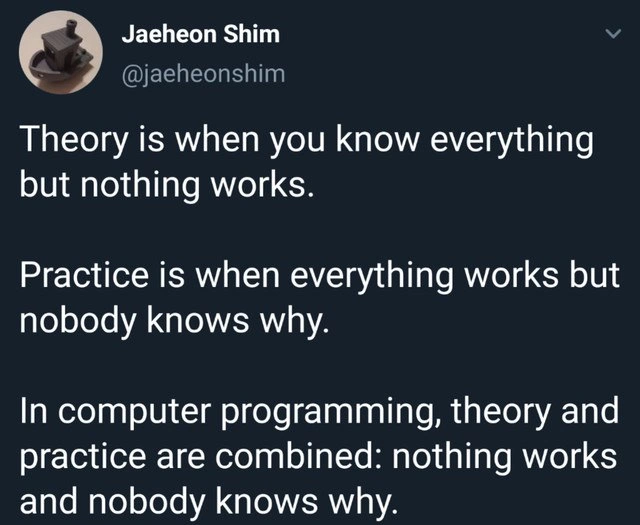
This meme delivers a punchline that senior developers know all too well. It sets up a contrast: first between theory and practice individually, then lands the real joke: software development manages to achieve the worst of both worlds. The humor here is a nod to the daily reality of programming, where software bugs and strange errors pop up even when you think you’ve done everything right. It’s classic DeveloperHumor born from shared pain. Let’s break down the tweet’s three statements (as shown in the screenshot of Jaeheon Shim’s tweet):

Theory is when you know everything but nothing works.
Practice is when everything works but nobody knows why.

These first lines riff on an old saying. They contrast an academic, theoretical approach with a pragmatic, hands-on approach. In a pure theoretical scenario, you’ve read all the books and you think you know how every piece should fit (CS_Fundamentals galore) — yet when you run the system, it doesn’t work. Seasoned engineers chuckle here, recalling times they meticulously followed the textbook approach and still got a face-full of DebuggingFrustration. For instance, you might use a well-known algorithm (say, an optimal sorting method you learned in college) but your actual code throws mysterious errors. On paper you did everything right, but the app is crashing — the theory didn’t translate to a working result. It’s a dig at those who have only academic knowledge without practical seasoning: knowing the concepts but not the gritty details needed to make it run.

The second line flips the scenario: you have practice without theory. Think of a situation where a developer hacks together a solution that miraculously works, but they used some Stack Overflow snippet or cargo-cult programming trick without really understanding it. Everything functions (the program produces the correct result, the bug goes away, the site stays up), but nobody knows why it works. It might be pure luck or a side-effect. For example, suppose an on-call developer at 3 AM tries five random fixes until the system starts working again. The website is back online (whew!), but even the dev is sitting there going, “What on Earth fixed it? Was it the cache flush, the reboot, or that one-line change in the config?” The code is in production, users are happy, but there’s this uneasy feeling because the team can’t pinpoint the root cause. That’s practice over theory: success without understanding. This is common in real-life Debugging firefights – you’re just glad the bug is gone, and you pray it doesn’t return because you’re not entirely sure which change fixed it.

Now, the meme’s final payoff:

In computer programming, theory and practice are combined: nothing works and nobody knows why.

And there it is: the programming paradox. This line lampoons the grim reality that in software development, we often end up with systems where nothing works and nobody knows why. It’s funny because it feels so true on a bad day. You deploy your application update and suddenly everything crashes. The team is scrambling, poring over log files that might as well be hieroglyphs. You have architects with big theoretical knowledge and senior devs with practical experience all in one room. Yet collectively you’re all stumped — the microservice isn’t talking to the database and none of your theories pan out in practice. This is the stuff of Debugging Hell, where you experience the ultimate DeveloperFrustration: an outage or a bug that defies all logic.

Why is this scenario so relatable? Because every experienced dev team has lived it:

  • You meticulously followed best practices (theory) in building a new feature, but when deployed, it fails spectacularly. The bug might be in an unrelated module or some weird environment issue. Everyone is baffled because “this should work, in theory…”.
  • Or the opposite: something that was never designed properly is somehow holding the system together (perhaps a legacy piece of code running on luck and duct tape). When it finally breaks, no one understands that code well enough to quickly fix it. “It worked all these years by accident, and now we have no idea what it’s doing,” the team admits.
  • Combine these, and you get the dreaded scenario: you apply all your knowledge and all your tinkering skills, and the system is still broken. You feel like nobody knows why it’s broken or how to fix it, not the junior devs, not the senior architects, not even the internet at large. It’s the ultimate programming nightmare: a critical issue with no clear cause or solution in sight.

The tweet’s humor lands because it hyperbolically describes programming as a field that merges theoretical knowledge and practical application, yet somehow manages to nullify the advantages of both. It’s poking fun at our developer experience (DX) where bridging the gap between theory and practice is our daily grind. We study computer science so we’ll “know everything” about algorithms, design patterns, and systems (the hope is to avoid mistakes), and we practice by coding and building real projects to gain intuition on what actually works. In theory, combining theory + practice should yield robust, well-understood systems. In theory. But programming is hard – complexities and unknowns lurk everywhere. The meme wryly suggests that instead we often get a perfect mix of failure and confusion. It’s a bit dark, yes, but that’s why developers smirk at it. It acknowledges the truth: even the best of us end up in situations where the app is on fire and no one has a clue which theoretical principle or practical fix will douse the flames. It’s relatable humor because it’s a shared industry joke; anyone who’s been stuck in an all-hands-on-deck bug hunt at 2 AM recognizes the painful irony. Remember the mantra “Works on my machine!” – it captures a slice of this problem. Your code ran fine on your laptop (practice seemed good), but in theory it should run anywhere… and then the server throws a tantrum. Nothing works outside your cozy environment, and you don’t know why because perhaps you didn’t fully understand an assumption. The meme is essentially a tongue-in-cheek way of saying programming is humbling: it will remind you that no matter how much you think you know (theory) or how many quick fixes you have up your sleeve (practice), the computer can still baffle you.

This theme fits squarely under CodingHumor and BugsInSoftware. It satirizes the disconnect that often exists between what we learned (like big-O notation, elegant design principles) and what we have to do to get things working (like print debugging, rebooting servers, changing one config value at a time until stuff works). The tweet format, shown in a dark-mode UI screenshot, is a common way developers share these jokes – short, punchy, and perfect for a quick laugh amid a long debugging session. “Nothing works and nobody knows why” could practically be the subtitle of many real-world projects. In a way, the meme also serves as a stress reliever: it tells you that you’re not alone. Even though it feels like you’re the only one whose code is imploding inexplicably, every programmer from newbie to guru has been there. We’ve all combined theory and practice and still ended up bewildered by a stubborn bug. So we laugh, then sigh, and get back to troubleshooting.

Level 4: Heisenbug Uncertainty Principle

In advanced computing theory, we confront the uncomfortable truth that it's impossible to fully predict a complex program’s behavior. This meme jokingly alludes to that reality. In an ideal theoretical world, every algorithm can be proven correct and every execution path known. In practice, however, actual software systems behave like chaotic ecosystems. There’s a whiff of the Halting Problem here: Alan Turing proved we can’t have an algorithm that determines for every possible program and input whether it halts (finishes) or runs forever. This fundamental limit hints that you can’t know everything about how a non-trivial program will behave in all cases. So even if in theory you possess complete knowledge of a system (which you never truly do), unexpected conditions can still make nothing work.

Real-world programs have practically infinite states and interactions. Consider multi-threaded applications: in theory, we use models like locks, semaphores, and the happens-before principle to ensure correctness. Yet unpredictable thread scheduling can produce a race condition that only occurs once in a blue moon. The code might deadlock or crash, and even the most seasoned engineers are left scratching their heads. This is often called a Heisenbug – a bug that changes behavior when you try to study it, akin to the observer effect in physics. For example, adding a print statement (to see what’s going wrong) might subtly change timing and make the bug disappear, so nothing works and nobody knows why it failed in the first place. The meme’s punchline captures this Heisenbug uncertainty principle: when you combine exhaustive theoretical knowledge with hands-on practice, you still face the unknowable. The emergent complexity of modern software (from CPU caching quirks to distributed system latencies) means even rigorous theory meets its match in practice. In short, computer science theory provides CS fundamentals and models, but reality injects nondeterminism and Murphy’s Law. The result? A perfect storm where the code is broken and the cause is an enigma.

This dark humor resonates in academia and industry alike. It echoes the famous quip by Donald Knuth: “Beware of bugs in the above code; I have only proved it correct, not tried it.” Knuth highlights that even if something is theoretically verified, the real world might laugh in your face. The tweet’s scenario of nothing working despite knowing everything sounds a lot like a failed attempt at formal verification meeting the messy complexity of hardware, operating systems, and networks. When theory and practice collide in programming, you often hit fundamental limits (like undecidability or intractable state spaces) that ensure nobody truly knows why a program misbehaves. It’s a heady mix of academic paradox and programming pragmatism gone awry, which forms the brainy backdrop of this joke.

Description

A screenshot of a tweet from user Jaeheon Shim (@jaeheonshim). The profile picture is a small, dark, 3D-printed-looking boat. The tweet, in white text on a dark blue background, presents a three-part aphorism: 'Theory is when you know everything but nothing works. Practice is when everything works but nobody knows why. In computer programming, theory and practice are combined: nothing works and nobody knows why.' This meme captures the cynical but relatable experience of software development, where the gap between theoretical knowledge and practical application can feel vast and chaotic. It humorously suggests that programming is a field where complex systems often fail for reasons that are difficult to diagnose, defying both theoretical understanding and practical intuition. This resonates deeply with senior engineers who have spent years debugging inexplicable issues in large-scale systems

Comments

7
Anonymous ★ Top Pick The difference between a junior and a senior developer is that the junior is surprised when nothing works and they don't know why. The senior just calls it 'Tuesday'
  1. Anonymous ★ Top Pick

    The difference between a junior and a senior developer is that the junior is surprised when nothing works and they don't know why. The senior just calls it 'Tuesday'

  2. Anonymous

    Our codebase finally reconciles theory and practice: the type system proves the bug can’t exist, and the metrics prove it’s happening in every region

  3. Anonymous

    After 20 years, I've mastered the art of confidently explaining why something should work while simultaneously having three different theories about why it doesn't, none of which survive contact with the debugger

  4. Anonymous

    This perfectly encapsulates the senior engineer's journey: you start thinking CS theory will solve everything, then you discover production systems held together by Stack Overflow answers and a prayer, and finally you achieve enlightenment when you realize your distributed system's 'eventual consistency' is really just 'eventually someone will file a ticket.' The real mastery is confidently saying 'it works in production' while having absolutely no idea why that one mutex you added three years ago prevents the race condition that only happens during leap years

  5. Anonymous

    Programming is where proofs meet pagers: the spec says it can’t happen, the traces say it did, and the RCA is “clock skew and DNS” - aka nothing works and nobody knows why

  6. Anonymous

    Theory proves your microservice is ACID-compliant; practice laughs as it eventually-consistent-ly loses transactions nobody can trace

  7. Anonymous

    If theory says “race condition” and practice says “works on my machine,” production resolves it with kubectl rollout restart and a blameless postmortem

Use J and K for navigation