Skip to content
DevMeme
6135 of 7435
The Billion-Dollar Regret of Not Forking VSCode
OpenSource Post #6729, on May 6, 2025 in TG

The Billion-Dollar Regret of Not Forking VSCode

Why is this OpenSource meme funny?

Level 1: The Missed Jackpot Clown

Imagine you have a free magical recipe for the best cake in the world. Anyone can use this recipe – it’s not secret at all. You think, “That’s cool,” but you don’t bother to open a bakery with it. Then your friend takes that same recipe, opens a super popular bakery, and becomes a millionaire selling those cakes. How would you feel? You’d probably smack your forehead and think, “Why didn’t I do that?!” You might even feel so silly that you joke about wearing a clown costume, because you think you’ve been as goofy as a clown for missing out.

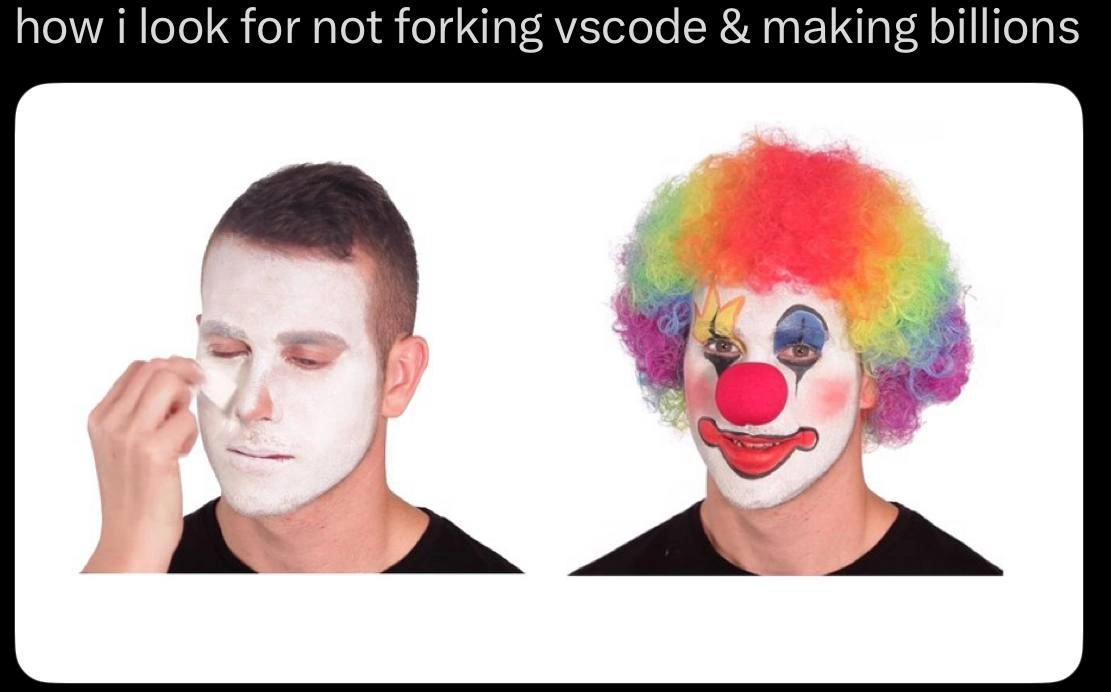
That’s exactly what’s happening in this meme, but with software instead of cake. Visual Studio Code is like that free recipe – it’s a free program that anyone could use to start a business. The person in the meme is saying they didn’t take that chance. Now they’re pretending to be a clown, with white face paint and a rainbow wig, to playfully show how foolish they feel. It’s funny because we’ve all felt that regret when we miss a big chance. The clown costume is a silly way to admit, “Whoops, I made a dumb mistake by not trying that when I could have!” In simple terms, the meme is laughing about feeling like a clown for not using something free to become super rich. It’s a joke about missing the jackpot and knowing it, told in a way anyone who’s missed an obvious opportunity can understand.

Level 2: From Open Source to Opportunity

Let’s break down the joke in simpler terms. First, Visual Studio Code (VS Code) is a hugely popular code editor (like a programmer’s primary tool for writing and editing code). It’s often called a lightweight IDE (Integrated Development Environment) because it has so many features and extensions. Importantly, VS Code is open-source software. This means its code is publicly available for anyone to see, use, and even modify. In fact, VS Code uses a very permissive open-source license (the MIT license), which basically says: “Here’s the code, you can do almost anything you want with it, even use it in your own projects or sell it, just give credit.”

Now, forking in this context means copying the code into a new project – essentially making your own version of VS Code. On platforms like GitHub, there’s literally a “Fork” button that creates your personal copy of the code repository. By forking VS Code, a developer could add new features, change the name, and release it as a separate product. The meme jokes about someone not doing this – not creating their own spin-off of VS Code – and later realizing they missed out on a huge business opportunity. The phrase “making billions” refers to earning a ton of money, in the range of billions of dollars. That’s an exaggeration for comic effect (most software products, even successful ones, don’t reach billion-dollar valuations easily), but it points to real big successes in tech. For instance, think of how GitHub (a site for sharing code) was bought by Microsoft for $7.5 billion, or how startups like GitLab went public – there’s serious money in developer tools and platforms. So, the idea is that maybe a custom version of VS Code could have been “the next big thing” financially.

The images in the meme drive the joke home. We see two side-by-side pictures of the same person. On the left, he looks normal, maybe a bit thoughtful, and someone’s applying white makeup to his face. On the right, he’s in full clown mode – white face paint, a bright red clown nose, and a rainbow-colored afro clown wig – smiling directly at the camera. This is a popular meme format where a person gradually turns into a clown as they realize they’ve done something foolish. Here, the developer is essentially calling himself a clown for not forking VS Code and missing the chance to potentially become super rich. It’s a form of self-mockery: he’s putting on the clown makeup voluntarily, saying “Yep, that was a dumb move on my part.”

Why would forking VS Code be seen as such a golden opportunity? It comes down to how tech businesses work with open source. Open-source monetization is when someone takes free community-made software and builds services or products around it to make money. Many companies do this by offering things like premium features, customer support, or cloud-hosted versions of the software. In the case of VS Code, one could imagine making a special version for big companies, or an online IDE service using VS Code’s engine, and charging for it. If that took off in the market, it could indeed lead to a very valuable company. The meme’s author imagines that possibility (“billion-dollar payday!”) and is poking fun at themselves for not pursuing it.

For a junior developer or someone new to these concepts, think of it this way: you know how VS Code is free and you can install it without paying anything? That’s because of its open-source license. Now, “forking VS Code” means making your own VS Code. You’d copy the code that makes VS Code work, rename it (because “Visual Studio” is Microsoft’s trademark, you can’t use their exact name), maybe call it “SuperCode Editor Pro”, add some cool new features or integrate it with a service (say an AI that helps code, or a cloud storage for code), and then sell that as your product. If it became as popular as VS Code, you could earn a lot of money from subscriptions, licenses, or an acquisition by a big company. This has happened with other open-source projects: someone packages it nicely or adds value on top, and people pay for the convenience or support.

The relatable experience here is the “could have, would have, should have” feeling. Developers often see tech trends or big successes and think, “I had that idea!” or “I could have done that!” For example, maybe you thought of a great app but never built it, and later someone else did and became successful. It’s a mix of envy and kicking yourself for not acting. In this meme, VS Code is that big success story and the person is humorously regretting not jumping on it. They feel so silly about it that they depict themselves as a clown – an extreme way to say “Wow, that was dumb of me, huh?”

Also, it’s touching on how in the tech industry, things can seem obvious in hindsight. VS Code is everywhere now, but five or six years ago, nobody knew it would dominate as the go-to editor. Many developers were using Atom, Sublime Text, or IntelliJ. If you were there at the time, you might not have predicted VS Code’s rise. Now that it’s huge, it’s easy to joke, “Haha, if only I’d taken that code and made my own editor, I’d be rich.” It’s a lighthearted way to cope with the fact that we can’t predict these things easily. So the meme mixes a bit of developer humor with a lesson: in tech, even a free tool can spawn big money ventures, and missing one can make you feel pretty foolish (at least in jest).

Level 3: Fork, Fortune, Foolery

At the highest level, this meme lampoons the missed opportunity to monetize an open-source goldmine. The top caption "how i look for not forking vscode & making billions" sets a self-deprecating tone. We see a developer's transformation into a clown – white face paint, a big red nose, and that signature rainbow afro wig – visually implying “I was a fool.” The context is the wildly popular code editor VS Code (Visual Studio Code). Since VS Code’s source is open under a permissive license (MIT), any enterprising dev could have forked it (i.e., copied the code to start a new project) and built their own product. The punchline: not doing so might feel like missing a billion-dollar payday.

From a seasoned developer’s perspective, the humor strikes close to industry reality. VS Code is more than just a free editor – it’s essentially a platform with an extension ecosystem and millions of users. The meme riffs on the idea that simply taking this open-source foundation and creating a proprietary spin could yield a startup unicorn (a company worth over $1B). It’s a tongue-in-cheek nod to how IDE ecosystems and open-source monetization work in real life. After all, companies have made fortunes repackaging community-driven projects. For example, Red Hat famously built a billion-dollar business by packaging Linux (an open-source OS) with support services. In a similar spirit, one could imagine forking VS Code, adding exclusive features or cloud services, and charging money – a model often called “open-core” or “commercial open-source”. The clown imagery represents the developer realizing too late that this was a viable path, branding themselves foolish for not seizing it.

This is also industry satire about hype and hindsight. In venture capital circles, developer tools can attract huge valuations, and every engineer has heard stories of someone striking it rich with a simple idea. By comparing themselves to a clown, the meme’s author mockingly acknowledges the absurd confidence (or naiveté) it takes to assume “I too could have minted billions if only I’d thought to fork VS Code.” There’s an implicit eye-roll from veteran devs here: if only it were that easy! We know building a billion-dollar company is more than copying code – it requires timing, execution, market fit, and a dash of luck. Yet, the feeling of regret is real and relatable. Seeing tools like VS Code become ubiquitous, any dev can’t help but wonder, “What if I had jumped on that bandwagon early?”

Technically, forking VS Code was and is entirely possible. The MIT license allows anyone to use the codebase, rebrand it, even sell it, as long as they preserve the license notice. In fact, some did fork or repackage VS Code: there’s VSCodium (a fully open-source build sans Microsoft’s branding/telemetry) and companies integrating VS Code’s editor component into cloud platforms (e.g. GitHub Codespaces, code-server by Coder). None of these became independent “billion-dollar” products in and of themselves (often because they are open and free, or tied back to Microsoft’s ecosystem), but the potential was there. The meme exaggerates this potential for comedic effect. It’s the classic developer FOMO – fear of missing out on the next big payday by not acting on a tech trend. The rainbow clown wig signifies the author’s playful shame in thinking, “I really played myself by not jumping on that opportunity.”

Underneath the humor is a grain of truth about open-source and industry trends: many successful companies stand on the shoulders of community projects. Consider how cloud providers profit from open-source databases or how Chrome was built on the open-source Chromium project. The tech industry has a history of turning free tools into massive commercial successes:

  • Red Hat’s Linux – Took free Linux, sold support & services, became a multibillion-dollar company.
  • AWS & Open-Source – Amazon has offered managed services for open projects (like Apache Kafka, MySQL, or ElasticSearch forks) generating huge revenue from others’ open code.
  • Google Chrome – Built on the open-source Chromium browser, but with Google’s services, it dominates the market (indirectly fueling Google’s profits).
  • Android OS – Based on open-source Linux and Java, yet it became the core of a giant mobile ecosystem and revenue via app stores and ads.

In light of these, the idea of a “billion-dollar VS Code fork” isn’t purely fantasy – it’s a cheeky reflection on real IndustryTrends. But it’s also ironic: VS Code’s success as an open tool might be exactly why a fork didn’t mint an overnight billionaire. Microsoft gave it away for free, undercutting would-be competitors, and focused on community adoption over direct revenue. This meme’s senior-level chuckle comes from recognizing both the temptation (“We’d all love to cash in on the next big IDE”) and the folly (“It’s not as simple as hitting the fork button on GitHub”). In other words, hindsight makes everyone feel like a genius or a clown. Here, our developer chooses “clown,” acknowledging with a wink that missing an easy win in tech can make you feel pretty foolish.

Description

This meme uses the popular two-panel 'Putting on Clown Makeup' format to express a feeling of foolishness and missed opportunity in the software development world. In the first panel, a man is applying white face paint, the initial step in becoming a clown. In the second panel, he is shown in full clown attire, including a colorful wig and a red nose. The caption above reads, 'how i look for not forking vscode & making billions'. The joke is a self-deprecating take on the immense success of Visual Studio Code, an open-source code editor developed by Microsoft. The creator of the meme is humorously portraying themselves as a clown for not having the foresight to 'fork' (create a personal copy of) the open-source project and turn it into a multi-billion dollar enterprise, a common daydream among developers who witness open-source projects achieve massive commercial success
Comments

16
Anonymous ★ Top Pick Everyone thinks they could fork VS Code and make billions, until they see the pull request backlog and realize they'd need a multi-billion dollar company just to manage the incoming issues
  1. Anonymous ★ Top Pick

    Everyone thinks they could fork VS Code and make billions, until they see the pull request backlog and realize they'd need a multi-billion dollar company just to manage the incoming issues

  2. Anonymous

    Skipped the MIT-licensed VS Code fork because “no one pays for an editor,” now a startup just re-skinned it, toggled off telemetry, added SAML, and closed a $200 M Series C - meanwhile I’m the clown paying for seats

  3. Anonymous

    The real clowns are those of us who spent years contributing to VSCode extensions for free while someone else just slapped GPT-4 on a fork and got a $400M valuation. Next time Microsoft releases something under MIT, I'm forking it before the ink dries on the license

  4. Anonymous

    Ah yes, the classic founder's dilemma: spend years forking VSCode, battling Electron's memory leaks, implementing your own extension marketplace, and somehow convincing developers to abandon their perfectly configured setups with 47 extensions... or just accept that Microsoft already won the editor wars and focus on building something that doesn't already have 15 million daily active users. But sure, your fork with a slightly different color scheme and 'AI-powered' autocomplete will definitely be the one that disrupts the market. The rainbow wig really captures that Series A pitch energy

  5. Anonymous

    Senior lesson: the billion‑dollar architecture wasn’t microservices - it was git fork microsoft/vscode, change the logo, bind Ctrl+Enter to an LLM, and ship a pricing page

  6. Anonymous

    Forking VSCode? That's how you trade billions for eternal upstream merge hell

  7. Anonymous

    Amazing how the billion‑dollar moat ended up being: change productName in package.json, point autocomplete at an LLM endpoint, and add a billing page

  8. @apBUS_amp_K 1y

    i don't understand, can some1 clarify pls?

    1. Bogdan 1y

      Cursor raised 900 million at 9 billion evaluation.

    2. @SanyaDez 1y

      Cursor, windsurf, trae

      1. @apBUS_amp_K 1y

        vscode 2: vibe coding boogaloo

    3. @ZgGPuo8dZef58K6hxxGVj3Z2 1y

      Because MS is sabotaging vscode forks. Tbf only the ones that bundle packages that have their own repos like the c++ linters and what not

      1. @TheFloofyFloof 1y

        Back when it was just VSCodium I was upset but now with cursor and the other forks it's deserved

  9. @Art3m_1502 1y

    VS Code Hannah Montana Edition

  10. @apBUS_amp_K 1y

    Although I'm pretty sure MS is not happy with this, is it?

  11. @ShiningFlames 1y

    Use AI to vibe-code a vscode fork for vibe-coding

Use J and K for navigation