Skip to content
DevMeme
6134 of 7435
Semantic Versioning Ideal vs. Fragile Codebase Reality
VersionControl Post #6728, on May 5, 2025 in TG

Semantic Versioning Ideal vs. Fragile Codebase Reality

Why is this VersionControl meme funny?

Level 1: Always Breaking Toys

Imagine you and a friend are each building a tower out of blocks. You are very careful with your tower. You only call it a “new tower” when you make a big change – like using a completely different kind of block or a totally new design that the old tower can’t support. Otherwise, you just keep adding pieces gently, and your tower stays standing.

Now your friend is also building a tower, but here’s the problem: every time they add a new block, their tower tumbles and crashes. 😬 Instead of fixing it slowly or figuring out what went wrong, they immediately start over and call it “Tower version 2,” then “Tower version 3” on the next crash, and so on. Every single block they add changes something so much that the whole tower breaks and they begin a brand new tower each time.

When you say, “I only start a new tower when I really change the plan,” and your friend says, “I start a new tower every time because I always knock it down,” you two are doing things very differently. Your friend might even sound like they’re bragging, saying “We are not the same” – meaning you’re careful and I’m... well, I’m always causing a mess. It’s funny in a silly way: they’re basically proud that everything they do breaks their tower, which is not usually something to be proud of!

So the joke is comparing a careful builder (who only restarts when necessary) to a clumsy builder (who restarts every single time because things keep breaking). In real software terms, a “tower” is like a software version. Most people only declare a big new version when there’s a big planned change, but this joke person declares a new version every time because they keep breaking stuff by accident. It’s like saying: “I’m not like you – I break my toys every day and get a new one. We are not the same.” It’s playful humor about being too breakable, which makes us laugh because of how exaggerated it is.

Level 2: Breaking Changes 101

For a newer developer or someone early in their career, let’s break down what’s going on. This meme is about semantic versioning, which is a standard way to label software versions. You’ve probably seen version numbers like 2.4.7 or 1.0.0 on apps or libraries. Semantic versioning (SemVer for short) uses three numbers in the format X.Y.Z:

  • X is the major version – increase this when you make changes that are not backward-compatible (i.e. old code that worked with the previous version might break because of these changes).
  • Y is the minor version – bump this when you add new features or improvements that are backward-compatible (existing stuff still works fine).
  • Z is the patch version – bump this for small bug fixes or tweaks that don’t affect how others use the code.

So normally, you only increase the major version (X) if you introduce a breaking change – meaning you changed something significant in your API (the interface your code exposes to other code) such that anyone using the old version would have to modify their code for it to work with the new version. For example, if you have a function getUser(id) and you change it to getUserById(id), code calling the old getUser function will break; that’s a breaking change, deserving a major version increment.

Now, the meme compares two developers’ attitudes toward these version bumps. The text in all-caps is following a popular meme format where two people claim “we are not the same” by highlighting their differences. Here’s what it’s saying in simpler terms:

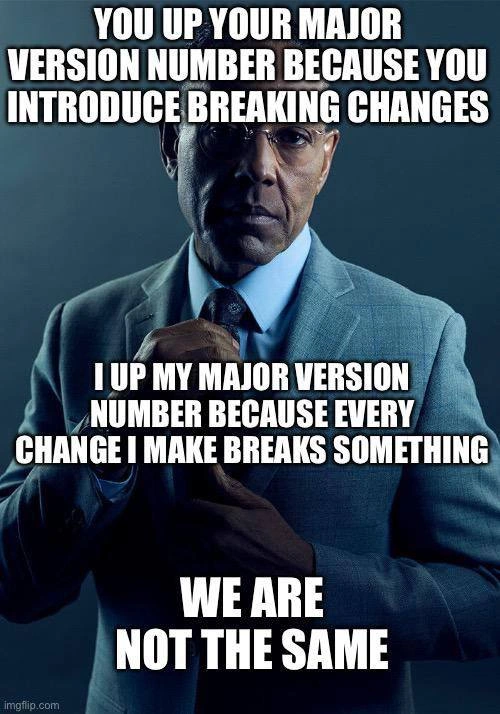
  • “You increase your major version number because you introduce breaking changes.” – This is the normal approach. You (the disciplined developer) only bump the major version when you know you’ve made a change that will break compatibility. Maybe you removed a function, changed a data format, or altered how an endpoint works in an API. You do it knowingly and you communicate that with a new major release, like going from version 2.5.4 to 3.0.0. Essentially, you follow the semantic versioning rules as intended.

  • “I increase my major version number because every change I make breaks something.” – This is the chaotic approach. This developer bumps the major version for every single commit because apparently every change is breaking something new. 😅 It implies that their code or process is so unreliable that even a tiny change ends up causing a big problem (perhaps an unintended side-effect or regression). They’re saying “I’m always making breaking changes, even when I don’t mean to, so I’m constantly upping the major version.” It’s like if after every code change, they discover a part of the system no longer works with the rest, so they label the new state as a completely new version.

  • “We are not the same.” – This phrase drives home the contrast. The first developer does versioning properly and probably doesn’t break things often, whereas the second developer is essentially admitting to being a walking disaster in terms of software stability. It’s tongue-in-cheek; usually, “we are not the same” memes are about one-upping in a serious or bragging way. Here it’s used ironically – the second dev sounds almost proud that they break stuff so often that they’re constantly on a new major version.

Now, why is this funny? It’s a bit of inside developer humor. The joke targets the concept of “breaking changes” and reliability. Developers rely on version numbers to know what to expect. A major version jump (say from 3.x.x to 4.0.0) is a big deal – it tells everyone “Be careful, things have changed in a way that might not work with the old code.” Typically that doesn’t happen too frequently; if it did, users would get frustrated because they have to keep updating their own code or risk things crashing.

So when someone says “every change I make breaks something,” it’s highlighting a ridiculously bad scenario:

  • It hints at poor code quality or lack of testing. In a well-tested project, most changes (especially small ones) shouldn’t break existing features. If every commit breaks something, it suggests there aren’t enough automated tests or checks to catch issues, or the design is so fragile that nothing can be changed without collapsing part of the system.
  • It also hints at a chaotic workflow. Perhaps this person is not reviewing their code carefully or is in such a rush that they keep introducing bugs. There’s an expression “move fast and break things” (Facebook’s old motto) – the meme is a bit of a parody of that: this developer moves fast and breaks things every single time, to the point they’ve made breakage a routine part of versioning.

Let’s connect this to dependencies. In software, a dependency is when one piece of code (like your project) relies on another piece of code (a library). If you use a library and its author keeps bumping the major version, it means every update could require you to make changes. Imagine you depend on a library at version 1.2.0. If the next release is 2.0.0 (major changed), you might have to update your code to use it. If a week later it’s 3.0.0, and then 4.0.0, you’d either stick to an older version or constantly scramble to adjust your code. That situation is part of what developers call dependency hell – when keeping all your libraries up-to-date becomes a nightmare because of incompatibilities and constant changes. We often specify version ranges (like “give me any 1.x version of this library”) trusting that 1.9.5 will work just as well as 1.2.0 did. But if the library jumps to 2.0.0, that’s a signal it’s not the same as 1.x and we might not want to automatically upgrade to it without preparation.

Now, consider a project that itself is unstable and keeps releasing major versions. It’s essentially telling its users: “We break stuff all the time, good luck!” No one wants to depend on something that unreliable. So developers try to avoid that by writing tests, reviewing changes, and using semantic versioning properly. The meme exaggerates the opposite scenario for comic effect.

Think of release management – that’s the practice of planning and controlling how new versions of software are released. Good release management means being careful about when you introduce breaking changes (maybe bundling them into a planned major release occasionally) and otherwise adding features in a backward-compatible way. The “I bump major version every commit” approach is like the anti-pattern of release management. It’s basically uncontrolled releases with no regard for stability.

To a junior developer, an analogy might help: It’s as if you have a rule in a board game that says “flip the table (start a new game) only if the game rules fundamentally change.” One player follows that rule properly, only flipping the table when the rules truly change. Another player is so clumsy that every turn they accidentally knock pieces off the board and say “Oops, new game!” and flips the table each time. They technically obey the letter of the rule (the game state indeed got wrecked, so a new game is needed), but it’s because they keep messing up, not because they intended a new rule. It’s chaotic and funny in a frustrating way.

In summary for Level 2: the meme is highlighting the difference between proper use of semantic versioning vs. chaotic use. Semantic_versioning is supposed to bring order (major for incompatible changes, minor for new features, patch for fixes). Breaking_changes are meant to be rare and deliberate. But here we have someone basically saying “I break stuff so often, I live in permanent breaking-change mode.” It’s humorous exaggeration that carries a hint of truth – if you don’t have good processes, you might feel like every deploy breaks something new. This resonates with developers who have been on projects with flaky stability. It stresses the importance of good test coverage and careful changes: nobody wants to be that second person in real life!

Level 3: Major Mayhem in SemVer

At the highest complexity, this meme satirizes the semantic versioning ethos by showing two wildly different approaches to bumping a software’s major version number. For experienced engineers, the humor lands because it exaggerates a painful reality of API versioning strategy gone off the rails. In a disciplined project, you increment the major version (the X in X.Y.Z) only when you introduce deliberate breaking changes – those big refactors or API redesigns that require users to change their code. But in the chaotic scenario, every single commit triggers a new major version bump because every change unintentionally breaks something. The meme’s text, styled in the “we are not the same” format, underlines the contrast:

YOU up your major version number for planned breaking changes;
I up mine because every commit is a breaking change.
We are not the same.

This absurd brag pokes fun at projects where code quality is so poor or the architecture so brittle that any tweak causes regressions. Seasoned devs recognize the subtext: it’s lampooning unstable changes and nonexistent backward compatibility. In practice, constantly bumping the major version is an anti-pattern. It means the software has no stable contract; clients live in dependency hell trying to keep up, and version numbers skyrocket like a runaway odometer.

Why is this funny to a senior developer? Because we’ve all encountered that one library (or product) that seems to hit version 10.0.0 before it even leaves beta. 🙃 It’s a gallows humor acknowledgment of poor code quality – like a dark inside joke about those 2 AM production deployments where continuous breakage is the norm. Instead of proper testing and incremental improvement, every release shatters something fundamental, forcing a “major” do-over. The meme exaggerates this into a persona who is proud of turning each commit into a major release. It’s essentially saying: “You follow SemVer best practices; I treat SemVer like an incident log.” The punchline “we are not the same” carries the ironic tone: the second developer’s workflow is not something to emulate, yet they boast as if it’s an accomplishment.

From an API and dependencies standpoint, this scenario is nightmare fuel. Semantic versioning (SemVer) is supposed to bring order to dependency management by signaling compatibility. Consumers of a library use version ranges (like ^1.2.0 or ~2.3.4) to allow safe upgrades: a patch or minor bump shouldn’t break anything, while a major bump warns “breaking changes ahead!” If a library author bumps the major version for every commit, it implies nothing stays compatible for long. Imagine a library going from 1.0.0 to 2.0.0 to 3.0.0 in rapid succession because the author keeps introducing regressions. Downstream projects depending on that lib would be constantly stuck updating their code or locking dependencies. This is dependency hell: when multiple components demand different, incompatible versions of the same library, or when upgrades become a minefield of breakages. Bumping the major version is like declaring “no guarantees with the previous version, folks!” – doing that continuously is basically waving a white flag on stability.

Under the hood, this touches on why poor test coverage and fragile design are so destructive. In a well-run project, you introduce a breaking API change only after careful design and usually with a deprecation period or major release plan. You know it’s breaking because you have tests that fail if older usage doesn’t work, or you’ve communicated changes in documentation. In the chaotic project, every change is a surprise break because there’s likely a lack of tests, no QA process, and highly coupled code. Perhaps function signatures keep changing, or data formats keep shifting unintentionally. Each commit that “fixes” one thing ends up breaking another part of the system (classic whack-a-mole development). The only way they adhere to semantic versioning’s rule (“don’t break compatibility on the same major version”) is by reluctantly bumping the major number every time: “Oops, broke it again – guess this is version 5.0.0 now!” It’s both comedic and tragic. Comedic, because of the exaggeration; tragic, because such projects exist in real life and maintaining them is a developer’s recurring nightmare.

Historically, semantic versioning was introduced to prevent exactly this kind of chaos. The SemVer specification (famously version 2.0.0 itself) was written to bring some sanity to release management. It formalized what many devs were already doing: Major = incompatible API changes, Minor = added functionality backward-compatible, Patch = backward-compatible bug fixes. The meme plays on this by twisting the intent: the second developer is following SemVer rules (technically they are bumping majors when things break), but the spirit of SemVer assumes breaking changes are rare, not a daily occurrence! The humor is amplified by the respectable, imposing image of the man in a suit adjusting his cufflinks. It’s a template often used to convey a tone of superiority or “I am very distinguished” energy. Here that fancy vibe is juxtaposed with an almost shameful engineering truth: my code breaks so much, I’m effectively always on a major version. It’s mockingly self-aggrandizing, like saying “I don’t always break my build, but when I do, I increment the major version... which is always.” The well-dressed man meme format (we_are_not_the_same_meme) usually highlights one-upmanship, and in developer humor it often underscores absurd anti-patterns taken to the extreme.

In real team dynamics, someone behaving like this would be a release manager’s bane. Constant major version increases suggest no release management control, no long-term planning. If every commit is a fire-drill requiring a new version, how do you communicate changes to users or maintain documentation? The meme hints at “release management irony” – the notion that version numbers, meant to convey meaningful information, become meaningless when abused. A version 42.0.0 doesn’t tell you anything except that 41 previous releases fell apart. It’s like versioning has turned into an error counter. Experienced developers find this funny because it’s a hyperbole of real cautionary tales: e.g., a small library that jumped major versions rapidly because the author kept refactoring (breaking APIs without realizing) and had to keep signaling those breaks after the fact. We’ve seen NPM packages or Python libraries that churn versions and cause grief in our requirements.txt or package.json. It’s funny in a “I’ve been there, I feel your pain” way. It’s also a bit of schadenfreude – better to laugh at this scenario than cry if you’re the one dealing with it in production.

In summary, Level 3 analysis unwraps why the meme is developer humor gold: it takes the sensible concept of semantic versioning and pushes it to a ridiculous extreme to highlight issues of code quality and process. It resonates with senior devs who have managed dependencies and maintained APIs: we strive to avoid breaking changes, but here’s a caricature of a developer who only ships breaking changes. The contrast (“We are not the same”) is a tongue-in-cheek reminder that doing things technically right (bumping the major) can still be totally wrong if you’re breaking stuff continuously. It’s a comedic cautionary tale: don’t be that person whose every commit is a major version bump – if you are, something is very, very not right.

Description

This is a 'We Are Not the Same' meme, featuring a half-body shot of actor Giancarlo Esposito in his role as the character Gus Fring. He is wearing a grey suit and adjusting his tie, looking directly at the viewer with a calm but intimidating expression. The background is a dark, moody grey. White, all-caps text is overlaid on the image in three parts. Top text: 'YOU UP YOUR MAJOR VERSION NUMBER BECAUSE YOU INTRODUCE BREAKING CHANGES'. Middle text: 'I UP MY MAJOR VERSION NUMBER BECAUSE EVERY CHANGE I MAKE BREAKS SOMETHING'. Bottom text: 'WE ARE NOT THE SAME'. The humor contrasts the formal, correct practice of Semantic Versioning (SemVer), where a major version increment signals intentional, incompatible API changes, with the chaotic reality of working on a brittle, poorly-architected system. In the latter case, any modification, no matter how small, causes unintentional breaking changes, forcing a major version bump not as a sign of planned evolution, but as an admission of code fragility and high technical debt. It's a cynical joke relatable to any senior developer who has maintained a legacy system where every bug fix is a gamble

Comments

18
Anonymous ★ Top Pick The first team follows SemVer. The second team follows 'OhGodWhatBrokeNowVer'
  1. Anonymous ★ Top Pick

    The first team follows SemVer. The second team follows 'OhGodWhatBrokeNowVer'

  2. Anonymous

    My package is on v73.0.0 and still marked “beta” - turns out we invented quantum semver: every release is simultaneously stable and broken until someone observes it in prod

  3. Anonymous

    The difference between a junior and senior developer isn't that seniors write better code - it's that seniors have learned to preemptively bump the major version because they know their 'minor refactor' will somehow break that one integration test written in 2016 that nobody understands but everyone's afraid to delete

  4. Anonymous

    The real semantic versioning debate: Some architects carefully orchestrate major version bumps after months of deprecation warnings and migration guides, while others treat version numbers like a high score in 'how many prod incidents can one commit cause.' Both reach v47.0.0, but only one knows why they're there - the other just knows their CI/CD pipeline has trust issues and their users have Stockholm syndrome

  5. Anonymous

    You architect breaking changes; I just refactor one module and watch the monolith unravel like a poorly managed Kubernetes cluster

  6. Anonymous

    Our semver policy is simple: every merge increments the leftmost digit - incident count is monotonic, so our versioning is too

  7. Anonymous

    SemVer says major = breaking changes; in our distributed monolith that’s basically major-per-commit - we just call it Continuous Incompatibility

  8. @ZgGPuo8dZef58K6hxxGVj3Z2 1y

    Also thats a binary tree*

  9. @LeakyRectifiedLinearUnit 1y

    I up version number because cicd fails otherwise

  10. @ashit_axar 1y

    Why don't you just simply use: current modified modified1 modified2 new neww newww latest latest2 2024.10.07 2024.10.11 2024.10.11.2 🙄🤌

    1. @deadgnom32 1y

      last final realfinal

      1. @SamsonovAnton 1y

        ultimate!

    2. @SamsonovAnton 1y

      2025.05.05.20.25.05

  11. @qtsmolcat 1y

    Version 252412

    1. @alexandr_guluta 1y

      06052025

      1. @alexandr_guluta 1y

        best style

      2. @qtsmolcat 1y

        05052025-2

  12. @n3oney 1y

    0.0.YYYYMMDDHHmm

Use J and K for navigation