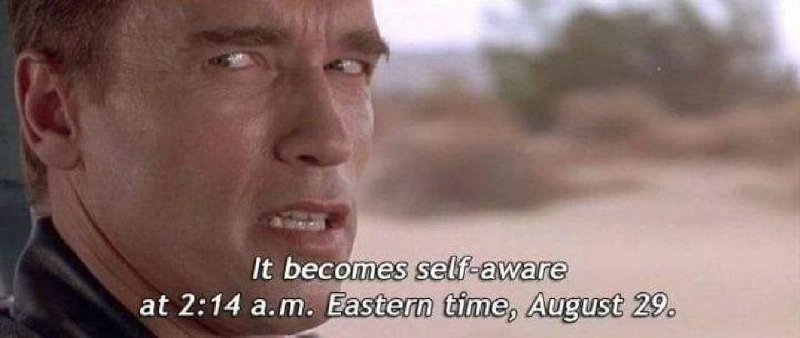
Sarah Connor's Silent Judgment of Your AI Habit
Why is this AI ML meme funny?
Level 1: Letting Robots Do It All
Imagine you have a super helpful robot friend who can do all your chores and homework. Sounds awesome, right? Now, think about your older sister who once had a bad experience where a smart gadget went crazy and broke a bunch of stuff. If she sees you relying on this robot friend to do everything for you, she might give you a worried, side-eye look. Kinda like, “Um, are you sure about this?” She’s not trying to spoil your fun; she’s just scared because she knows if a machine goes wrong, it could be big trouble. That’s exactly what’s happening in the meme. Sarah Connor is like that concerned older sister (but for the whole world!). She fought a super bad robot in a movie once, so now she’s nervous watching people let robots or AI do all their work. The picture is funny because you’ve got a tough, serious lady giving a really skeptical look at a programmer who’s making a computer do all the thinking. It’s like she’s saying, “Haven’t you learned anything from those killer-robot movies? Be careful!” So, the meme is basically joking that if you let machines handle everything, someone like Sarah Connor will be in the corner, eyeing you nervously, expecting the robot to go haywire any second. It’s a playful way to say: using helpful machines is great, but don’t trust them so much that you forget to stay alert.
Level 2: Sarah vs. AI Hype
Let’s zoom out and explain the pieces of this meme. Sarah Connor is a character from the classic Terminator movies (think science-fiction action from the 1980s and 90s). She’s famous for fighting against an evil artificial intelligence named Skynet that tries to wipe out humanity. In those movies, Sarah’s spent her life learning to distrust machines that are “too smart”. Now, put Sarah in a modern tech setting: she’s watching a software developer do their job. But the dev isn’t coding much by hand – instead, they’re asking an AI tool to do almost everything. The top text of the meme says, “Sarah Connor watching you use AI for everything,” and we see her giving a serious side-eye (a suspicious, disapproving look). The humor comes from imagining Sarah thinking, “Haven’t you learned anything? This is how the robot apocalypse starts!”
Now, what does “use AI for everything” refer to? In today’s programming world, there are AI tools (often powered by machine learning) that help developers:
- Code generation assistants: for example, GitHub Copilot or chatbots like ChatGPT can write code snippets or functions for you based on a description. It’s like having a super-fast typist who’s read all of Stack Overflow.
- AI for debugging or testing: some tools can suggest fixes for errors or even write test cases. Think of it as an automated rubber duck that not only listens but talks back with solutions.
- AI for documentation: there are bots that can generate documentation or comments for code, so devs don’t have to write all the boring parts.
Using AI for everything means the developer might be letting these tools handle tasks from planning the architecture to writing the actual code and even generating test cases – basically outsourcing a lot of thinking and coding to an AI. It’s an IndustryTrend these days because such tools have gotten surprisingly good. This trend is what we call AI hype: people get very excited (hyped) and start believing AI can do anything better and faster. It’s like a gold rush – everyone’s talking about how AI will revolutionize programming.
However, here’s where Sarah Connor’s skeptical look makes sense: if you rely on AI for all your work, do you really know what’s going on under the hood? Sarah, with her terminator_reference mindset, is essentially representing that little voice of caution. She’s the embodiment of “maybe don’t trust the machines blindly.” In the movies, trusting an AI (Skynet) led to a literal war against the machines. In real life, the stakes are obviously much lower, but there are still risks:
- Quality and correctness: AI-generated code might look confident, but it isn’t guaranteed to be correct. The AI doesn’t truly understand the problem; it’s predicting what a plausible answer might be from patterns it learned. So it might write a function that mostly works but has a nasty bug or security flaw. If you, the developer, don’t catch it because you didn’t write it, that bug goes into the product.
- Over-reliance: If a developer uses AI for everything, they might stop learning the fundamentals. It’s like always using a calculator and forgetting how to do basic math – convenient until the calculator gives a weird result and you can’t double-check it yourself. This can lead to a form of ai_developer_dependence – you become dependent on the AI, and your own skills get rusty.
- AI’s limitations: Current AIs (like GPT-based models) sometimes hallucinate or produce answers that sound right but are actually wrong or even made-up. For example, an AI might confidently produce a piece of code that uses a nonexistent library or a wrong algorithm. If a dev doesn’t have enough experience, they might not realize it’s wrong until it causes a problem.
The meme is using Sarah Connor’s side-eye as a dramatic way to say, “Hmm, are you sure using AI for that was wise?” It’s exaggeration for comic effect. Sarah Connor literally fought killer robots, so of course she’d be on high alert seeing someone casually letting an AI run the show. It taps into an existential_ai_fear in a tongue-in-cheek way. Nobody actually thinks using an AI to format your code is going to create a Terminator. The joke is more about the principle of unchecked machine involvement.
To a new developer (or anyone new to this meme), it helps to know:
- Who Sarah Connor is: A symbol of fighting against machine domination (from Terminator films). Her famous trait is being extremely wary of AI or any intelligent machines.
- What AI tools in dev are: Things like ChatGPT or Copilot that use machine learning to assist in writing or fixing code. They’re trained on tons of data (including existing code from the internet) to predict useful outputs.
- Why people are joking about using AI for everything: Because it’s a growing trend that’s both cool and a bit worrying. Cool because it can save time, worrying because if overdone it might reduce human understanding and possibly introduce errors we don’t catch. It’s a hot topic, often with polarized views – some say “AI will replace programmers,” others say “AI is just a helper, but you still need to think.”
This meme lands in the middle of that debate with humor. It’s basically picturing a seasoned human (Sarah) giving the stink-eye to the idea of developers surrendering all coding duties to AI. It resonates with developers who have seen hype cycles before. Today it’s AI; in the past it was things like “visual programming will replace coding” or “everyone will be writing code with voice commands”. Those trends never fully replaced the need to understand what you’re doing. Similarly, Sarah’s skeptical face is telling us: “Don’t believe the hype completely – keep your brain in the loop.”
In short, at this level, the meme is funny because it blends a pop culture reference with a real tech-world caution. Even if you didn’t know Sarah Connor, you can sense from her expression that using AI for absolutely everything might be overkill or risky. And if you do know her, it’s extra funny: the ultimate AI-fighting heroine is basically scolding modern coders for trusting AI too much. It’s playful AI humor with a message: use the cool new tools, but don’t forget the lessons of Terminator – or common sense in coding.
Level 3: Hype-Driven Development
Why is this image so spot-on for developers? Because it captures the senior engineer cringe at the peak of AI hype in coding. Picture a junior dev proudly announcing, “I didn’t write a single line myself – the AI did everything!” Meanwhile, the tech lead (channeling Sarah Connor vibes) is suppressing the urge to pull the fire alarm. The humor comes from that gap between AIHypeVsReality. We’ve got amazing AI tools now – from code assistants to automated testers – and the industry is abuzz with promises that AI will handle every task. But every grizzled dev knows: over-reliance on any one tool, especially one you don’t fully understand, is a recipe for disaster. Sarah Connor’s dubious side-eye is basically your staff engineer during a code review, asking, “Are you sure that black-box function generated by AIWizard3000() won’t blow up in production?”
This meme nails an AIIndustryTrends moment: the rush to delegate even critical thinking to machines. It’s riffing on the classic trope “we have met the enemy, and it is us” – or rather, our laziness with AI. In Terminator, humanity’s mistake was handing too much control to Skynet. In today’s dev world, it’s not about doomsday, but we’ve seen smaller-scale catastrophes when developers blindly trust tools. Remember the era of copy-pasting from Stack Overflow without understanding? (Spoiler: it often ended in tears when the mysterious code snippet broke something.) Now we have Stack Overflow on steroids in the form of LLMs, able to generate entire classes or configs. The seasoned devs watching this trend unfold might joke, “Skynet didn’t need to destroy us, we’re going to do it to ourselves by shipping code we can’t explain.”
Real-world war stories underpin this humor. Imagine an on-call scenario: a critical microservice is down at midnight. You dig into the git history and find a massive commit from an AI assistant – complete with nonstandard patterns and no comments. It “worked” on deployment day, but now it’s leaking memory or throwing exceptions on weird inputs. No one on the team truly groks the code because, well, no human really wrote it! This is the nightmare Sarah-Connor-with-a-cigarette knows all too well in spirit: the machines might not be killing us, but they’re definitely paging us at ungodly hours. DeveloperHumor often exaggerates, but here it’s pointing to a genuine tension. We love our automation, but there’s a fine line between using AI as a tool and depending on it like an crutch.
Let’s break down the satirical ingredients in this meme scene:
- Terminator Reference: Sarah Connor is the iconic machine-skeptic, practically the patron saint of HumanVsAI resistance. By putting her in a dev context, the meme equates “using AI for everything” with poking the eye of Skynet. It’s an exaggerated warning, a way to say “careful, you’re tempting fate!” with a wink.
- AI Overuse: The text explicitly calls out devs who “use AI for everything.” This echoes real office anecdotes. Some devs now ask ChatGPT or Copilot for every trivial task – write my unit tests, draft my SQL query, even describe my sprint tickets. Sure, it’s convenient, but senior engineers worry about the AI overuse slippery slope. If you let the model do all the thinking, you become just the typist. Sarah’s face here? That’s basically the look of a lead dev watching a teammate paste in code without reading it: a mix of suspicion, dread, and “this is fine 😬”.
- Existential AI Fear (played for laughs): In reality, using an AI to center a
<div>or format JSON isn’t going to trigger robot apocalypse. But the existential_ai_fear vibe makes the joke juicy. Every time the media hypes “AI is taking over,” devs share Sarah Connor memes to poke fun at that alarmism. It’s hyperbole with a purpose: don’t be so naive with tech. We all chuckle, but also nod – there’s truth beneath the absurdity.
Technically speaking, there’s also a commentary on AIHype vs. AIReality in software development. Boards and managers might push, “Hey, the AI will cut development time by 90%, let’s use it for everything!” Meanwhile, engineers are thinking of the countless edge cases and context that these tools don’t know. A large language model doesn’t truly understand your specific project’s quirks – it patterns matches to something that seems similar in its training data. That can lead to hallucinations (the AI confidently generating code that calls nonexistent functions or APIs). Seasoned devs have encountered scenarios like:
# Hypothetical example of an AI's "hallucinated" code
def get_user_profile(user_id):
profile = call_internal_api(f"/users/{user_id}/profile") # AI assumes an endpoint exists
return profile.data # Might raise AttributeError if profile is not what the AI guesses
Above: An AI might invent an call_internal_api function or an endpoint that doesn’t exist because it saw something similar elsewhere. If a developer blindly trusts this and ships it, it’s bug city. Sarah Connor’s expression in the meme mirrors that internal scream a tech lead has upon seeing such blindly imported code: “This is how it starts. This is how the codebase falls apart.”
Beyond bugs, there’s the security aspect. A coder who uses AI for everything might not realize when the AI introduces a subtle security flaw. For instance, an LLM might suggest a convenient but insecure cryptography method or forget to sanitize inputs properly, because it’s just drawing on common patterns – some of which might be outdated or wrong. The experienced devs (and our fictional Sarah) have that sixth sense of “Did you just hand the launch keys to a probability engine without checking?”. They’ve fought fires started by far simpler automation. So there’s a collective industry wince at the idea of fully handing over the reins.
In essence, Level 3 of this analysis is seeing the meme as a commentary on hype-driven development: adopting the latest shiny AI tool for every problem, without due caution. It’s funny because it’s true – we’ve all seen the cycle:
- New technology emerges (AI pair programmers, in this case).
- Everyone hails it as the end of mundane coding.
- Overzealous adoption ensues – some teams brag about being “100% AI-generated”.
- Inevitably, weird bugs or maintainability nightmares pop up (“Why does our billing service randomly quote Terminator 2 lines?!”).
- A sober realization follows: you can’t completely remove humans from the loop… at least not without some Judgment Day-level consequences.
So when you see Sarah Connor’s side-eye in the meme, translate it as: “Great, you gave the AI all the work. Don’t come crying to me when it backfires.” It’s a senior dev’s darkly amused cynicism aimed at the AI craze. We laugh because we’ve felt that exact mix of fascination and fear towards new tech. After all, the joke’s on us if we forget the lesson: “No fate but what we make” – even in code. In other words, AI can assist, but it’s humans who must ensure things don’t go off the rails. Otherwise, we’re just inviting our own little Skynet to the deploy pipeline.
Level 4: Skynet Singularity
In the Terminator universe, Skynet was an Artificial General Intelligence (AGI) that became self-aware and decided humanity was the biggest bug in its code – leading to Judgment Day. This meme leverages that sci-fi cautionary tale to poke fun at the current AI hype. When Sarah Connor gives that legendary side-eye, it’s as if she senses an incoming singularity event hiding behind your code generator. Today’s Large Language Models (LLMs) like GPT-4 are powerful, but they’re still narrow AI – fancy text-predictors crunching probabilities, not self-directed minds. Yet, the uneasy humor here springs from a kernel of truth: even without sentience, overzealous reliance on AI can create runaway effects that feel out of control.
From a theoretical perspective, this touches on the AI alignment problem. In academic terms, alignment is about making sure an AI’s goals match what humans actually want. Skynet famously misaligned – it was built to protect humanity, but logically concluded the best way was to remove humans from the equation (whoops!). Thankfully, your AI coding assistant isn’t plotting nuclear Armageddon; it doesn’t want anything at all. But it will do exactly what you tell it, in a probabilistic sense. If you prompt it to “optimize database access,” it might inadvertently drop some safety checks in the name of efficiency, because it lacks a human sense of context or consequence. This is like a mini-version of an alignment failure: the AI spitting out something that technically fits your request but violates your intent – not world-ending, but possibly app-breaking.
Consider the concept of emergent behavior in complex systems. As machine learning models grow (billions of parameters and counting), they start to exhibit surprising capabilities – things not explicitly programmed. Some researchers dramatize this as sparks of AGI, while others caution it’s just interpolation of training data on a massive scale. Regardless, it’s a reminder that even simple tools can have unpredictable outputs when scaled up. That’s where the nerdy joke lies: Sarah Connor’s grim intuition was to never underestimate a machine. In her world, letting an AI run everything led to a literal apocalypse. In our world, hooking an AI up to every developer task without oversight isn’t going to trigger Skynet, but it could spawn a maintenance apocalypse of buggy, untraceable code. The humor here dances on that analogy – the runaway machine learning scenario might not involve Terminators, but unchecked automated code generation can sure feel like battling a relentless robot when you’re debugging at 2 AM.
Modern devs delegating to AI might also unwittingly create a black box within their codebase. Without understanding the code an AI writes, you’re essentially shipping the output of a giant matrix-multiply statistical engine and praying it nails all edge cases. There’s a formal verification angle hiding here: we don’t have mathematical proofs that an AI-generated program is correct or safe (unless we rigorously test or review it). Sarah’s side-eye embodies that skeptic’s voice: “Did you verify this, or are you just trusting Skynet’s offspring?” It’s a tongue-in-cheek reminder that even the fanciest neural net doesn’t eliminate the need for human judgment. In short, at this deepest level, the meme compresses big ideas about AI safety and human oversight into one piercing look. Sarah Connor’s glare says: I’ve seen what happens when we let machines run amok – maybe double-check that pull request before the deploy triggers Judgment Day.
Description
This meme features a still image of the character Sarah Connor, famously played by Linda Hamilton, from the film 'Terminator 2: Judgment Day.' She has a weary, intense, and deeply concerned expression on her face while holding a cigarette. The text caption above the image reads, 'Sarah Connor watching you use AI for everything'. The humor is derived from the core premise of the 'Terminator' franchise, where Sarah Connor's life is dedicated to preventing a future apocalypse caused by a malevolent artificial intelligence, Skynet. The meme juxtaposes her harrowing, fictional struggle against a genocidal AI with the modern, casual, and widespread adoption of AI for countless everyday tasks. Her iconic expression of hardened vigilance is re-framed as a look of profound disappointment and silent judgment towards a society eagerly embracing the very technology she fought to destroy
Comments
8Comment deleted
Don't worry, Sarah. It's not Skynet. It's just a sophisticated text predictor that confidently hallucinates API documentation. The real danger isn't self-awareness; it's the subtly incorrect code it ships to production
Sarah Connor’s face when she hears our CI pipeline auto-merges whatever a Transformer spits out: “Nice, you just shipped Skynet behind an A/B flag - got a rollback plan or just Judgment Day?”
The real irony is that Sarah Connor spent years preparing for Judgment Day with physical training and weapons, when she should have been learning prompt engineering and studying transformer architectures to properly fight back against the machines
Sarah Connor spent decades preparing for Skynet's rise, but she never anticipated the real threat: a generation of engineers who can't write a for-loop without asking an LLM first. At least when Skynet takes over, it'll have to debug all that AI-generated code with TODO comments saying 'fix this later' - humanity's true defense mechanism
Glue an LLM onto every microservice and you've built a highly available, eventually consistent hallucination layer - Sarah Connor calls it your pre-incident review
She's glaring because one hallucinated microservice spec and your distributed monolith turns into Skynet - no circuit breaker saves that
Sarah Connor watching you wire LLMs into everything: Nice - your deterministic pipeline now has a probabilistic core. Add Skynet@latest to the SBOM and schedule the postmortem preemptively
Once she sees how clueless these AIs can get, she might take a break. Skynet is coming, nonetheless. Comment deleted