Russian Roulette, Sysadmin Edition
Why is this OnCall ProductionIssues meme funny?
Level 1: Risky Dare with a Computer
Imagine you and a friend have built a giant sandcastle together, which stands for something really important you both worked on. Now, would you ever play a game where you flip a coin, and if it lands on heads, you kick down your own sandcastle on purpose? Probably not, right? That would be a crazy and reckless dare.
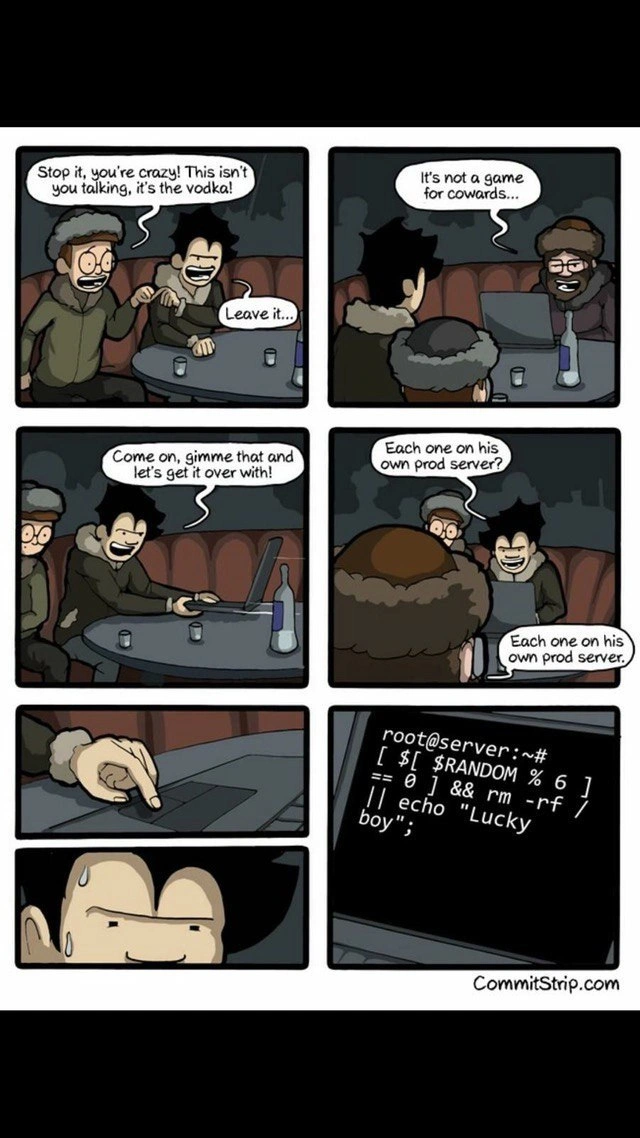
This meme shows two tech guys doing something just as silly with their computers. They have a big important computer (like the sandcastle, but in real life it’s a server running a website or service). They’re a bit like two friends who had too much candy (in the comic it’s actually vodka, which is a grown-up drink that can make people act foolish). One of them suggests a dangerous game: each of them will press a “self-destruct” button on their own computer, but the trick is the button only actually destroys everything one time out of six. It’s like they’re rolling a die and saying, “If I roll a 6, I’ll smash my sandcastle (delete everything on my server). If not, I got lucky and nothing happens.” This is basically a digital version of Russian roulette, which is a very dangerous chance game – but here it’s played with computers instead of anything physical.
Why is this funny? Because it’s so outrageous and dumb that you laugh at the absurdity. In real life, nobody in their right mind wants to destroy their own hard work or take down a website just for a thrill. These two characters are doing it because the comic exaggerates how sometimes working with computers can feel risky and nerve-wracking. It’s poking fun at that feeling by showing an extreme, silly scenario.
Think of it like two mechanics deciding to randomly cut a car’s brake lines to “see what happens,” or two kids deciding to spin a spinner, where one tiny slice means they have to break their favorite toy. You’d think, “That’s insane, why would anyone do that?!” Exactly. It’s a crazy dare born from impaired judgment (in this case, one too many drinks). The humor comes from knowing how terrible the idea is. We chuckle because it’s a comic – thankfully no real servers were harmed! – and it highlights, in a twisted way, why being super careless with important things is a bad idea.
So even if you don’t get the computer jargon, the core is: these guys are betting their entire computer’s life on a lucky roll, and that’s both funny and scary. The lesson under the joke? Don’t gamble with things you care about, especially not your important computers or data. And maybe wait until you’re sober before making big decisions!
Level 2: Bash Roulette Breakdown
Let’s break down exactly what’s happening for those newer to Bash and DevOps. The final panel shows a terminal with the prompt root@server:~#, which already tells us a lot:
root@server– This means the user is logged in as root on a server. Root is the superuser account on Unix/Linux systems, with permission to do anything. Being root is powerful but dangerous – mistakes are not easily undone because there are no safety locks.~– The tilde indicates the current directory.~is shorthand for the user’s home directory. Soroot@server:~#means the root user is in /root (root’s home) and has a shell open. The#at the end of the prompt is another giveaway that this is the root user (regular users often have$as the prompt).
Now the command itself:
[ $[ $RANDOM % 6 ] == 0 ] && rm -rf / || echo "Lucky boy"
This is a compact Bash one-liner. Let’s deconstruct it step by step:
$RANDOM– In Bash scripting,$RANDOMis a built-in variable that produces a random integer each time you access it. Think of it as pulling a random number out of a hat whenever you use it. Its range is 0 to 32767 (it’s essentially like rolling a very large die). Here, the script uses$RANDOMto introduce chance, like a dice roll or a spin of the revolver’s cylinder.$[ $RANDOM % 6 ]– This part is doing an arithmetic operation.$[ ... ]is an older Bash syntax to evaluate an expression. Inside it,$RANDOM % 6means “take the random number and get the remainder when dividing by 6”. The result of$RANDOM % 6will be an integer from 0 to 5, essentially random with equal probability. This is just like rolling a six-sided die, but numbering the faces 0 through 5 instead of 1 through 6. There are 6 possible outcomes, each equally likely.[ ... ] == 0– The outer brackets[ ... ](single brackets) form a test command in Bash. This checks a condition. Here it’s checking if the result of that random expression equals 0. In plain English: “Did the random roll come up as 0?” If yes, the test succeeds (exit status 0 meaning “true” in shell terms); if not, the test fails. So effectively, we have a 1 in 6 chance that this condition is true (since only one of the six possible random outcomes – the ‘0’ – triggers success).&&– This is the logical AND operator for shell commands. It means “execute the next command only if the previous command succeeded.” In this context, “if the test was true (i.e., the random number was 0), then proceed to run the next part.” It’s a common Bash idiom to chain commands based on conditions without writing an explicitifstatement.rm -rf /– Now we get to the heart-attack inducing part.rmis the remove command (used for deleting files). The flags-rand-ftogether mean “recursive (delete directories and everything inside them) and force (no asking for confirmation, no warnings)”. And/is the root directory of the system – the top of the filesystem hierarchy that contains everything on the server (all files, all directories). Sorm -rf /means “delete everything from the root on down, obliterating the entire filesystem.” This is an extremely dangerous command – essentially the self-destruct button for a Linux/Unix system. Once this runs, all files get deleted rapidly: your app, your databases, the operating system files, logs – nothing is spared. The server will almost certainly crash or become unusable while the command is in progress (since it’s even deleting system libraries and critical files needed for the OS to run). 🔥 In short, this is the “bullet” in our round of Russian roulette – if this command executes, the server is toast.||– This is the logical OR operator in Bash command chaining. It means “execute the next command only if the previous command failed.” Why is it here? It pairs with the&&from before to create a kind of if-else logic in a single line. Essentially, we had:[ condition ] && do_something || do_something_else. This pattern works like: if condition is true, run the first thing; if the condition is false (and thus the first thing didn’t run), run the second thing. There is a subtlety: if therm -rf /command actually runs and somehow returns a non-zero error code, the||could also trigger – but usually, ifrmstarts deleting, it may not finish or it might return 0 for success (not that it matters, the system would be in shambles). The intention is clearly to have an else case for when the random chance is not 0.echo "Lucky boy"–echois a command that prints text to the terminal. So if the random test was false (meaning the random number was 1-5, i.e., you didn’t “get the bullet”), this part runs and simply outputs "Lucky boy". It’s the script’s way of saying “phew, you survived this round.” In the comic, that phrase is the dark punchline: if nothing happens, you’re just “lucky” – implying if you run this game enough times, eventually your luck runs out.
All together, this one-liner acts like an if/else in a very compressed form:
# Pseudocode of what the one-liner does:
random_value = $RANDOM % 6 # roll a six-sided die (0-5)
if [ random_value == 0 ]; then
rm -rf / # bullet: destroy everything
else
echo "Lucky boy" # empty chamber: you got away this time
fi
Each developer in the comic is running this on their own server, as they agreed: “Each one on his own prod server.” “Prod server” stands for production server, meaning a live server that real users or critical processes rely on. It’s not a test machine or a personal laptop; it’s the real deal that hosts a service or data. That raises the stakes immensely – a prod server going down can mean downtime for a website, loss of user data, frantic 3 AM calls to engineers, and lots of explaining to do. Essentially, they are each putting their actual work system on the line.
For a junior developer or someone new to DevOps, it’s important to grasp how outlandish this is. Professionals never want to run risky commands directly on production environments. In fact, there are usually many processes in place to prevent mistakes: code reviews, backup systems, restricted permissions, and so on. The idea of purposely introducing a 16% chance of total system failure is the opposite of everything DevOps and SRE practices preach about reliability and caution. It’s akin to deciding deployment to production should be done by literally rolling dice – which is why this is labeled as humor. It’s poking fun at the feeling that deployments can be a gamble by showing an absurdly literal gamble.
The context of the bar and vodka hints at another lesson: never administer servers under the influence or in an impaired state. Just like you shouldn’t drink and drive, you certainly shouldn’t drink and rm -rf. The sober friend in the comic says “This isn’t you talking, it’s the vodka!” because he knows his buddy would never attempt such a stunt while clear-headed. Alcohol has given the drunk dev a false bravado (call it vodka courage 😅), making him willing to do something incredibly reckless. In real life, even without alcohol, sometimes overconfidence or peer pressure can lead engineers to take unwise risks with systems (“It’s fine, I’ll just run this one quick fix directly in prod…” – famous last words). The comic exaggerates it to an extreme scenario to highlight how crazy it is.
Let’s also touch on the Russian roulette metaphor explicitly. Russian roulette is a lethal game of chance: one bullet in a six-chamber gun, one in six chance of firing the bullet when you pull the trigger. Here the bullet is the rm -rf / command, and the trigger pull is executing that Bash line. Five out of six times (echo "Lucky boy") nothing bad happens – you’d wipe some sweat and maybe pour another drink. But that one time out of six, you’ve essentially shot your server in the head. The nervous sweat on the character’s face in the last panel shows that even as a joke, the tension is real. This is a high-stakes gamble of the worst kind.
For a new engineer, imagine the worst bug you could accidentally introduce – that’s what rm -rf / is. It’s not a normal bug or crash; it’s erasing the entire system. The only recovery is restoring from backups (assuming you have them) or rebuilding the server from scratch. Data that wasn’t backed up is gone forever. This is why even the phrase “rm -rf” is spoken of with a bit of fear in tech circles. It’s like the computing equivalent of saying “Voldemort” – it invokes a sense of dread. Senior devs joke about it precisely because it’s so unthinkably bad; humor is a way to cope with the fear.
So, in summary, this comic strip shows two engineers doing something incredibly stupid with a Bash command as a dare. If you’re less familiar with the tools: remember that the command line is extremely powerful – one typo or bad command can wreak havoc, especially as the root user. This one-liner is a perfect storm of bad ideas:
- Running as root (no limits on your destructive power).
- Directly on a production server (the one place you must be most careful).
- Using
rm -rf /(the single scariest deletion command you can run). - Leaving the outcome to chance (no safety, no undo, pure luck).
It’s a cautionary tale wrapped in a joke. The takeaway for any budding DevOps engineer or sysadmin: don’t try this at home (or at work!). Responsible practice is to automate safe deployments, double-check commands, and maybe keep the vodka locked away until after the servers are safely updated and backed up. 😉
Level 3: Shell Game in Prod
In this darkly comic scenario, two DevOps engineers sit in a dim bar, vodka shots lined up, about to do the unthinkable on their production servers. One slurs, "It's not a game for cowards...", while the other nervously mutters "This isn't you talking, it's the vodka!". What game are they playing? Russian roulette – but instead of a revolver, they have a root shell. Each will run a Bash one-liner on their prod server that gives a one-in-six chance of utter catastrophe. The final panel reveals the command:
[ $[ $RANDOM % 6 ] == 0 ] && rm -rf / || echo "Lucky boy"
This tiny CLI snippet is the loaded gun. It uses Bash’s $RANDOM to simulate a revolver’s spin, and rm -rf / as the single bullet in the chamber. The joke hits home for any experienced SRE or sysadmin: running rm -rf / on a live system is tantamount to nuking the server from orbit. It will recursively delete every file starting at the root directory, effectively wiping out the operating system, application code, user data – everything. On a production machine hosting real users or critical data, this is the worst-case scenario, a ProductionIncident of legendary proportions.
Why is this funny (in a terrifying way)? It’s an exaggeration of the reckless behavior that keeps on-call engineers awake at night. In real life, deployments can feel like a gamble – there’s always a risk something might go wrong (DeploymentAnxiety is real). But here the devs are literally gambling with a destructive command. It’s DevOps humor dialed up: a cringeworthy dare that no sane engineer would attempt (except perhaps after far too much “liquid courage”). The comic plays on the shared trauma of OnCall Nightmares – that gut-wrenching moment when you realize someone ran the wrong script or a bug wiped out data. We usually assume such disasters are accidents (like a faulty script that accidentally had rm -rf in it or a bug in a deployment tool). Seeing it done willfully, as a pub game, is absurd. It’s the kind of dark joke you laugh at because the alternative is to cry.
From a senior perspective, this panel satirizes cowboy engineering and the importance of risk management (or utter lack thereof). A seasoned SRE would shudder: in a well-run production environment, safeguards exist specifically to prevent this scenario. For instance, many Linux systems won’t even execute rm -rf / without an extra --no-preserve-root flag, precisely because it’s so destructive. Companies put guardrails in place: requiring multiple approvals for dangerous operations, disabling direct root access, maintaining robust backups, and drilling “test in staging, not in prod” into every engineer’s head. Here, those guardrails are gone – or rather, intentionally ignored by two drunk daredevils in fur hats. (In fact, the root@server prompt tells us they’re logged in as the all-powerful root user, which itself is something SREs try to avoid for day-to-day ops).
The comic also nods to the concept of Chaos Engineering but twists it into a sick joke. Chaos Engineering (pioneered by Netflix’s Chaos Monkey) involves intentionally causing controlled failures (like randomly terminating servers) to ensure your system is resilient. But no sane team’s chaos test involves a 1 in 6 chance of permanently deleting everything on a server! Chaos Monkey might randomly reboot instances, but it doesn’t pull the trigger on rm -rf /. What these characters are doing is more like Chaos Gorilla with a death wish. It’s DevOps/SRE culture commentary: we strive to build systems that can survive random failures – but here the “experiment” is just two humans being recklessly irresponsible.
There’s a layer of wink-nudge history in the gag too. The command rm -rf / is infamous in tech folklore – practically the UNIX equivalent of a self-destruct button. Many old sysadmins have horror stories (or cautionary legends) of an intern or newbie admin mistakenly running something similar and taking down a system. Pretty much every Linux user is warned early on: never run rm -rf / (or any variant like rm -rf * in the wrong directory). It’s the first line in the sysadmin Hall of Shame. So when we see it deliberately used here, it triggers that memory of every close call and disaster story. The sweat drop on the character’s face in the last panel – even in his boozy bravado, he knows this is insane.
For those who like to quantify the madness: there’s roughly a 16.7% chance this one-liner will annihilate the server (1 out of 6, just like a six-shooter revolver). In math form, $$P(\text{catastrophic_failure}) = \frac{1}{6}.$$ That’s staggeringly high risk – if someone told you a deployment had a 16% chance of total failure, you’d slam the brakes. Yet these two are proceeding knowing the odds! It’s comedic precisely because it’s so suicidally stupid. As the caption says, “Drunken DevOps Russian roulette” – a perfect name for this blend of vodka-fueled courage and terminal stupidity. And of course, the punchline: if the random check passes (chamber empty), the script prints "Lucky boy". A dark, ironic reward for surviving this round. If it fails… well, no message at all, just the deafening silence of a server that’s now a blank slate. 🍸🔫
In summary, this meme takes a common sysadmin nightmare – the rm -rf / disaster – and treats it like a bar bet between crazed ops engineers. It’s funny to seasoned developers because it’s an outrageous exaggeration of real fears and bad practices we work hard to avoid. It’s the kind of joke you laugh at after you’ve survived a few 3 AM outages: a bit of gallows humor reminding us that with great power (a root shell) comes great responsibility… and that drunk debugging is a spectacularly bad idea. As one might dryly note on an OnCall forum: “Russian roulette with prod? Sure, what could go wrong... 🙄” Everyone laughs because the answer is obvious: everything can and will go wrong – so don’t be these guys.
Description
A multi-panel comic from CommitStrip.com depicting a group of developers, seemingly in a cold climate and drinking vodka, playing a high-stakes game. One developer dares another to play a 'game for cowards' on their laptops, confirming that they are each on their own production server. The final panels show a close-up of a character sweating nervously as their finger hovers over the enter key, and the command visible on the terminal screen: 'root@server:~# [ $[ $RANDOM % 6 ] == 0 ] && rm -rf / || echo "Lucky boy";'. This comic illustrates a terrifying game of 'Russian Roulette' for developers or system administrators. The Bash command has a 1 in 6 chance (since `$RANDOM % 6` yields a number from 0-5) of being true, which would trigger the `rm -rf /` command, catastrophically deleting the entire root filesystem of the production server. If the condition is false, it safely prints 'Lucky boy'. The humor comes from the gallows humor and absurd recklessness of gamifying a career-ending mistake
Comments
27Comment deleted
The sudo password prompt is just the universe's way of asking, 'Are you *sure* you want to potentially update your resume in the next five seconds?'
Vodka-driven chaos engineering: 1/6 chance you rm-rf /, 5/6 chance you finally discover the DR playbook is just an outdated Confluence page
The only difference between this and most production deployments is that here the 16.67% failure rate is intentional and well-documented. In reality, we achieve similar odds through untested config changes, missing environment variables, and that one dependency that only exists on Steve's laptop
When your deployment strategy is literally 'rm -rf / || echo "Lucky boy"' with a 1-in-6 chance, you've achieved what most organizations only dream of: true continuous delivery - of either your application or your resignation letter. The real production incident here isn't the potential filesystem wipe; it's that someone thought running RANDOM % 6 on a prod server was an acceptable risk assessment framework
When “chaos engineering” is a 1‑in‑6 rm -rf on prod, the only thing under test is whether your IAM and backups are as fictional as staging
Chaos engineering is fun until the plan is $RANDOM%6 as root on prod - then your SLO becomes an obituary and --preserve-root is the designated driver
echo 'frag' > /prod/outage; tail -f /dev/pagerduty
😂 Comment deleted
well. that won't work. you need /* or --no-preserve-root. Comment deleted
I think the joke is older than rm preserving root, I've seen it some years ago Comment deleted
preserve root was introduced like in the beginning of 2000 :) Comment deleted
--no-preserve-root is from 2003 Comment deleted
is better dd if=/dev/zero of=/dev/sd* && dd if=/dev/zero of=/dev/nvme* Comment deleted
rpi is safe Comment deleted
nothing is safe if a prod server is on rpi :D Comment deleted
Nice Comment deleted
TIL, we can use $[ ], usually I use $(( )) Comment deleted
what's with the touchpad buttons? Should've been 'Enter', no? Comment deleted
thanks to the new microsoft office click-to-run shell add-in, you can now click to run commands Comment deleted
yes, however I kept reading "I accidentally rm -rf /" until late 2000s Comment deleted
> Русскоязычный паблик с мемами . . . > Комментеры выше ... Comment deleted
please only speak English in here Comment deleted
https://t.me/devs_chat/21715 As long as translation to English is present, you can talk in any language you want Разговаривай на любом языке, но не забывай про перевод на английский Comment deleted
Memes transcend language barriers and you thought they were in your native language Мемы преодолевают языковые барьеры и ты думал что читаешь их на своем родном языке Wake up, neo Comment deleted
Sry but I thought that's a russian speaking public, as there were some memes in russian language. Comment deleted
Or am I wrong? Comment deleted
I don't think that there was a Russian meme this month, no Comment deleted