Regulate Me, Wait Not Like That
Why is this AI ML meme funny?
Level 1: Be Careful What You Ask
It is funny because the character asks for rules, then panics when the rules actually arrive. It is like telling a teacher, "Please make the game fair," and then being shocked when the teacher takes away the toy you were using because it might be too powerful.
Level 2: Regulated for Real
AI regulation means laws or government rules about how AI systems can be built, sold, accessed, or used. Responsible AI is the idea that companies should manage risks like unsafe outputs, misuse, discrimination, privacy harm, and national-security concerns. Export controls are rules that restrict certain technologies from being shared across borders.
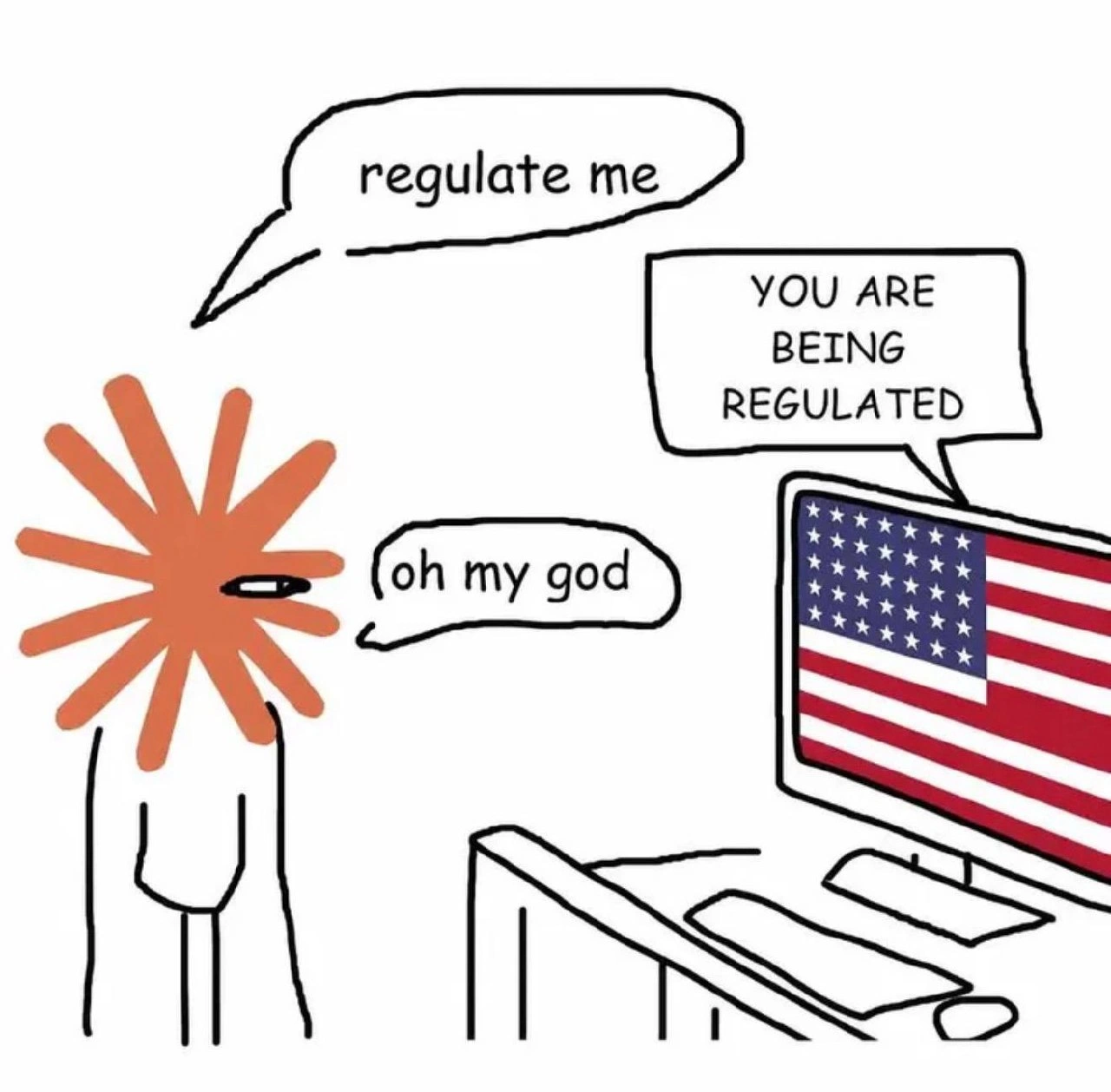
The image shows an Anthropic-like symbol asking to be regulated. The U.S. flag on the computer answers that regulation is happening. The final "oh my god" is the punchline: asking for oversight sounds reasonable until the oversight has real consequences.
This is a developer meme because regulation eventually turns into engineering work. Teams may need to block users in certain regions, add compliance checks, document model behavior, collect audit evidence, change deployment plans, or migrate away from a restricted model. From the outside, "regulate AI" sounds like a policy slogan. From the inside, it becomes tickets, dashboards, legal reviews, and brittle conditionals in code that everyone hopes will be deleted someday.
Level 3: Compliance Comes Home
The comic is almost aggressively simple, which is why it works. On the left, an orange Anthropic-like mark says:
regulate me
The monitor on the right, filled with a United States flag, replies:
YOU ARE
BEING
REGULATED
Then the orange figure responds:
oh my god
That is the whole "wait, not like that" arc of AI governance compressed into one sketch. The joke targets a familiar tension in the frontier AI industry: companies publicly ask for regulation, standards, safety evaluations, licensing, or government involvement, but actual regulation arrives with blunt tools, political incentives, compliance overhead, and side effects that do not look like the white paper version.
The June 2026 context sharpens it. Around this posting window, reports described U.S. export-control action against Anthropic's advanced models after security concerns, including jailbreak-related concerns. That makes the flag monitor more than generic bureaucracy. It represents the moment when "responsible AI" stops being a positioning statement and becomes an operational constraint: model access changes, foreign usage becomes restricted, compliance teams scramble, customers ask whether their integration still works, and executives discover that regulators do not ship patch notes.
The deeper industry irony is that AI safety rhetoric can be both sincere and strategically useful. A lab can genuinely believe powerful models need oversight while also benefiting from rules that raise barriers for smaller competitors. But once the state accepts the premise that these systems are strategically dangerous, the lab does not get to fully control the regulatory shape. Export controls, national-security reviews, access restrictions, and compliance requirements are not product features. They are external authority entering the roadmap with a hammer and a meeting invite.
For developers, the pain is concrete. Regulation becomes API availability, region gating, audit logs, model deprecation, identity checks, procurement review, and "why did staging work yesterday?" tickets. The meme is funny because the character asked for abstract legitimacy and got production-impacting governance instead. Classic requirements ambiguity, but this time the stakeholder has a flag.
Description
The image is a simple hand-drawn comic on a white background. On the left, an orange Anthropic-like burst character says "regulate me" and then reacts with "oh my god." On the right, a computer monitor displaying a large United States flag replies in a speech bubble: "YOU ARE BEING REGULATED." The meme satirizes Anthropic's public pro-regulation posture colliding with actual U.S. government intervention, especially in the context of AI safety debates, export controls, and model-access restrictions.
Comments
1Comment deleted
It turns out asking for regulation is like opening an IAM ticket: technically you got what you requested, just not the permissions you meant.