NoSQL Bar Joke for DBAs
Why is this Databases meme funny?
Level 1: Nowhere to Sit
Imagine you and two friends go into an ice cream shop called “No Cones Ice Cream.” You walk in excited, looking around for an ice cream cone, but all they have are bowls and shakes – no cones at all. You’d probably walk right out and say, “Well, they didn’t have cones, so we left.” That’s basically what’s happening in this joke! It’s a funny play on words. In the computer world, a “table” is like a structured way to store information (kind of like a sorted notebook or an organized list). Some experts, called database admins, really love using these tables. The joke says they went into a NoSQL bar, which is a pretend place that, by its very name, wouldn’t have any tables. So of course, they come out grumpily saying, “We couldn’t find a table in there!” It’s like going to a restaurant and discovering there are no chairs or tables to use – you’d be confused and leave. The reason it’s funny is because it’s so obvious (to us) that a “No-Table place” wouldn’t have a table, yet those three went in expecting one. It makes us laugh because the situation is silly: they were looking for something in a place that clearly doesn’t have it. It’s a simple mix-up joke, just with tech words – and once you know “table” has two meanings (a piece of furniture, and a way to store data), the punchline clicks. It’s basically a nerdy way of saying “they went somewhere and didn’t find what they expected, duh!” and we all giggle at how perfectly it fits the name.
Level 2: Where’s My Table?
Let’s break down the joke in simpler terms, especially for those newer to the world of databases. First off, what exactly is a “table” in this context? In a traditional SQL database (think of SQL as Structured Query Language, the way we talk to these databases), data is organized into tables. A table is a structured set of data held in a database, kind of like a spreadsheet with rows and columns. Each table has a predefined set of columns (like name, age, etc.), and each row is an entry (a record) with values for those columns. For example, you might have a table called Customers with columns for ID, Name, and Email. Every customer you add becomes a new row in that table. If you’re a Database admin or developer working with a relational database, you live and breathe tables. You design tables, link tables together (using relationships), and use the SQL language to query them (using commands like SELECT or JOIN to combine tables). This approach is the core of RelationalDatabaseDesign – data is stored in an orderly, structured way.
Now, what is NoSQL? NoSQL stands for “Not Only SQL.” It’s a broad term covering a variety of database systems that do not use the traditional table-based relational model. Instead of tables, a NoSQL database might use collections of documents (as MongoDB does), or key-value pairs (like a giant dictionary), or graphs, or wide-column stores. The key idea is that NoSQL databases are more flexible with how they store data – they don’t require a fixed schema. For instance, in a NoSQL document database, you can just chuck in a JSON document (essentially a blob of data with some structure, like a big {...} object) into a collection without defining a strict table schema beforehand. This is great when your data doesn’t fit neatly into rows and columns, or when you expect the shape of your data to change over time. NoSQL databases became popular for things like storing user profiles, logs, or other data that can vary a lot, and for scaling out across many servers (something that can be harder with one big SQL table).
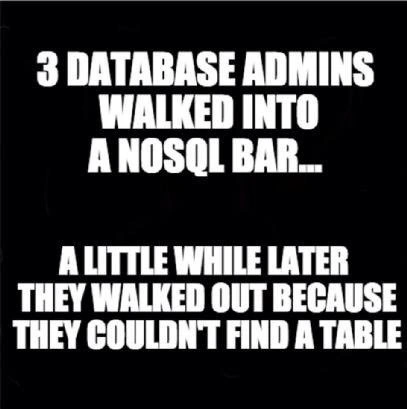
So the meme’s text says: “3 database admins walked into a NoSQL bar... a little while later they walked out because they couldn’t find a table.” The funny bit relies on knowing that NoSQL databases don’t have tables, and it’s making a pun as if “NoSQL bar” were a real bar (like a pub) with no physical tables to sit at. The database admins (DBAs) are portrayed as customers who expected to find a table – in the database sense (because that’s what they’re used to working with). But since it’s a “NoSQL” bar, of course, there are no tables inside! It’s like the bar’s theme is “we don’t do tables here.” The DBAs get confused or disappointed and leave. This is poking fun at how tied to tables a database admin’s thinking can be. They’re so used to the idea that a database must have tables that if they go into a system (or bar) that proudly advertises “No SQL (no tables)”, they feel lost.
To a junior developer or someone new to this, think of it this way: imagine you’ve learned about databases by picturing them as Excel sheets (tables) where each sheet has a set of columns. That’s the SQL world. Now someone shows you a database where there is no sheet with fixed columns – instead, you just have a bunch of JSON files or objects, each could have different fields. You might reasonably ask, “Uh, where do I put my rows? Where’s the table I’m supposed to insert this data into?” That’s the kind of question a DBA might ask when first encountering a pure NoSQL system. The meme exaggerates it humorously: instead of learning, they just turn around and walk out, as if to say, “If there are no tables, count me out.” It’s a play on both the literal and technical meaning of "table."
Let’s clarify some key terms and differences to ensure the joke makes sense:
- Relational (SQL) Database: Uses tables with predefined schemas. You might use SQL commands to create and manipulate these tables. For example:
-- In a SQL database, you'd define a table structure and insert data like this:
CREATE TABLE Users (
id INT PRIMARY KEY,
name VARCHAR(100),
signup_date DATE
);
INSERT INTO Users (id, name, signup_date) VALUES (1, 'Alice', '2021-07-09');
In this SQL snippet, we created a table Users with columns (id, name, signup_date). Every user must have those columns. We then inserted a row for a user named Alice. In a relational DB, if you don’t define that table first, you cannot just insert data. You must adhere to the schema (the table’s column definitions).
- NoSQL Database (Document store example): Might not require defining a table. You can insert a document (like a JSON) directly into a collection. For instance, using a MongoDB-like pseudocode:
// In a NoSQL database (MongoDB example), you store a document into a collection:
db.users.insertOne({
_id: 1,
name: "Alice",
signup_date: "2021-07-09"
});
// There's no fixed table schema here. "users" is a collection, not a predefined table.
In this NoSQL example, we didn’t have to predefine a “Users” table with columns. We just took a JSON object representing Alice and saved it into a collection named "users." We could later insert another document into "users" that has extra fields or missing fields compared to Alice’s document – no problem. That flexibility is a hallmark of NoSQL.
To summarize in a more visual way, here’s a quick comparison between the SQL/Relational model and a NoSQL approach:
| Relational DB (SQL) | NoSQL DB |
|---|---|
| Data in structured tables (rows & columns). | Data in flexible documents, key-value pairs, or graphs (no fixed columns). |
| Pre-defined schema – you must decide the column structure upfront. | Schema-less or dynamic schema – each record (document) can vary in form. |
Uses SQL for queries (e.g., SELECT * FROM Users WHERE ...). |
Uses varied query methods/APIs (e.g., MongoDB’s JSON queries, or key lookups). |
| Can do JOINs (combine data from multiple tables via relationships). | Typically no JOINs; combine data in your application or by embedding related data together. |
| Emphasizes ACID transactions (strong, immediate consistency for updates). | Often uses eventual consistency (updates propagate in time) for scalability – sometimes called BASE philosophy. |
Now, back to the meme with this context: The database admins in the joke are experts in the left column of that table. They live in a world of tables, schemas, and SQL. They walk into a NoSQL environment (right column world) and it’s like stepping onto another planet. No tables anywhere – data is just... stored in some unstructured way? It’s so foreign to them that, comedically, they just exit stage left. 😅 (In reality, a DBA might try to learn or adapt, but the meme plays it for laughs by having them literally bail out immediately.)
The phrase “NoSQL bar” itself is a play on words: obviously, in reality there’s no bar serving database engines. It’s phrased like a classic joke intro (“X walks into a bar…”). By calling it a NoSQL bar, the meme sets up the expectation that anything usual in a bar that sounds like a database term might be missing. And lo and behold, it’s the table – which is both something you’d find in a bar (furniture) and the main thing you find in a SQL database. The punchline “couldn’t find a table” hits on both meanings.
For a junior dev, the big takeaway is understanding that SQL databases = tables and NoSQL databases ≠ tables (they use other structures). That’s the crux of the joke. It’s poking fun at the habits of experienced folks: when you’re so used to one way of doing things, encountering a totally different approach can be jarring. The DB admins weren’t prepared for a world without their trusty tables, just like a newbie might be confused the first time they hear you don’t have to define a schema in, say, MongoDB before storing data. Once you know these terms, the meme is a light-hearted way to remember the difference. After all, you’ll definitely remember that a NoSQL store might be missing a “table” if you recall this joke!
Level 3: Schema Shock
From a seasoned developer’s perspective, this meme is a cocktail of wordplay and hard-earned wisdom from the backend trenches. The humor triggers an immediate aha! because it plays on the double meaning of "table" in a way only DatabaseHumor can. On the surface, we imagine three database administrators (DBAs) literally entering a "NoSQL bar" and leaving since there’s no table to sit at. But behind that, we’re chuckling at the idea of veteran SQL experts stepping into the world of NoSQL databases and panicking when they realize there are no familiar tables to be found in the system. It’s a comical exaggeration of the culture clash between SQL and NoSQL paradigms.
Many experienced devs have seen a scenario like this: a team of old-school DBAs or backend engineers, deeply fluent in RelationalDatabaseDesign, walks into a meeting where someone’s proposing a MongoDB or Cassandra solution. You can almost see the confusion and horror in their eyes when they ask, “So where’s the schema? Where are the tables?” and the answer is, “Well, there are no tables in the traditional sense…”. That moment – the schema shock – is exactly what this meme amplifies for comedic effect. The admins in the joke don’t even stick around; it’s as if the absence of a table (their anchor in the data world) is so unsettling that they nope out of the NoSQL bar immediately.
Why is this so funny (and a little too real)? Because it pokes fun at real industry patterns. Relational databases (like Oracle, MySQL, PostgreSQL) have been the backbone of enterprise applications for decades – they’re tried, true, and come with strict rules (tables, schemas, normalized data, SQL queries). DBAs are the guardians of these systems, and they love their tables the way a chef loves a well-organized kitchen. Now introduce NoSQL, a newer style of database that became famous in the late 2000s and 2010s for powering web-scale companies. NoSQL databases (MongoDB, CouchDB, Cassandra, DynamoDB, etc.) store data in JSON documents or key-value pairs or graphs. They often have flexible schemas or none at all – which is great for rapid development and scaling horizontally across servers, but it can feel like utter chaos to someone used to neat tables with defined columns.
The meme’s punchline, “they walked out because they couldn’t find a table,” is essentially saying: those DBAs couldn’t cope with a database environment that doesn’t even have the concept of a table. It’s a lighthearted jab at how backend folks sometimes cling to familiar tools. After all, a table is the fundamental unit of a SQL database – it’s where you store rows of data. Telling a career DBA to work without tables is like telling an electrician to re-wire a house in the dark. We find it funny because we’ve been in those conversations where someone jokes, “This newfangled DB doesn’t even have joins or tables, what is this madness?”
There’s also an implicit nod to the history of these tech debates. In the real world, teams sometimes adopt a NoSQL database for a project because it promises scalability or flexibility, only to later discover they miss the reliability of relational tables. There are legendary tales in developer forums (prime DeveloperHumor material) about projects that tried to go “full NoSQL” and ended up reintroducing some SQL or structured aspects later on – essentially dragging a table back into the NoSQL bar. This meme captures that irony in one quick punchline. The DB admins leaving immediately is a hyperbole for how some seasoned professionals respond to the “no-schema, no-table” idea – with exasperation or disbelief.
From an organizational standpoint, it highlights a divide: the cautious, often older-school DBAs who prioritize data integrity vs. the move-fast-and-scale ethos of NoSQL that many startups championed. Neither side is exactly wrong – they just have different priorities. But when those worlds collide, you get humorous situations. Picture a meeting room (or a bar) where the DBA asks about foreign keys, and the NoSQL advocate says, “We don’t have those, you handle relations in code,” – you might literally see the DBA’s eye twitch. It’s funny because it’s true: bridging the gap between these systems can be awkward.
The text-only, bold white lettering of the meme even feels like a classic setup-delivery joke format, almost like something you’d see on a bar’s chalkboard. It’s straightforward: “3 database admins walked into a NoSQL bar…” – we anticipate a typical bar joke twist, and we get one, but it’s tailor-made for tech folks. No explanation needed if you’re in the know: NoSQL doesn’t do tables, of course the DBAs left! For those of us who’ve spent late nights migration-planning or debugging scaling issues, the phrase “couldn’t find a table” evokes a knowing grin. Been there, felt that – when dealing with a new datastore that doesn’t match our mental model, sometimes we too want to just walk away.
And let’s appreciate the layered wordplay: a bar with no tables is itself absurd (where do you put your drink?!), just as a database with no tables was once seen as absurd to the old guard. The meme tickles that absurdity. It’s also gently ribbing the DBAs: “haha, they’re so stuck in their ways they left the bar.” But at the same time, it’s sympathetic – we get why they left. Who wants to stay in a place that doesn’t serve what you’re looking for? In a sense, the meme is saying “SQL folks and NoSQL folks sometimes live in different worlds.” And the crossover can be comedic.
In summary, the humor works on multiple levels for a senior developer. It’s a pun, yes, but it’s backed by the real tensions and transitions in the tech world. The tags like NoSQL, SQL, DatabaseHumor all point to this rich context of inside jokes among developers. The admins didn’t literally flip a table on their way out – but only because there was no table to flip! The whole scene playfully encapsulates the “not my cup of tea” reaction many seasoned DB experts had during the NoSQL craze. It’s a nod to all those heated discussions in architecture meetings and the gentle absurdity of expecting a “table” in a place that proudly advertises it doesn’t have any. The joke resonates because it’s true: you can’t teach an old schema new tricks (at least not without some grumbling).
Level 4: The CAP Theorem Hangover
Deep down, this joke hints at fundamental database design principles and trade-offs. In the world of DatabaseSystems, relational databases and NoSQL databases differ like night and day because of core theoretical constraints. The relational model (pioneered by E. F. Codd in 1970) is built around tables (mathematical relations). These tables enforce a strict schema and support powerful operations like JOINs that combine data from multiple tables. Relational databases prioritize ACID properties (Atomicity, Consistency, Isolation, Durability) to guarantee that transactions behave reliably. When a DBA thinks “database,” they picture this structured, table-centric system that guarantees consistency – every query sees a predictable state of data.
Enter NoSQL databases, which often forgo the table-based, schema-on-write approach to achieve distributed scalability. Here’s where the famous CAP theorem (Brewer’s theorem) comes into play: in a distributed data store you can only have at most two out of three guarantees – Consistency, Availability, and Partition tolerance. Traditional SQL databases choose consistency over partition tolerance (they’d rather be correct than always online across network splits). But many NoSQL systems choose availability and partition tolerance, accepting eventual consistency. That means they relax the immediate consistency of tables spread across clusters – there’s no single up-to-date “table” view at every moment, by design. This trade-off is why NoSQL databases are comfortable without fixed tables; they might store data as documents, key-value pairs, or wide-column records across many nodes. They use schema-less or flexible designs so they can keep serving data even if some nodes (partitions) are down or slow, replaying updates later to catch up (hence eventually consistent).
Another theoretical angle is the contrast between ACID and BASE. Relational systems are ACID: they treat data with the strict care of a well-balanced chemical reaction – everything either fully succeeds or nothing takes effect, ensuring strong consistency. NoSQL often follows the BASE philosophy (Basically Available, Soft state, Eventually consistent). Think of ACID as a straight shot of truth serum – undiluted consistency – whereas BASE is more like a cocktail mixed for high availability, tolerating a bit of “fuzziness” in state until things settle. The DBA “walking out” of the NoSQL bar is a tongue-in-cheek nod to these principles: they came looking for the solid table of ACID consistency, but NoSQL’s menu specializes in eventual consistency cocktails. It’s the hangover of the CAP theorem – you can’t have tables-with-strong-consistency in every distributed scenario without giving up something. The joke lands because anyone who’s dug into distributed databases knows that you can’t magically have a perfectly consistent, single-table view in a NoSQL cluster without paying the CAP price. Our poor DB admins left because the bar didn’t serve their favorite table (the reliable, structured consistency they crave). Instead it serves up flexible, partition-tolerant brews that might cause an ACID expert some heartburn (or should we say ACID reflux?).
Description
This is a text-based meme presented as a classic two-part joke. The image has a black background with bold, white, sans-serif text. The first line sets up the joke: '3 DATABASE ADMINS WALKED INTO A NOSQL BAR...'. The second line delivers the punchline: 'A LITTLE WHILE LATER THEY WALKED OUT BECAUSE THEY COULDN'T FIND A TABLE'. The humor is a technical pun that plays on the dual meaning of the word 'table'. In a bar, it's furniture for seating, but in the world of relational databases (SQL), a 'table' is the fundamental structure for organizing data. NoSQL databases are, by definition, non-relational and typically do not use tables, opting for models like documents, key-value pairs, or graphs. The joke humorously imagines database administrators, who live and breathe relational tables, being unable to function in a 'NoSQL' environment
Comments
9Comment deleted
The bartender offered them a document, but they left after realizing it had a flexible schema and they couldn't JOIN it with their bar tab
The DBAs asked the NoSQL bartender for a JOIN; she slid over three separate drinks and said, “Sorry folks, we’re strictly BASE - ACID shots would wreck our eventual consistency.”
The real reason they left? They heard the bar had eventual consistency on drink orders, and after waiting for convergence across all nodes, they realized their Friday night would achieve better throughput at a ACID-compliant establishment with proper transaction isolation
This perfectly captures the existential crisis of a DBA trained in decades of normalization theory suddenly facing a schemaless world. It's the database equivalent of a carpenter walking into a 3D printing shop asking for wood - technically they're both building things, but the fundamental materials and mental models are so different that even the vocabulary becomes a barrier. The real tragedy? They probably spent 20 minutes debating ACID compliance before even ordering drinks
NoSQL: Infinite horizontal scale, zero tables - DBAs normalize their exit strategy on the way out
NoSQL bar: no tables - just BASE service; seating is eventual consistency and joins are BYO
At the NoSQL bar you get eventual seating, no joins, and the menu is sharded across rooms - consistency level set to quorum if the bouncers agree
Vim: at least they walked out Comment deleted
They still haven't been charged for the drinks due to eventual consistency Comment deleted