Emergency Git Evacuation Procedure
Why is this VersionControl meme funny?
Level 1: Homework First
This is like a school sign that says, "If the classroom is on fire, put your homework in the teacher's mailbox, then run outside." It is funny because saving the work is treated as more urgent than saving yourself, even though everyone knows that is backwards.
Level 2: Save Then Escape
Git is a version control system. It tracks changes to code so developers can save history, compare versions, collaborate, and recover from mistakes. A commit is a saved snapshot with a message. A push sends local commits to a remote server, such as a shared repository used by the team.
The sign's first instruction, GIT ADD *, is about staging files. Staging means choosing which changed files will go into the next commit. After that, git commit creates the saved checkpoint, and git push sends it somewhere outside the developer's computer.
This is relatable because early-career developers often learn the hard difference between "I wrote the code" and "the team can recover the code." If changes only live on your laptop, they can be lost to a disk failure, a spilled drink, a stolen bag, or in this meme, a literal fire. Once pushed, the work is at least available from the remote repository.
The joke is exaggerated, of course: in an actual fire, leave the building. But the emotional truth is familiar. Developers can become so trained to protect work-in-progress that the fake safety procedure feels almost plausible for half a second, which is exactly long enough for the joke to do damage.
Level 3: Evacuate After Push
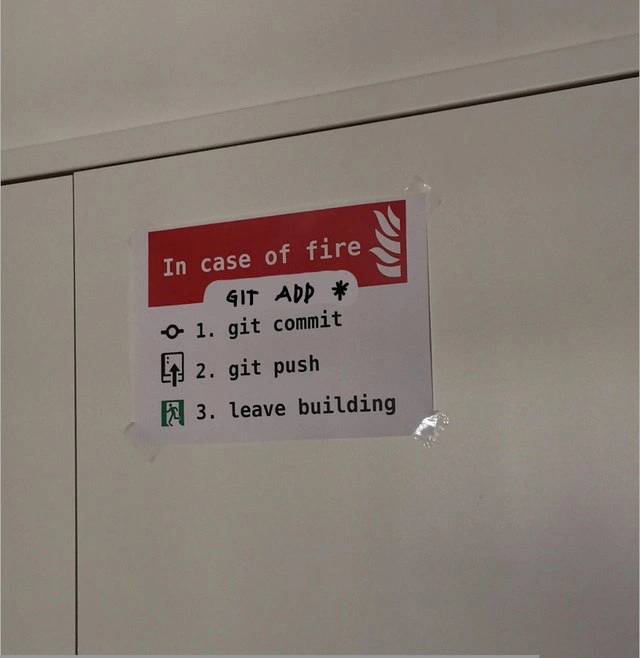
The sign copies the visual language of a fire-safety placard, then replaces survival procedure with version-control ritual:
In case of fire
GIT ADD *
- git commit
- git push
- Leave building
That ordering is the whole joke. The building is on fire, but the real emergency is apparently that somebody has unpushed work sitting on a laptop. In developer culture, local changes can feel like a single point of failure: if the machine dies, the only copy of the fix dies with it. So the sign turns Git workflow into disaster recovery, where the recovery time objective for human evacuation is gated by whether origin/main has the latest heroic mess.
There is also a sharper Git joke hiding in the handwritten GIT ADD *. In many shells, * is expanded before Git sees it, usually to visible files and directories in the current directory. That means it may miss dotfiles, may not represent the exact pathspec the developer intended, and is a worse emergency habit than something like git add -A when the goal is to stage additions, modifications, and removals across the worktree. The sign is funny because it is both overcommitted to version control and still slightly wrong, which is painfully on brand.
The command chain itself compresses a full local-to-remote save:
git add *
git commit
git push
git add stages changes, git commit snapshots them into local repository history, and git push uploads those commits to a remote repository. Only after the push does the work become resilient against the specific failure mode of "my laptop is now smoke with a keyboard." It does not guarantee quality, tests, review, or even that the commit message says anything better than fire, but at least the repo has a copy.
The corporate-culture part is what makes it extra bleak. A real fire sign prioritizes people. This fake sign prioritizes source code, then lets people leave. Anyone who has seen a team treat Jira tickets, uptime dashboards, or release deadlines as more real than human limits will recognize the vibe immediately. The office has an evacuation plan; engineering has an unspoken one: always push before the universe gets creative.
Description
A photo shows a paper sign taped to a wall, styled like a fire-safety instruction placard. The red header says "In case of fire," and a handwritten bubble underneath adds "GIT ADD *" above the steps "1. git commit," "2. git push," and "3. Leave building." Small emergency-style icons appear beside the numbered steps. The developer joke is that source control hygiene becomes more urgent than personal safety, because unpushed work is treated like a disaster-recovery failure.
Comments
12Comment deleted
The RTO for leaving the building is apparently gated on upstream accepting your commit.
Always add changes to the stage early on, otherwise you can catch another kind of fire (called reset HEAD) and your changes will be lost forever 🥲 Comment deleted
better: git add -A Comment deleted
After one more fire: git push -f Comment deleted
git commit -a Comment deleted
leave building -f Comment deleted
https://github.com/sharpvik/sema With this tool you can just sema -ap Comment deleted
Oops, the pre-receive hook barfed at you ... better don't leave just yet. Make sure to reference ticket/sign commit/correctly format commit message/... Comment deleted
--no-verify Comment deleted
Doubt that this allows to dodge certain checks for all implementations; I shall definitely give this a try tomorrow for our host. Thanks for the reminder. 👍 Comment deleted
Placed it at my desk Comment deleted
i prefer this Comment deleted