Skip to content
DevMeme
574 of 7435
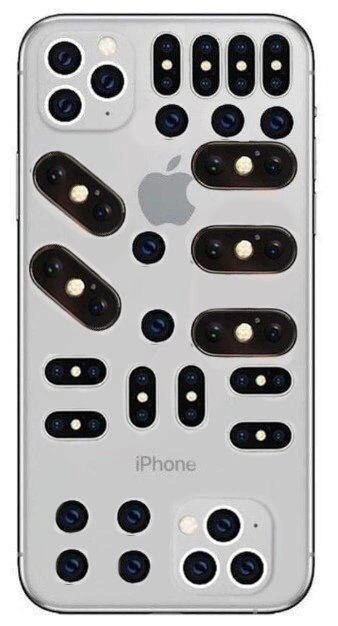
Apple's Ultimate Multi-Camera iPhone Design
Apple Post #657, on Sep 10, 2019 in TG

Apple's Ultimate Multi-Camera iPhone Design

Why is this Apple meme funny?

Level 1: More Cameras, Less Sense

Imagine you have an ice cream cone that’s really good with just one big scoop of ice cream. Now, someone comes along and says, “Hey, if one scoop is good, let’s put thirty scoops on your cone!” What do you think would happen? The cone would become super tall, ice cream would be falling all over the place, and it would be impossible to actually enjoy it. In the end, having thirty scoops doesn’t make the treat thirty times better – it just makes a mess. This meme is joking in the same way, but with phone cameras. A normal phone might have one or two cameras on the back that do the job of taking pictures. The silly picture here shows a phone covered with way too many cameras, kind of like that overloaded ice cream cone. It’s funny because we can tell it’s pointless – putting dozens of cameras on the phone isn’t really going to make your photos any nicer, it just looks ridiculous. The feeling behind the joke is that sometimes people keep adding more and more stuff (like features or gadgets) thinking it will be better, but at some point it just stops making sense. In simple terms: more isn’t always better, and this crazy many-eyed iPhone shows that in a way anyone can laugh at.

Level 2: Feature Creep in Focus

In this meme image, we see a silver iPhone whose entire back is covered with camera lenses – not just the usual one, two, or three cameras that real smartphones have, but dozens of them. There are also multiple LED flashes scattered around. It looks almost like a phone designed by someone who thought, “If one camera is good, then thirty must be amazing!” This over-the-top design is meant to be funny. It’s highlighting the idea of feature creep, which is when a product keeps getting more and more features added over time, even if those additions aren’t really necessary or helpful. Another term for this is feature bloat – when extra features pile up so much that they start to feel excessive. In the world of software, for example, imagine a simple app that began just letting you take notes. If over time it keeps getting new buttons and menus to also chat with friends, play music, track your fitness, and order pizza, it might become confusing and hard to use. That’s feature bloat: adding a bunch of capabilities that go beyond the original purpose just because someone thought more features would sound better.

Now, phones these days do often have multiple cameras. A typical high-end smartphone might have a dual-camera or triple-camera setup on the back. Each lens usually has a purpose: one might be a normal wide-angle camera, another might be a telephoto (for zoom), and another could be ultra-wide or used for depth sensing (to create that blurred background effect in portraits). These are genuine features – having two or three different cameras can actually help the phone take better or more versatile photos. But there’s a practical limit to how useful this is. The meme jokes about a phone with roughly thirty cameras as a way to say “this is overkill.” It’s making fun of the smartphone_camera_arms_race – that’s the trend where phone makers keep increasing certain specs (like the number of camera lenses, or the megapixels, or the amount of RAM) every year to look more advanced. Sometimes this is driven by hype: companies know that customers will be impressed by big numbers or new shiny hardware, even if the improvement in experience is small. This can lead to over-engineering, where engineers design a far more complicated device than anyone really needs, just to check a marketing box. In plain terms, over-engineering is like using a sledgehammer to crack a nut – it’s overly complex for the problem at hand.

For a junior developer or anyone new to tech, it’s useful to connect this to real projects. Think about times you’ve seen a simple idea become complicated due to extra requirements. For example, maybe you wrote a basic game, and then someone said, “Can we also add an online multiplayer? And a level editor? And a chat system?” Before you know it, a small game becomes an entire complex platform. That’s feature creep happening in software. It usually starts with good intentions (“wouldn’t it be cool if...”) but can end up making the product unfocused and harder to maintain. In the case of smartphones, each new generation (often called “next-gen” devices) tries to introduce something new to excite buyers. With iPhones, Apple might add things like a faster processor, a better screen, or yes, an extra camera lens for new photo capabilities. The meme is poking fun at this “more, more, more!” mentality. The phrase "solves absolutely nothing" in the title is a blunt way of saying: just because you add tons of something (features or hardware), doesn’t mean you’re actually fixing a real problem or making the product better in a meaningful way. Often, it might just be tech humor or marketing satire, pointing out that sometimes companies add features for show rather than substance.

This image falls into hardware humor because it exaggerates a hardware design to make a point. Apple’s real products are much more streamlined – they’d never actually put thirty cameras on the back of a phone (at least, one hopes not!). But by seeing this ridiculous fake iPhone, we instantly understand the joke: it’s like when an idea in engineering or product design is taken too far. The humor also resonates with developers because we experience similar situations in software projects. We might chuckle and think, “Yep, I’ve seen a project where they kept bolting on so many new modules that it became a monstrous grid of camera lenses features that nobody asked for.” The IndustryTrends_Hype tag hints that this is commenting on tech industry trends – specifically how every year there’s hype around new hardware features (more cameras! more sensors! more cores!). The meme serves as a lighthearted warning: Don’t get carried away with spec sheets and feature lists; remember to actually solve problems and make things user-friendly.

Level 3: Cameras All the Way Down

At first glance, this next-gen iPhone parody looks like an electronic spider's eye: the entire back is plastered with camera lenses of varying shapes and sizes. In the real world of Apple product launches (like the September 2019 keynote), going from two cameras to three was the big upgrade for the iPhone 11 Pro. This meme satirically asks, "Why stop there?" by slapping on roughly thirty cameras. It's an absurdist take on the smartphone camera arms race, where each year manufacturers try to one-up each other with more sensors. Seasoned engineers recognize the humor: it's feature bloat taken to the extreme. Instead of addressing any actual limitation (like sensor size or battery life), the design just multiplies one component over and over. We’ve seen this pattern before in tech and beyond – think of the megapixel war in digital cameras or the GHz race in CPUs, where marketing pushed numbers higher with diminishing returns. Here it's the number of lenses climbing into ridiculous territory, a hardware version of "more is better" sarcasm.

For a senior developer, this is a textbook parody of over-engineering. Over-engineering means solving a problem by making a system far more complex than it needs to be. The iPhone in the image literally has cameras all the way down. It's solving "nothing" (as the title jokes) because adding 27 extra lenses doesn't truly overcome the fundamental challenges of mobile photography. Real image quality depends on physics – sensor size, optics, and software algorithms – not just sheer sensor count. By cramming dozens of tiny cameras, you're not magically getting a 30x better photo. It's like trying to speed up a slow program by running 30 copies of it in parallel; if the bottleneck was elsewhere (say, disk I/O or network), you just end up with 30 slow programs instead of one. Feature creep in hardware form means each new iPhone model might tack on another lens or two because it sounds innovative, even if it yields marginal benefit. The meme exaggerates this to make us laugh at how ridiculous it would be if a phone literally followed that trend without ever changing course.

There's a dark humor here that senior folks in tech appreciate: often, companies keep adding flashy components or features when they can't (or won't) fix the core issue. On a phone, maybe low-light photography could be solved with a single larger sensor and better image processing. But that doesn't look as exciting on a spec sheet as "5 cameras, 10 cameras, 30 cameras!" Similarly, in software projects, if the product isn't inherently better, sometimes more gimmicky features get bolted on to impress sales and marketing. We've all been in those meetings where the solution to lagging metrics was to pile on another bullet point for the brochure. The result is usually a bloated product that’s harder to maintain. In the meme's case, imagine the insane complexity of managing outputs from 30 different cameras: merging data, calibrating colors, syncing shutters. Each added lens is another potential point of failure (camera driver bugs x30, anyone?). This speaks to the kind of technical debt that accumulates when you multiply components needlessly. A veteran dev can almost feel the pain of the hypothetical iOS camera team trying to debug why camera #17 is causing a crash. It's hilariously nightmarish – a perfect illustration of how feature creep can snowball into an unmanageable beast.

The industry satire cuts deep: it's poking fun at how the tech hype machine works. Apple and other smartphone makers love to tout yearly improvements, and cameras have become a prime selling point. After all, it's easy to market “Now with an extra lens for ultra-wide shots!” or “5 sensors for pro photography!” because consumers can count the lenses and assume more = better. The meme basically says, "Sure, why not 30 then?" – exposing the absurdity. It's reminiscent of the satire about razor companies adding more and more blades. (First two blades were closer, then three, then five... until a joke ad showed a razor with like twenty blades.) In the same way, tech companies sometimes chase industry trends to avoid looking behind, even if it leads them into feature overload. A senior audience knows that true innovation isn’t just stacking more of the same component. Yet, we've all seen management choose the flashier checkbox over the substantive fix. The humor lands because it's too real: we've witnessed products where the list of features grows long, but the actual user problems remain unsolved. This meme takes that familiar frustration and gives it a hyperbolic, visual form – an iPhone that tries so hard to impress with numbers that it forgets the point of a camera: to take a good picture.

Description

This is a photoshopped, satirical image showing the back of a silver iPhone that is completely covered with an absurd number of camera lenses. There are dozens of lenses of various sizes, arranged in different patterns across the entire surface, leaving very little empty space. The iconic Apple logo is visible in the center, and the word 'iPhone' is printed below it. The image is a parody, exaggerating the trend of smartphone manufacturers, particularly Apple, adding more and more cameras to their devices. The meme was created around the time of the iPhone 11 launch in September 2019, which was notable for introducing a three-camera system that was widely discussed and parodied. For experienced tech professionals, this meme humorously critiques the concept of 'feature creep' and the focus on hardware specifications as a primary marketing tool, sometimes at the expense of practical innovation or aesthetic design


Comments

7
Anonymous ★ Top Pick Introducing the iPhone 11 Pro Max S Plus Ultra Enterprise Edition. We replaced the SoC with cameras so now every photo you take is a distributed system
  1. Anonymous ★ Top Pick

    Introducing the iPhone 11 Pro Max S Plus Ultra Enterprise Edition. We replaced the SoC with cameras so now every photo you take is a distributed system

  2. Anonymous

    Introducing the iPhone 15 Quorum: one leader lens, two followers, and thirty-four hot stand-bys - so your cat photo only commits to iCloud after full Raft consensus

  3. Anonymous

    When your product manager says "we need to A/B test everything" and the hardware team takes it literally

  4. Anonymous

    This is what happens when product managers discover that 'more cameras = better' is easier to market than explaining the nuances of sensor size, aperture physics, and ISP pipeline optimization. Each lens represents another sprint where the hardware team quietly died inside while the marketing deck promised 'revolutionary computational photography.' The real engineering challenge isn't fitting 30 cameras - it's the thermal management when they all try to write to the same I²C bus simultaneously

  5. Anonymous

    Peak iPhone architecture: we didn’t fix optics, we sharded them - photons now traverse a distributed pipeline, with Deep Fusion doing eventual consistency

  6. Anonymous

    Apple's iPhone camera cluster: the hardware equivalent of nanoservices - unmanageable endpoints everywhere, yet somehow scales to zero reliability

  7. Anonymous

    New iPhone architecture: they decomposed the camera into N microservices - every photon gets a sidecar flash, retries, and eventual consistency

Use J and K for navigation